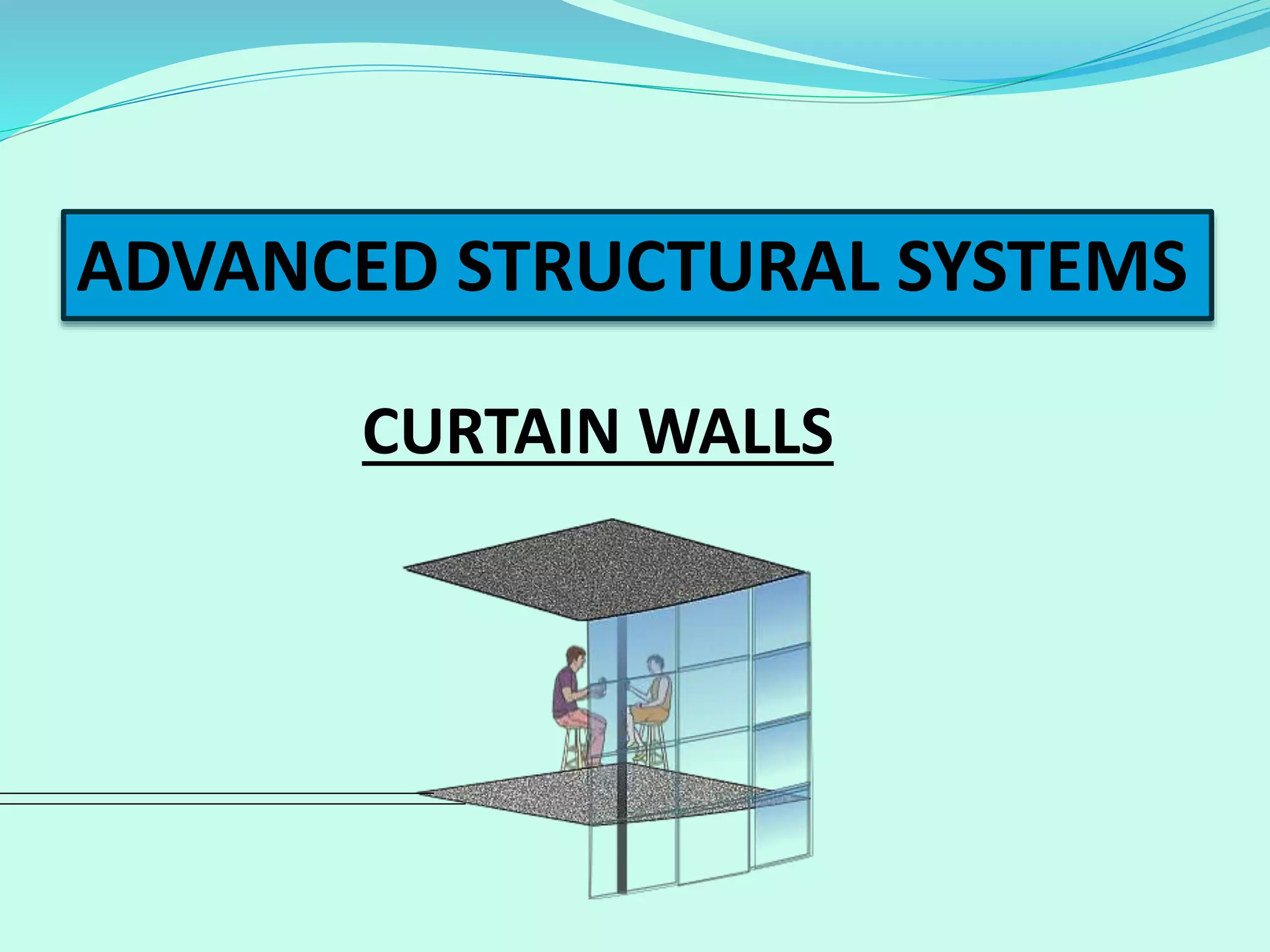
A curtain wall system is a non-structural exterior that protects buildings from weather while allowing for lightweight materials, helping control costs. This system transfers horizontal loads to the main structure and is designed to resist environmental forces while incorporating aesthetic elements, typically using aluminum framing and glass infills. However, challenges such as air and water leakage, misalignment, and careful handling during installation can complicate their effectiveness.
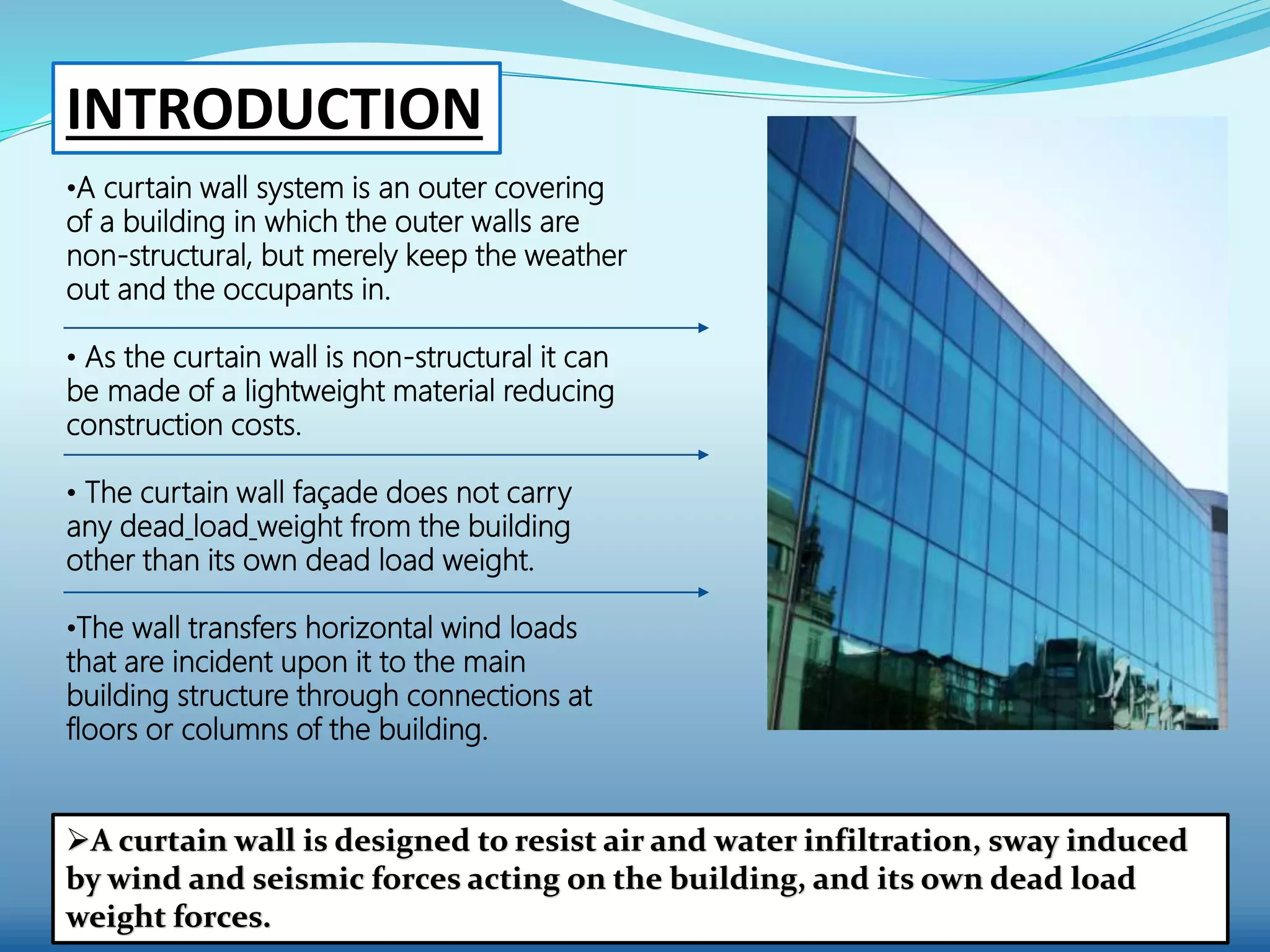
•A curtain wallsystem is an outer covering
of a building in which the outer walls are
non-structural, but merely keep the weather
out and the occupants in.
• As the curtain wall is non-structural it can
be made of a lightweight material reducing
construction costs.
• The curtain wall façade does not carry
any dead load weight from the building
other than its own dead load weight.
•The wall transfers horizontal wind loads
that are incident upon it to the main
building structure through connections at
floors or columns of the building.
A curtain wall is designed to resist air and water infiltration, sway induced
by wind and seismic forces acting on the building, and its own dead load
weight forces.
INTRODUCTION
3.
•Curtain wall systemsare typically designed with
extruded aluminum members.
•The aluminum frame is typically in filled with glass,
which provides an architecturally pleasing building, as
well as benefits such as day lighting.
•Other common infill include: stone veneer, metal
panels, louvers, and operable windows or vents.
•Curtain walls differ from
store-front systems in that
they are designed to span
multiple floors, and take into
consideration design
requirements such as:
thermal expansion and
contraction; building
sway and movement; water
diversion; and thermal
efficiency for cost-effective
heating, cooling, and lighting
in the building.
DESIGN
4.
COMPONENTS
OF A CURTAIN
WALL
1.Anchors
2. Mullion
3.Horizontalrais
4.Spandrelpanel
5. Vision Glass
CURTAIN WALL INTERNAL CONSTRUCTION
Shear block
Joint plug
cover
Glazing pressure plate
Thermal isolator
5.
ANCHORS
•Gravity anchors
•Wind anchors
necessaryfor two-
story systems
•Adjustability and
ease of erection
issues
•Unitized panel
anchors must
accommodate
setting large panels
VERTICAL MULLIONS
•Typically span from floor to
floor
•Two-story “stick” possible
due to ease of extruding 25
foot long sections
•Anchorage to slab edge
requires integration with SE’s
system
•SE remains responsible to
carry curtain wall loads
imposed at anchor through
structure
FRAMING CONCEPTS :
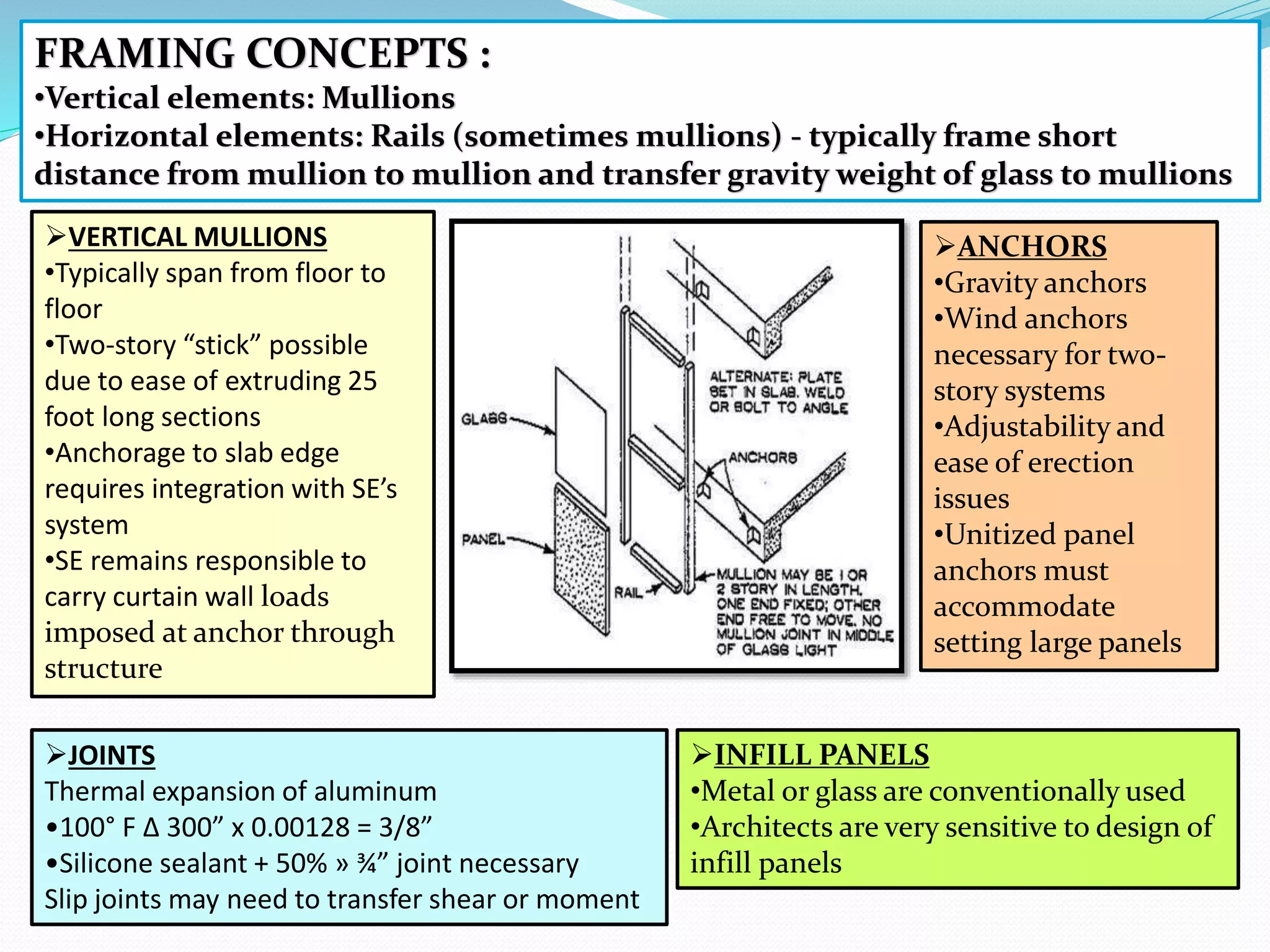
•Vertical elements: Mullions
•Horizontal elements: Rails (sometimes mullions) - typically frame short
distance from mullion to mullion and transfer gravity weight of glass to mullions
JOINTS
Thermal expansion of aluminum
•100° F Δ 300” x 0.00128 = 3/8”
•Silicone sealant + 50% » ¾” joint necessary
Slip joints may need to transfer shear or moment
INFILL PANELS
•Metal or glass are conventionally used
•Architects are very sensitive to design of
infill panels
6.
MATERIALS USED –
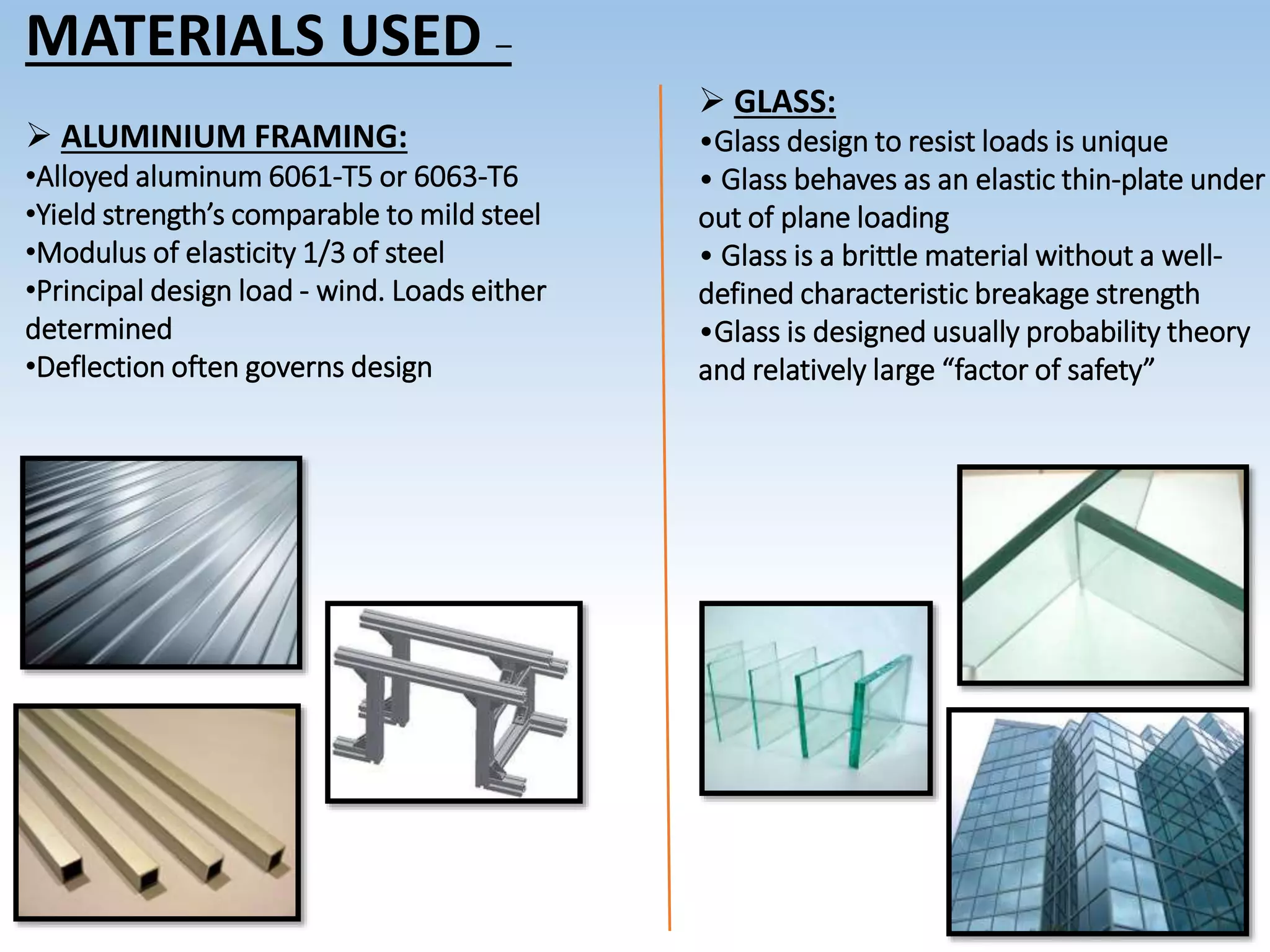
ALUMINIUM FRAMING:
•Alloyed aluminum 6061-T5 or 6063-T6
•Yield strength’s comparable to mild steel
•Modulus of elasticity 1/3 of steel
•Principal design load - wind. Loads either
determined
•Deflection often governs design
GLASS:
•Glass design to resist loads is unique
• Glass behaves as an elastic thin-plate under
out of plane loading
• Glass is a brittle material without a well-
defined characteristic breakage strength
•Glass is designed usually probability theory
and relatively large “factor of safety”
8.
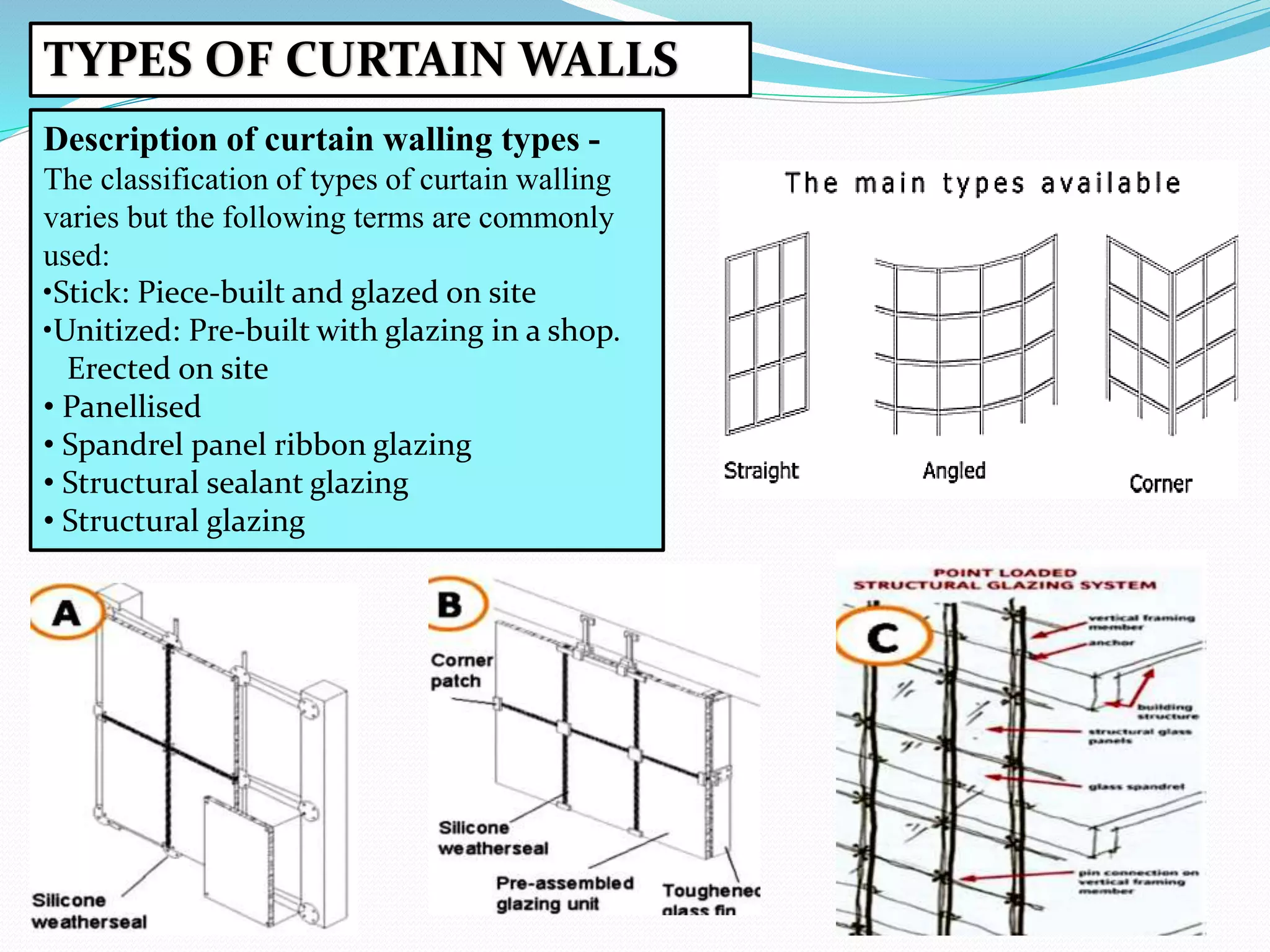
TYPES OF CURTAINWALLS
Description of curtain walling types -
The classification of types of curtain walling
varies but the following terms are commonly
used:
•Stick: Piece-built and glazed on site
•Unitized: Pre-built with glazing in a shop.
Erected on site
• Panellised
• Spandrel panel ribbon glazing
• Structural sealant glazing
• Structural glazing
9.
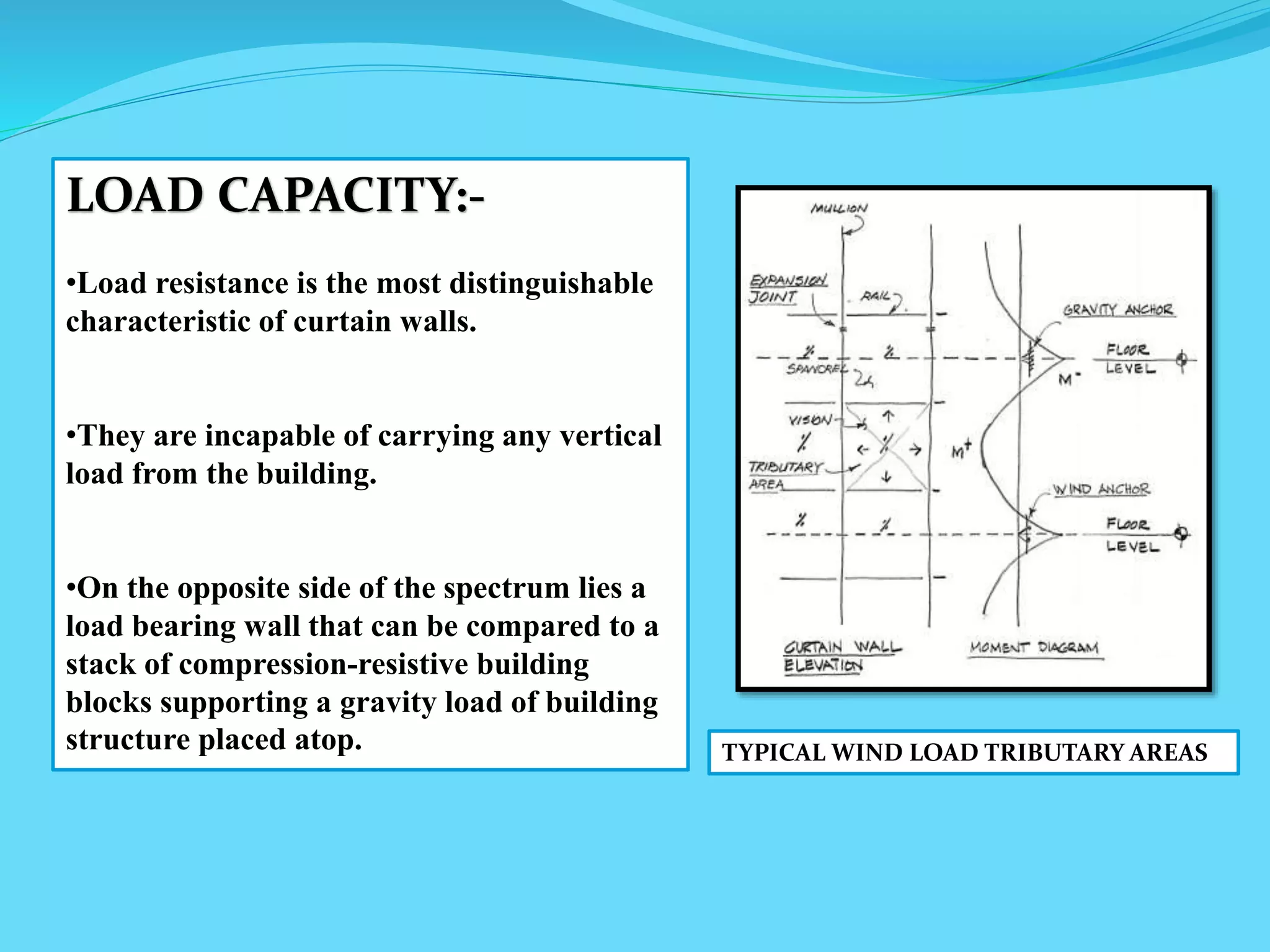
LOAD CAPACITY:-
•Load resistanceis the most distinguishable
characteristic of curtain walls.
•They are incapable of carrying any vertical
load from the building.
•On the opposite side of the spectrum lies a
load bearing wall that can be compared to a
stack of compression-resistive building
blocks supporting a gravity load of building
structure placed atop. TYPICAL WIND LOAD TRIBUTARY AREAS
10.
•The structural glasswall, with
horizontal structural glass mullions
suspended on stainless steel
cables.
•The glass fins play structural role
by resisting lateral load, as
opposed to the traditional load-
collecting role of glass.
•No structural sealant used here.
Vertical movement of
building structure.
11.
Glass-and-metal curtain wallscan provide an attractive, durable
and cost-effective cladding solution, but in many buildings, they
are plagued with problems ranging from air and water leakage to
falling trim covers.
Careless erection techniques
To take care during erection of the curtain wall is the most obvious
caution.
•Curtain walls with damaged stone, glass, aluminum, metal panels, gaskets
and other materials caused by reckless transportation and placement of
framing and panels during erection have been investigated.
•Curtain-wall modules are often large, heavy and awkward and require
careful planning and implementation of protective crating, handling,
transportation and erection.
STRUCTURAL PROBLEMS OF CURTAIN WALLS -
12.
• Misalignment -
Misalignmentof adjacent curtain wall elements can have serious
consequences.
• Such misalignment is often due to errors in laying out the
structural framing systems, but might also result from lack of
coordination of building structure tolerances and curtain wall
tolerances, or improper layout of imbeds to receive curtain wall
anchors.
• In the case of coordinating construction tolerances, if the
construction tolerance for the structural frame is +/- 1 inch over
the height of the building and the tolerance for the curtain wall is
+/- 1⁄4 inch over that same height, it is the curtain wall that will
need to be adjusted to conform to the looser tolerance of the
structural framing.