

Copyright protected: 2005 Hi Tech Criminal Justice, Raymond E. Foster
Police TechnologyPolice Technology
Chapter ElevenChapter Eleven
Information ExchangeInformation Exchange
Copyright protected: 2005 Hi Tech Criminal Justice, Raymo
Learning ObjectivesLearning Objectives
 The value of information exchangeThe value of information exchange
between state, local, and federal agenciesbetween state, local, and federal agencies
 The issue of InteroperabilityThe issue of Interoperability
 The various factors that make informationThe various factors that make information
exchange difficultexchange difficult
 Some of the potential solutions toSome of the potential solutions to
information exchangeinformation exchange
Copyright protected: 2005 Hi Tech Criminal Justice, Raymo
IntroductionIntroduction
We will look at information exchange in twoWe will look at information exchange in two
primary ways:primary ways:
 The exchange ofThe exchange of tactical informationtactical information
 The exchange ofThe exchange of strategic informationstrategic information
Copyright protected: 2005 Hi Tech Criminal Justice, Raymo
Integration - DefinedIntegration - Defined
A completely integrated criminal justiceA completely integrated criminal justice
system would be a network designed tosystem would be a network designed to
provide each agency from the police to theprovide each agency from the police to the
courts, to the prison system, with thecourts, to the prison system, with the
information it needs to make a decision.information it needs to make a decision.
Copyright protected: 2005 Hi Tech Criminal Justice, Raymo
The Importance of IntegrationThe Importance of Integration
Interoperability is the process ofInteroperability is the process of
connecting different agencies orconnecting different agencies or
units with agencies usingunits with agencies using
communication technologies so thatcommunication technologies so that
they can communicate directly.they can communicate directly.
Copyright protected: 2005 Hi Tech Criminal Justice, Raymo
Tactical Importance ofTactical Importance of
IntegrationIntegration
Tactical information isTactical information is
used to make immediateused to make immediate
decisions. Incorrect ordecisions. Incorrect or
incomplete informationincomplete information
can cause poor decisionscan cause poor decisions
The inability to shareThe inability to share
critical information iscritical information is
dangerous.dangerous.
Screen Capture provided by FAAC Inc
Copyright protected: 2005 Hi Tech Criminal Justice, Raymo
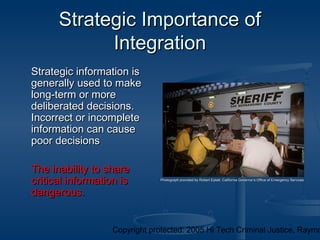
Strategic Importance ofStrategic Importance of
IntegrationIntegration
Strategic information isStrategic information is
generally used to makegenerally used to make
long-term or morelong-term or more
deliberated decisions.deliberated decisions.
Incorrect or incompleteIncorrect or incomplete
information can causeinformation can cause
poor decisionspoor decisions
The inability to shareThe inability to share
critical information iscritical information is
dangerous.dangerous.
Photograph provided by Robert Eplett, California Governor’s Office of Emergency ServicesPhotograph provided by Robert Eplett, California Governor’s Office of Emergency Services
Copyright protected: 2005 Hi Tech Criminal Justice, Raymo
Why Can’t AgenciesWhy Can’t Agencies
Exchange Information?Exchange Information?
Fragmentation has createdFragmentation has created
organizational islands.organizational islands.
Organizations are influencedOrganizations are influenced
by:by:
 Sub-cultureSub-culture
 BudgetsBudgets
 Community PrioritiesCommunity Priorities
Copyright Protected: 2005 Hi Tech
Criminal Justice, Raymond E. Foster
Copyright protected: 2005 Hi Tech Criminal Justice, Raymo
More on FragmentationMore on Fragmentation
The entire criminal justice system tends toThe entire criminal justice system tends to
perform the function of informationperform the function of information
management exchange poorly becausemanagement exchange poorly because
each island enters information into theeach island enters information into the
systemsystem separately, differently, andseparately, differently, and
repeatedlyrepeatedly..
Copyright protected: 2005 Hi Tech Criminal Justice, Raymo
Fragmentation ResultsFragmentation Results
As state and local agenciesAs state and local agencies
adapt new ideas andadapt new ideas and
technologies, they tend to adapttechnologies, they tend to adapt
them to their own ways of doingthem to their own ways of doing
business.business.
These agencies end up with anThese agencies end up with an
assortment of systems,assortment of systems,
applications, databases, andapplications, databases, and
communications schemes –communications schemes –
often different from neighboringoften different from neighboring
or even overlapping agenciesor even overlapping agencies
Copyright protected: 2005 Hi Tech Criminal Justice, Raymo
What Should Integration Look Like?What Should Integration Look Like?
An integrated criminal justice informationAn integrated criminal justice information
sharing system must:sharing system must:
 FulfillFulfill the needs of the agencythe needs of the agency
employing the system andemploying the system and
 AddressAddress the needs of other agencies.the needs of other agencies.
Copyright protected: 2005 Hi Tech Criminal Justice, Raymo
What Should Integration Look Like?What Should Integration Look Like?
For any system integrationFor any system integration
to be successful, it must beto be successful, it must be
founded on standards in:founded on standards in:
 Data entryData entry
 ProtocolsProtocols
 PoliciesPolicies
 SoftwareSoftware
 Hardware systemsHardware systems
Copyright protected: 2005 Hi Tech Criminal Justice, Raymo
For these transactions to be complete,For these transactions to be complete,
they need to employ several differentthey need to employ several different
concepts:concepts:
 ContextContext – an agreement between the– an agreement between the
agencies that the exchange is goingagencies that the exchange is going
to be about a certain subjectto be about a certain subject
 ProtocolProtocol – Rules for how information– Rules for how information
is going to be exchanged and usedis going to be exchanged and used
IntegrationIntegration
Copyright protected: 2005 Hi Tech Criminal Justice, Raymo
 Information would be captured once andInformation would be captured once and
reused during subsequent decision-reused during subsequent decision-
making pointsmaking points
 Would have the ability to automaticallyWould have the ability to automatically
query databases of other organizationsquery databases of other organizations
 Would have the ability to push and pullWould have the ability to push and pull
only data that was neededonly data that was needed
 Have the ability to receive notificationsHave the ability to receive notifications
A fully integrated system . . .A fully integrated system . . .
Copyright protected: 2005 Hi Tech Criminal Justice, Raymo
Why aren’t law enforcement agenciesWhy aren’t law enforcement agencies
using Web-based standards?using Web-based standards?
 Agencies only need certain portions ofAgencies only need certain portions of
each other’s dataeach other’s data
 Except,Except, databases are often incompatibledatabases are often incompatible
(data fields, values, and attributes are(data fields, values, and attributes are
nonstandard)nonstandard)
Are Internet Standards a Solution?Are Internet Standards a Solution?
Copyright protected: 2005 Hi Tech Criminal Justice, Raymo
 Extensible Mark-up LanguageExtensible Mark-up Language is a root markupis a root markup
language that is derived from and similar tolanguage that is derived from and similar to
HTMLHTML
 Intended primarily for the transmission ofIntended primarily for the transmission of texttext
informationinformation
 Can be used to pass other binary data such asCan be used to pass other binary data such as
imagesimages
 UsesUses tagstags to identify information so disparateto identify information so disparate
applications and systems can easily recognizeapplications and systems can easily recognize
the datathe data
The XML SolutionThe XML Solution
Copyright protected: 2005 Hi Tech Criminal Justice, Raymo
XML separates style from contentXML separates style from content
 StyleStyle is the wayis the way
in which anin which an
agency decidesagency decides
it wants its datait wants its data
presentedpresented
 ContentContent is theis the
part of the totalpart of the total
that each picksthat each picks
for its own stylefor its own style
Copyright protected: 2005 Hi Tech Criminal Justice, Raymo
Tactical CommunicationsTactical Communications
There are two common technologicalThere are two common technological
strategies and one operationalstrategies and one operational
strategy that can improvestrategy that can improve
communications between differentcommunications between different
agencies.agencies.
Copyright protected: 2005 Hi Tech Criminal Justice, Raymo
 Trunked Radio SystemsTrunked Radio Systems - allow for- allow for
the programming of other agencythe programming of other agency
frequencies into the radio systemfrequencies into the radio system
carries in the vehiclecarries in the vehicle
 Gateway InterfaceGateway Interface – permanently– permanently
installed or used during majorinstalled or used during major
tactical incidentstactical incidents
Technological SolutionsTechnological Solutions
Copyright protected: 2005 Hi Tech Criminal Justice, Raymo
Organizational SolutionOrganizational Solution
 Incident Command System (ICS)Incident Command System (ICS) ––
Provides common terminology andProvides common terminology and
organization structures for successfulorganization structures for successful
joint field operationsjoint field operations
Copyright protected: 2005 Hi Tech Criminal Justice, Raymo
Agency PartnershipsAgency Partnerships
There are ways that agency partnershipsThere are ways that agency partnerships
can improve interoperability and thecan improve interoperability and the
exchange of data information.exchange of data information.
 Direct pooling of physical resourcesDirect pooling of physical resources
 Pool data, not facilitiesPool data, not facilities
 Contract communications with a largerContract communications with a larger
agencyagency
 Create regional systemsCreate regional systems
Copyright protected: 2005 Hi Tech Criminal Justice, Raymo
Two ways of looking at information-Two ways of looking at information-
integration partnershipsintegration partnerships
 Horizontal PartnershipHorizontal Partnership– between– between
agencies at the same level ofagencies at the same level of
governmentgovernment
 Vertical PartnershipVertical Partnership – Involves– Involves
agencies at varying levels ofagencies at varying levels of
government. More complexgovernment. More complex
Copyright protected: 2005 Hi Tech Criminal Justice, Raymo
Economies of ScaleEconomies of Scale
 Based on economic theoryBased on economic theory
that the more you producethat the more you produce
of a good, the less that itof a good, the less that it
costs for each additionalcosts for each additional
unit.unit.
 In government services,In government services,
economy of scale can beeconomy of scale can be
realized by expanding therealized by expanding the
geographic boundaries ofgeographic boundaries of
serviceservice
Copyright protected: 2005 Hi Tech Criminal Justice, Raymo
Economies of ScaleEconomies of Scale
Combining Technology ResourcesCombining Technology Resources
Eighty-five percent of most state and localEighty-five percent of most state and local
law enforcement budgets are personnellaw enforcement budgets are personnel
costs, not equipment costs.costs, not equipment costs.
How many fewer people will it take to runHow many fewer people will it take to run
an operation? Will there be significantan operation? Will there be significant
savings over the long term?savings over the long term?
Copyright protected: 2005 Hi Tech Criminal Justice, Raymo
 Information Sharing is the transfer ofInformation Sharing is the transfer of
information from one system to anotherinformation from one system to another
via an intermediate system.via an intermediate system.
 Instead of pooling facilities, agenciesInstead of pooling facilities, agencies
agree to send their data to a centralagree to send their data to a central
data warehousedata warehouse
 This does not address voiceThis does not address voice
communications.communications.
Economies of ScaleEconomies of Scale
Combining Technology ResourcesCombining Technology Resources
Copyright protected: 2005 Hi Tech Criminal Justice, Raymo
Contract information services with aContract information services with a
private vendor or with a larger agency.private vendor or with a larger agency.
Typically used by small municipal policeTypically used by small municipal police
department that contracts with a countrydepartment that contracts with a country
law enforcement agencylaw enforcement agency
Economies of ScaleEconomies of Scale
Combining Technology ResourcesCombining Technology Resources
Copyright protected: 2005 Hi Tech Criminal Justice, Raymo
Economies of ScaleEconomies of Scale
Combining Technology ResourcesCombining Technology Resources
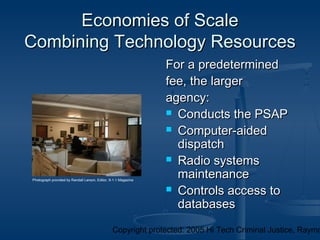
For a predeterminedFor a predetermined
fee, the largerfee, the larger
agency:agency:
 Conducts the PSAPConducts the PSAP
 Computer-aidedComputer-aided
dispatchdispatch
 Radio systemsRadio systems
maintenancemaintenance
 Controls access toControls access to
databasesdatabases
Photograph provided by Randall Larson, Editor, 9-1-1 Magazine
Copyright protected: 2005 Hi Tech Criminal Justice, Raymo
Regional SystemRegional System
 Agencies form joint communicationsAgencies form joint communications
projects.projects.
 Sometimes referred to asSometimes referred to as
Intergovernmental Agreements (IGA)Intergovernmental Agreements (IGA) oror
Joint Powers Authorities (JPA)Joint Powers Authorities (JPA)
 Some agencies form not-for-profitSome agencies form not-for-profit
organizations to create and manage aorganizations to create and manage a
regional systemregional system
Copyright protected: 2005 Hi Tech Criminal Justice, Raymond E. Foster
Police TechnologyPolice Technology
Go to theGo to the Student ResourcesStudent Resources pagepage
atat
www.hitechcj.comwww.hitechcj.com

Information Exchange

  • 1.
    Copyright protected: 2005Hi Tech Criminal Justice, Raymond E. Foster Police TechnologyPolice Technology Chapter ElevenChapter Eleven Information ExchangeInformation Exchange
  • 2.
    Copyright protected: 2005Hi Tech Criminal Justice, Raymo Learning ObjectivesLearning Objectives  The value of information exchangeThe value of information exchange between state, local, and federal agenciesbetween state, local, and federal agencies  The issue of InteroperabilityThe issue of Interoperability  The various factors that make informationThe various factors that make information exchange difficultexchange difficult  Some of the potential solutions toSome of the potential solutions to information exchangeinformation exchange
  • 3.
    Copyright protected: 2005Hi Tech Criminal Justice, Raymo IntroductionIntroduction We will look at information exchange in twoWe will look at information exchange in two primary ways:primary ways:  The exchange ofThe exchange of tactical informationtactical information  The exchange ofThe exchange of strategic informationstrategic information
  • 4.
    Copyright protected: 2005Hi Tech Criminal Justice, Raymo Integration - DefinedIntegration - Defined A completely integrated criminal justiceA completely integrated criminal justice system would be a network designed tosystem would be a network designed to provide each agency from the police to theprovide each agency from the police to the courts, to the prison system, with thecourts, to the prison system, with the information it needs to make a decision.information it needs to make a decision.
  • 5.
    Copyright protected: 2005Hi Tech Criminal Justice, Raymo The Importance of IntegrationThe Importance of Integration Interoperability is the process ofInteroperability is the process of connecting different agencies orconnecting different agencies or units with agencies usingunits with agencies using communication technologies so thatcommunication technologies so that they can communicate directly.they can communicate directly.
  • 6.
    Copyright protected: 2005Hi Tech Criminal Justice, Raymo Tactical Importance ofTactical Importance of IntegrationIntegration Tactical information isTactical information is used to make immediateused to make immediate decisions. Incorrect ordecisions. Incorrect or incomplete informationincomplete information can cause poor decisionscan cause poor decisions The inability to shareThe inability to share critical information iscritical information is dangerous.dangerous. Screen Capture provided by FAAC Inc
  • 7.
    Copyright protected: 2005Hi Tech Criminal Justice, Raymo Strategic Importance ofStrategic Importance of IntegrationIntegration Strategic information isStrategic information is generally used to makegenerally used to make long-term or morelong-term or more deliberated decisions.deliberated decisions. Incorrect or incompleteIncorrect or incomplete information can causeinformation can cause poor decisionspoor decisions The inability to shareThe inability to share critical information iscritical information is dangerous.dangerous. Photograph provided by Robert Eplett, California Governor’s Office of Emergency ServicesPhotograph provided by Robert Eplett, California Governor’s Office of Emergency Services
  • 8.
    Copyright protected: 2005Hi Tech Criminal Justice, Raymo Why Can’t AgenciesWhy Can’t Agencies Exchange Information?Exchange Information? Fragmentation has createdFragmentation has created organizational islands.organizational islands. Organizations are influencedOrganizations are influenced by:by:  Sub-cultureSub-culture  BudgetsBudgets  Community PrioritiesCommunity Priorities Copyright Protected: 2005 Hi Tech Criminal Justice, Raymond E. Foster
  • 9.
    Copyright protected: 2005Hi Tech Criminal Justice, Raymo More on FragmentationMore on Fragmentation The entire criminal justice system tends toThe entire criminal justice system tends to perform the function of informationperform the function of information management exchange poorly becausemanagement exchange poorly because each island enters information into theeach island enters information into the systemsystem separately, differently, andseparately, differently, and repeatedlyrepeatedly..
  • 10.
    Copyright protected: 2005Hi Tech Criminal Justice, Raymo Fragmentation ResultsFragmentation Results As state and local agenciesAs state and local agencies adapt new ideas andadapt new ideas and technologies, they tend to adapttechnologies, they tend to adapt them to their own ways of doingthem to their own ways of doing business.business. These agencies end up with anThese agencies end up with an assortment of systems,assortment of systems, applications, databases, andapplications, databases, and communications schemes –communications schemes – often different from neighboringoften different from neighboring or even overlapping agenciesor even overlapping agencies
  • 11.
    Copyright protected: 2005Hi Tech Criminal Justice, Raymo What Should Integration Look Like?What Should Integration Look Like? An integrated criminal justice informationAn integrated criminal justice information sharing system must:sharing system must:  FulfillFulfill the needs of the agencythe needs of the agency employing the system andemploying the system and  AddressAddress the needs of other agencies.the needs of other agencies.
  • 12.
    Copyright protected: 2005Hi Tech Criminal Justice, Raymo What Should Integration Look Like?What Should Integration Look Like? For any system integrationFor any system integration to be successful, it must beto be successful, it must be founded on standards in:founded on standards in:  Data entryData entry  ProtocolsProtocols  PoliciesPolicies  SoftwareSoftware  Hardware systemsHardware systems
  • 13.
    Copyright protected: 2005Hi Tech Criminal Justice, Raymo For these transactions to be complete,For these transactions to be complete, they need to employ several differentthey need to employ several different concepts:concepts:  ContextContext – an agreement between the– an agreement between the agencies that the exchange is goingagencies that the exchange is going to be about a certain subjectto be about a certain subject  ProtocolProtocol – Rules for how information– Rules for how information is going to be exchanged and usedis going to be exchanged and used IntegrationIntegration
  • 14.
    Copyright protected: 2005Hi Tech Criminal Justice, Raymo  Information would be captured once andInformation would be captured once and reused during subsequent decision-reused during subsequent decision- making pointsmaking points  Would have the ability to automaticallyWould have the ability to automatically query databases of other organizationsquery databases of other organizations  Would have the ability to push and pullWould have the ability to push and pull only data that was neededonly data that was needed  Have the ability to receive notificationsHave the ability to receive notifications A fully integrated system . . .A fully integrated system . . .
  • 15.
    Copyright protected: 2005Hi Tech Criminal Justice, Raymo Why aren’t law enforcement agenciesWhy aren’t law enforcement agencies using Web-based standards?using Web-based standards?  Agencies only need certain portions ofAgencies only need certain portions of each other’s dataeach other’s data  Except,Except, databases are often incompatibledatabases are often incompatible (data fields, values, and attributes are(data fields, values, and attributes are nonstandard)nonstandard) Are Internet Standards a Solution?Are Internet Standards a Solution?
  • 16.
    Copyright protected: 2005Hi Tech Criminal Justice, Raymo  Extensible Mark-up LanguageExtensible Mark-up Language is a root markupis a root markup language that is derived from and similar tolanguage that is derived from and similar to HTMLHTML  Intended primarily for the transmission ofIntended primarily for the transmission of texttext informationinformation  Can be used to pass other binary data such asCan be used to pass other binary data such as imagesimages  UsesUses tagstags to identify information so disparateto identify information so disparate applications and systems can easily recognizeapplications and systems can easily recognize the datathe data The XML SolutionThe XML Solution
  • 17.
    Copyright protected: 2005Hi Tech Criminal Justice, Raymo XML separates style from contentXML separates style from content  StyleStyle is the wayis the way in which anin which an agency decidesagency decides it wants its datait wants its data presentedpresented  ContentContent is theis the part of the totalpart of the total that each picksthat each picks for its own stylefor its own style
  • 18.
    Copyright protected: 2005Hi Tech Criminal Justice, Raymo Tactical CommunicationsTactical Communications There are two common technologicalThere are two common technological strategies and one operationalstrategies and one operational strategy that can improvestrategy that can improve communications between differentcommunications between different agencies.agencies.
  • 19.
    Copyright protected: 2005Hi Tech Criminal Justice, Raymo  Trunked Radio SystemsTrunked Radio Systems - allow for- allow for the programming of other agencythe programming of other agency frequencies into the radio systemfrequencies into the radio system carries in the vehiclecarries in the vehicle  Gateway InterfaceGateway Interface – permanently– permanently installed or used during majorinstalled or used during major tactical incidentstactical incidents Technological SolutionsTechnological Solutions
  • 20.
    Copyright protected: 2005Hi Tech Criminal Justice, Raymo Organizational SolutionOrganizational Solution  Incident Command System (ICS)Incident Command System (ICS) –– Provides common terminology andProvides common terminology and organization structures for successfulorganization structures for successful joint field operationsjoint field operations
  • 21.
    Copyright protected: 2005Hi Tech Criminal Justice, Raymo Agency PartnershipsAgency Partnerships There are ways that agency partnershipsThere are ways that agency partnerships can improve interoperability and thecan improve interoperability and the exchange of data information.exchange of data information.  Direct pooling of physical resourcesDirect pooling of physical resources  Pool data, not facilitiesPool data, not facilities  Contract communications with a largerContract communications with a larger agencyagency  Create regional systemsCreate regional systems
  • 22.
    Copyright protected: 2005Hi Tech Criminal Justice, Raymo Two ways of looking at information-Two ways of looking at information- integration partnershipsintegration partnerships  Horizontal PartnershipHorizontal Partnership– between– between agencies at the same level ofagencies at the same level of governmentgovernment  Vertical PartnershipVertical Partnership – Involves– Involves agencies at varying levels ofagencies at varying levels of government. More complexgovernment. More complex
  • 23.
    Copyright protected: 2005Hi Tech Criminal Justice, Raymo Economies of ScaleEconomies of Scale  Based on economic theoryBased on economic theory that the more you producethat the more you produce of a good, the less that itof a good, the less that it costs for each additionalcosts for each additional unit.unit.  In government services,In government services, economy of scale can beeconomy of scale can be realized by expanding therealized by expanding the geographic boundaries ofgeographic boundaries of serviceservice
  • 24.
    Copyright protected: 2005Hi Tech Criminal Justice, Raymo Economies of ScaleEconomies of Scale Combining Technology ResourcesCombining Technology Resources Eighty-five percent of most state and localEighty-five percent of most state and local law enforcement budgets are personnellaw enforcement budgets are personnel costs, not equipment costs.costs, not equipment costs. How many fewer people will it take to runHow many fewer people will it take to run an operation? Will there be significantan operation? Will there be significant savings over the long term?savings over the long term?
  • 25.
    Copyright protected: 2005Hi Tech Criminal Justice, Raymo  Information Sharing is the transfer ofInformation Sharing is the transfer of information from one system to anotherinformation from one system to another via an intermediate system.via an intermediate system.  Instead of pooling facilities, agenciesInstead of pooling facilities, agencies agree to send their data to a centralagree to send their data to a central data warehousedata warehouse  This does not address voiceThis does not address voice communications.communications. Economies of ScaleEconomies of Scale Combining Technology ResourcesCombining Technology Resources
  • 26.
    Copyright protected: 2005Hi Tech Criminal Justice, Raymo Contract information services with aContract information services with a private vendor or with a larger agency.private vendor or with a larger agency. Typically used by small municipal policeTypically used by small municipal police department that contracts with a countrydepartment that contracts with a country law enforcement agencylaw enforcement agency Economies of ScaleEconomies of Scale Combining Technology ResourcesCombining Technology Resources
  • 27.
    Copyright protected: 2005Hi Tech Criminal Justice, Raymo Economies of ScaleEconomies of Scale Combining Technology ResourcesCombining Technology Resources For a predeterminedFor a predetermined fee, the largerfee, the larger agency:agency:  Conducts the PSAPConducts the PSAP  Computer-aidedComputer-aided dispatchdispatch  Radio systemsRadio systems maintenancemaintenance  Controls access toControls access to databasesdatabases Photograph provided by Randall Larson, Editor, 9-1-1 Magazine
  • 28.
    Copyright protected: 2005Hi Tech Criminal Justice, Raymo Regional SystemRegional System  Agencies form joint communicationsAgencies form joint communications projects.projects.  Sometimes referred to asSometimes referred to as Intergovernmental Agreements (IGA)Intergovernmental Agreements (IGA) oror Joint Powers Authorities (JPA)Joint Powers Authorities (JPA)  Some agencies form not-for-profitSome agencies form not-for-profit organizations to create and manage aorganizations to create and manage a regional systemregional system
  • 29.
    Copyright protected: 2005Hi Tech Criminal Justice, Raymond E. Foster Police TechnologyPolice Technology Go to theGo to the Student ResourcesStudent Resources pagepage atat www.hitechcj.comwww.hitechcj.com