Copyrighted Material.

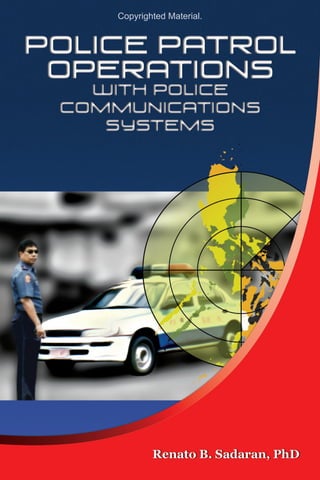
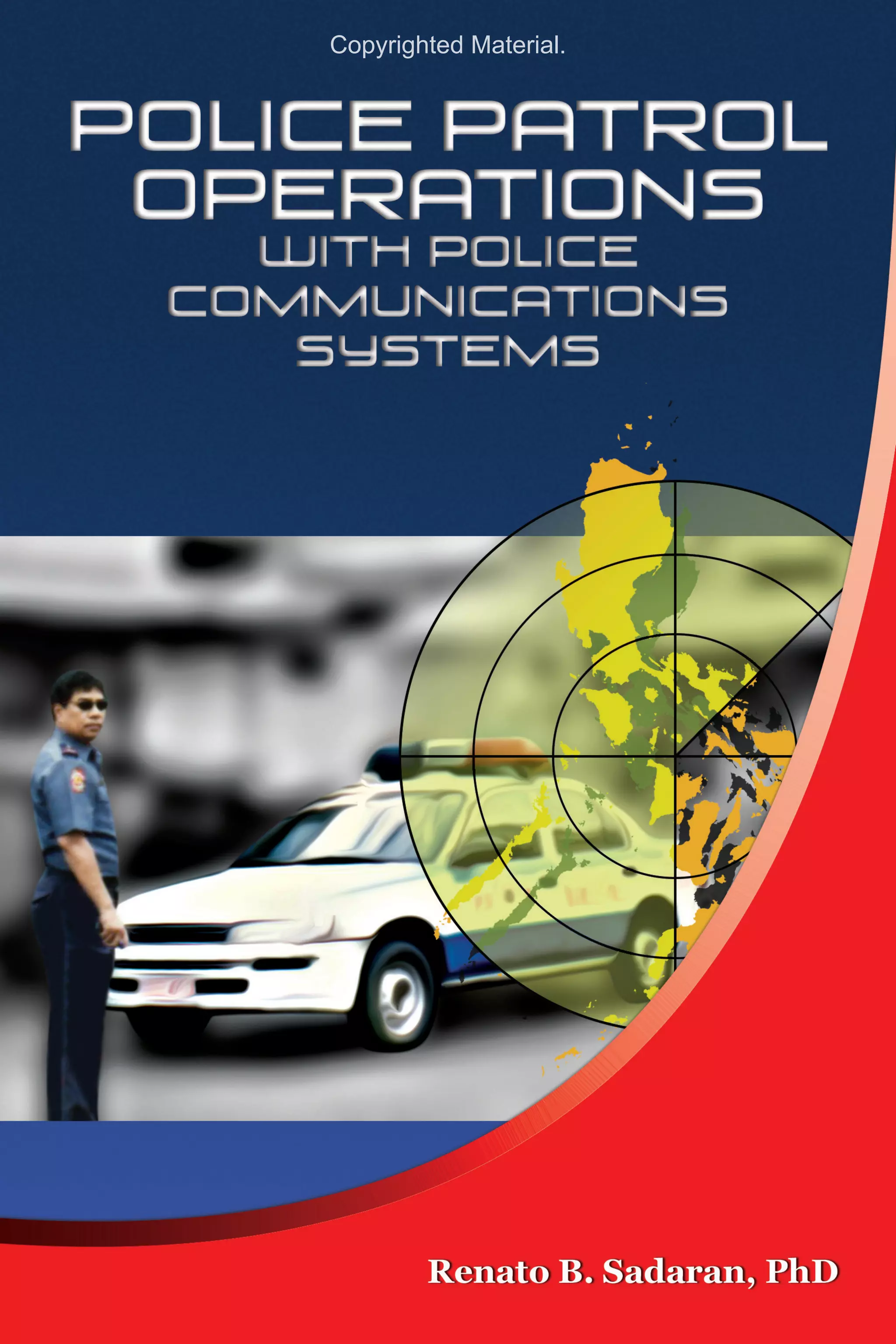
Police Patrol Operations with Police Communications Systems
First Edition
Philippine Copyright, 2013
By: ChapterHouse Publishing Incorporated
All Rights Reserved.
The text of this book or any part hereof, may not be reproduced or
transmitted in any form or by any means, electronic or mechanical,
including copying, recording, storage in any informational retrieval
system, or otherwise, without the prior written permission of the
publisher.
Any unauthorized copying, reproduction, or dissemination of any
portion of this book shall be prosecuted in accordance with law.
Published and Distributed by:
ChapterHouse Publishing Incorporated
Novaliches, Quezon City
Edited by:
The English Factor
www.englishfactor.com
“Providing international-quality editorial services at reasonable costs.”
ISBN: 978-971-95775-3-9
Copyrighted Material.

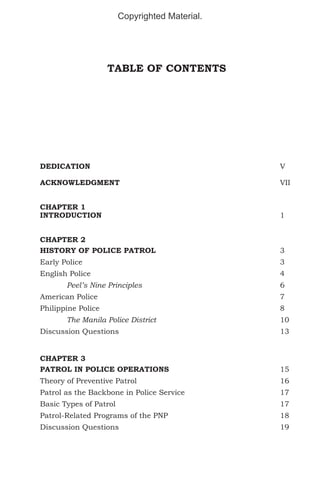
TABLE OF CONTENTS

DEDICATION								V
ACKNOWLEDGMENT							VII
CHAPTER 1
INTRODUCTION							1
CHAPTER 2
HISTORY OF POLICE PATROL					

3

Early Police								3
English Police								4
	

Peel’s Nine Principles						6

American Police							7
Philippine Police							8
	

The Manila Police District	

				10

Discussion Questions							13
CHAPTER 3
PATROL IN POLICE OPERATIONS					

15

Theory of Preventive Patrol						16
Patrol as the Backbone in Police Service				

17

Basic Types of Patrol							17
Patrol-Related Programs of the PNP					

18

Discussion Questions							19
Copyrighted Material.
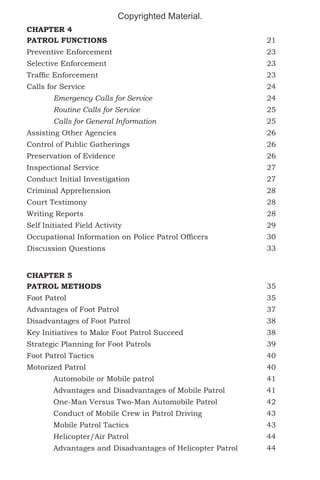
CHAPTER 4
PATROL FUNCTIONS						21
Preventive Enforcement						23
Selective Enforcement						23
Traffic Enforcement							

23

Calls for Service							24
	

Emergency Calls for Service 					24


Routine Calls for Service					25


Calls for General Information					25

Assisting Other Agencies						26
Control of Public Gatherings						26
Preservation of Evidence 						26
Inspectional Service							27
Conduct Initial Investigation						27
Criminal Apprehension						28
Court Testimony							28
Writing Reports							28
Self Initiated Field Activity						29
Occupational Information on Police Patrol Officers			

30

Discussion Questions							33
CHAPTER 5
PATROL METHODS							35
							35
Foot Patrol	
Advantages of Foot Patrol						37
Disadvantages of Foot Patrol						38
Key Initiatives to Make Foot Patrol Succeed				

38

Strategic Planning for Foot Patrols					

39

Foot Patrol Tactics							40
Motorized Patrol							40
	Automobile or Mobile patrol					41
	

Advantages and Disadvantages of Mobile Patrol		

41


One-Man Versus Two-Man Automobile Patrol		

42


Conduct of Mobile Crew in Patrol Driving			

43

	Mobile Patrol Tactics						43
	Helicopter/Air Patrol 					44
	

Advantages and Disadvantages of Helicopter Patrol		

44
Copyrighted Material.
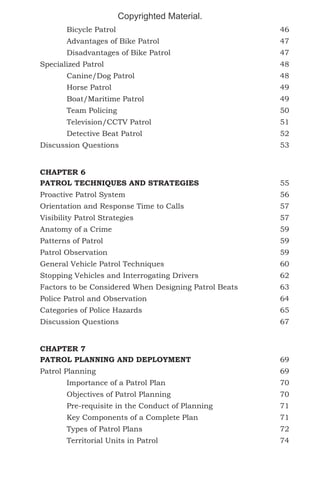
	Bicycle Patrol							46
	Advantages of Bike Patrol					47
	Disadvantages of Bike Patrol					47
Specialized Patrol							48
	Canine/Dog Patrol						48
	Horse Patrol							49
	Boat/Maritime Patrol						49
	Team Policing							50
	Television/CCTV Patrol					51
	Detective Beat Patrol						52
Discussion Questions							53
CHAPTER 6
PATROL TECHNIQUES AND STRATEGIES				

55

Proactive Patrol System						56
Orientation and Response Time to Calls				

57

Visibility Patrol Strategies 						57
Anatomy of a Crime							59
Patterns of Patrol							59
Patrol Observation							59
General Vehicle Patrol Techniques					60
Stopping Vehicles and Interrogating Drivers				

62

Factors to be Considered When Designing Patrol Beats		

63

Police Patrol and Observation					64
Categories of Police Hazards						65
Discussion Questions							67
CHAPTER 7
PATROL PLANNING AND DEPLOYMENT				69
Patrol Planning							69
	Importance of a Patrol Plan					70
	Objectives of Patrol Planning					70
	

Pre-requisite in the Conduct of Planning			

71


Key Components of a Complete Plan 			

71

	Types of Patrol Plans						72
	Territorial Units in Patrol					74
Copyrighted Material.
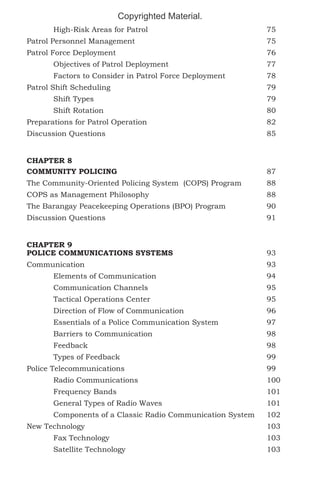
	High-Risk Areas for Patrol					75
Patrol Personnel Management					75
Patrol Force Deployment						76
	Objectives of Patrol Deployment				77
	

Factors to Consider in Patrol Force Deployment		

78

Patrol Shift Scheduling						79
	Shift Types							79
	Shift Rotation							80
Preparations for Patrol Operation					82
Discussion Questions							85
CHAPTER 8
COMMUNITY POLICING						87
The Community-Oriented Policing System (COPS) Program	

88

COPS as Management Philosophy					88
The Barangay Peacekeeping Operations (BPO) Program		

90

Discussion Questions							91
CHAPTER 9
POLICE COMMUNICATIONS SYSTEMS				

93

Communication							93
	Elements of Communication					94
	Communication Channels					95
	Tactical Operations Center					95
	

Direction of Flow of Communication				

96


Essentials of a Police Communication System		

97

	Barriers to Communication					98
	Feedback							98
	Types of Feedback						99
Police Telecommunications						99
	Radio Communications					100
	Frequency Bands						101
	

General Types of Radio Waves				

101


Components of a Classic Radio Communication System	

102

New Technology							103
	Fax Technology						103
	Satellite Technology						103
Copyrighted Material.
	Scanning Technology						104
	Video Technology						105
	Telephone Communications					105
	Cellular Telephones						106
Use of Phonetic Alphabet						106
Official APCO Ten-Code Signals					

107

Discussion Questions							111
CHAPTER 10
PNP PROCEDURES ON PATROL OPERATIONS			

113

GENERAL PROCEDURES						113
Rule 1. POLICE BLOTTER 						114
Rule 2. POLICE UNIFORM						114
Rule 3. POLICE NOTEBOOK AND PEN 				

114

Rule 4. INTER-UNIT COORDINATION				

114

Rule 5. BASIC REQUIREMENTS OF
	POLICE INTERVENTION OPERATIONS			115
Rule 6. WARNING BY USE OF MEGAPHONES			

115

Rule 7. WARNING SHOTS						115
Rule 8. USE OF FORCE						116
Rule 9. MOVING VEHICLES						117
Rule 10. THINGS TO BE DONE AFTER AN
	ARMED CONFRONTATION 					117
Rule 11. INVESTIGATION BY THE TERRITORIAL
	UNIT CONCERNED						118
BASIC PROCEDURES							118
Rule 12. PATROL PROCEDURES					118
Rule 13. SPOT CHECKS /ACCOSTING AND
	PAT-DOWN SEARCHES 					123
Rule 14. ARREST							126
Rule 17. SEARCHES AND SEIZURES				

132

Rule 18. CRIME SCENE RESPONSE PROCEDURES		

136

Rule 20. DEMOLITIONS, INJUNCTIONS AND
	OTHER SIMILAR ORDERS					138
Rule 22. POLICE ASSISTANCE IN THE IMPLEMENTATION
	

OF FINAL DECISIONS OR ORDERS OR RESOLUTIONS


OF THE COMELEC OR DILG OR LOCAL GOVERNMENT
Copyrighted Material.
	

UNIT EXERCISING DISCIPLINARY POWERS IN 		


ADMINISTRATIVE CASES OF ELECTED OFFICIALS	

139

SPECIAL PROCEDURES						141
Rule 23. RALLIES AND DEMONSTRATIONS				

141

Rule 24. CIVIL DISTURBANCE MANAGEMENT OPERATIONS	

149

Rule 25. CHECKPOINTS						151
Rule 26. HOSTAGE SITUATION/BARRICADED SITUATIONS	

161

Rule 29. BOMB, BOMB THREAT AND BOMB INCIDENT
	EMERGENCY RESPONSE PROCEDURES			162
REFERENCES							167
IMAGE CREDITS							169
Copyrighted Material.
Introduction

CHAPTER 1
INTRODUCTION

	
Police authorities throughout the world consider patrol as
the most important component in any police organization. This is
because patrol officers have direct contact with the public and project
the authority and visibility of police service in the community. In fact,
patrol is considered the “backbone of policing, the central aspect of
police operations, and the center of police activity” (Walker & Katz,
2002). To a great extent, the physical presence of a patrol force can
discourage an individual’s desire to commit a crime or violation.
	
The significance of patrol in police work was underscored
by an influential leader and author, O.W. Wilson, who was Dean
Emeritus of the School of Criminology at the University of California
at Berkeley and a former police chief in Wichita, Kansas and Chicago,
Illinois. In his book Police Administration, he stated that:
“Patrol is an indispensable service that plays a leading
role in the accomplishment of the police purpose. It
is the only form of police service that directly attempts
to eliminate opportunity for misconduct. It also checks
the development of desire for misconduct by destroying
wholesome influences, by actively creating wholesome ones,
and by probably influencing individual and group attitudes
in its routine daily association with the public… Constant
availability is important because time is of the essence
in most police work. In addition to performing duties
relating to incidents of misconducts, the complete coverage

1
Copyrighted Material.
2

Police Patrol Operations with Police Communications Systems

provided by patrol makes it available for other services.
The Patrolman searches for and returns lost persons and
property and informs and assists citizens. He serves as
the eyes and ears of the police department by gathering
information useful to the administration, to the special
branches of police service and other city departments.”
(Wilson, 1963)
	
The patrol force is considered to be the backbone or nucleus
of the police service since it is responsible for the performance
of practically all primary police tasks.
Patrol officers can be
considered the most valuable people in the police department because
all activities radiate from them. A police department’s ability to carry
out its functions depends greatly on the patrol officer’s 24/7 watchful
vigilance. Hence, the patrol force is responsible for accomplishing the
total police job.
	
Retired Police Major Isaias Alma Jose of the Manila Police
District (MPD) constantly reminded his patrol officers that visibility
and omnipresence is their psychological tool to make their presence
felt, so as to give a feeling of security to the law abiding citizen and
a feeling of fear to the would-be criminal. He was a highly respected
police officer and my mentor as a student of criminology. He instilled in
me the importance of performing patrol work -- which the objective is
to prevent the commission of the crime by destroying the opportunity
through constant and alert patrolling. He likewise inspired me to instill
in others the crucial role of patrol operations in crime prevention;
hence, the creation of this book. It is my sincere hope that police
officers, criminology students and the general public realize the service
that every patrol officer provides to the community.
	
This book aims to provide the requisite knowledge on police
patrol, specifically in the Philippine setting. It is generally intended to
facilitate the learning of criminology students, but it can also benefit
the patrol officer seeking continuous learning or other students and
professionals interested in the field of police operations, specifically in
patrol work.

Police patrol preview

  • 1.
  • 2.
  • 3.
    Copyrighted Material. Police PatrolOperations with Police Communications Systems First Edition Philippine Copyright, 2013 By: ChapterHouse Publishing Incorporated All Rights Reserved. The text of this book or any part hereof, may not be reproduced or transmitted in any form or by any means, electronic or mechanical, including copying, recording, storage in any informational retrieval system, or otherwise, without the prior written permission of the publisher. Any unauthorized copying, reproduction, or dissemination of any portion of this book shall be prosecuted in accordance with law. Published and Distributed by: ChapterHouse Publishing Incorporated Novaliches, Quezon City Edited by: The English Factor www.englishfactor.com “Providing international-quality editorial services at reasonable costs.” ISBN: 978-971-95775-3-9
  • 4.
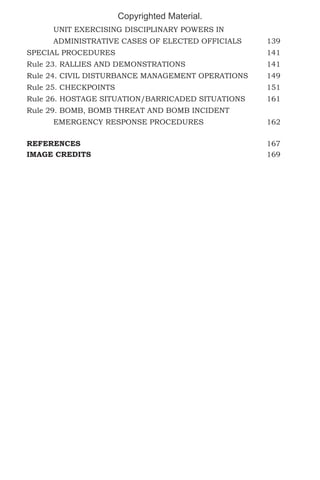
    Copyrighted Material. TABLE OFCONTENTS DEDICATION V ACKNOWLEDGMENT VII CHAPTER 1 INTRODUCTION 1 CHAPTER 2 HISTORY OF POLICE PATROL 3 Early Police 3 English Police 4 Peel’s Nine Principles 6 American Police 7 Philippine Police 8 The Manila Police District 10 Discussion Questions 13 CHAPTER 3 PATROL IN POLICE OPERATIONS 15 Theory of Preventive Patrol 16 Patrol as the Backbone in Police Service 17 Basic Types of Patrol 17 Patrol-Related Programs of the PNP 18 Discussion Questions 19
  • 5.
    Copyrighted Material. CHAPTER 4 PATROLFUNCTIONS 21 Preventive Enforcement 23 Selective Enforcement 23 Traffic Enforcement 23 Calls for Service 24 Emergency Calls for Service 24 Routine Calls for Service 25 Calls for General Information 25 Assisting Other Agencies 26 Control of Public Gatherings 26 Preservation of Evidence 26 Inspectional Service 27 Conduct Initial Investigation 27 Criminal Apprehension 28 Court Testimony 28 Writing Reports 28 Self Initiated Field Activity 29 Occupational Information on Police Patrol Officers 30 Discussion Questions 33 CHAPTER 5 PATROL METHODS 35 35 Foot Patrol Advantages of Foot Patrol 37 Disadvantages of Foot Patrol 38 Key Initiatives to Make Foot Patrol Succeed 38 Strategic Planning for Foot Patrols 39 Foot Patrol Tactics 40 Motorized Patrol 40 Automobile or Mobile patrol 41 Advantages and Disadvantages of Mobile Patrol 41 One-Man Versus Two-Man Automobile Patrol 42 Conduct of Mobile Crew in Patrol Driving 43 Mobile Patrol Tactics 43 Helicopter/Air Patrol 44 Advantages and Disadvantages of Helicopter Patrol 44
  • 6.
    Copyrighted Material. Bicycle Patrol 46 Advantagesof Bike Patrol 47 Disadvantages of Bike Patrol 47 Specialized Patrol 48 Canine/Dog Patrol 48 Horse Patrol 49 Boat/Maritime Patrol 49 Team Policing 50 Television/CCTV Patrol 51 Detective Beat Patrol 52 Discussion Questions 53 CHAPTER 6 PATROL TECHNIQUES AND STRATEGIES 55 Proactive Patrol System 56 Orientation and Response Time to Calls 57 Visibility Patrol Strategies 57 Anatomy of a Crime 59 Patterns of Patrol 59 Patrol Observation 59 General Vehicle Patrol Techniques 60 Stopping Vehicles and Interrogating Drivers 62 Factors to be Considered When Designing Patrol Beats 63 Police Patrol and Observation 64 Categories of Police Hazards 65 Discussion Questions 67 CHAPTER 7 PATROL PLANNING AND DEPLOYMENT 69 Patrol Planning 69 Importance of a Patrol Plan 70 Objectives of Patrol Planning 70 Pre-requisite in the Conduct of Planning 71 Key Components of a Complete Plan 71 Types of Patrol Plans 72 Territorial Units in Patrol 74
  • 7.
    Copyrighted Material. High-Risk Areasfor Patrol 75 Patrol Personnel Management 75 Patrol Force Deployment 76 Objectives of Patrol Deployment 77 Factors to Consider in Patrol Force Deployment 78 Patrol Shift Scheduling 79 Shift Types 79 Shift Rotation 80 Preparations for Patrol Operation 82 Discussion Questions 85 CHAPTER 8 COMMUNITY POLICING 87 The Community-Oriented Policing System (COPS) Program 88 COPS as Management Philosophy 88 The Barangay Peacekeeping Operations (BPO) Program 90 Discussion Questions 91 CHAPTER 9 POLICE COMMUNICATIONS SYSTEMS 93 Communication 93 Elements of Communication 94 Communication Channels 95 Tactical Operations Center 95 Direction of Flow of Communication 96 Essentials of a Police Communication System 97 Barriers to Communication 98 Feedback 98 Types of Feedback 99 Police Telecommunications 99 Radio Communications 100 Frequency Bands 101 General Types of Radio Waves 101 Components of a Classic Radio Communication System 102 New Technology 103 Fax Technology 103 Satellite Technology 103
  • 8.
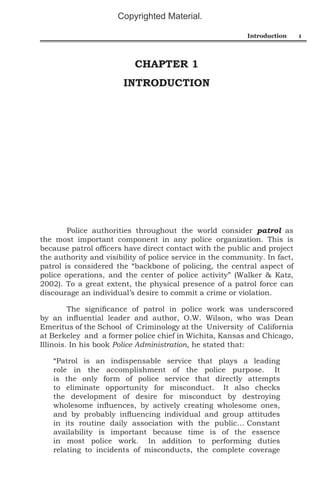
    Copyrighted Material. Scanning Technology 104 VideoTechnology 105 Telephone Communications 105 Cellular Telephones 106 Use of Phonetic Alphabet 106 Official APCO Ten-Code Signals 107 Discussion Questions 111 CHAPTER 10 PNP PROCEDURES ON PATROL OPERATIONS 113 GENERAL PROCEDURES 113 Rule 1. POLICE BLOTTER 114 Rule 2. POLICE UNIFORM 114 Rule 3. POLICE NOTEBOOK AND PEN 114 Rule 4. INTER-UNIT COORDINATION 114 Rule 5. BASIC REQUIREMENTS OF POLICE INTERVENTION OPERATIONS 115 Rule 6. WARNING BY USE OF MEGAPHONES 115 Rule 7. WARNING SHOTS 115 Rule 8. USE OF FORCE 116 Rule 9. MOVING VEHICLES 117 Rule 10. THINGS TO BE DONE AFTER AN ARMED CONFRONTATION 117 Rule 11. INVESTIGATION BY THE TERRITORIAL UNIT CONCERNED 118 BASIC PROCEDURES 118 Rule 12. PATROL PROCEDURES 118 Rule 13. SPOT CHECKS /ACCOSTING AND PAT-DOWN SEARCHES 123 Rule 14. ARREST 126 Rule 17. SEARCHES AND SEIZURES 132 Rule 18. CRIME SCENE RESPONSE PROCEDURES 136 Rule 20. DEMOLITIONS, INJUNCTIONS AND OTHER SIMILAR ORDERS 138 Rule 22. POLICE ASSISTANCE IN THE IMPLEMENTATION OF FINAL DECISIONS OR ORDERS OR RESOLUTIONS OF THE COMELEC OR DILG OR LOCAL GOVERNMENT
  • 9.
    Copyrighted Material. UNIT EXERCISINGDISCIPLINARY POWERS IN ADMINISTRATIVE CASES OF ELECTED OFFICIALS 139 SPECIAL PROCEDURES 141 Rule 23. RALLIES AND DEMONSTRATIONS 141 Rule 24. CIVIL DISTURBANCE MANAGEMENT OPERATIONS 149 Rule 25. CHECKPOINTS 151 Rule 26. HOSTAGE SITUATION/BARRICADED SITUATIONS 161 Rule 29. BOMB, BOMB THREAT AND BOMB INCIDENT EMERGENCY RESPONSE PROCEDURES 162 REFERENCES 167 IMAGE CREDITS 169
  • 10.
    Copyrighted Material. Introduction CHAPTER 1 INTRODUCTION Policeauthorities throughout the world consider patrol as the most important component in any police organization. This is because patrol officers have direct contact with the public and project the authority and visibility of police service in the community. In fact, patrol is considered the “backbone of policing, the central aspect of police operations, and the center of police activity” (Walker & Katz, 2002). To a great extent, the physical presence of a patrol force can discourage an individual’s desire to commit a crime or violation. The significance of patrol in police work was underscored by an influential leader and author, O.W. Wilson, who was Dean Emeritus of the School of Criminology at the University of California at Berkeley and a former police chief in Wichita, Kansas and Chicago, Illinois. In his book Police Administration, he stated that: “Patrol is an indispensable service that plays a leading role in the accomplishment of the police purpose. It is the only form of police service that directly attempts to eliminate opportunity for misconduct. It also checks the development of desire for misconduct by destroying wholesome influences, by actively creating wholesome ones, and by probably influencing individual and group attitudes in its routine daily association with the public… Constant availability is important because time is of the essence in most police work. In addition to performing duties relating to incidents of misconducts, the complete coverage 1
  • 11.
    Copyrighted Material. 2 Police PatrolOperations with Police Communications Systems provided by patrol makes it available for other services. The Patrolman searches for and returns lost persons and property and informs and assists citizens. He serves as the eyes and ears of the police department by gathering information useful to the administration, to the special branches of police service and other city departments.” (Wilson, 1963) The patrol force is considered to be the backbone or nucleus of the police service since it is responsible for the performance of practically all primary police tasks. Patrol officers can be considered the most valuable people in the police department because all activities radiate from them. A police department’s ability to carry out its functions depends greatly on the patrol officer’s 24/7 watchful vigilance. Hence, the patrol force is responsible for accomplishing the total police job. Retired Police Major Isaias Alma Jose of the Manila Police District (MPD) constantly reminded his patrol officers that visibility and omnipresence is their psychological tool to make their presence felt, so as to give a feeling of security to the law abiding citizen and a feeling of fear to the would-be criminal. He was a highly respected police officer and my mentor as a student of criminology. He instilled in me the importance of performing patrol work -- which the objective is to prevent the commission of the crime by destroying the opportunity through constant and alert patrolling. He likewise inspired me to instill in others the crucial role of patrol operations in crime prevention; hence, the creation of this book. It is my sincere hope that police officers, criminology students and the general public realize the service that every patrol officer provides to the community. This book aims to provide the requisite knowledge on police patrol, specifically in the Philippine setting. It is generally intended to facilitate the learning of criminology students, but it can also benefit the patrol officer seeking continuous learning or other students and professionals interested in the field of police operations, specifically in patrol work.