Sloshing-aware attitude control of
impulsively actuated spacecraft
P. Sopasakisa, D. Bernardinia,c, H. Strauchb,
S. Bennanid and A. Bemporada,c
a Institute for Advanced Studies Lucca,
b Airbus DS, c ODYS Srl
d European Space Agency
July 14, 2015
CFD computations...
1 / 16
CFD computations...
Sloshing cannot be ignored!
1 / 16
Outline
1. Derivation of a sloshing-aware dynamical model
2. State estimation and model linearisation
3. Modelling of minimum impulse effect
4. Model predictive control & simulations
2 / 16
I. Modelling
Fixed Body Frame
3 / 16
Modelling sloshing
The concept of a rotating mass is used to
model the sloshing dynamics. Using
Lagrangian arguments we arrive at:
˙α = β,
˙β = κβ +
θ(α, ω)
mf r2
where θ is a nonlinear functiona which
depends of parameters p and r.
a
Given in the appendix
4 / 16
Modelling sloshing
The inertia tensor J of the upper stage is:
J(α) = J0 + Jmf
(α)
J0: diagonal inertia tensor without sloshing,
Jmf
(α) contribution of the moving mass given by
Jmf
(α)=mf


r2 pr cos α pr sin α
∗ p2 + r2 sin2
α − sin α cos α
∗ ∗ p2 + r2 cos2 α

 .
5 / 16
Modelling sloshing
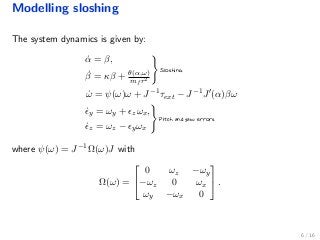
The system dynamics is given by:
˙α = β,
˙β = κβ + θ(α,ω)
mf r2
Sloshing
˙ω = ψ(ω)ω + J−1
τext − J−1
J (α)βω
˙y = ωy + zωx,
˙z = ωz − yωx
Pitch and yaw errors
where ψ(ω) = J−1Ω(ω)J with
Ω(ω) =


0 ωz −ωy
−ωz 0 ωx
ωy −ωx 0

 .
6 / 16
System dynamics
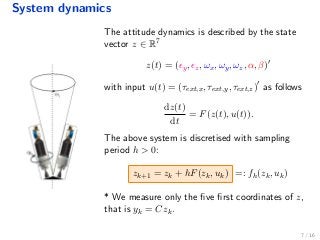
The attitude dynamics is described by the state
vector z ∈ R7
z(t) = ( y, z, ωx, ωy, ωz, α, β)
with input u(t) = (τext,x, τext,y, τext,z) as follows
dz(t)
dt
= F(z(t), u(t)).
The above system is discretised with sampling
period h > 0:
zk+1 = zk + hF(zk, uk) =: fh(zk, uk)
* We measure only the five first coordinates of z,
that is yk = Czk.
7 / 16
II. State Estimation and
Linearisation
Ext. Kalman Filter
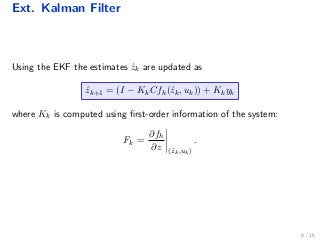
Using the EKF the estimates ˆzk are updated as
ˆzk+1 = (I − KkCfh(ˆzk, uk)) + Kkyk
where Kk is computed using first-order information of the system:
Fk =
∂fh
∂z (ˆzk,uk)
.
8 / 16
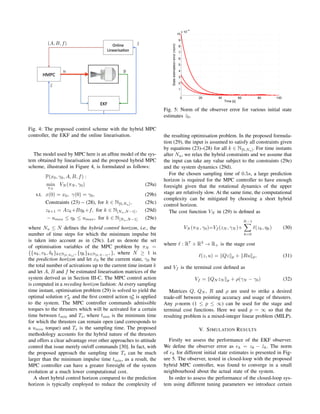
Ext. Kalman Filter
0 20 40 60 80 100
1
2
3
4
5
6
7
8
9
10
x 10
−4
Time [s]
Stateestimateionerror(norm)
9 / 16
Linearisation
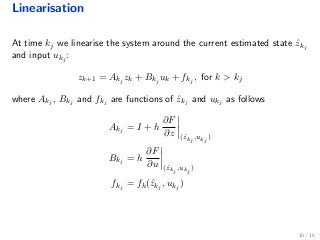
At time kj we linearise the system around the current estimated state ˆzkj
and input ukj
:
zk+1 = Akj
zk + Bkj
uk + fkj
, for k > kj
where Akj
, Bkj
and fkj
are functions of ˆzkj
and ukj
as follows
Akj
= I + h
∂F
∂z (ˆzkj
,ukj
)
Bkj
= h
∂F
∂u (ˆzkj
,ukj
)
fkj
= fh(ˆzkj
, ukj
)
10 / 16
III. Minimum Impulse Effect
Minimum impulse effect
Minimum impulse effect: thrusters cannot produce arbitrarily small
torques, thus uk is constrained in
U = [−umax, −umin] ∪ {0} ∪ [umin, umax]
We introduce the binary vectors δ−
k and δ+
k so that1
δ−
k = [uk ≤ −umin],
δ+
k = [uk ≥ umin],
and the auxiliary variable ηk defined as
ηk,i = [δ−
k,i ∨ δ+
k,i] · uk,i
1
Here ≤ and ≥ are element-wise comparison operators.
11 / 16
Minimum impulse effect
To detect thruster activations we use the variable
vk = [δ−
k ∨ δ+
k ]
and we recast the system dynamics as
zk+1 = Azk + Bηk + f,
γk+1 = γk + [ 1 1 1 ] vk,
where γk is the total actuation count up to time k on which we impose:
γk ≤ γmax.
12 / 16
IV. Hybrid Model Predictive
Control
Control scheme
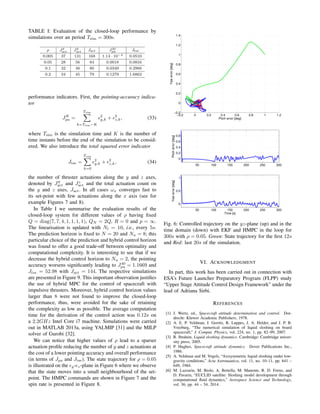
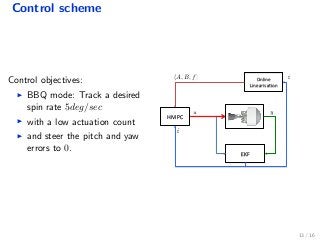
Control objectives:
BBQ mode: Track a desired
spin rate 5deg/sec
with a low actuation count
and steer the pitch and yaw
errors to 0.
HMPC	
  
EKF	
  
Online	
  
Linearisa2on	
  	
  
(A, B, f)
ˆz
u y
ˆz
13 / 16
Hybrid Model Predictive Control
MPC problem2:
P(x0, γ0, A, B, f) : min
πN
VN (πN , γ0)
s.t. x(0) = x0, γ(0) = γ0,
Hybrid dynamics for k ∈ N[0,Nu−1],
Assume U = [−umax, umax] for k ∈ N[Nu,N−1],
where
VN (πN , γ0)= QN zN p + ρ(γN − γ0)
Penalises the tot.
actuation count along
the horizon
+
N−1
k=0
Qzk p + Rηk p
2
Optimisation with respect to the sequence of control actions uk, δk, vk and ηk.
14 / 16
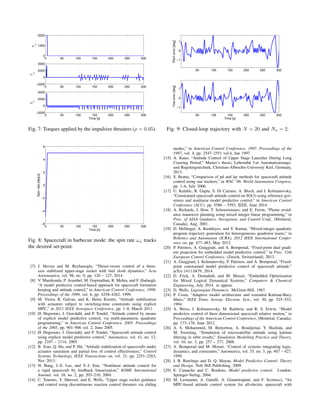
Simulation results3
−0.2 0 0.2 0.4 0.6 0.8 1 1.2
−0.2
0
0.2
0.4
0.6
0.8
1
1.2
1.4
Pitch error [deg]
Yawerror[deg]
50 100 150 200 250 300
0
0.2
0.4
0.6
0.8
Pitcherror[deg]
50 100 150 200 250 300
0
0.5
1
Yawerror[deg]
Time [s]
0 50 100 150 200 250 300
−6
−4
−2
0
2
4
6
Time [s]
Spinrate[deg/s]
0 50 100 150 200 250 300
0
1000
2000
T
x
0 50 100 150 200 250 300
−2000
0
2000
4000
T
y
0 50 100 150 200 250 300
−2000
0
2000
4000
T
z
Time [s]
3
Simulation parameters: Nu = 8, N = 20, ρ = 0.05
15 / 16
Simulation results
Choosing Nu = 2 we get:
50 100 150 200 250 300
−1
0
1Pitcherror[deg]
50 100 150 200 250 300
−1
0
1
Yawerror[deg]
Time [s]
16 / 16
Thank you for your attention
V. Appendix
Sloshing dynamics
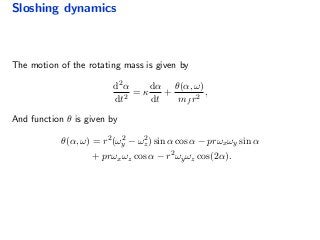
The motion of the rotating mass is given by
d2α
dt2
= κ
dα
dt
+
θ(α, ω)
mf r2
,
And function θ is given by
θ(α, ω) = r2
(ω2
y − ω2
z) sin α cos α − prωxωy sin α
+ prωxωz cos α − r2
ωyωz cos(2α).
Attidute dynamics
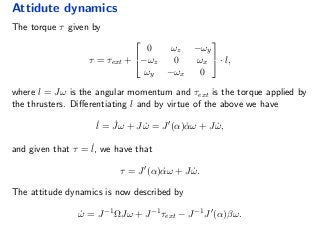
The torque τ given by
τ = τext +


0 ωz −ωy
−ωz 0 ωx
ωy −ωx 0

 · l,
where l = Jω is the angular momentum and τext is the torque applied by
the thrusters. Differentiating l and by virtue of the above we have
˙l = ˙Jω + J ˙ω = J (α) ˙αω + J ˙ω,
and given that τ = ˙l, we have that
τ = J (α) ˙αω + J ˙ω.
The attitude dynamics is now described by
˙ω = J−1
ΩJω + J−1
τext − J−1
J (α)βω.
Performance indicators and assessment
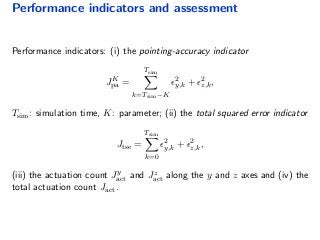
Performance indicators: (i) the pointing-accuracy indicator
JK
pa =
Tsim
k=Tsim−K
2
y,k + 2
z,k,
Tsim: simulation time, K: parameter; (ii) the total squared error indicator
Jtse =
Tsim
k=0
2
y,k + 2
z,k,
(iii) the actuation count Jy
act and Jz
act along the y and z axes and (iv) the
total actuation count Jact.
Performance indicators and assessment
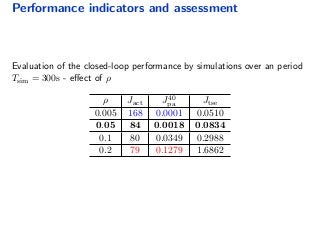
Evaluation of the closed-loop performance by simulations over an period
Tsim = 300s - effect of ρ
ρ Jact J40
pa Jtse
0.005 168 0.0001 0.0510
0.05 84 0.0018 0.0834
0.1 80 0.0349 0.2988
0.2 79 0.1279 1.6862
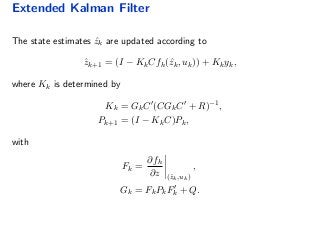
Extended Kalman Filter
The state estimates ˆzk are updated according to
ˆzk+1 = (I − KkCfh(ˆzk, uk)) + Kkyk,
where Kk is determined by
Kk = GkC (CGkC + R)−1
,
Pk+1 = (I − KkC)Pk,
with
Fk =
∂fh
∂z (ˆzk,uk)
,
Gk = FkPkFk + Q.

Sloshing-aware MPC for upper stage attitude control

  • 1.
    Sloshing-aware attitude controlof impulsively actuated spacecraft P. Sopasakisa, D. Bernardinia,c, H. Strauchb, S. Bennanid and A. Bemporada,c a Institute for Advanced Studies Lucca, b Airbus DS, c ODYS Srl d European Space Agency July 14, 2015
  • 2.
  • 3.
  • 4.
    Outline 1. Derivation ofa sloshing-aware dynamical model 2. State estimation and model linearisation 3. Modelling of minimum impulse effect 4. Model predictive control & simulations 2 / 16
  • 5.
  • 6.
  • 7.
    Modelling sloshing The conceptof a rotating mass is used to model the sloshing dynamics. Using Lagrangian arguments we arrive at: ˙α = β, ˙β = κβ + θ(α, ω) mf r2 where θ is a nonlinear functiona which depends of parameters p and r. a Given in the appendix 4 / 16
  • 8.
    Modelling sloshing The inertiatensor J of the upper stage is: J(α) = J0 + Jmf (α) J0: diagonal inertia tensor without sloshing, Jmf (α) contribution of the moving mass given by Jmf (α)=mf   r2 pr cos α pr sin α ∗ p2 + r2 sin2 α − sin α cos α ∗ ∗ p2 + r2 cos2 α   . 5 / 16
  • 9.
    Modelling sloshing The systemdynamics is given by: ˙α = β, ˙β = κβ + θ(α,ω) mf r2 Sloshing ˙ω = ψ(ω)ω + J−1 τext − J−1 J (α)βω ˙y = ωy + zωx, ˙z = ωz − yωx Pitch and yaw errors where ψ(ω) = J−1Ω(ω)J with Ω(ω) =   0 ωz −ωy −ωz 0 ωx ωy −ωx 0   . 6 / 16
  • 10.
    System dynamics The attitudedynamics is described by the state vector z ∈ R7 z(t) = ( y, z, ωx, ωy, ωz, α, β) with input u(t) = (τext,x, τext,y, τext,z) as follows dz(t) dt = F(z(t), u(t)). The above system is discretised with sampling period h > 0: zk+1 = zk + hF(zk, uk) =: fh(zk, uk) * We measure only the five first coordinates of z, that is yk = Czk. 7 / 16
  • 11.
    II. State Estimationand Linearisation
  • 12.
    Ext. Kalman Filter Usingthe EKF the estimates ˆzk are updated as ˆzk+1 = (I − KkCfh(ˆzk, uk)) + Kkyk where Kk is computed using first-order information of the system: Fk = ∂fh ∂z (ˆzk,uk) . 8 / 16
  • 13.
    Ext. Kalman Filter 020 40 60 80 100 1 2 3 4 5 6 7 8 9 10 x 10 −4 Time [s] Stateestimateionerror(norm) 9 / 16
  • 14.
    Linearisation At time kjwe linearise the system around the current estimated state ˆzkj and input ukj : zk+1 = Akj zk + Bkj uk + fkj , for k > kj where Akj , Bkj and fkj are functions of ˆzkj and ukj as follows Akj = I + h ∂F ∂z (ˆzkj ,ukj ) Bkj = h ∂F ∂u (ˆzkj ,ukj ) fkj = fh(ˆzkj , ukj ) 10 / 16
  • 15.
  • 16.
    Minimum impulse effect Minimumimpulse effect: thrusters cannot produce arbitrarily small torques, thus uk is constrained in U = [−umax, −umin] ∪ {0} ∪ [umin, umax] We introduce the binary vectors δ− k and δ+ k so that1 δ− k = [uk ≤ −umin], δ+ k = [uk ≥ umin], and the auxiliary variable ηk defined as ηk,i = [δ− k,i ∨ δ+ k,i] · uk,i 1 Here ≤ and ≥ are element-wise comparison operators. 11 / 16
  • 17.
    Minimum impulse effect Todetect thruster activations we use the variable vk = [δ− k ∨ δ+ k ] and we recast the system dynamics as zk+1 = Azk + Bηk + f, γk+1 = γk + [ 1 1 1 ] vk, where γk is the total actuation count up to time k on which we impose: γk ≤ γmax. 12 / 16
  • 18.
    IV. Hybrid ModelPredictive Control
  • 19.
    Control scheme Control objectives: BBQmode: Track a desired spin rate 5deg/sec with a low actuation count and steer the pitch and yaw errors to 0. HMPC   EKF   Online   Linearisa2on     (A, B, f) ˆz u y ˆz 13 / 16
  • 20.
    Hybrid Model PredictiveControl MPC problem2: P(x0, γ0, A, B, f) : min πN VN (πN , γ0) s.t. x(0) = x0, γ(0) = γ0, Hybrid dynamics for k ∈ N[0,Nu−1], Assume U = [−umax, umax] for k ∈ N[Nu,N−1], where VN (πN , γ0)= QN zN p + ρ(γN − γ0) Penalises the tot. actuation count along the horizon + N−1 k=0 Qzk p + Rηk p 2 Optimisation with respect to the sequence of control actions uk, δk, vk and ηk. 14 / 16
  • 21.
    Simulation results3 −0.2 00.2 0.4 0.6 0.8 1 1.2 −0.2 0 0.2 0.4 0.6 0.8 1 1.2 1.4 Pitch error [deg] Yawerror[deg] 50 100 150 200 250 300 0 0.2 0.4 0.6 0.8 Pitcherror[deg] 50 100 150 200 250 300 0 0.5 1 Yawerror[deg] Time [s] 0 50 100 150 200 250 300 −6 −4 −2 0 2 4 6 Time [s] Spinrate[deg/s] 0 50 100 150 200 250 300 0 1000 2000 T x 0 50 100 150 200 250 300 −2000 0 2000 4000 T y 0 50 100 150 200 250 300 −2000 0 2000 4000 T z Time [s] 3 Simulation parameters: Nu = 8, N = 20, ρ = 0.05 15 / 16
  • 22.
    Simulation results Choosing Nu= 2 we get: 50 100 150 200 250 300 −1 0 1Pitcherror[deg] 50 100 150 200 250 300 −1 0 1 Yawerror[deg] Time [s] 16 / 16
  • 23.
    Thank you foryour attention
  • 24.
  • 25.
    Sloshing dynamics The motionof the rotating mass is given by d2α dt2 = κ dα dt + θ(α, ω) mf r2 , And function θ is given by θ(α, ω) = r2 (ω2 y − ω2 z) sin α cos α − prωxωy sin α + prωxωz cos α − r2 ωyωz cos(2α).
  • 26.
    Attidute dynamics The torqueτ given by τ = τext +   0 ωz −ωy −ωz 0 ωx ωy −ωx 0   · l, where l = Jω is the angular momentum and τext is the torque applied by the thrusters. Differentiating l and by virtue of the above we have ˙l = ˙Jω + J ˙ω = J (α) ˙αω + J ˙ω, and given that τ = ˙l, we have that τ = J (α) ˙αω + J ˙ω. The attitude dynamics is now described by ˙ω = J−1 ΩJω + J−1 τext − J−1 J (α)βω.
  • 27.
    Performance indicators andassessment Performance indicators: (i) the pointing-accuracy indicator JK pa = Tsim k=Tsim−K 2 y,k + 2 z,k, Tsim: simulation time, K: parameter; (ii) the total squared error indicator Jtse = Tsim k=0 2 y,k + 2 z,k, (iii) the actuation count Jy act and Jz act along the y and z axes and (iv) the total actuation count Jact.
  • 28.
    Performance indicators andassessment Evaluation of the closed-loop performance by simulations over an period Tsim = 300s - effect of ρ ρ Jact J40 pa Jtse 0.005 168 0.0001 0.0510 0.05 84 0.0018 0.0834 0.1 80 0.0349 0.2988 0.2 79 0.1279 1.6862
  • 29.
    Extended Kalman Filter Thestate estimates ˆzk are updated according to ˆzk+1 = (I − KkCfh(ˆzk, uk)) + Kkyk, where Kk is determined by Kk = GkC (CGkC + R)−1 , Pk+1 = (I − KkC)Pk, with Fk = ∂fh ∂z (ˆzk,uk) , Gk = FkPkFk + Q.