NASAL FRACTURE
DR.PADMASREE PATOWARY
MDS II
CONTENTS
• Introduction
• Surgical anatomy
• Biomechanics
• Classifications
• Epidemiology
• Diagnosis and Evaluation
• Management
• Controversies
• Conclusion
INTRODUCTION
• Fractures of the maxilla, nose, zygomatic
complex and associated bones are commonly
referred to as fractures of the middle third of
the facial skeleton.
• Nose is a prominent facial structure and nasal
bone fractures are the most common facial
fractures.
• Compared to the any other facial bone, less
energy is required to fracture the nasal
complex.
• The frequency of nasal fractures is high and
often unnoticed by both maxillofacial
surgeons and patients.
SURGICAL ANATOMY
The nose
External nose
Bony part
Carilagenous
part
Nasal cavity
Floor Roof Lateral wall
Medial (septal)
wall
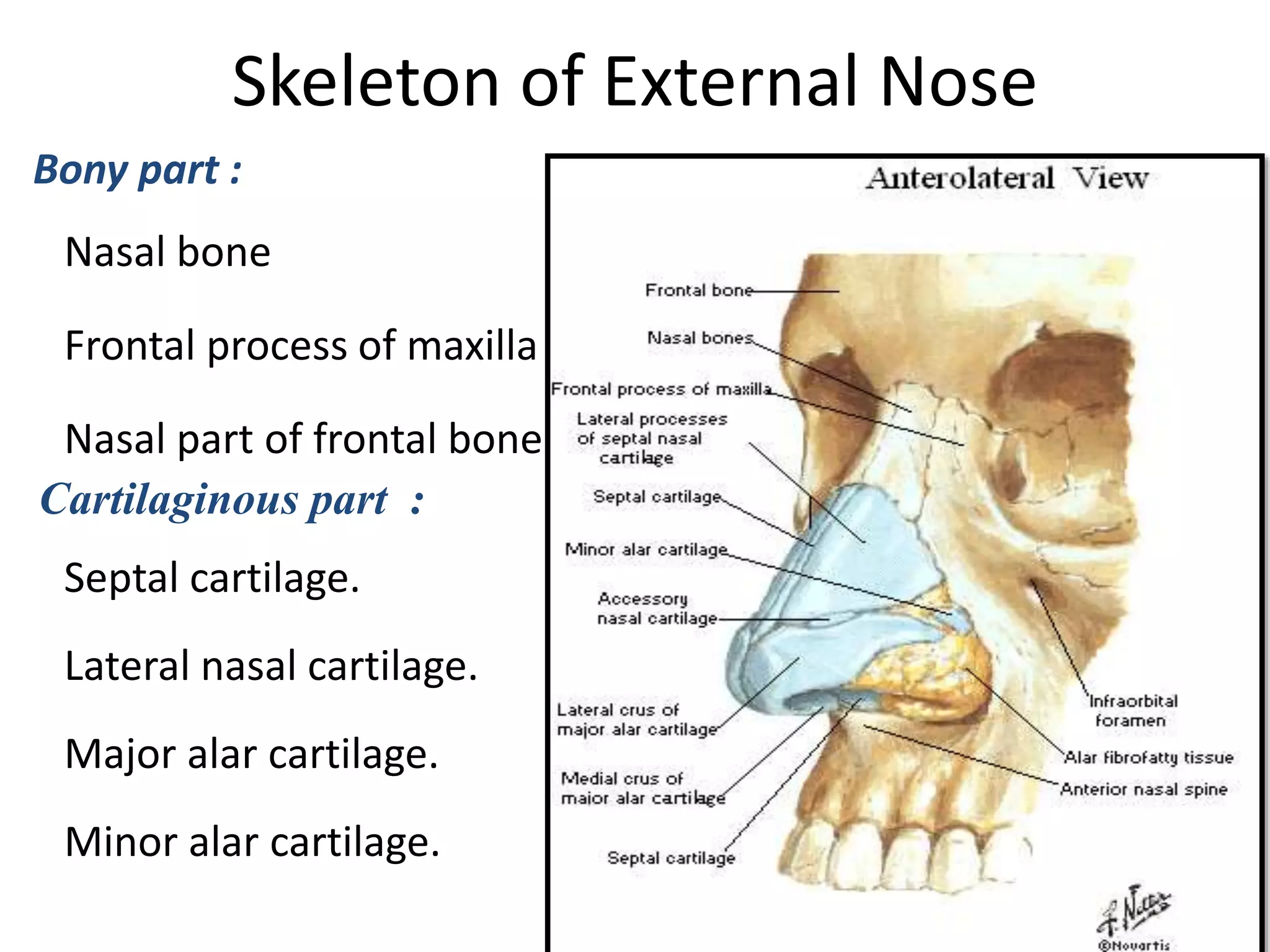
Skeleton of External Nose
Bony part :
Nasal bone
Frontal process of maxilla
Nasal part of frontal bone
Cartilaginous part :
Septal cartilage.
Lateral nasal cartilage.
Major alar cartilage.
Minor alar cartilage.
NASAL
SEPTUM
VOMAR
ETHMOID
Nasal septum
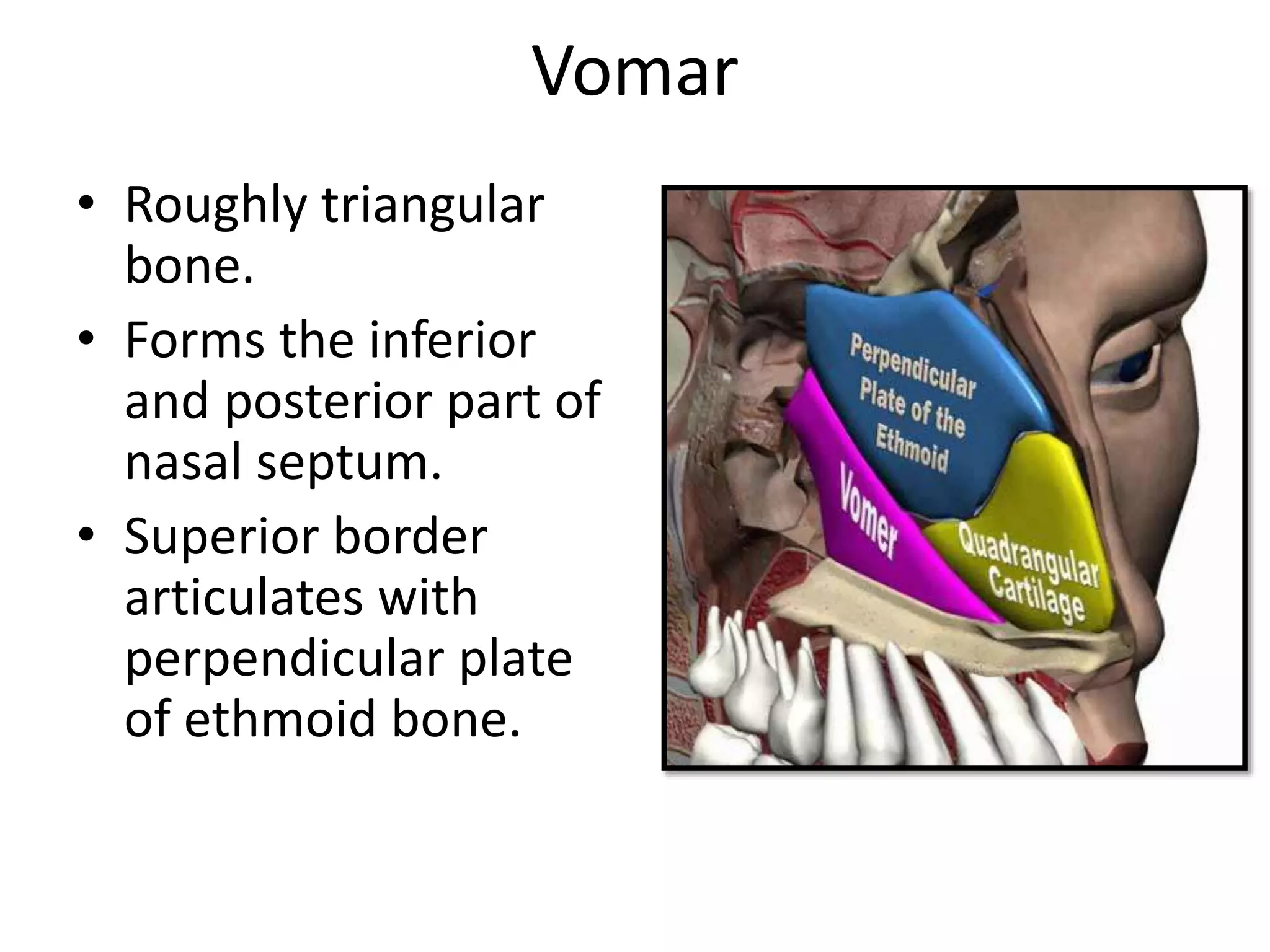
Vomar
• Roughly triangular
bone.
• Forms the inferior
and posterior part of
nasal septum.
• Superior border
articulates with
perpendicular plate
of ethmoid bone.
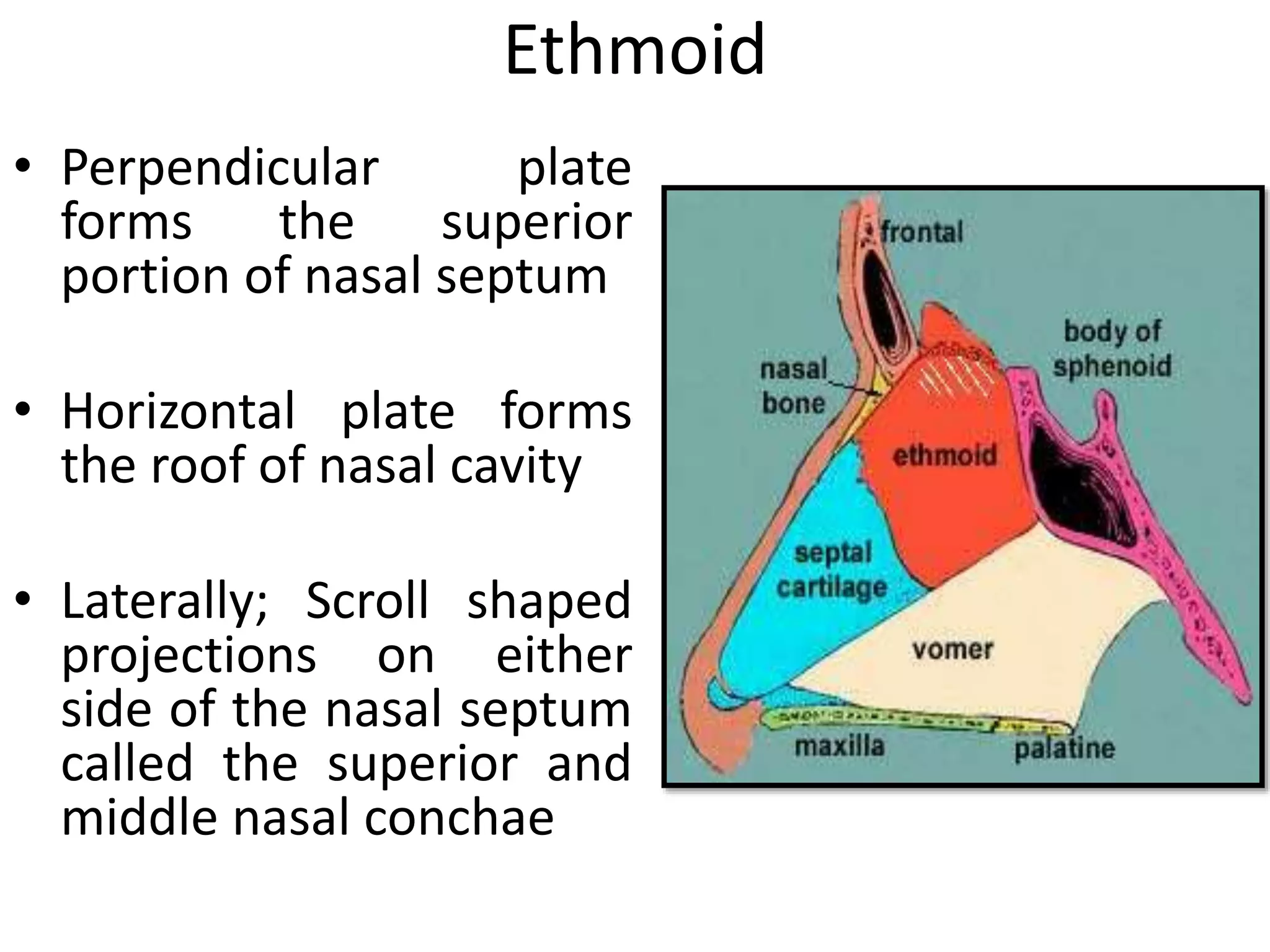
Ethmoid
• Perpendicular plate
forms the superior
portion of nasal septum
• Horizontal plate forms
the roof of nasal cavity
• Laterally; Scroll shaped
projections on either
side of the nasal septum
called the superior and
middle nasal conchae
Blood supply
Nerve supply
Innervation of the nasal cavityInnervation of the external nose
BIOMECHANICS OF NASAL FRACTURES
Nasal fractures occur in one of two main
patterns-
 From a lateral impact
 From a head-on impact
In lateral impact , the
nose is displaced away
from the midline on
the side of the injury.
In head-on impact , the
nasal bones are pushed
up and splayed so that
the upper nose (bridge)
appears broad, but the
height of the nose is
collapsed (saddle-nose
deformity).
• Approximately 80% of fractures occur at the
lower one third to one half of the nasal bones.
This area represents a transition zone between
the thicker proximal and thinner distal segments.
Surgical Treatment of Facial Injuries by Kazanjian and Converse,
1959.
• Rowe & Killey ‘s classification.
• Strance & Robertson’s classification.
• Harrison’s classification.
• Murray & Maran’s pathological classification.
• Rorich et al’s classification.
• AO classification.
CLASSIFICATIONS
Rowe and Killey (1968) described fractures of the
nasal bones and/or nasal septum according to the
pattern of disturbance and the degree of
displacement of the nasal structures found when the
nose fractures are dependent upon the direction
and degree of the forces applied.
I. Lateral nasal injuries
II. Anterior nasal injuries
Drawback- They only explained the impact factor
not about the force or involvement of the bone.
Strance & Robertson (1979) classified nasal
bone fractures based on direction of injury.
1. Lateral blow – frequently occurring.
2. Frontal impact – less frequently occurring.
Plane i.
Plane ii.
Plane iii.
Plane i
Plane ii
Plane iii
In 1979 , Harrison classified nasal fracture
which included subclasses to include fractures
of the nasal tip and anterior nasal spine,
fractures of the dorsum with or without septal
deflection, and comminuted nasal fractures
with management.
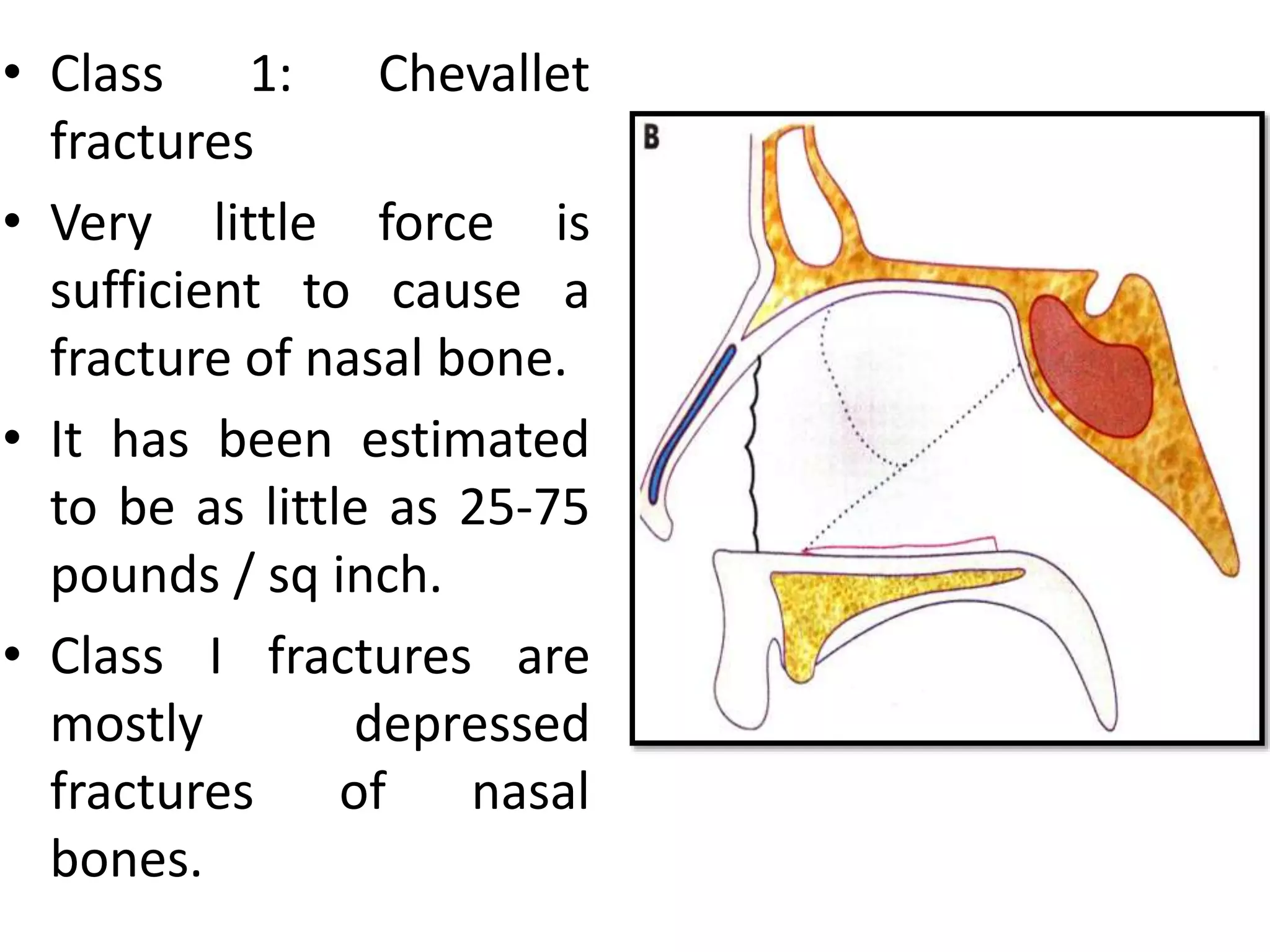
• Class 1: Chevallet
fractures
• Very little force is
sufficient to cause a
fracture of nasal bone.
• It has been estimated
to be as little as 25-75
pounds / sq inch.
• Class I fractures are
mostly depressed
fractures of nasal
bones.
• Clinically this fracture will present as a
depression over the nasal bone area. There
may be tenderness and crepitus over the
affected nasal bone.
• Radiological evidence may or may not be
present. In fact class I fracture of nasal bone is
purely a clinical diagnosis.
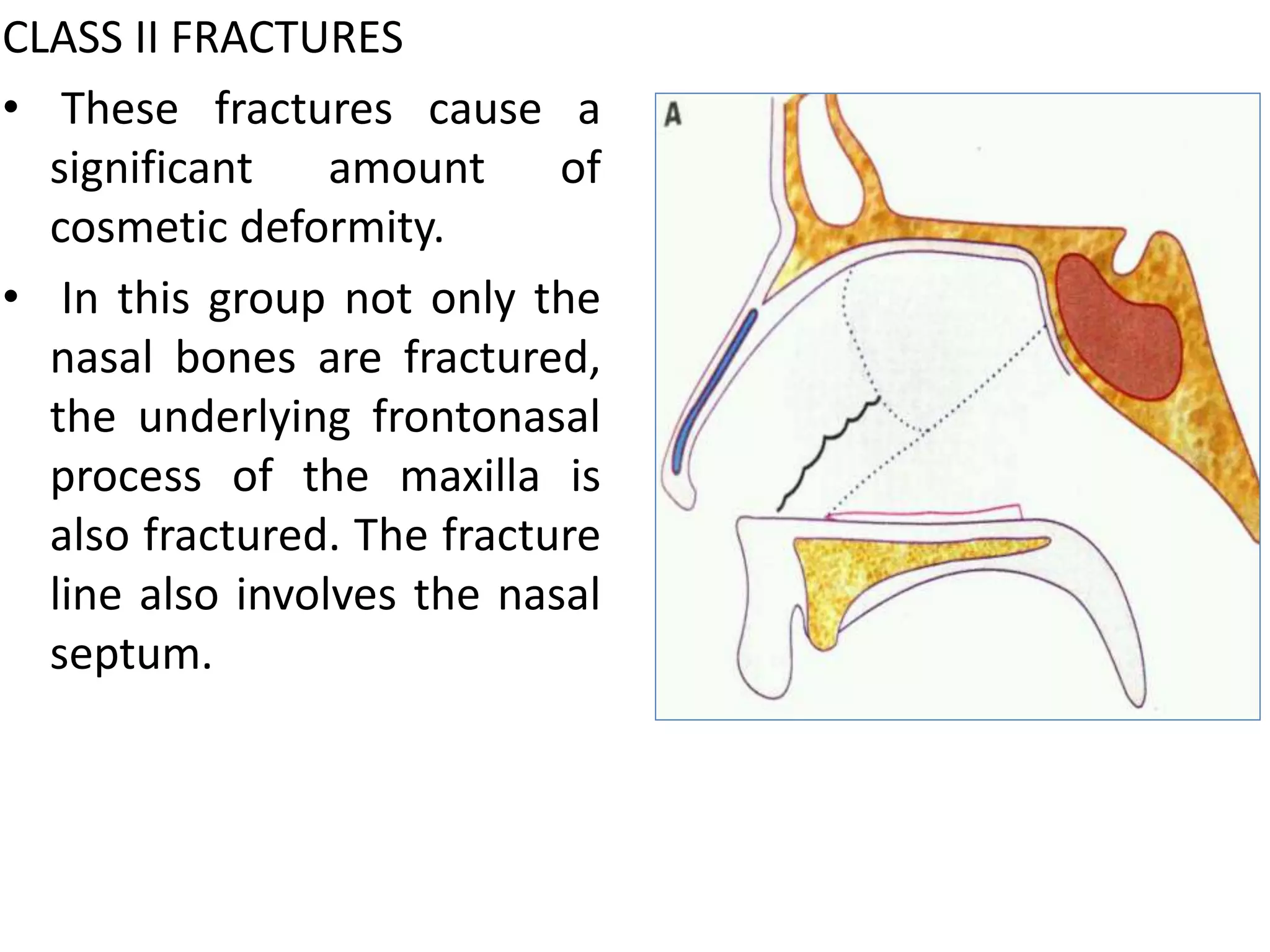
CLASS II FRACTURES
• These fractures cause a
significant amount of
cosmetic deformity.
• In this group not only the
nasal bones are fractured,
the underlying frontonasal
process of the maxilla is
also fractured. The fracture
line also involves the nasal
septum.
CLASS III FRACTURES:
• These are the most severe nasal injuries
encountered. This is caused by high velocity
trauma.
• It is also known as naso orbital fracture / naso
ethmoidal fracture. (Naso orbito ethmoid
fracture)
• Murray and Maran (1986) described a
pathological classification of nasal fractures
following experiments on fifty cadavers. They
have devised a more complicated system
based on seven types of fractures; this system
emphasizes the deviation of the nasal pyramid
from the midline as being a clinical predictor
of treatment outcome.
• Rorich et al (2000) proposed a simple
classification that might guide treatment
Type Description
I Simple unilateral
2 Simple bilateral
3 Comminuted
a) Unilateral
b) Bilateral
c) Frontal process of maxilla
4 Complex
a) Associated with septal hematoma
b) Associated with open nasal laceration
5 Associated NOE fracture/midface fracture
AO (Arbeitsgemeinschaft fur Osteosynthese)
surgery provides a simple classification system
based on clinical findings (2009)
1. Laterally displaced.
2. Posteriorly depressed fractures
3. Disarticulation of upper lateral cartilage
4. Anterior nasal spine fracture
5. Involvement of nasal septum
Laterally displaced fractures
Posteriorly depressed fractures
Disarticulation of upper
lateral cartilage
Anterior nasal spine fracture
• The nasal septum is almost always involved in
nasal fractures and must be evaluated to determine if
treatment is necessary.
• If the impact force is weak, nasal bone
displacement is usually present without septal
fractures.
Involvement of nasal septum
Epidemiology
• Rowe and Killey (1968) analysed 629 middle third
fracture and the relative frequency of nasal
fracture was 6.99%.
• Fights and sports injuries are the most common
causes of nasal fractures in adults, followed by
falls and vehicle crashes.
• Physical abuse should be considered when
evaluating children and women with nasal
fractures.
• Nasal fractures may occur in isolation, but are
commonly associated with other facial injuries
and fractures.
Clinical Significance
• Most nasal fractures cause significant bleeding.
• Proper techniques for haemostasis should be
applied before any diagnostic procedure and any
definitive treatment.
• Prompt appropriate treatment to prevents
functional and cosmetic changes.
• Because of the nose's central location and
proximity to important structures, the clinician
should carefully search for other facial injuries in
the presence of nasal fractures.
• Diagnosis should be made with history of the
patient, physical examination and radiographic
investigation. The direction and strength of the
impact should be noted.
• Preexisting nasal or septal deformities should
also be considered.
• A history of nasal bleeding may indicate a
mucosal laceration. Skin laceration over the nasal
area may guide fracture diagnosis to the specific
anatomical area.
Diagnosis
Physical examination
A
B
Radiological investigation
The usual facial radiographs may not clearly
reveal a nasal fracture.
a. In 1957 Gillies and Millard recommended
Waters ( occipitomental ) view.
b. Lateral view
c. CT scans accurately demonstrate most nasal
fractures and their displacement.
• Management of nasal fracture can do in two
ways
1) Emergency management
2) Surgical management
Management
Emergency management
• Elevation of the head
• Use of cold compresses in the peri orbital
and nasal regions can be helpful for subside
the edema.
• Nasal packing is the most common method
of controlling bleeding within the nose. The
packing should be placed precisely at the
bleeding site(s) to provide uniform pressure
over the entire area.
• In most patients packing will control nasal
bleeding. After 2 to 5 days the packing can be
removed.
• Posterior nasal pack is needed when obstruction
of the airway because of hemorrhage into the
nasopharynx .
Anterior Nasal Packing
• This packing is done if localized
bleeding is profuse or bleeding
point is not localize.
• Use of a ribbon gauze soaked
with liquid paraffin(1 m gauze;
2.5 cm gauze in adult and 12 mm
in children).
• It can be done with vertical layer
and horizontal layer.
• It can be removed with 24 hour
and can be kept upto 2-3 days.
• Systemic antibiotic should be
given to prevent sinus infection
and toxic shock syndrome.
Posterior Nasal Packing
Epistaxin balloon.Smaller (10ml)
posterior ballon and bigger (30ml)
anterior balloon are inflated.
Channel of catheter provides airway
for nasal breathing.
•Foley catheter, and insert the device
into the nostril.
• Visualize the catheter tip in the back
of the throat. Inflate the balloon with
up to 10 mL of sterile water
• Withdraw the balloon gently until it
seats posteriorly.
•Pack the anterior nasal cavity with a
balloon device or layered ribbon gauze.
• Apply a padded umbilical clamp
across the catheter to prevent alar
necrosis and to keep the balloon from
dislodging.
Surgical management
Nasal trauma algorium
History : physical and radiographically
Fracture No Fracture
Discharge
Classify fracture
Classify fracture
Type I simple
Type II simple
Type III comminuted
Type IV complex
(associated septal
Hematoma)
Type V
Significant edema Evaculate /pack septal
hematoma irrigate/close
wound
No Yes
No Yes
Significant edema
Elevation /ice
Reassess in 3-5
days after swelling
subsides
Fracture reduction
•Meticulous septal
examination
with or without
endoscope
•Closed reduction
Fracture reduction
•Meticulous septal examination
with or without endoscope
•Closed reduction
Type I II III
•Antibiotics /steroids
•Splints
Type IV
•Reduce septal fracture/
dislocaton
•Consider limited inferior septal
reconstruction
Closed reduction is usually
reserved for simple, non
comminuted nasal fractures,
although exceptions can be
made .
Closed reduction
The indications for closed reduction are:
• Unilateral or bilateral fractures of the nasal
bone with displacement.
• Fractures of the nasal septal complex causing
nasal airway compromise.
• Closed reduction should be performed as soon
as possible, preferably 10-14 days post injury,
but may be possible up to 21 days.
Few instruments are needed for fracture reduction.
These include
I. Asch nasal septal forceps.
II. Walsham nasal forceps.
III. Boies or Ballengers elevator.
IV. Internasal specula.
Fracture reduction instruments
Fracture reduction instruments for acute nasal fracture management. From
left: Walsham forceps, Asch forceps, Boies elevator, nasal speculum.
In laterally displaced fractures
In centrally depressed fractures
Reduction of the nasal septum
Nasal bones-
After reduction, adhesive strips
are placed over the skin of the
nasal dorsum and the nasal
bones are splinted using an
external splint that conforms
to the patients nose. If the
nasal bones are comminuted
or loose, they should be
supported with an intranasal
packing, which should be
placed before placing the
external splint.
Splinting
Nasal septum
The nasal septum can
be stabilized with
splints or packs.
Removal of packings and splints
Hemostatic packs are removed after 24 hours. Packs that are
supporting the nasal bones are left in place as long as the
external splint is in place.
The patient should be prescribed antibiotic treatment for as
long as the nasal packs are in place.
Open reduction
Essentially in two conditions , open reduction are
performed.
• 1st early correction of nasal fractures that could
not be properly reduced in a closed fashion.
• Secondly correct a previously existing nasal
deformity.
The latter should be more properly classified as
septorhinoplasty to correct an internal and
external deformity.
Indications for open reduction are:
• Extensive fracture dislocation of the nasal
bone and septum.
• Fracture dislocation of the lower septum.
• Open septal fractures.
• Deformity after closed reduction.
• Inadequate bony reduction due to deformity.
• Combined deformities of septal and alar
cartilages
Surgical Approach
1. Through existing laceration.
2. Bicoronal approach.
3. Endonasal
a. Transcartilaginous (Intracartilaginous, Cartilage splitting)
b. Retrograde
c. Bipedicled chondrocutaneous flap (delivery)
4. External (open)
• Use of existing
lacerations
Nasal fractures are often
associated with
lacerations. These
existing soft-tissue
injuries can be used to
access directly the nasal
bones for management
of the fractures.
• Bicoronal approach
The bicoronal or
bitemporal incision
is used to approach
the anterior cranial
vault, the forehead,
and the upper and
middle regions of
the facial skeleton.
For endonasal and external techniques are accomplished
through various incisions strategically placed to allow for
careful anatomic dissection of the underlying nasal skeleton.
The following incisions can be used:
1. Alar cartilage incisions
a.transcartilaginous(intracartilaginous,cartilage
splitting)
b. intercartilaginous
c. marginal
2. Septal incisions
a. complete transfixion
b. partial transfi xion
c. hemitransfixion
3. Transcolumellar incision
1.Endonasal
a. Transcartilaginous
Approach- Intracartilaginous
incision extending up to and
around anterior septal angle
into a partial transfixion
incision with dissection of
vestibular skin off
undersurface of lower lateral
cartilage.
b. Retrograde Approach-
For this approach
intercartilagious incision is
used. This incision is placed
between the caudal end of
the upper lateral cartilage and
the cephalic margin of the
lower lateral cartilage and
then carried into the
appropriate septal incision.
This edge is brought into
full view by retracting the
ala with the double
ended nasal hook while
simultaneously providing
gentle pressure with the
middle finger over the
upper lateral cartilage.
c. Bipedicled
chondrocutaneous flap
(delivery) -
The delivery approach to the tip
and lower two thirds of the
nose allows for direct view of
the lower lateral cartilages,
both of which may be viewed
simultaneously.
Two incisions are required for
this technique.
i. Intercartilaginous incision
ii. Marginal incision
A sharp, angled tip (Converse)
scissors are used to dissect the
soft tissue plane just above the
perichondrium of the lateral
crura and dome. Single hook
retraction in the dome are aids
in dissection here.
The lower lateral cartilage with
attached, intact vestibular skin is
the “delivered” out of the nose
as a bipedicled
chondrocutaneous
flap, with exceptional exposure
of the majority of the lower
lateral cartilage.
2. External (open)-
Marginal and inverted
“V” transcolumellar
incision used for
external approach.
Exposure obtained of
lower two thirds of
the nose using the
external approach
Associated fractures
Grafting
Midline repositioning of
quadrangular cartilage of the
septum and the vomer
The septum is repositioned in
its original midline position
together with the
quadrangular cartilage and
vomer. As small suture may
be placed from the anterior
nasal spine to the anterior
portion of the septum to
maintain its reduction.
Closure
A quilting stitch using
absorbable suture material is
passed back and forth through
the septum to stabilize the
mucosal flap and prevent
septal hematoma formation.
A few interrupted
absorbable sutures
are used to re
approximate the
mucosal incisions.
Post operative care
• Postoperative positioning : Keeping the patient’s
head in a raised position both preoperatively and
postoperatively may significantly improve edema
and pain.
• Nose-blowing : To prevent orbital emphysema,
nose-blowing should be avoided.
• Ice packs for reduce the nasal edema.
Complications
a) Early complications
b) Late complications
• Early complication
a. Septal hematoma.
b. Edema , ecchymosis and epistaxis .
c. Infection.
d. Emphysema.
•Late complication
a.Untreated hematomas of the nasal septum may
become organized, resulting in subperichondial
fibrosis and thickening with partial nasal airway
obstruction.
b.Synechiae may form between the septal and the
turbinate in area where soft tissue lacerations
occur and the tissues are in contact.
c. Residual osteitis is seen occasionally in compound
fractures of the nose or in fracture associated with
infected hematomas. Dacryocystorhinostomy may
be needed for its correction.
CONTROVERSIES
i. Closed Versus Open Reduction.
ii. Timing Of The Treatment.
iii. Anesthesia.
Closed Versus Open Reduction
• Nasal bone fractures can be treated by either
closed or open techniques.
• Before choosing a method of reduction, the status
of the septum must be established.
• If the septum is fractured and displaced, attempts
at closed reduction often result in unsatisfactory
results.
• Closed treatment should be reserved for simple
unilaterally displaced nasal fractures without any
significantly displaced septal fractures.
• Results following closed reduction have been
examined in some past reports.
• Crowther et al reported the result of closed
reduction of nasal fractures with 85% of the
patients satisfied with their nasal appearance.
• A Danish study reported similar favorable long-
term results at 3 years following closed reduction
of nasal fractures .
• These past reports suggest that in the appropriate
patient closed reduction can be an extremely
useful modality to treat simple nasal fractures
with significant septal pathology.
• There are differences of opinion regarding
timing of the treatment of nasal fractures.
• If a patient is seen shortly after trauma, before
significant edema develops, immediate treatment
may be indicated.
• Other indications for immediate treatment
include the presence of lacerations with exposure
of the underlying skeletal or cartilaginous elements
or the presence of a septal hematoma that requires
immediate drainage.
Timing Of The Treatment
• However, many surgeons said to re-evaluate
the patient in a number of days before
performing definitive treatment.
• By re-evaluating a patient a number of days
after the trauma, factors that may contribute to
postoperative nasal deformity, such as acute
edema, unrecognized pre-existing nasal deformity
and undetected septal fractures, can better be
assessed before surgical intervention (Rohrich RJ
et all in 2000).
LOCAL VERSUS GENERAL ANESTHESIA
• Reduction of nasal fractures may be performed
under local anesthesia supplemented with
intravenous sedation or under general
anesthesia.
• Fracture reduction under local anesthesia is an
attractive alternative to general anesthesia
because hospitalization and operating room
utilization are not required and it is a safe and
efficient method to deal with these injuries.
• Studies comparing both techniques have
determined there are no differences in clinical
outcome as far as patient satisfaction.
Conclusion
• Skilled management of nasal and septal fractures
requires a detail understanding of facial anatomy,
causes of injuries, function and aesthetics of the
nose, modern operative techniques, timing for
reconstruction, setting and anesthesia choices, and
possible complications.
• Although most operative repairs have good
results, secondary reconstructions are
surprisingly common.
• Accordingly, long-term follow-up may be
helpful in select patients, but most patients
should be informed of the possible long-term
aesthetic and functional consequences of
their injuries.
Nasal fracture

Nasal fracture

  • 1.
  • 2.
    CONTENTS • Introduction • Surgicalanatomy • Biomechanics • Classifications • Epidemiology • Diagnosis and Evaluation • Management • Controversies • Conclusion
  • 3.
    INTRODUCTION • Fractures ofthe maxilla, nose, zygomatic complex and associated bones are commonly referred to as fractures of the middle third of the facial skeleton.
  • 5.
    • Nose isa prominent facial structure and nasal bone fractures are the most common facial fractures. • Compared to the any other facial bone, less energy is required to fracture the nasal complex. • The frequency of nasal fractures is high and often unnoticed by both maxillofacial surgeons and patients.
  • 6.
  • 7.
    The nose External nose Bonypart Carilagenous part Nasal cavity Floor Roof Lateral wall Medial (septal) wall
  • 8.
    Skeleton of ExternalNose Bony part : Nasal bone Frontal process of maxilla Nasal part of frontal bone Cartilaginous part : Septal cartilage. Lateral nasal cartilage. Major alar cartilage. Minor alar cartilage.
  • 9.
  • 10.
    Vomar • Roughly triangular bone. •Forms the inferior and posterior part of nasal septum. • Superior border articulates with perpendicular plate of ethmoid bone.
  • 11.
    Ethmoid • Perpendicular plate formsthe superior portion of nasal septum • Horizontal plate forms the roof of nasal cavity • Laterally; Scroll shaped projections on either side of the nasal septum called the superior and middle nasal conchae
  • 12.
  • 13.
    Nerve supply Innervation ofthe nasal cavityInnervation of the external nose
  • 14.
    BIOMECHANICS OF NASALFRACTURES Nasal fractures occur in one of two main patterns-  From a lateral impact  From a head-on impact
  • 15.
    In lateral impact, the nose is displaced away from the midline on the side of the injury.
  • 16.
    In head-on impact, the nasal bones are pushed up and splayed so that the upper nose (bridge) appears broad, but the height of the nose is collapsed (saddle-nose deformity).
  • 17.
    • Approximately 80%of fractures occur at the lower one third to one half of the nasal bones. This area represents a transition zone between the thicker proximal and thinner distal segments. Surgical Treatment of Facial Injuries by Kazanjian and Converse, 1959.
  • 18.
    • Rowe &Killey ‘s classification. • Strance & Robertson’s classification. • Harrison’s classification. • Murray & Maran’s pathological classification. • Rorich et al’s classification. • AO classification. CLASSIFICATIONS
  • 19.
    Rowe and Killey(1968) described fractures of the nasal bones and/or nasal septum according to the pattern of disturbance and the degree of displacement of the nasal structures found when the nose fractures are dependent upon the direction and degree of the forces applied. I. Lateral nasal injuries II. Anterior nasal injuries Drawback- They only explained the impact factor not about the force or involvement of the bone.
  • 20.
    Strance & Robertson(1979) classified nasal bone fractures based on direction of injury. 1. Lateral blow – frequently occurring. 2. Frontal impact – less frequently occurring. Plane i. Plane ii. Plane iii.
  • 21.
  • 22.
  • 23.
    In 1979 ,Harrison classified nasal fracture which included subclasses to include fractures of the nasal tip and anterior nasal spine, fractures of the dorsum with or without septal deflection, and comminuted nasal fractures with management.
  • 24.
    • Class 1:Chevallet fractures • Very little force is sufficient to cause a fracture of nasal bone. • It has been estimated to be as little as 25-75 pounds / sq inch. • Class I fractures are mostly depressed fractures of nasal bones.
  • 25.
    • Clinically thisfracture will present as a depression over the nasal bone area. There may be tenderness and crepitus over the affected nasal bone. • Radiological evidence may or may not be present. In fact class I fracture of nasal bone is purely a clinical diagnosis.
  • 26.
    CLASS II FRACTURES •These fractures cause a significant amount of cosmetic deformity. • In this group not only the nasal bones are fractured, the underlying frontonasal process of the maxilla is also fractured. The fracture line also involves the nasal septum.
  • 27.
    CLASS III FRACTURES: •These are the most severe nasal injuries encountered. This is caused by high velocity trauma. • It is also known as naso orbital fracture / naso ethmoidal fracture. (Naso orbito ethmoid fracture)
  • 28.
    • Murray andMaran (1986) described a pathological classification of nasal fractures following experiments on fifty cadavers. They have devised a more complicated system based on seven types of fractures; this system emphasizes the deviation of the nasal pyramid from the midline as being a clinical predictor of treatment outcome.
  • 29.
    • Rorich etal (2000) proposed a simple classification that might guide treatment Type Description I Simple unilateral 2 Simple bilateral 3 Comminuted a) Unilateral b) Bilateral c) Frontal process of maxilla 4 Complex a) Associated with septal hematoma b) Associated with open nasal laceration 5 Associated NOE fracture/midface fracture
  • 30.
    AO (Arbeitsgemeinschaft furOsteosynthese) surgery provides a simple classification system based on clinical findings (2009) 1. Laterally displaced. 2. Posteriorly depressed fractures 3. Disarticulation of upper lateral cartilage 4. Anterior nasal spine fracture 5. Involvement of nasal septum
  • 31.
  • 32.
    Disarticulation of upper lateralcartilage Anterior nasal spine fracture
  • 33.
    • The nasalseptum is almost always involved in nasal fractures and must be evaluated to determine if treatment is necessary. • If the impact force is weak, nasal bone displacement is usually present without septal fractures. Involvement of nasal septum
  • 34.
    Epidemiology • Rowe andKilley (1968) analysed 629 middle third fracture and the relative frequency of nasal fracture was 6.99%. • Fights and sports injuries are the most common causes of nasal fractures in adults, followed by falls and vehicle crashes. • Physical abuse should be considered when evaluating children and women with nasal fractures. • Nasal fractures may occur in isolation, but are commonly associated with other facial injuries and fractures.
  • 35.
    Clinical Significance • Mostnasal fractures cause significant bleeding. • Proper techniques for haemostasis should be applied before any diagnostic procedure and any definitive treatment. • Prompt appropriate treatment to prevents functional and cosmetic changes. • Because of the nose's central location and proximity to important structures, the clinician should carefully search for other facial injuries in the presence of nasal fractures.
  • 36.
    • Diagnosis shouldbe made with history of the patient, physical examination and radiographic investigation. The direction and strength of the impact should be noted. • Preexisting nasal or septal deformities should also be considered. • A history of nasal bleeding may indicate a mucosal laceration. Skin laceration over the nasal area may guide fracture diagnosis to the specific anatomical area. Diagnosis
  • 37.
  • 38.
  • 39.
    Radiological investigation The usualfacial radiographs may not clearly reveal a nasal fracture. a. In 1957 Gillies and Millard recommended Waters ( occipitomental ) view. b. Lateral view c. CT scans accurately demonstrate most nasal fractures and their displacement.
  • 40.
    • Management ofnasal fracture can do in two ways 1) Emergency management 2) Surgical management Management
  • 41.
    Emergency management • Elevationof the head • Use of cold compresses in the peri orbital and nasal regions can be helpful for subside the edema. • Nasal packing is the most common method of controlling bleeding within the nose. The packing should be placed precisely at the bleeding site(s) to provide uniform pressure over the entire area.
  • 42.
    • In mostpatients packing will control nasal bleeding. After 2 to 5 days the packing can be removed. • Posterior nasal pack is needed when obstruction of the airway because of hemorrhage into the nasopharynx .
  • 43.
    Anterior Nasal Packing •This packing is done if localized bleeding is profuse or bleeding point is not localize. • Use of a ribbon gauze soaked with liquid paraffin(1 m gauze; 2.5 cm gauze in adult and 12 mm in children). • It can be done with vertical layer and horizontal layer. • It can be removed with 24 hour and can be kept upto 2-3 days. • Systemic antibiotic should be given to prevent sinus infection and toxic shock syndrome.
  • 44.
    Posterior Nasal Packing Epistaxinballoon.Smaller (10ml) posterior ballon and bigger (30ml) anterior balloon are inflated. Channel of catheter provides airway for nasal breathing. •Foley catheter, and insert the device into the nostril. • Visualize the catheter tip in the back of the throat. Inflate the balloon with up to 10 mL of sterile water • Withdraw the balloon gently until it seats posteriorly. •Pack the anterior nasal cavity with a balloon device or layered ribbon gauze. • Apply a padded umbilical clamp across the catheter to prevent alar necrosis and to keep the balloon from dislodging.
  • 45.
    Surgical management Nasal traumaalgorium History : physical and radiographically Fracture No Fracture Discharge Classify fracture
  • 46.
    Classify fracture Type Isimple Type II simple Type III comminuted Type IV complex (associated septal Hematoma) Type V Significant edema Evaculate /pack septal hematoma irrigate/close wound No Yes
  • 47.
    No Yes Significant edema Elevation/ice Reassess in 3-5 days after swelling subsides Fracture reduction •Meticulous septal examination with or without endoscope •Closed reduction
  • 48.
    Fracture reduction •Meticulous septalexamination with or without endoscope •Closed reduction Type I II III •Antibiotics /steroids •Splints Type IV •Reduce septal fracture/ dislocaton •Consider limited inferior septal reconstruction
  • 49.
    Closed reduction isusually reserved for simple, non comminuted nasal fractures, although exceptions can be made . Closed reduction
  • 50.
    The indications forclosed reduction are: • Unilateral or bilateral fractures of the nasal bone with displacement. • Fractures of the nasal septal complex causing nasal airway compromise. • Closed reduction should be performed as soon as possible, preferably 10-14 days post injury, but may be possible up to 21 days.
  • 51.
    Few instruments areneeded for fracture reduction. These include I. Asch nasal septal forceps. II. Walsham nasal forceps. III. Boies or Ballengers elevator. IV. Internasal specula. Fracture reduction instruments
  • 52.
    Fracture reduction instrumentsfor acute nasal fracture management. From left: Walsham forceps, Asch forceps, Boies elevator, nasal speculum.
  • 53.
  • 54.
  • 55.
    Reduction of thenasal septum
  • 56.
    Nasal bones- After reduction,adhesive strips are placed over the skin of the nasal dorsum and the nasal bones are splinted using an external splint that conforms to the patients nose. If the nasal bones are comminuted or loose, they should be supported with an intranasal packing, which should be placed before placing the external splint. Splinting
  • 57.
    Nasal septum The nasalseptum can be stabilized with splints or packs. Removal of packings and splints Hemostatic packs are removed after 24 hours. Packs that are supporting the nasal bones are left in place as long as the external splint is in place. The patient should be prescribed antibiotic treatment for as long as the nasal packs are in place.
  • 58.
    Open reduction Essentially intwo conditions , open reduction are performed. • 1st early correction of nasal fractures that could not be properly reduced in a closed fashion. • Secondly correct a previously existing nasal deformity. The latter should be more properly classified as septorhinoplasty to correct an internal and external deformity.
  • 59.
    Indications for openreduction are: • Extensive fracture dislocation of the nasal bone and septum. • Fracture dislocation of the lower septum. • Open septal fractures. • Deformity after closed reduction. • Inadequate bony reduction due to deformity. • Combined deformities of septal and alar cartilages
  • 60.
    Surgical Approach 1. Throughexisting laceration. 2. Bicoronal approach. 3. Endonasal a. Transcartilaginous (Intracartilaginous, Cartilage splitting) b. Retrograde c. Bipedicled chondrocutaneous flap (delivery) 4. External (open)
  • 61.
    • Use ofexisting lacerations Nasal fractures are often associated with lacerations. These existing soft-tissue injuries can be used to access directly the nasal bones for management of the fractures.
  • 62.
    • Bicoronal approach Thebicoronal or bitemporal incision is used to approach the anterior cranial vault, the forehead, and the upper and middle regions of the facial skeleton.
  • 63.
    For endonasal andexternal techniques are accomplished through various incisions strategically placed to allow for careful anatomic dissection of the underlying nasal skeleton. The following incisions can be used: 1. Alar cartilage incisions a.transcartilaginous(intracartilaginous,cartilage splitting) b. intercartilaginous c. marginal 2. Septal incisions a. complete transfixion b. partial transfi xion c. hemitransfixion 3. Transcolumellar incision
  • 64.
    1.Endonasal a. Transcartilaginous Approach- Intracartilaginous incisionextending up to and around anterior septal angle into a partial transfixion incision with dissection of vestibular skin off undersurface of lower lateral cartilage.
  • 65.
    b. Retrograde Approach- Forthis approach intercartilagious incision is used. This incision is placed between the caudal end of the upper lateral cartilage and the cephalic margin of the lower lateral cartilage and then carried into the appropriate septal incision.
  • 66.
    This edge isbrought into full view by retracting the ala with the double ended nasal hook while simultaneously providing gentle pressure with the middle finger over the upper lateral cartilage.
  • 67.
    c. Bipedicled chondrocutaneous flap (delivery)- The delivery approach to the tip and lower two thirds of the nose allows for direct view of the lower lateral cartilages, both of which may be viewed simultaneously. Two incisions are required for this technique. i. Intercartilaginous incision ii. Marginal incision
  • 68.
    A sharp, angledtip (Converse) scissors are used to dissect the soft tissue plane just above the perichondrium of the lateral crura and dome. Single hook retraction in the dome are aids in dissection here. The lower lateral cartilage with attached, intact vestibular skin is the “delivered” out of the nose as a bipedicled chondrocutaneous flap, with exceptional exposure of the majority of the lower lateral cartilage.
  • 69.
    2. External (open)- Marginaland inverted “V” transcolumellar incision used for external approach. Exposure obtained of lower two thirds of the nose using the external approach
  • 70.
  • 71.
    Midline repositioning of quadrangularcartilage of the septum and the vomer The septum is repositioned in its original midline position together with the quadrangular cartilage and vomer. As small suture may be placed from the anterior nasal spine to the anterior portion of the septum to maintain its reduction.
  • 72.
    Closure A quilting stitchusing absorbable suture material is passed back and forth through the septum to stabilize the mucosal flap and prevent septal hematoma formation. A few interrupted absorbable sutures are used to re approximate the mucosal incisions.
  • 73.
    Post operative care •Postoperative positioning : Keeping the patient’s head in a raised position both preoperatively and postoperatively may significantly improve edema and pain. • Nose-blowing : To prevent orbital emphysema, nose-blowing should be avoided. • Ice packs for reduce the nasal edema.
  • 74.
  • 75.
    • Early complication a.Septal hematoma. b. Edema , ecchymosis and epistaxis . c. Infection. d. Emphysema.
  • 76.
    •Late complication a.Untreated hematomasof the nasal septum may become organized, resulting in subperichondial fibrosis and thickening with partial nasal airway obstruction. b.Synechiae may form between the septal and the turbinate in area where soft tissue lacerations occur and the tissues are in contact.
  • 77.
    c. Residual osteitisis seen occasionally in compound fractures of the nose or in fracture associated with infected hematomas. Dacryocystorhinostomy may be needed for its correction.
  • 78.
    CONTROVERSIES i. Closed VersusOpen Reduction. ii. Timing Of The Treatment. iii. Anesthesia.
  • 79.
    Closed Versus OpenReduction • Nasal bone fractures can be treated by either closed or open techniques. • Before choosing a method of reduction, the status of the septum must be established. • If the septum is fractured and displaced, attempts at closed reduction often result in unsatisfactory results. • Closed treatment should be reserved for simple unilaterally displaced nasal fractures without any significantly displaced septal fractures.
  • 80.
    • Results followingclosed reduction have been examined in some past reports. • Crowther et al reported the result of closed reduction of nasal fractures with 85% of the patients satisfied with their nasal appearance. • A Danish study reported similar favorable long- term results at 3 years following closed reduction of nasal fractures . • These past reports suggest that in the appropriate patient closed reduction can be an extremely useful modality to treat simple nasal fractures with significant septal pathology.
  • 81.
    • There aredifferences of opinion regarding timing of the treatment of nasal fractures. • If a patient is seen shortly after trauma, before significant edema develops, immediate treatment may be indicated. • Other indications for immediate treatment include the presence of lacerations with exposure of the underlying skeletal or cartilaginous elements or the presence of a septal hematoma that requires immediate drainage. Timing Of The Treatment
  • 82.
    • However, manysurgeons said to re-evaluate the patient in a number of days before performing definitive treatment. • By re-evaluating a patient a number of days after the trauma, factors that may contribute to postoperative nasal deformity, such as acute edema, unrecognized pre-existing nasal deformity and undetected septal fractures, can better be assessed before surgical intervention (Rohrich RJ et all in 2000).
  • 83.
    LOCAL VERSUS GENERALANESTHESIA • Reduction of nasal fractures may be performed under local anesthesia supplemented with intravenous sedation or under general anesthesia. • Fracture reduction under local anesthesia is an attractive alternative to general anesthesia because hospitalization and operating room utilization are not required and it is a safe and efficient method to deal with these injuries. • Studies comparing both techniques have determined there are no differences in clinical outcome as far as patient satisfaction.
  • 84.
    Conclusion • Skilled managementof nasal and septal fractures requires a detail understanding of facial anatomy, causes of injuries, function and aesthetics of the nose, modern operative techniques, timing for reconstruction, setting and anesthesia choices, and possible complications.
  • 85.
    • Although mostoperative repairs have good results, secondary reconstructions are surprisingly common. • Accordingly, long-term follow-up may be helpful in select patients, but most patients should be informed of the possible long-term aesthetic and functional consequences of their injuries.

Editor's Notes

  • #15 Timothy J Rupp, MD, MBA, FACEP, FAAEM
  • #25 Blows from below. Runs vertically from antarior nasal spine of maxilla upwards to the bony and cartilaginous dorsum of nose.  the bridge of a stringed musical instrument
  • #27  Blows from front. Starts just above the antarior nasal spine of maxilla &runs horizontally backwards just above the jn of septal cartilage with vomer
  • #32 Laterally displaced fractures occur secondary to a lateral blow to the nose. The nasal bones are pushed medially on the side of the impact and laterally on the contralateral side. They make up the majority of nasal fractures. Most of them can be managed by closed reduction. The dorsal part of the nasal septum is usually involved and can be displaced. Posteriorly depressed fractures occur secondary to a direct blow over the nasal bones, which are pushed inside to the ascending process of the maxilla. The nasal septum is always involved. This type of fracture can be associated with NOE fractures.
  • #33 A disarticulation of upper lateral cartilage is usually due to a localized strong blow to the central third of the nose, as in car accidents with the steering wheel hitting the nose. The upper lateral cartilage can be avulsed from the bone. The diagnosis is mostly clinical because cartilage is not visible on standard radiographic imaging. It can be diagnosed on soft-tissue windows of CT scans. A nasal spine fractures can occur in isolation or in association with other nasal fractures. Displaced fractures are often associated with nasal septum dislocations and/or fractures. The illustration shows an anterior nasal spine fracture which occurs in association to degloving injuries of the upper labial vestibule as in a steering wheel injury. If isolated, anterior nasal spine fractures do not usually require treatment
  • #38 Physical examination The external nose should be examined via bimanual digital palpation.  Swelling may preclude proper assessment.
  • #39 A.Steps, humps, and crepitus are all signs of nasal bone fractures. Ecchymosis and/or the presence of a hematoma should also be noted. B. Intranasal anatomy should be assed using a nasal speculum, looking for a septal deviation, mucosal laceration and/or septal hematoma. The presence of a significant septal hematoma requires immediate drainage.  Hematoma is diagnosed as follows: The main symptom is severe nasal obstruction On examination the septum appears swollen and boggy The swollen area should be palpated with a cotton-tipped applicator. If a hematoma is present it should be compressible.
  • #54 In laterally displaced fractures Commonly laterally displaced fractures on one side are medially depressed on the other side. Place an instrument (eg, Boies elevator) in the depressed side along the lateral wall of the nose to a point below the nasal frontal angle. Place a finger along the lateral side of the nose above the depressed area. Pearl: correct instrument placement  Prior to the endonasal placement of the elevator, it is placed against the outside of the nose to the level of the medial canthus. The index finger is then placed against the edge of the elevator and is used as a stop when the elevator is placed intranasally to ensure that it can not be advanced too far superiorly. Carefully position the instrument under the depressed nasal bone.
  • #55 In centrally depressed fractures Sometimes the frontal processes of the maxillae are displaced laterally with the nasal bones impacted inside them. Reduction requires elevation of the nasal bones anteriorly and repositioning of the frontal processes medially. The elevator must not be inserted too far into the nasal cavity. In this case the elevator is placed in the nose and lifts the nasal dorsal pyramid anteriorly, while simultaneously the thumb and index finger put medial pressure on the displaced frontal processes of the maxillae.
  • #56 Reduction of the nasal septum The Asch nasal septum-straightening forceps are used to straighten the nasal septum. Grasp the nasal septum with the blades of the instrument and gently manipulate the septum into proper alignment. 
  • #71 Associated fractures In case of associated NOE, frontal sinus and/or Le Fort II, or Le Fort III fractures the use of microplates may be necessary to fix nasal bones and the frontal process of the maxilla. Great care should be taken when considering placing plates anterior to the medial canthal ligament as these may be visible through the thin overlying skin. Grafting Bone or cartilage grafting may be necessary in severely comminuted nasal bone fractures. When inserting the graft, the following points should be respected: The nasofrontal angle should be reconstructed in a normal relationship (105°-120) The collapsed septum should be suspended to the graft using non-resorbable sutures The graft should be long enough to re-suspend the lower lateral cartilages
  • #76 , treatment is by horizontal incision at the base of the septal so as to produce dependent drainage. Silastic splints, light packing or mattress sutures 2 to 3 days will prevent re-accumulation usually resolve spontaneously. treated with prophylactic antibiotics. usually resolves spontaneously with avoidance of pressure in upper airway.
  • #77 A synechia is an eye condition where the iris adheres to either the cornea (i.e. anterior synechia) or lens (i.e. posteriorsynechia). Synechiae can be caused by ocular trauma, iritis or iridocyclitis and may lead to certain types of glaucoma.
  • #78 Dacryocystorhinostomy (DCR) is a surgical procedure to restore the flow of tears into the nose from the lacrimal sac when the nasolacrimal duct does not function.