Maxillofacial
Trauma
 The face can be divided into three regions:
 1. Upper third. Above the level of supraorbital ridge.
 2. Middle third. Between the supraorbital ridge and the
 upper teeth.
 3. Lower third. Mandible and the lower teeth.
 Upper third Middle third Lower third
 Frontal sinus
 Supraorbital ridge
 Frontalbone
 Frontal sinus fractures may involve anterior wall, posterior
wall or the nasofrontal duct.
 1. Anterior wall fractures may be depressed or comminuted.
Defect is mainly cosmetic. Sinus is approached through a wound in the skin
if that I is present, or through a brow incision. The bone fragments are
elevated, taking care not to strip them from the periosteum. The interior of the
sinus is always inspected to rule out fracture of the posterior wall.
 2. Posterior wall fractures may be accompanied by dural tears,brain injury
and CSF rhinorrhoea. They may require neurosurgical consultation. Dural
tears can be covered by temporalis fascia. Small sinuses can be
obliterated with fat
 3. Injury to nasofrontal duct causes obstruction to sinus drainage and may
later be complicated by a mucocele. In such cases, make a large
communication between the sinus and the nose. Small sinuses can be
obliterated with fat after removing the sinus mucosa completely.
B. SUPRAORBITAL RIDGE
 Ridge fractures often cause periorbital ecchymosis, flattening of the
eyebrow, proptosis or downward displacement of eye.
 Fragment of bone may also be pushed into the orbit and get impacted.
Ridge fractures require open reduction through an incision in the brow or
transverse skin line of the forehead.
C. FRACTURES OF FRONTAL
BONE
 They may be depressed or linear, with or without separation. They often
extend into the orbit. Brain injury and cerebral oedema are commonly
associated with each other and require neurosurgical consultation.
II. FRACTURES OF MIDDLE THIRD
OF FACE
 A. NASAL BONES AND SEPTUM
 Fractures of nasal bones are the most common because of the projection
of nose on the face. Traumatic forces may act from the front or side.
Magnitude of force will determine the depth of injury.
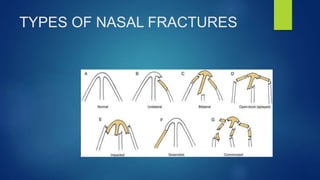
TYPES OF NASAL FRACTURES
 1. Depressed. They are due to frontal blow. Lower part of nasal bones
which is thinner, easily gives way. A severe frontal blow will cause “open-
book fracture” in which nasal septum is collapsed and nasal bones splayed
out.
 Still, greater forces will cause comminution of nasal bones and even the
frontal processes of maxillae with flattening and widening of nasal dorsum.
 2. Angulated. A lateral blow may cause unilateral depression of nasal bone on the
same side or may fracture both the nasal bones and the septum with deviation of
nasal bridge.
 Nasal fractures are often accompanied by injuries of nasal septum which may be
simply buckled, dislocated or fractured into several pieces. Septal haematoma may
form.
CLINICAL FEATURES
 1. Swelling of nose. Appears within few hours and may obscure details of
examination.
 2. Periorbital ecchymosis.
 3. Tenderness.
 4. Nasal deformity. Nose may be depressed from the front or side, or the
whole of the nasal pyramid deviated to one side.
 5. Crepitus and mobility of fractured fragments.
 6. Epistaxis.
 7. Nasal obstruction due to septal injury or haematoma.
 8. Lacerations of the nasal skin with exposure of nasal bones and cartilage
may be seen in compound fractures.
DIAGNOSIS
 Diagnosis is best made on physical
examination. X-rays may or may not show
fracture. Patient should not be dismissed as
having no fracture because X-rays did not
reveal it.
 X-rays should include Waters’ view, right and
left lateral views and occlusal view.
TREATMENT
 Simple fractures without displacement need no treatment;
 others may require closed or open reduction. Presence of oedema interferes with
accurate reduction by closed methods.
 Therefore, the best time to reduce a fracture is before the appearance of oedema, or
after it has subsided, which is usually in 5–7 days. It is difficult to reduce a nasal
fracture after 2 weeks because it heals by that time. Healing is faster in children and
therefore earlier reduction is imperative.
 1. Closed reduction.
 Depressed fractures of nasal bones sustained by either frontal or lateral blow can be
reduced by a straight blunt elevator guided by digital manipulation from outside.
 Laterally, displaced nasal bridge can be reduced by firm digital pressure in the opposite
direction. Impacted fragments sometimes require disimpaction with Walsham or
Asch’s forceps before realignment. Septal fractures are also reduced by Asch’s
forceps. Septal haematoma, if present, must be drained.
 Simple fractures may not require intranasal packing.
 Unstable fractures require intranasal packing and external splintage.
Treatment
 2. Open reduction. Early open reduction in nasal fractures is rarely required.
This is indicated when closed methods fail. Certain septal injuries can be better
reduced by open methods. Healed nasal deformities resulting from nasal trauma
can be corrected by rhinoplasty or septorhinoplasty.
 B. NASO-ORBITAL FRACTURES
 Direct force over the nasion fractures nasal bones and displaces them posteriorly.
 Perpendicular plate of ethmoid, ethmoidal air cells and medial orbital wall are
fractured and driven posteriorly. Injury may involve cribriform plate, frontal sinus,
frontonasal duct, extraocular muscles, eyeball and the lacrimal apparatus. Medial
canthal ligament may be avulsed.
CLINICAL FEATURES
 1. Telecanthus, due to lateral displacement of medial orbital wall.
 2. Pug nose. Bridge of nose is depressed and tip turned up.
 3. Periorbital ecchymosis.
 4. Orbital haematoma due to bleeding from anterior and posterior ethmoidal
arteries.
 5. CSF leakage due to fracture of cribriform plate and dura.
 6. Displacement of eyeball.
 DIAGNOSIS
 Various facial films will be required to assess the extent of fracture and injury to
other facial bones. Computed tomography
 (CT) scans are more useful.
TREATMENT
 1. Closed reduction. In uncomplicated cases, fracture is reduced with
Asch’s forceps and stabilized by a wire passed through fractured bony
fragments and septum and then tied over the lead plates. Intranasal
packing is given. Splinting is kept for 10 days or so.
 2. Open reduction. This is required in cases with extensive comminution
of nasal and orbital bones, and those complicated by other injuries to
lacrimal apparatus, medial canthal ligaments, frontal sinus, etc.
 An H-type incision gives adequate exposure of the fractured area. This can
be extended to the eyebrows if access to frontal sinuses is also required.
 Nasal bones are reduced under vision and bridge height is achieved.
Medial orbital walls can be reduced. Medial canthal ligaments, if avulsed,
are restored with a through and through wire.
 Intranasal packing may be required to restore the contour. When bone
comminution is severe, restoration of medial canthal ligaments and
lacrimal apparatus should receive preference over reconstruction of nasal
contour
C. FRACTURES OF ZYGOMA (TRIPOD FRACTURE)
 After nasal bones, zygoma is the second most frequently fractured bone.
 Usually, the cause is direct trauma. Lower segment of zygoma is pushed medially
and posteriorly resulting in flattening of the malar prominence and a step deformity
at the infraorbital margin. Zygoma is separated at its three processes.
 Fracture line passes through zygomaticofrontal suture, orbital floor, infraorbital
margin and foramen, anterior wall of maxillary sinus and the zygomaticotemporal
suture.
 Orbital contents may herniate into the maxillary sinus.
CLINICAL FEATURES
 1. Flattening of malar prominence.
 2. Step deformity of infraorbital margin.
 3. Anaesthesia in the distribution of infraorbital nerve.
 4. Trismus, due to depression of zygoma on the underlying coronoid process.
 5. Oblique palpebral fissure, due to the displacement of lateral palpebral ligament.
 6. Restricted ocular movements, due to entrapment of inferior rectus muscle. It
may cause diplopia.
 7. Periorbital emphysema, due to escape of air from the maxillary sinus on nose
blowing.
DIAGNOSIS
 Waters’ or exaggerated Waters’ view shows the fracture and displacement the
best. Maxillary sinus may show clouding due to the presence of blood.
Comminution with depression
 of orbital floor and herniation of orbital contents cannot be seen on plain X-rays. CT
scan of the orbital will be more useful.
 .
TREATMENT
 Only displaced fractures require treatment. Open reduction and internal
wire fixation gives best results. Fracture is exposed at the frontozygomatic
suture through lateral brow incision and reduced by passing an elevator
behind the zygoma.
 Wire fixation is done at frontozygomatic suture and infraorbital margin. The
latter is exposed by a separate incision in the lower lid. Fracture of orbital
floor can also be repaired through this incision.
 Transantral approach is less favourable. Antrum is exposed as in
Caldwell–Luc operation, blood is aspirated, fracture reduced and then
stabilized by a pack in the antrum.
 Fractures of orbital floor can also be reduced. Antral pack is removed in
about 10 days through the buccal incision, which is left open at the end of
operation, or through the intranasal antrostomy route
D. FRACTURES OF ZYGOMATIC
ARCH
 Zygomatic arch generally breaks into two fragments which get depressed.
 There are three fracture lines, one at each end and third in the centre of the arch.
 CLINICAL FEATURES
 Characteristic features are depression in the area of zygomatic arch, local pain
aggravated by talking and chewing, trismus or limitation of the movements of
mandible due to impingement of fragments on the condyle or coronoid process.

Maxillofacial Trauma.pptx

  • 1.
  • 2.
     The facecan be divided into three regions:  1. Upper third. Above the level of supraorbital ridge.  2. Middle third. Between the supraorbital ridge and the  upper teeth.  3. Lower third. Mandible and the lower teeth.
  • 3.
     Upper thirdMiddle third Lower third  Frontal sinus  Supraorbital ridge  Frontalbone
  • 4.
     Frontal sinusfractures may involve anterior wall, posterior wall or the nasofrontal duct.  1. Anterior wall fractures may be depressed or comminuted. Defect is mainly cosmetic. Sinus is approached through a wound in the skin if that I is present, or through a brow incision. The bone fragments are elevated, taking care not to strip them from the periosteum. The interior of the sinus is always inspected to rule out fracture of the posterior wall.  2. Posterior wall fractures may be accompanied by dural tears,brain injury and CSF rhinorrhoea. They may require neurosurgical consultation. Dural tears can be covered by temporalis fascia. Small sinuses can be obliterated with fat
  • 5.
     3. Injuryto nasofrontal duct causes obstruction to sinus drainage and may later be complicated by a mucocele. In such cases, make a large communication between the sinus and the nose. Small sinuses can be obliterated with fat after removing the sinus mucosa completely.
  • 6.
    B. SUPRAORBITAL RIDGE Ridge fractures often cause periorbital ecchymosis, flattening of the eyebrow, proptosis or downward displacement of eye.  Fragment of bone may also be pushed into the orbit and get impacted. Ridge fractures require open reduction through an incision in the brow or transverse skin line of the forehead.
  • 7.
    C. FRACTURES OFFRONTAL BONE  They may be depressed or linear, with or without separation. They often extend into the orbit. Brain injury and cerebral oedema are commonly associated with each other and require neurosurgical consultation.
  • 8.
    II. FRACTURES OFMIDDLE THIRD OF FACE  A. NASAL BONES AND SEPTUM  Fractures of nasal bones are the most common because of the projection of nose on the face. Traumatic forces may act from the front or side. Magnitude of force will determine the depth of injury.
  • 9.
    TYPES OF NASALFRACTURES
  • 10.
    TYPES OF NASALFRACTURES  1. Depressed. They are due to frontal blow. Lower part of nasal bones which is thinner, easily gives way. A severe frontal blow will cause “open- book fracture” in which nasal septum is collapsed and nasal bones splayed out.  Still, greater forces will cause comminution of nasal bones and even the frontal processes of maxillae with flattening and widening of nasal dorsum.  2. Angulated. A lateral blow may cause unilateral depression of nasal bone on the same side or may fracture both the nasal bones and the septum with deviation of nasal bridge.  Nasal fractures are often accompanied by injuries of nasal septum which may be simply buckled, dislocated or fractured into several pieces. Septal haematoma may form.
  • 11.
    CLINICAL FEATURES  1.Swelling of nose. Appears within few hours and may obscure details of examination.  2. Periorbital ecchymosis.  3. Tenderness.  4. Nasal deformity. Nose may be depressed from the front or side, or the whole of the nasal pyramid deviated to one side.  5. Crepitus and mobility of fractured fragments.  6. Epistaxis.  7. Nasal obstruction due to septal injury or haematoma.  8. Lacerations of the nasal skin with exposure of nasal bones and cartilage may be seen in compound fractures.
  • 12.
    DIAGNOSIS  Diagnosis isbest made on physical examination. X-rays may or may not show fracture. Patient should not be dismissed as having no fracture because X-rays did not reveal it.  X-rays should include Waters’ view, right and left lateral views and occlusal view.
  • 13.
    TREATMENT  Simple fractureswithout displacement need no treatment;  others may require closed or open reduction. Presence of oedema interferes with accurate reduction by closed methods.  Therefore, the best time to reduce a fracture is before the appearance of oedema, or after it has subsided, which is usually in 5–7 days. It is difficult to reduce a nasal fracture after 2 weeks because it heals by that time. Healing is faster in children and therefore earlier reduction is imperative.  1. Closed reduction.  Depressed fractures of nasal bones sustained by either frontal or lateral blow can be reduced by a straight blunt elevator guided by digital manipulation from outside.  Laterally, displaced nasal bridge can be reduced by firm digital pressure in the opposite direction. Impacted fragments sometimes require disimpaction with Walsham or Asch’s forceps before realignment. Septal fractures are also reduced by Asch’s forceps. Septal haematoma, if present, must be drained.  Simple fractures may not require intranasal packing.  Unstable fractures require intranasal packing and external splintage.
  • 14.
    Treatment  2. Openreduction. Early open reduction in nasal fractures is rarely required. This is indicated when closed methods fail. Certain septal injuries can be better reduced by open methods. Healed nasal deformities resulting from nasal trauma can be corrected by rhinoplasty or septorhinoplasty.  B. NASO-ORBITAL FRACTURES  Direct force over the nasion fractures nasal bones and displaces them posteriorly.  Perpendicular plate of ethmoid, ethmoidal air cells and medial orbital wall are fractured and driven posteriorly. Injury may involve cribriform plate, frontal sinus, frontonasal duct, extraocular muscles, eyeball and the lacrimal apparatus. Medial canthal ligament may be avulsed.
  • 15.
    CLINICAL FEATURES  1.Telecanthus, due to lateral displacement of medial orbital wall.  2. Pug nose. Bridge of nose is depressed and tip turned up.  3. Periorbital ecchymosis.  4. Orbital haematoma due to bleeding from anterior and posterior ethmoidal arteries.  5. CSF leakage due to fracture of cribriform plate and dura.  6. Displacement of eyeball.  DIAGNOSIS  Various facial films will be required to assess the extent of fracture and injury to other facial bones. Computed tomography  (CT) scans are more useful.
  • 16.
    TREATMENT  1. Closedreduction. In uncomplicated cases, fracture is reduced with Asch’s forceps and stabilized by a wire passed through fractured bony fragments and septum and then tied over the lead plates. Intranasal packing is given. Splinting is kept for 10 days or so.  2. Open reduction. This is required in cases with extensive comminution of nasal and orbital bones, and those complicated by other injuries to lacrimal apparatus, medial canthal ligaments, frontal sinus, etc.  An H-type incision gives adequate exposure of the fractured area. This can be extended to the eyebrows if access to frontal sinuses is also required.  Nasal bones are reduced under vision and bridge height is achieved. Medial orbital walls can be reduced. Medial canthal ligaments, if avulsed, are restored with a through and through wire.  Intranasal packing may be required to restore the contour. When bone comminution is severe, restoration of medial canthal ligaments and lacrimal apparatus should receive preference over reconstruction of nasal contour
  • 17.
    C. FRACTURES OFZYGOMA (TRIPOD FRACTURE)  After nasal bones, zygoma is the second most frequently fractured bone.  Usually, the cause is direct trauma. Lower segment of zygoma is pushed medially and posteriorly resulting in flattening of the malar prominence and a step deformity at the infraorbital margin. Zygoma is separated at its three processes.  Fracture line passes through zygomaticofrontal suture, orbital floor, infraorbital margin and foramen, anterior wall of maxillary sinus and the zygomaticotemporal suture.  Orbital contents may herniate into the maxillary sinus.
  • 18.
    CLINICAL FEATURES  1.Flattening of malar prominence.  2. Step deformity of infraorbital margin.  3. Anaesthesia in the distribution of infraorbital nerve.  4. Trismus, due to depression of zygoma on the underlying coronoid process.  5. Oblique palpebral fissure, due to the displacement of lateral palpebral ligament.  6. Restricted ocular movements, due to entrapment of inferior rectus muscle. It may cause diplopia.  7. Periorbital emphysema, due to escape of air from the maxillary sinus on nose blowing.
  • 19.
    DIAGNOSIS  Waters’ orexaggerated Waters’ view shows the fracture and displacement the best. Maxillary sinus may show clouding due to the presence of blood. Comminution with depression  of orbital floor and herniation of orbital contents cannot be seen on plain X-rays. CT scan of the orbital will be more useful.  .
  • 20.
    TREATMENT  Only displacedfractures require treatment. Open reduction and internal wire fixation gives best results. Fracture is exposed at the frontozygomatic suture through lateral brow incision and reduced by passing an elevator behind the zygoma.  Wire fixation is done at frontozygomatic suture and infraorbital margin. The latter is exposed by a separate incision in the lower lid. Fracture of orbital floor can also be repaired through this incision.  Transantral approach is less favourable. Antrum is exposed as in Caldwell–Luc operation, blood is aspirated, fracture reduced and then stabilized by a pack in the antrum.  Fractures of orbital floor can also be reduced. Antral pack is removed in about 10 days through the buccal incision, which is left open at the end of operation, or through the intranasal antrostomy route
  • 21.
    D. FRACTURES OFZYGOMATIC ARCH  Zygomatic arch generally breaks into two fragments which get depressed.  There are three fracture lines, one at each end and third in the centre of the arch.  CLINICAL FEATURES  Characteristic features are depression in the area of zygomatic arch, local pain aggravated by talking and chewing, trismus or limitation of the movements of mandible due to impingement of fragments on the condyle or coronoid process.