Sampling Terminology
..
There are a number of technical terms used in books on research and statistics
which need explanation. Some of the important terms are:
Element
An element is that unit
about which
information is
collected and which
provides the basis of
analysis.
It can be a person,
groups, families,
organizations,
communities, and so
forth.
Population
A population is the theoretically specified
aggregation of study elements.
It is translating the abstract concept into
workable concept.
For example, let us look at the study of
“college students.”
Theoretically who are the college students?
They might include students registered in
government colleges and/or private
colleges, students of intermediate classes
and/or graduate classes, students of
professional colleges and/or non-
professional colleges,
and many other variations. In this way the
pool of all available elements is population
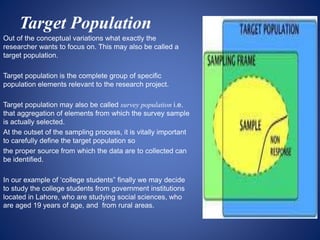
Target Population
Out of the conceptual variations what exactly the
researcher wants to focus on. This may also be called a
target population.
Target population is the complete group of specific
population elements relevant to the research project.
Target population may also be called survey population i.e.
that aggregation of elements from which the survey sample
is actually selected.
At the outset of the sampling process, it is vitally important
to carefully define the target population so
the proper source from which the data are to collected can
be identified.
In our example of ‘college students” finally we may decide
to study the college students from government institutions
located in Lahore, who are studying social sciences, who
are aged 19 years of age, and from rural areas.
Sampling
The process of using a
small number of items or
parts of a larger
population to make
conclusions about
the whole population.
It enables the
researchers to estimate
characteristics of the
population.
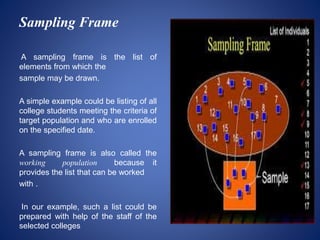
Sampling Frame
A sampling frame is the list of
elements from which the
sample may be drawn.
A simple example could be listing of all
college students meeting the criteria of
target population and who are enrolled
on the specified date.
A sampling frame is also called the
working population because it
provides the list that can be worked
with .
In our example, such a list could be
prepared with help of the staff of the
selected colleges
Sampling Frame Error
A sampling frame error occurs
when certain sample elements
are excluded
or when the entire
population is not accurately
represented in the sampling
frame.
The error that occurs when
certain sample elements are
not listed or available and are
not represented in the sampling
frame.
Sampling Unit
A sampling unit is that element or set of elements
considered for selection in some stage of sampling.
Sampling may be done in single stage or in multiple
stages.
For example, a researcher may select a sample of
Mohallahs in a city, and then select a sample of families
from the selected Mohallahs, and finally may select a
sample of adults from the selected families.
The sampling units of these three stages of sampling are
respectively Mohallah, families, and adults, of which thee
last of these are the elements.
More specifically, the terms “primary sampling units,”
“secondary sampling units,” and “final sampling units”
would be used to designate the successive stages.
Observation Unit
An observation unit, or unit of data
collection, is an element or aggregation
of elements from which the
information is collected.
Often the unit of analysis and unit of
observation are the same –
Thus the researcher may interview
heads of family (the observation units) to
collect information about every member
of the household (the unit of analysis)
Difference between statistics and parameters
A parameter describes the characteristics of an entire
population.
A statistic describes the characteristics of only a sample
drawn from a larger population.
Since the average weight came from a sample of only 40
people, not the entire population, it is properly described
as a statistic.
Suppose in a hospital with 600 patients/beds, we are just
interviewing or studying part of them (taking sample) we
call it statistic (it means studying part to describe the
whole). On the contrary, while we are asking question /
interviewing all the patients (600 patients of that hospital)
we call it parameter (means studying the whole to
describe the whole).

Business Research Method Sampling Terminology

  • 1.
    Sampling Terminology .. There area number of technical terms used in books on research and statistics which need explanation. Some of the important terms are:
  • 2.
    Element An element isthat unit about which information is collected and which provides the basis of analysis. It can be a person, groups, families, organizations, communities, and so forth.
  • 3.
    Population A population isthe theoretically specified aggregation of study elements. It is translating the abstract concept into workable concept. For example, let us look at the study of “college students.” Theoretically who are the college students? They might include students registered in government colleges and/or private colleges, students of intermediate classes and/or graduate classes, students of professional colleges and/or non- professional colleges, and many other variations. In this way the pool of all available elements is population
  • 4.
    Target Population Out ofthe conceptual variations what exactly the researcher wants to focus on. This may also be called a target population. Target population is the complete group of specific population elements relevant to the research project. Target population may also be called survey population i.e. that aggregation of elements from which the survey sample is actually selected. At the outset of the sampling process, it is vitally important to carefully define the target population so the proper source from which the data are to collected can be identified. In our example of ‘college students” finally we may decide to study the college students from government institutions located in Lahore, who are studying social sciences, who are aged 19 years of age, and from rural areas.
  • 5.
    Sampling The process ofusing a small number of items or parts of a larger population to make conclusions about the whole population. It enables the researchers to estimate characteristics of the population.
  • 6.
    Sampling Frame A samplingframe is the list of elements from which the sample may be drawn. A simple example could be listing of all college students meeting the criteria of target population and who are enrolled on the specified date. A sampling frame is also called the working population because it provides the list that can be worked with . In our example, such a list could be prepared with help of the staff of the selected colleges
  • 7.
    Sampling Frame Error Asampling frame error occurs when certain sample elements are excluded or when the entire population is not accurately represented in the sampling frame. The error that occurs when certain sample elements are not listed or available and are not represented in the sampling frame.
  • 8.
    Sampling Unit A samplingunit is that element or set of elements considered for selection in some stage of sampling. Sampling may be done in single stage or in multiple stages. For example, a researcher may select a sample of Mohallahs in a city, and then select a sample of families from the selected Mohallahs, and finally may select a sample of adults from the selected families. The sampling units of these three stages of sampling are respectively Mohallah, families, and adults, of which thee last of these are the elements. More specifically, the terms “primary sampling units,” “secondary sampling units,” and “final sampling units” would be used to designate the successive stages.
  • 9.
    Observation Unit An observationunit, or unit of data collection, is an element or aggregation of elements from which the information is collected. Often the unit of analysis and unit of observation are the same – Thus the researcher may interview heads of family (the observation units) to collect information about every member of the household (the unit of analysis)
  • 10.
    Difference between statisticsand parameters A parameter describes the characteristics of an entire population. A statistic describes the characteristics of only a sample drawn from a larger population. Since the average weight came from a sample of only 40 people, not the entire population, it is properly described as a statistic. Suppose in a hospital with 600 patients/beds, we are just interviewing or studying part of them (taking sample) we call it statistic (it means studying part to describe the whole). On the contrary, while we are asking question / interviewing all the patients (600 patients of that hospital) we call it parameter (means studying the whole to describe the whole).