Welcome to our
presentation
Topic: Classical Theories of
Development
i. Md. Nazmul Hasan - 15078
ii. Amanullah - 15080
iii. Md. Manazir Rahman - 15081
iv. Md. Belal Hossain - 15082
v. Md. Roknuzzaman - 15083
vi. Muhammad Ferdaus - 15084
vii. Md. Mahmudul Hasan - 15085
viii. Yousuf Ali- 15086
ix. Mustarin Salati - 15087
x. Rupa Das- 15088
Group Member
What`s classical development theory ?
• The basic theme of the classical model was the development of the
economy from a progressive state into a stationary state.
• The classical growth theory argues that economic growth will
decrease or end because of an increasing population and limited
resources. Classical growth theory economists believed that
temporary increases in real GDP per person would cause a population
explosion that would consequently decrease real GDP.
• The classical theory is basically a synthesis of the doctrines put
forward by Adam Smith, T. R. Malthus, David Ricardo, J. S Mill and
others.
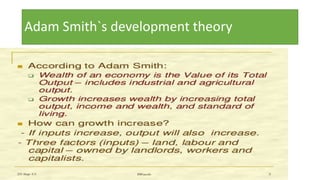
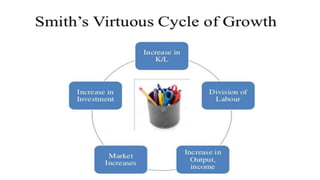
Adam Smith`s development theory
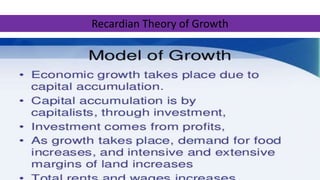
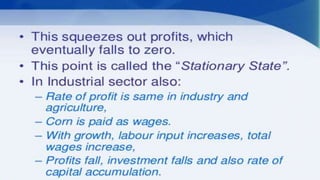
Recardian Theory of Growth
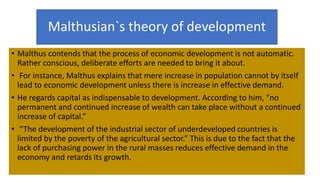
Malthusian`s theory of development
• Malthus contends that the process of economic development is not automatic.
Rather conscious, deliberate efforts are needed to bring it about.
• For instance, Malthus explains that mere increase in population cannot by itself
lead to economic development unless there is increase in effective demand.
• He regards capital as indispensable to development. According to him, “no
permanent and continued increase of wealth can take place without a continued
increase of capital.”
• “The development of the industrial sector of underdeveloped countries is
limited by the poverty of the agricultural sector.” This is due to the fact that the
lack of purchasing power in the rural masses reduces effective demand in the
economy and retards its growth.
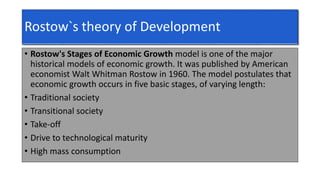
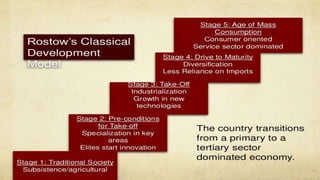
Rostow`s theory of Development
• Rostow's Stages of Economic Growth model is one of the major
historical models of economic growth. It was published by American
economist Walt Whitman Rostow in 1960. The model postulates that
economic growth occurs in five basic stages, of varying length:
• Traditional society
• Transitional society
• Take-off
• Drive to technological maturity
• High mass consumption
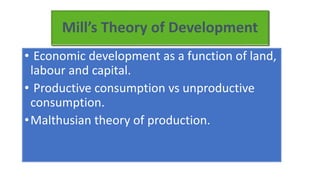
Mill’s Theory of Development
• Economic development as a function of land,
labour and capital.
• Productive consumption vs unproductive
consumption.

•Malthusian theory of production.
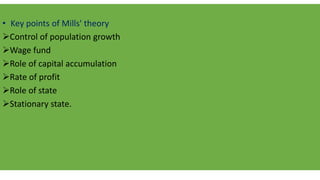
• Key points of Mills' theory
Control of population growth
Wage fund
Role of capital accumulation
Rate of profit
Role of state
Stationary state.
Classical development theory

Classical development theory

  • 1.
  • 2.
    Topic: Classical Theoriesof Development i. Md. Nazmul Hasan - 15078 ii. Amanullah - 15080 iii. Md. Manazir Rahman - 15081 iv. Md. Belal Hossain - 15082 v. Md. Roknuzzaman - 15083 vi. Muhammad Ferdaus - 15084 vii. Md. Mahmudul Hasan - 15085 viii. Yousuf Ali- 15086 ix. Mustarin Salati - 15087 x. Rupa Das- 15088 Group Member
  • 3.
    What`s classical developmenttheory ? • The basic theme of the classical model was the development of the economy from a progressive state into a stationary state. • The classical growth theory argues that economic growth will decrease or end because of an increasing population and limited resources. Classical growth theory economists believed that temporary increases in real GDP per person would cause a population explosion that would consequently decrease real GDP. • The classical theory is basically a synthesis of the doctrines put forward by Adam Smith, T. R. Malthus, David Ricardo, J. S Mill and others.
  • 4.
  • 6.
  • 8.
    Malthusian`s theory ofdevelopment • Malthus contends that the process of economic development is not automatic. Rather conscious, deliberate efforts are needed to bring it about. • For instance, Malthus explains that mere increase in population cannot by itself lead to economic development unless there is increase in effective demand. • He regards capital as indispensable to development. According to him, “no permanent and continued increase of wealth can take place without a continued increase of capital.” • “The development of the industrial sector of underdeveloped countries is limited by the poverty of the agricultural sector.” This is due to the fact that the lack of purchasing power in the rural masses reduces effective demand in the economy and retards its growth.
  • 9.
    Rostow`s theory ofDevelopment • Rostow's Stages of Economic Growth model is one of the major historical models of economic growth. It was published by American economist Walt Whitman Rostow in 1960. The model postulates that economic growth occurs in five basic stages, of varying length: • Traditional society • Transitional society • Take-off • Drive to technological maturity • High mass consumption
  • 11.
    Mill’s Theory ofDevelopment • Economic development as a function of land, labour and capital. • Productive consumption vs unproductive consumption. •Malthusian theory of production.

  • 12.
    • Key pointsof Mills' theory Control of population growth Wage fund Role of capital accumulation Rate of profit Role of state Stationary state.