POPULATION and
SAMPLE
West Visayas State University
College of Education, Graduate School
Prepared by:
LORLIE A. ABIERA
PhD Educational Management
Discussant
• A high school administrator
wants to analyze the final
exam scores of all graduating
seniors to see if there is a
trend.
• Is it possible to use the whole
population of graduating
seniors?
Population
● The group of interest to the researcher
● The group to whom the researcher
would like to generalize the results of
the study
Examples of Population
● All high school principals in the Schools
Division of Iloilo
● All secondary school counselors in the
Schools Division of Antique
● The population can be any size and that it will
have at least one (and sometimes several)
characteristic that sets it off from other
population
● A population is always all of the individuals
who possess certain characteristics or set of
characteristics
● Population of interest in educational
research– a group of persons (students,
teachers, or other individuals) who possess
certain characteristics
● In some cases, population may be defined as
a group of classrooms, schools or even
facilities
Collecting Data from Population
● Populations are used when your research
question requires, or when you have access
to, data from every member of the population.
● Usually, it is only straightforward to collect
data from a whole population when it is small,
accessible and cooperative.
Target versus Accessible Populations
● Target population- the actual population to
which the researcher would really like to
generalize
 The researchers’ ideal choice
● Accessible population- the population to which
the researcher is able to generalize
○ The researcher’s realistic choice
Example:
Research problem to be investigated- The effects
of computer assisted instruction on the reading
achievement of first and second graders in the
Schools Division of Antique
Target population – all first and second grade
children in the Schools Division of Antique
Example:
Accessible population – all first and second grade
children in the District of San Jose, Antique
Sample – Ten percent of the first and second grade
children in the District of San Jose
Example:
Research problem to be investigated- The attitudes
of fifth-year teachers in training toward their student
teaching experience
Target population – all fifth year students enrolled in
teacher-training programs in the United States
Example:
Accessible population – All fifth year students
enrolled in teacher training programs in the
University of New York
Sample – Two hundred fifth year students selected
from those enrolled in the teacher training programs
in the State University of New York
• The more narrowly researchers define population,
the more they save on time, effort, money but the
more they limit generalizability
• It is essential that researchers describe the
population and the sample in sufficient detail so that
interested individuals can determine the
applicability of the findings to their own situations
How do scientists track migratory animals?
● They tag the sample of the population and
track the sample
● They use the sample to gather statistical data
about the population
● A researcher might want to study the adverse
health effects associated with working in a
coal mine. However, it would be impossible to
study a large population of coal workers. So,
the researcher would need to narrow down the
population and build a sample to collect data.
This sample might be a group of coal workers
in one city.
Sample
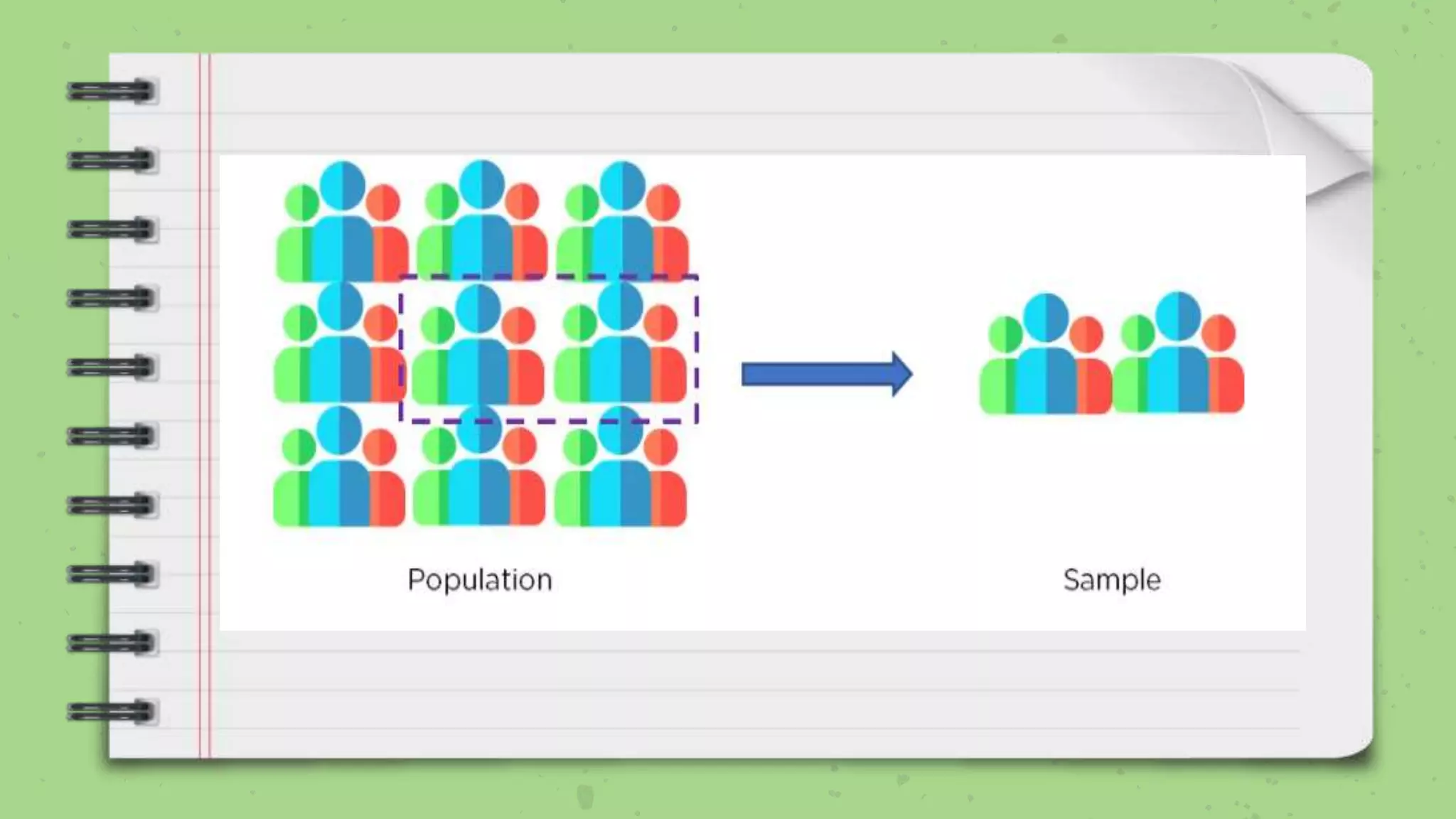
● In a research study, a sample is a
group on which an information is
obtained
● Selected from population
● Subset of the population
● Most population of interest are large, diverse,
and scattered over a large geographic area.
● The researcher often select a sample to
study.
Example: .
A researcher is interested in studying the effects of diet
on the attention span of third grade students in a large city.
There are 1500 third graders attending the elementary schools in
the city. The researcher selects 150 of these third graders, 30
each in 5 different schools as sample of the study
Reasons for Sampling
● Necessity-
● Practicality-
● Cost effectiveness-
● Manageability
A sample should generally :
● Satisfy all different variations present in the
population as well as a well-defined selection
criterion.
● Be utterly unbiased on the properties of the
objects being selected.
● Be random to choose the objects of study fairly.
Why are samples important?
● within many models of scientific research, it is
impossible (from both a strategic and a resource
perspective) to study all the members of a
population for a research project
○ It just costs too much and takes too much
time.
● Instead, a selected few participants (who make up
the sample) are chosen to ensure that the sample
is representative of the population.
○ then the results from the sample can be
inferred to the population, which is exactly the
purpose of inferential statistics—using
information on a smaller group of participants
to infer to the group of all participants.
• Identify the sample and the population in the
given situation:
• Population- all the registered voters
• Sample- 1000 voters who were surveyed
The mayor survey 1000 voters if they approve the
job she is doing.
○ Sampling yields significant research result.
However, with the differences that can be present
between a population and a sample, sample errors
can occur.
○ Therefore, knowing the difference between sample
and population, makes the researcher use the most
relevant and useful sampling method so that error
can be avoided.
Summary
● Population refers to the collection of all elements possessing
common characteristics while sample means a subgroup of the
members of population chosen for participation of the study
● Population includes each and every unit of the group and focus
on identifying the characteristics of the group while sample
includes only a handful of units of population making inferences
about the population
● The more representative the sample of the population, the more
confident the researcher can be in the quality of the results.
References
Bhandari, P. (2021). Population vs Sample. Retrieved from Scribb.com
on March 9. 2022
Wallen, N.E, Fraenkel. Jack R., Hyun, H. H (2012). How To Design and
Evaluate Research in Education. Mc Graw Hill
Sample and population.pptx

Sample and population.pptx

  • 1.
    POPULATION and SAMPLE West VisayasState University College of Education, Graduate School Prepared by: LORLIE A. ABIERA PhD Educational Management Discussant
  • 2.
    • A highschool administrator wants to analyze the final exam scores of all graduating seniors to see if there is a trend. • Is it possible to use the whole population of graduating seniors?
  • 3.
    Population ● The groupof interest to the researcher ● The group to whom the researcher would like to generalize the results of the study
  • 4.
    Examples of Population ●All high school principals in the Schools Division of Iloilo ● All secondary school counselors in the Schools Division of Antique
  • 5.
    ● The populationcan be any size and that it will have at least one (and sometimes several) characteristic that sets it off from other population ● A population is always all of the individuals who possess certain characteristics or set of characteristics
  • 6.
    ● Population ofinterest in educational research– a group of persons (students, teachers, or other individuals) who possess certain characteristics ● In some cases, population may be defined as a group of classrooms, schools or even facilities
  • 7.
    Collecting Data fromPopulation ● Populations are used when your research question requires, or when you have access to, data from every member of the population. ● Usually, it is only straightforward to collect data from a whole population when it is small, accessible and cooperative.
  • 8.
    Target versus AccessiblePopulations ● Target population- the actual population to which the researcher would really like to generalize  The researchers’ ideal choice ● Accessible population- the population to which the researcher is able to generalize ○ The researcher’s realistic choice
  • 9.
    Example: Research problem tobe investigated- The effects of computer assisted instruction on the reading achievement of first and second graders in the Schools Division of Antique Target population – all first and second grade children in the Schools Division of Antique
  • 10.
    Example: Accessible population –all first and second grade children in the District of San Jose, Antique Sample – Ten percent of the first and second grade children in the District of San Jose
  • 11.
    Example: Research problem tobe investigated- The attitudes of fifth-year teachers in training toward their student teaching experience Target population – all fifth year students enrolled in teacher-training programs in the United States
  • 12.
    Example: Accessible population –All fifth year students enrolled in teacher training programs in the University of New York Sample – Two hundred fifth year students selected from those enrolled in the teacher training programs in the State University of New York
  • 13.
    • The morenarrowly researchers define population, the more they save on time, effort, money but the more they limit generalizability • It is essential that researchers describe the population and the sample in sufficient detail so that interested individuals can determine the applicability of the findings to their own situations
  • 14.
    How do scientiststrack migratory animals? ● They tag the sample of the population and track the sample ● They use the sample to gather statistical data about the population
  • 15.
    ● A researchermight want to study the adverse health effects associated with working in a coal mine. However, it would be impossible to study a large population of coal workers. So, the researcher would need to narrow down the population and build a sample to collect data. This sample might be a group of coal workers in one city.
  • 16.
    Sample ● In aresearch study, a sample is a group on which an information is obtained ● Selected from population ● Subset of the population
  • 18.
    ● Most populationof interest are large, diverse, and scattered over a large geographic area. ● The researcher often select a sample to study. Example: . A researcher is interested in studying the effects of diet on the attention span of third grade students in a large city. There are 1500 third graders attending the elementary schools in the city. The researcher selects 150 of these third graders, 30 each in 5 different schools as sample of the study
  • 19.
    Reasons for Sampling ●Necessity- ● Practicality- ● Cost effectiveness- ● Manageability
  • 20.
    A sample shouldgenerally : ● Satisfy all different variations present in the population as well as a well-defined selection criterion. ● Be utterly unbiased on the properties of the objects being selected. ● Be random to choose the objects of study fairly.
  • 21.
    Why are samplesimportant? ● within many models of scientific research, it is impossible (from both a strategic and a resource perspective) to study all the members of a population for a research project ○ It just costs too much and takes too much time.
  • 22.
    ● Instead, aselected few participants (who make up the sample) are chosen to ensure that the sample is representative of the population. ○ then the results from the sample can be inferred to the population, which is exactly the purpose of inferential statistics—using information on a smaller group of participants to infer to the group of all participants.
  • 23.
    • Identify thesample and the population in the given situation: • Population- all the registered voters • Sample- 1000 voters who were surveyed The mayor survey 1000 voters if they approve the job she is doing.
  • 24.
    ○ Sampling yieldssignificant research result. However, with the differences that can be present between a population and a sample, sample errors can occur. ○ Therefore, knowing the difference between sample and population, makes the researcher use the most relevant and useful sampling method so that error can be avoided.
  • 25.
    Summary ● Population refersto the collection of all elements possessing common characteristics while sample means a subgroup of the members of population chosen for participation of the study ● Population includes each and every unit of the group and focus on identifying the characteristics of the group while sample includes only a handful of units of population making inferences about the population ● The more representative the sample of the population, the more confident the researcher can be in the quality of the results.
  • 26.
    References Bhandari, P. (2021).Population vs Sample. Retrieved from Scribb.com on March 9. 2022 Wallen, N.E, Fraenkel. Jack R., Hyun, H. H (2012). How To Design and Evaluate Research in Education. Mc Graw Hill