ELECTRONIC
BUSINESS
Course Objectives
 The Course highlights the basic aspect of E-business & E- commerce.
 The students will become familiar with different business models,
strategies, legal issues related to E-commerce
 Familiarizes students with the Electronic payment system, integrity and
reliability of transactions
 Most important the encryption and digital signature techniques needed
to support electronic cash, and the technologies available to support
secure transactions on the Internet.
 Also make the students to understand the theoretical & practical
experience of web development.
Abdus Salam 2
Lecture-1 & 2
 Introduction to E-Business & E-Commerce
 Electronic commerce Vs Traditional Commerce
 Advantages of E-Business & E-Commerce
 Disadvantages of E-Business & E-Commerce
 The Ocean of “E-”
 M-Commerce
 Brief History of E-Business
 Internet
 History of Internet
Abdus Salam 3
Abdus Salam 4
What is Business?
 “A company or other commercial organization that buys and sells
goods, makes products, or provides services.”
 “A commercial activity involving the exchange of money for goods
or services.”
Abdus Salam 5
What is Commerce?
 Commerce is all about buying and selling between two or more
entities.
 Commerce deals with the exchange of goods, services,
information or money from producer to final consumer.
Abdus Salam 6
Electronic Commerce
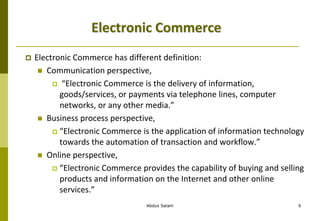
 Electronic Commerce has different definition:
 Communication perspective,
 “Electronic Commerce is the delivery of information,
goods/services, or payments via telephone lines, computer
networks, or any other media.”
 Business process perspective,
 “Electronic Commerce is the application of information technology
towards the automation of transaction and workflow.”
 Online perspective,
 “Electronic Commerce provides the capability of buying and selling
products and information on the Internet and other online
services.”
E-Business & E-Commerce
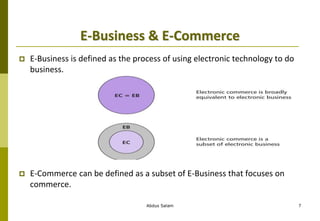
 E-Business is defined as the process of using electronic technology to do
business.
 E-Commerce can be defined as a subset of E-Business that focuses on
commerce.
Abdus Salam 7
So, what is our definition of
E-Business?
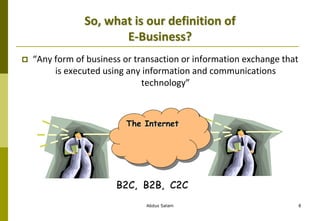
 “Any form of business or transaction or information exchange that
is executed using any information and communications
technology”
Abdus Salam 8
The Internet
B2C, B2B, C2C
Abdus Salam 9
Traditional Commerce
Vs
Electronic commerce
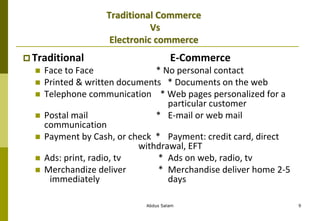
 Traditional E-Commerce
 Face to Face * No personal contact
 Printed & written documents * Documents on the web
 Telephone communication * Web pages personalized for a
particular customer
 Postal mail * E-mail or web mail
communication
 Payment by Cash, or check * Payment: credit card, direct
withdrawal, EFT
 Ads: print, radio, tv * Ads on web, radio, tv
 Merchandize deliver * Merchandise deliver home 2-5
immediately days
Abdus Salam 10
Traditional Commerce
Vs
Electronic commerce (Cont’d)
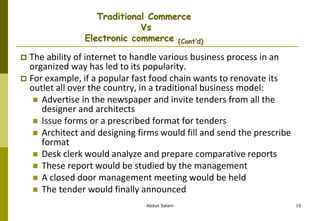
 The ability of internet to handle various business process in an
organized way has led to its popularity.
 For example, if a popular fast food chain wants to renovate its
outlet all over the country, in a traditional business model:
 Advertise in the newspaper and invite tenders from all the
designer and architects
 Issue forms or a prescribed format for tenders
 Architect and designing firms would fill and send the prescribe
format
 Desk clerk would analyze and prepare comparative reports
 These report would be studied by the management
 A closed door management meeting would be held
 The tender would finally announced
Abdus Salam 11
Traditional Commerce
Vs
Electronic commerce (Cont’d)
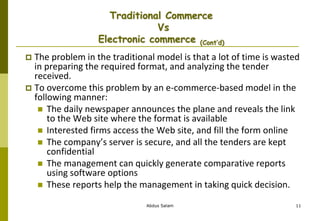
 The problem in the traditional model is that a lot of time is wasted
in preparing the required format, and analyzing the tender
received.
 To overcome this problem by an e-commerce-based model in the
following manner:
 The daily newspaper announces the plane and reveals the link
to the Web site where the format is available
 Interested firms access the Web site, and fill the form online
 The company’s server is secure, and all the tenders are kept
confidential
 The management can quickly generate comparative reports
using software options
 These reports help the management in taking quick decision.
Abdus Salam 12
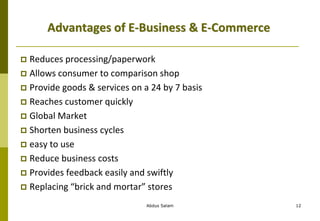
Advantages of E-Business & E-Commerce
 Reduces processing/paperwork
 Allows consumer to comparison shop
 Provide goods & services on a 24 by 7 basis
 Reaches customer quickly
 Global Market
 Shorten business cycles
 easy to use
 Reduce business costs
 Provides feedback easily and swiftly
 Replacing “brick and mortar” stores
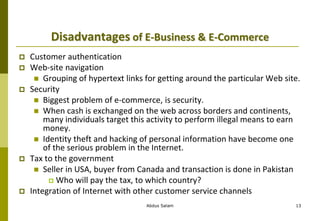
Disadvantages of E-Business & E-Commerce
 Customer authentication
 Web-site navigation
 Grouping of hypertext links for getting around the particular Web site.
 Security
 Biggest problem of e-commerce, is security.
 When cash is exchanged on the web across borders and continents,
many individuals target this activity to perform illegal means to earn
money.
 Identity theft and hacking of personal information have become one
of the serious problem in the Internet.
 Tax to the government
 Seller in USA, buyer from Canada and transaction is done in Pakistan
 Who will pay the tax, to which country?
 Integration of Internet with other customer service channels
Abdus Salam 13
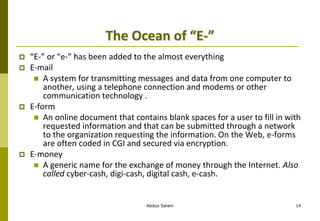
The Ocean of “E-”
 “E-” or “e-” has been added to the almost everything
 E-mail
 A system for transmitting messages and data from one computer to
another, using a telephone connection and modems or other
communication technology .
 E-form
 An online document that contains blank spaces for a user to fill in with
requested information and that can be submitted through a network
to the organization requesting the information. On the Web, e-forms
are often coded in CGI and secured via encryption.
 E-money
 A generic name for the exchange of money through the Internet. Also
called cyber-cash, digi-cash, digital cash, e-cash.
Abdus Salam 14
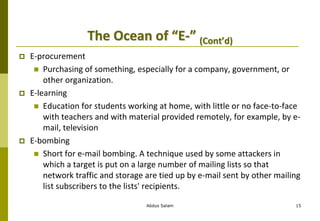
The Ocean of “E-” (Cont’d)
 E-procurement
 Purchasing of something, especially for a company, government, or
other organization.
 E-learning
 Education for students working at home, with little or no face-to-face
with teachers and with material provided remotely, for example, by e-
mail, television
 E-bombing
 Short for e-mail bombing. A technique used by some attackers in
which a target is put on a large number of mailing lists so that
network traffic and storage are tied up by e-mail sent by other mailing
list subscribers to the lists' recipients.
Abdus Salam 15
The Ocean of “E-” (Cont’d)
 E-tailing
 Electronic tailing refer to the web sites selling goods to consumers.
 The concept is similar to the to that of retail shop that stock useful
products. A customer can log in, survey the products, and place in
order.
 E-Government
 The use of Internet Technology in general and e-commerce in
particular to deliver information about public services to citizens
(called Government-to-citizen [G2C]), business partners and suppliers
(called government-to-business [G2B])
 others …
Abdus Salam 16
Recently have started
to see the same with
“M-” or “m-”.
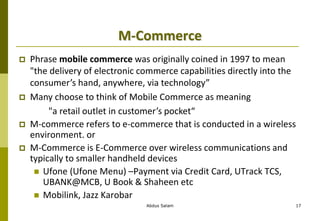
M-Commerce
 Phrase mobile commerce was originally coined in 1997 to mean
"the delivery of electronic commerce capabilities directly into the
consumer’s hand, anywhere, via technology”
 Many choose to think of Mobile Commerce as meaning
"a retail outlet in customer’s pocket“
 M-commerce refers to e-commerce that is conducted in a wireless
environment. or
 M-Commerce is E-Commerce over wireless communications and
typically to smaller handheld devices
 Ufone (Ufone Menu) –Payment via Credit Card, UTrack TCS,
UBANK@MCB, U Book & Shaheen etc
 Mobilink, Jazz Karobar
Abdus Salam 17
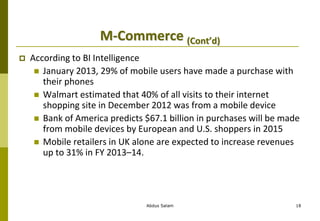
M-Commerce (Cont’d)
 According to BI Intelligence
 January 2013, 29% of mobile users have made a purchase with
their phones
 Walmart estimated that 40% of all visits to their internet
shopping site in December 2012 was from a mobile device
 Bank of America predicts $67.1 billion in purchases will be made
from mobile devices by European and U.S. shoppers in 2015
 Mobile retailers in UK alone are expected to increase revenues
up to 31% in FY 2013–14.
Abdus Salam 18
Origin and Growth of E-Commerce
 1970s: Electronic Funds Transfer (EFT)
 A computer-based system that facilitates the transfer of money
between two financial institutions
 The process by which money is transferred electronically from one
financial institution to another is termed EFT
 Used by the banking industry to exchange account information
over secured networks
 No physical appearance of an individual account holder or any
physical paper work involved in EFT, but computers and their
network used for this purpose
Abdus Salam 19
Origin and Growth of E-Commerce (Cont’d)
 Late 1970s and early 1980s: Electronic Data Interchange (EDI)
for e-commerce within companies
 EDI refers to the business communication between business
partners and clients.
 Used by Businesses to transmit data from one business to
another
 electronic messaging technologies:
 E-mails, faxes and newsletters is a part of EDI
 1990s: the World Wide Web on the Internet
 Provides easy-to-use technology for information publishing and
dissemination
 Cheaper to do business
 Enable diverse business activities
Abdus Salam 20
Origin and Growth of E-Commerce (Cont’d)
 Internet
 A network of networks in which user of any computer can get
information from other computer, if they have permission.
 An internet (note the lowercase letter i) is two or more
networks that can communicate with each other.
 It is a generic term used to mean an interconnection of
networks.
 The second is the name of a specific world wide network.
 The most notable internet is called Internet (uppercase letter
I), in which connect more than hundreds of thousands
interconnected networks.
 Every computer on the Internet has a unique Internet address
(similar to telephone address), which can be accessed any other
computer by dialing to the other IP address.
 The existing version now-e-days IP VER-4.
Abdus Salam 21
Origin and Growth of E-Commerce (Cont’d)
 The extraordinary communication system “Internet” came into
being in 1969.
 In mid-1960, mainframe computers in research organization were
stand-alone devices. Computers from different manufacturers
were unable to communicate with one another.
 The ARPA in the DoD was interesting in in finding a way to connect
computers, so
 In 1967, at an Association for Computing Machinery (ACM)
meeting, ARPA presented its ideas for ARPANET, a small network
connected computes.
 The basic purpose to create a network that allows the researchers of
one university to able, to talk or share their research to Researchers
computers.
 The network was designed to work without centralized control.
 This means if one portion of network fails or destroy in disaster or in
military attack, the remaining portion will be able to route packets
from sender to receiver through alternate path.
Abdus Salam 22
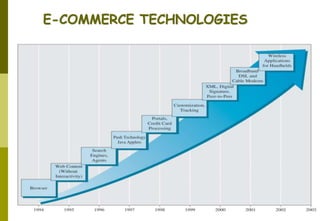
E-COMMERCE TECHNOLOGIES
Abdus Salam 23
Software
 Computer Instructions or data, anything that can be stored
electronically is called Software.
 The programs that control the operation of the computer system is
called System Software.
 In short, system software is the collection of those computer
programs which runs the computer and also helps the computer to run
another programs. e.g. Operating Systems (WINDOWS, UNIX)
 Application Software includes programs that do real work for user.
 Example:
 Payroll systems, Inventory Control, Manage student database, Word
Processor, Spreadsheet and Database Management System etc.
Abdus Salam 24

Introduction to electronic business electronic commerce

  • 1.
  • 2.
    Course Objectives  TheCourse highlights the basic aspect of E-business & E- commerce.  The students will become familiar with different business models, strategies, legal issues related to E-commerce  Familiarizes students with the Electronic payment system, integrity and reliability of transactions  Most important the encryption and digital signature techniques needed to support electronic cash, and the technologies available to support secure transactions on the Internet.  Also make the students to understand the theoretical & practical experience of web development. Abdus Salam 2
  • 3.
    Lecture-1 & 2 Introduction to E-Business & E-Commerce  Electronic commerce Vs Traditional Commerce  Advantages of E-Business & E-Commerce  Disadvantages of E-Business & E-Commerce  The Ocean of “E-”  M-Commerce  Brief History of E-Business  Internet  History of Internet Abdus Salam 3
  • 4.
    Abdus Salam 4 Whatis Business?  “A company or other commercial organization that buys and sells goods, makes products, or provides services.”  “A commercial activity involving the exchange of money for goods or services.”
  • 5.
    Abdus Salam 5 Whatis Commerce?  Commerce is all about buying and selling between two or more entities.  Commerce deals with the exchange of goods, services, information or money from producer to final consumer.
  • 6.
    Abdus Salam 6 ElectronicCommerce  Electronic Commerce has different definition:  Communication perspective,  “Electronic Commerce is the delivery of information, goods/services, or payments via telephone lines, computer networks, or any other media.”  Business process perspective,  “Electronic Commerce is the application of information technology towards the automation of transaction and workflow.”  Online perspective,  “Electronic Commerce provides the capability of buying and selling products and information on the Internet and other online services.”
  • 7.
    E-Business & E-Commerce E-Business is defined as the process of using electronic technology to do business.  E-Commerce can be defined as a subset of E-Business that focuses on commerce. Abdus Salam 7
  • 8.
    So, what isour definition of E-Business?  “Any form of business or transaction or information exchange that is executed using any information and communications technology” Abdus Salam 8 The Internet B2C, B2B, C2C
  • 9.
    Abdus Salam 9 TraditionalCommerce Vs Electronic commerce  Traditional E-Commerce  Face to Face * No personal contact  Printed & written documents * Documents on the web  Telephone communication * Web pages personalized for a particular customer  Postal mail * E-mail or web mail communication  Payment by Cash, or check * Payment: credit card, direct withdrawal, EFT  Ads: print, radio, tv * Ads on web, radio, tv  Merchandize deliver * Merchandise deliver home 2-5 immediately days
  • 10.
    Abdus Salam 10 TraditionalCommerce Vs Electronic commerce (Cont’d)  The ability of internet to handle various business process in an organized way has led to its popularity.  For example, if a popular fast food chain wants to renovate its outlet all over the country, in a traditional business model:  Advertise in the newspaper and invite tenders from all the designer and architects  Issue forms or a prescribed format for tenders  Architect and designing firms would fill and send the prescribe format  Desk clerk would analyze and prepare comparative reports  These report would be studied by the management  A closed door management meeting would be held  The tender would finally announced
  • 11.
    Abdus Salam 11 TraditionalCommerce Vs Electronic commerce (Cont’d)  The problem in the traditional model is that a lot of time is wasted in preparing the required format, and analyzing the tender received.  To overcome this problem by an e-commerce-based model in the following manner:  The daily newspaper announces the plane and reveals the link to the Web site where the format is available  Interested firms access the Web site, and fill the form online  The company’s server is secure, and all the tenders are kept confidential  The management can quickly generate comparative reports using software options  These reports help the management in taking quick decision.
  • 12.
    Abdus Salam 12 Advantagesof E-Business & E-Commerce  Reduces processing/paperwork  Allows consumer to comparison shop  Provide goods & services on a 24 by 7 basis  Reaches customer quickly  Global Market  Shorten business cycles  easy to use  Reduce business costs  Provides feedback easily and swiftly  Replacing “brick and mortar” stores
  • 13.
    Disadvantages of E-Business& E-Commerce  Customer authentication  Web-site navigation  Grouping of hypertext links for getting around the particular Web site.  Security  Biggest problem of e-commerce, is security.  When cash is exchanged on the web across borders and continents, many individuals target this activity to perform illegal means to earn money.  Identity theft and hacking of personal information have become one of the serious problem in the Internet.  Tax to the government  Seller in USA, buyer from Canada and transaction is done in Pakistan  Who will pay the tax, to which country?  Integration of Internet with other customer service channels Abdus Salam 13
  • 14.
    The Ocean of“E-”  “E-” or “e-” has been added to the almost everything  E-mail  A system for transmitting messages and data from one computer to another, using a telephone connection and modems or other communication technology .  E-form  An online document that contains blank spaces for a user to fill in with requested information and that can be submitted through a network to the organization requesting the information. On the Web, e-forms are often coded in CGI and secured via encryption.  E-money  A generic name for the exchange of money through the Internet. Also called cyber-cash, digi-cash, digital cash, e-cash. Abdus Salam 14
  • 15.
    The Ocean of“E-” (Cont’d)  E-procurement  Purchasing of something, especially for a company, government, or other organization.  E-learning  Education for students working at home, with little or no face-to-face with teachers and with material provided remotely, for example, by e- mail, television  E-bombing  Short for e-mail bombing. A technique used by some attackers in which a target is put on a large number of mailing lists so that network traffic and storage are tied up by e-mail sent by other mailing list subscribers to the lists' recipients. Abdus Salam 15
  • 16.
    The Ocean of“E-” (Cont’d)  E-tailing  Electronic tailing refer to the web sites selling goods to consumers.  The concept is similar to the to that of retail shop that stock useful products. A customer can log in, survey the products, and place in order.  E-Government  The use of Internet Technology in general and e-commerce in particular to deliver information about public services to citizens (called Government-to-citizen [G2C]), business partners and suppliers (called government-to-business [G2B])  others … Abdus Salam 16 Recently have started to see the same with “M-” or “m-”.
  • 17.
    M-Commerce  Phrase mobilecommerce was originally coined in 1997 to mean "the delivery of electronic commerce capabilities directly into the consumer’s hand, anywhere, via technology”  Many choose to think of Mobile Commerce as meaning "a retail outlet in customer’s pocket“  M-commerce refers to e-commerce that is conducted in a wireless environment. or  M-Commerce is E-Commerce over wireless communications and typically to smaller handheld devices  Ufone (Ufone Menu) –Payment via Credit Card, UTrack TCS, UBANK@MCB, U Book & Shaheen etc  Mobilink, Jazz Karobar Abdus Salam 17
  • 18.
    M-Commerce (Cont’d)  Accordingto BI Intelligence  January 2013, 29% of mobile users have made a purchase with their phones  Walmart estimated that 40% of all visits to their internet shopping site in December 2012 was from a mobile device  Bank of America predicts $67.1 billion in purchases will be made from mobile devices by European and U.S. shoppers in 2015  Mobile retailers in UK alone are expected to increase revenues up to 31% in FY 2013–14. Abdus Salam 18
  • 19.
    Origin and Growthof E-Commerce  1970s: Electronic Funds Transfer (EFT)  A computer-based system that facilitates the transfer of money between two financial institutions  The process by which money is transferred electronically from one financial institution to another is termed EFT  Used by the banking industry to exchange account information over secured networks  No physical appearance of an individual account holder or any physical paper work involved in EFT, but computers and their network used for this purpose Abdus Salam 19
  • 20.
    Origin and Growthof E-Commerce (Cont’d)  Late 1970s and early 1980s: Electronic Data Interchange (EDI) for e-commerce within companies  EDI refers to the business communication between business partners and clients.  Used by Businesses to transmit data from one business to another  electronic messaging technologies:  E-mails, faxes and newsletters is a part of EDI  1990s: the World Wide Web on the Internet  Provides easy-to-use technology for information publishing and dissemination  Cheaper to do business  Enable diverse business activities Abdus Salam 20
  • 21.
    Origin and Growthof E-Commerce (Cont’d)  Internet  A network of networks in which user of any computer can get information from other computer, if they have permission.  An internet (note the lowercase letter i) is two or more networks that can communicate with each other.  It is a generic term used to mean an interconnection of networks.  The second is the name of a specific world wide network.  The most notable internet is called Internet (uppercase letter I), in which connect more than hundreds of thousands interconnected networks.  Every computer on the Internet has a unique Internet address (similar to telephone address), which can be accessed any other computer by dialing to the other IP address.  The existing version now-e-days IP VER-4. Abdus Salam 21
  • 22.
    Origin and Growthof E-Commerce (Cont’d)  The extraordinary communication system “Internet” came into being in 1969.  In mid-1960, mainframe computers in research organization were stand-alone devices. Computers from different manufacturers were unable to communicate with one another.  The ARPA in the DoD was interesting in in finding a way to connect computers, so  In 1967, at an Association for Computing Machinery (ACM) meeting, ARPA presented its ideas for ARPANET, a small network connected computes.  The basic purpose to create a network that allows the researchers of one university to able, to talk or share their research to Researchers computers.  The network was designed to work without centralized control.  This means if one portion of network fails or destroy in disaster or in military attack, the remaining portion will be able to route packets from sender to receiver through alternate path. Abdus Salam 22
  • 23.
  • 24.
    Software  Computer Instructionsor data, anything that can be stored electronically is called Software.  The programs that control the operation of the computer system is called System Software.  In short, system software is the collection of those computer programs which runs the computer and also helps the computer to run another programs. e.g. Operating Systems (WINDOWS, UNIX)  Application Software includes programs that do real work for user.  Example:  Payroll systems, Inventory Control, Manage student database, Word Processor, Spreadsheet and Database Management System etc. Abdus Salam 24