Tool Wear Detection
and Quantitation by
Digital Microscopy
Olympus Scientific Solutions Americas
2018 ASNT Annual Conference
Marcel Lucas
1. Tool wear
− Economic impact
− Types of wear
2. Characterization techniques
− Scanning electron microscopy
− Optical microscopy
3. Digital microscopy applied to tool wear quantitation
− Illumination modes
− 3D imaging
Outline
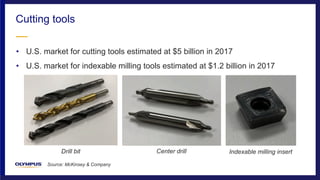
• U.S. market for cutting tools estimated at $5 billion in 2017
• U.S. market for indexable milling tools estimated at $1.2 billion in 2017
Cutting tools
Source: McKinsey & Company
Drill bit Center drill Indexable milling insert
• Industrial machinery/equipment
• Automotive
• Construction machinery
• Aerospace
• Oil and gas field machinery
• Utilities/telecommunications
• Farm machinery
• Pumps/valves
• Dies/tools, fixtures, molds
• Cutting tools
• Screw machine products
• Medical devices
Cutting tools: major consuming industries
Sources: Modern Distribution Management, MDM Analytics, McKinsey & Company
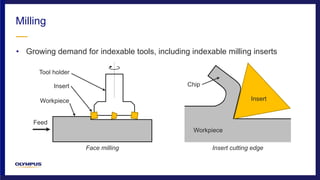
• Growing demand for indexable tools, including indexable milling inserts
Milling
Feed
Tool holder
Insert
Workpiece
Face milling Insert cutting edge
Insert
Workpiece
Chip
1. Negative impact on quality
− Reduced dimensional accuracy for workpieces
− Increased roughness of machined surfaces
− Increased residual stresses in workpieces
2. Negative impact on productivity
− Scrapped parts
− Downtime to replace tools
− Increased cutting forces and power consumption
Tool wear impact
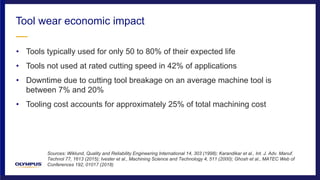
• Tools typically used for only 50 to 80% of their expected life
• Tools not used at rated cutting speed in 42% of applications
• Downtime due to cutting tool breakage on an average machine tool is
between 7% and 20%
• Tooling cost accounts for approximately 25% of total machining cost
Tool wear economic impact
Sources: Wiklund, Quality and Reliability Engineering International 14, 303 (1998); Karandikar et al., Int. J. Adv. Manuf.
Technol 77, 1613 (2015); Ivester et al., Machining Science and Technology 4, 511 (2000); Ghosh et al., MATEC Web of
Conferences 192, 01017 (2018)
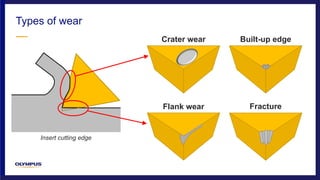
Types of wear
Insert cutting edge
Crater wear
Flank wear
Built-up edge
Fracture
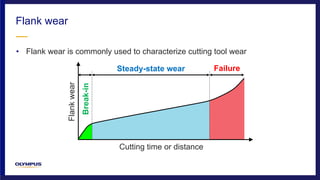
• Flank wear is commonly used to characterize cutting tool wear
Flank wear
Cutting time or distance
Flankwear
Break-in
Steady-state wear Failure
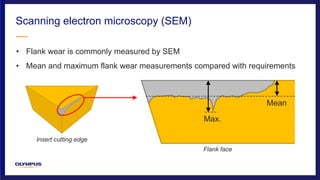
• Flank wear is commonly measured by SEM
• Mean and maximum flank wear measurements compared with requirements
Scanning electron microscopy (SEM)
Insert cutting edge
Flank face
Max.
Mean
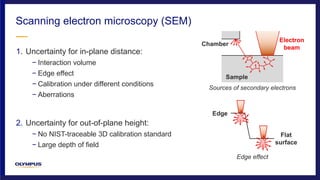
1. Uncertainty for in-plane distance:
− Interaction volume
− Edge effect
− Calibration under different conditions
− Aberrations
2. Uncertainty for out-of-plane height:
− No NIST-traceable 3D calibration standard
− Large depth of field
Scanning electron microscopy (SEM)
Edge effect
Sources of secondary electrons
Edge
Flat
surface
Chamber
Sample
Electron
beam
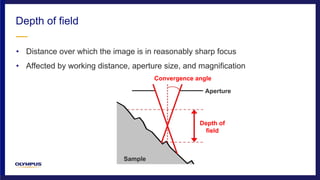
• Distance over which the image is in reasonably sharp focus
• Affected by working distance, aperture size, and magnification
Depth of field
Aperture
Depth of
field
Convergence angle
Sample
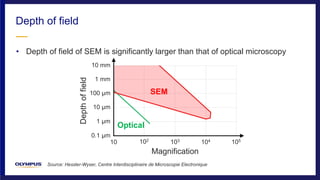
• Depth of field of SEM is significantly larger than that of optical microscopy
Depth of field
Source: Hessler-Wyser, Centre Interdisciplinaire de Microscopie Electronique
Magnification
Depthoffield
102
10 103 104 105
0.1 μm
1 μm
10 μm
100 μm
1 mm
10 mm
Optical
SEM
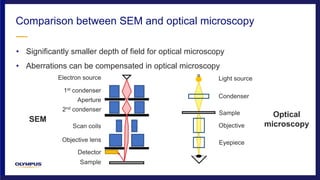
• Significantly smaller depth of field for optical microscopy
• Aberrations can be compensated in optical microscopy
Comparison between SEM and optical microscopy
SEM
Optical
microscopy
Electron source
1st condenser
2nd condenser
Aperture
Scan coils
Objective lens
Detector
Sample
Light source
Condenser
Sample
Objective
Eyepiece
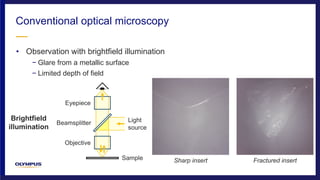
• Observation with brightfield illumination
− Glare from a metallic surface
− Limited depth of field
Conventional optical microscopy
Fractured insertSharp insert
Light
source
Sample
Eyepiece
Objective
Beamsplitter
Brightfield
illumination
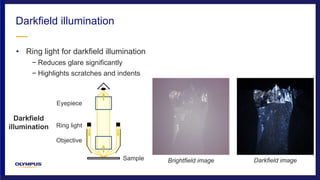
• Ring light for darkfield illumination
− Reduces glare significantly
− Highlights scratches and indents
Darkfield illumination
Darkfield
illumination
Sample
Eyepiece
Objective
Ring light
Brightfield image Darkfield image
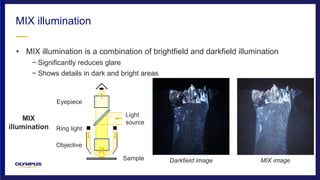
• MIX illumination is a combination of brightfield and darkfield illumination
− Significantly reduces glare
− Shows details in dark and bright areas
MIX illumination
MIX
illumination
Darkfield imageSample
Eyepiece
Objective
Ring light
Light
source
MIX image
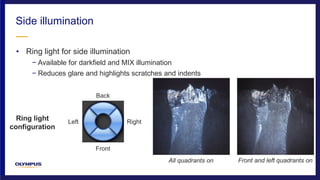
• Ring light for side illumination
− Available for darkfield and MIX illumination
− Reduces glare and highlights scratches and indents
Side illumination
Front
Back
Left Right
Ring light
configuration
All quadrants on Front and left quadrants on
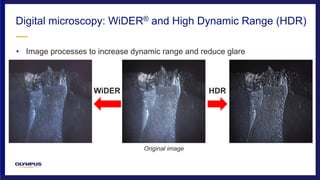
• Image processes to increase dynamic range and reduce glare
Digital microscopy: WiDER® and High Dynamic Range (HDR)
HDRWiDER
Original image
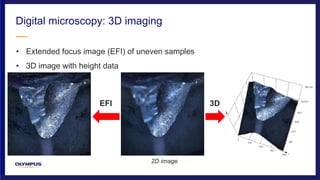
• Extended focus image (EFI) of uneven samples
• 3D image with height data
Digital microscopy: 3D imaging
3DEFI
2D image
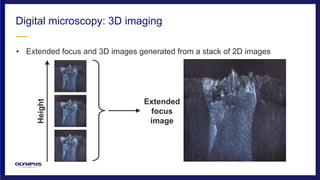
• Extended focus and 3D images generated from a stack of 2D images
Digital microscopy: 3D imaging
Height
Extended
focus
image
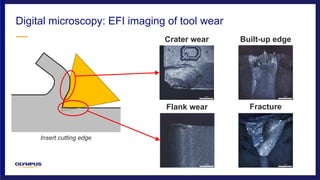
Digital microscopy: EFI imaging of tool wear
Insert cutting edge
Crater wear
Flank wear
Built-up edge
Fracture
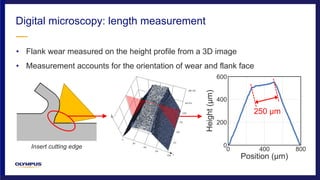
• Flank wear measured on the height profile from a 3D image
• Measurement accounts for the orientation of wear and flank face
Digital microscopy: length measurement
Insert cutting edge
Position (μm)
Height(μm)
4000
200
400
600
0
800
250 μm
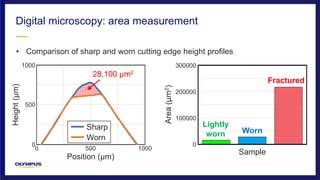
• Comparison of sharp and worn cutting edge height profiles
Digital microscopy: area measurement
Position (μm)
Height(μm)
0
1000
500
0
500 1000
Sharp
Worn
28,100 μm2
Sample
Area(μm2)
300000
200000
100000
0
Lightly
worn Worn
Fractured
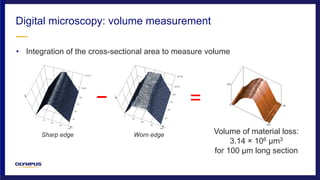
• Integration of the cross-sectional area to measure volume
Digital microscopy: volume measurement
Volume of material loss:
3.14 × 106 μm3
for 100 μm long section
=
Sharp edge Worn edge
0
200
350
190
• Measure wear rate:
− As a function of:
Ø Cutting conditions (speed, feed rate, depth of cut)
Ø Temperature
− For different:
Ø Tool geometry (rake angle, flank angle, edge preparation)
Ø Tool coatings, workpiece materials
Ø Coolant
Applications
1. The combination of brightfield and darkfield illumination significantly reduces
glare from the tool cutting edge
2. Digital microscopy can generate fully focused images of rough and uneven
cutting edges (extended focus and 3D images)
3. From 3D images, the length, cross-sectional area, and volume were
measured to quantify tool flank wear
Conclusions
Olympus and WiDER are registered trademarks of Olympus Corporation.

Tool Wear Detection and Quantitation by Digital Microscopy

  • 1.
    Tool Wear Detection andQuantitation by Digital Microscopy Olympus Scientific Solutions Americas 2018 ASNT Annual Conference Marcel Lucas
  • 2.
    1. Tool wear −Economic impact − Types of wear 2. Characterization techniques − Scanning electron microscopy − Optical microscopy 3. Digital microscopy applied to tool wear quantitation − Illumination modes − 3D imaging Outline
  • 3.
    • U.S. marketfor cutting tools estimated at $5 billion in 2017 • U.S. market for indexable milling tools estimated at $1.2 billion in 2017 Cutting tools Source: McKinsey & Company Drill bit Center drill Indexable milling insert
  • 4.
    • Industrial machinery/equipment •Automotive • Construction machinery • Aerospace • Oil and gas field machinery • Utilities/telecommunications • Farm machinery • Pumps/valves • Dies/tools, fixtures, molds • Cutting tools • Screw machine products • Medical devices Cutting tools: major consuming industries Sources: Modern Distribution Management, MDM Analytics, McKinsey & Company
  • 5.
    • Growing demandfor indexable tools, including indexable milling inserts Milling Feed Tool holder Insert Workpiece Face milling Insert cutting edge Insert Workpiece Chip
  • 6.
    1. Negative impacton quality − Reduced dimensional accuracy for workpieces − Increased roughness of machined surfaces − Increased residual stresses in workpieces 2. Negative impact on productivity − Scrapped parts − Downtime to replace tools − Increased cutting forces and power consumption Tool wear impact
  • 7.
    • Tools typicallyused for only 50 to 80% of their expected life • Tools not used at rated cutting speed in 42% of applications • Downtime due to cutting tool breakage on an average machine tool is between 7% and 20% • Tooling cost accounts for approximately 25% of total machining cost Tool wear economic impact Sources: Wiklund, Quality and Reliability Engineering International 14, 303 (1998); Karandikar et al., Int. J. Adv. Manuf. Technol 77, 1613 (2015); Ivester et al., Machining Science and Technology 4, 511 (2000); Ghosh et al., MATEC Web of Conferences 192, 01017 (2018)
  • 8.
    Types of wear Insertcutting edge Crater wear Flank wear Built-up edge Fracture
  • 9.
    • Flank wearis commonly used to characterize cutting tool wear Flank wear Cutting time or distance Flankwear Break-in Steady-state wear Failure
  • 10.
    • Flank wearis commonly measured by SEM • Mean and maximum flank wear measurements compared with requirements Scanning electron microscopy (SEM) Insert cutting edge Flank face Max. Mean
  • 11.
    1. Uncertainty forin-plane distance: − Interaction volume − Edge effect − Calibration under different conditions − Aberrations 2. Uncertainty for out-of-plane height: − No NIST-traceable 3D calibration standard − Large depth of field Scanning electron microscopy (SEM) Edge effect Sources of secondary electrons Edge Flat surface Chamber Sample Electron beam
  • 12.
    • Distance overwhich the image is in reasonably sharp focus • Affected by working distance, aperture size, and magnification Depth of field Aperture Depth of field Convergence angle Sample
  • 13.
    • Depth offield of SEM is significantly larger than that of optical microscopy Depth of field Source: Hessler-Wyser, Centre Interdisciplinaire de Microscopie Electronique Magnification Depthoffield 102 10 103 104 105 0.1 μm 1 μm 10 μm 100 μm 1 mm 10 mm Optical SEM
  • 14.
    • Significantly smallerdepth of field for optical microscopy • Aberrations can be compensated in optical microscopy Comparison between SEM and optical microscopy SEM Optical microscopy Electron source 1st condenser 2nd condenser Aperture Scan coils Objective lens Detector Sample Light source Condenser Sample Objective Eyepiece
  • 15.
    • Observation withbrightfield illumination − Glare from a metallic surface − Limited depth of field Conventional optical microscopy Fractured insertSharp insert Light source Sample Eyepiece Objective Beamsplitter Brightfield illumination
  • 16.
    • Ring lightfor darkfield illumination − Reduces glare significantly − Highlights scratches and indents Darkfield illumination Darkfield illumination Sample Eyepiece Objective Ring light Brightfield image Darkfield image
  • 17.
    • MIX illuminationis a combination of brightfield and darkfield illumination − Significantly reduces glare − Shows details in dark and bright areas MIX illumination MIX illumination Darkfield imageSample Eyepiece Objective Ring light Light source MIX image
  • 18.
    • Ring lightfor side illumination − Available for darkfield and MIX illumination − Reduces glare and highlights scratches and indents Side illumination Front Back Left Right Ring light configuration All quadrants on Front and left quadrants on
  • 19.
    • Image processesto increase dynamic range and reduce glare Digital microscopy: WiDER® and High Dynamic Range (HDR) HDRWiDER Original image
  • 20.
    • Extended focusimage (EFI) of uneven samples • 3D image with height data Digital microscopy: 3D imaging 3DEFI 2D image
  • 21.
    • Extended focusand 3D images generated from a stack of 2D images Digital microscopy: 3D imaging Height Extended focus image
  • 22.
    Digital microscopy: EFIimaging of tool wear Insert cutting edge Crater wear Flank wear Built-up edge Fracture
  • 23.
    • Flank wearmeasured on the height profile from a 3D image • Measurement accounts for the orientation of wear and flank face Digital microscopy: length measurement Insert cutting edge Position (μm) Height(μm) 4000 200 400 600 0 800 250 μm
  • 24.
    • Comparison ofsharp and worn cutting edge height profiles Digital microscopy: area measurement Position (μm) Height(μm) 0 1000 500 0 500 1000 Sharp Worn 28,100 μm2 Sample Area(μm2) 300000 200000 100000 0 Lightly worn Worn Fractured
  • 25.
    • Integration ofthe cross-sectional area to measure volume Digital microscopy: volume measurement Volume of material loss: 3.14 × 106 μm3 for 100 μm long section = Sharp edge Worn edge 0 200 350 190
  • 26.
    • Measure wearrate: − As a function of: Ø Cutting conditions (speed, feed rate, depth of cut) Ø Temperature − For different: Ø Tool geometry (rake angle, flank angle, edge preparation) Ø Tool coatings, workpiece materials Ø Coolant Applications
  • 27.
    1. The combinationof brightfield and darkfield illumination significantly reduces glare from the tool cutting edge 2. Digital microscopy can generate fully focused images of rough and uneven cutting edges (extended focus and 3D images) 3. From 3D images, the length, cross-sectional area, and volume were measured to quantify tool flank wear Conclusions
  • 28.
    Olympus and WiDERare registered trademarks of Olympus Corporation.