June 2018 12t h ECNDT – Gothenburg, Sweden 2018
Phased Array Scan Planning and Modeling
for Weld inspection
Thierry Couturier Olympus Europa
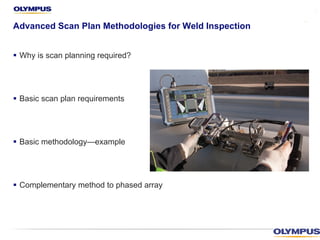
Advanced Scan Plan Methodologies for Weld Inspection
§ Why is scan planning required?
§ Basic scan plan requirements
§ Basic methodology—example
§ Complementary method to phased array
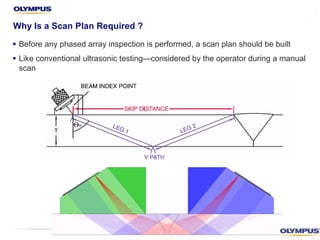
§ Before any phased array inspection is performed, a scan plan should be built
§ Like conventional ultrasonic testing—considered by the operator during a manual
scan
Why Is a Scan Plan Required ?
Why Is a Scan Plan Required?
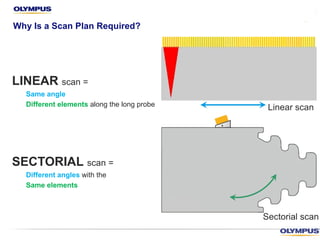
LINEAR scan =
Same angle
Different elements along the long probe
SECTORIAL scan =
Different angles with the
Same elements
Linear scan
Sectorial scan
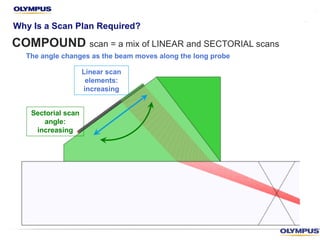
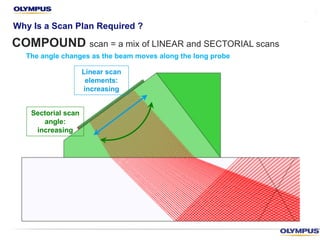
COMPOUND scan = a mix of LINEAR and SECTORIAL scans
The angle changes as the beam moves along the long probe
Why Is a Scan Plan Required?
Sectorial scan
angle:
increasing
Linear scan
elements:
increasing
COMPOUND scan = a mix of LINEAR and SECTORIAL scans
The angle changes as the beam moves along the long probe
Why Is a Scan Plan Required ?
Sectorial scan
angle:
increasing
Linear scan
elements:
increasing
Why Is a Scan Plan Required?
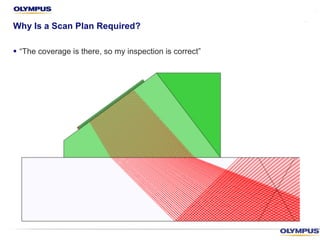
§ “The coverage is there, so my inspection is correct”
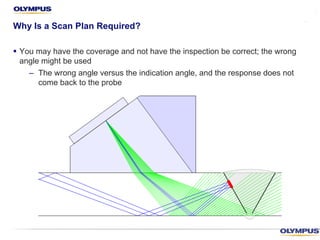
§ You may have the coverage and not have the inspection be correct; the wrong
angle might be used
– The wrong angle versus the indication angle, and the response does not
come back to the probe
Why Is a Scan Plan Required?
Dessin
de
soudure
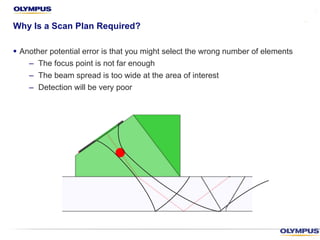
§ Another potential error is that you might select the wrong number of elements
– The focus point is not far enough
– The beam spread is too wide at the area of interest
– Detection will be very poor
Why Is a Scan Plan Required?
Scan Plan Definition
A scan plan is a documented inspection strategy to
provide repeatability for weld inspections
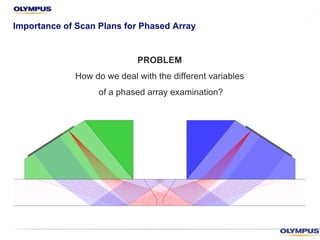
Importance of Scan Plans for Phased Array
PROBLEM
How do we deal with the different variables
of a phased array examination?
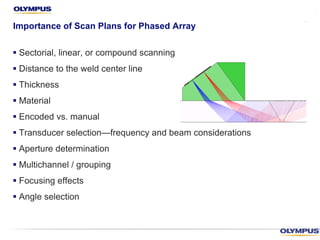
Importance of Scan Plans for Phased Array
§ Sectorial, linear, or compound scanning
§ Distance to the weld center line
§ Thickness
§ Material
§ Encoded vs. manual
§ Transducer selection—frequency and beam considerations
§ Aperture determination
§ Multichannel / grouping
§ Focusing effects
§ Angle selection
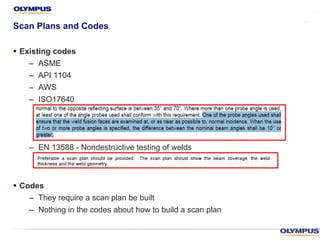
Scan Plans and Codes
§ Existing codes
– ASME
– API 1104
– AWS
– ISO17640
– EN 13588 - Nondestructive testing of welds
§ Codes
– They require a scan plan be built
– Nothing in the codes about how to build a scan plan
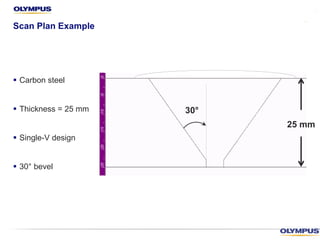
§ Carbon steel
§ Thickness = 25 mm
§ Single-V design
§ 30° bevel
30°
25 mm
Scan Plan Example
Scan Plan Example
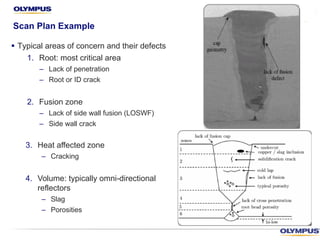
§ Typical areas of concern and their defects
1. Root: most critical area
– Lack of penetration
– Root or ID crack
2. Fusion zone
– Lack of side wall fusion (LOSWF)
– Side wall crack
3. Heat affected zone
– Cracking
4. Volume: typically omni-directional
reflectors
– Slag
– Porosities
How to Deal with a Scan Plan
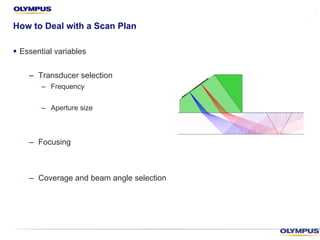
§ Essential variables
– Transducer selection
– Frequency
– Aperture size
– Focusing
– Coverage and beam angle selection
Example
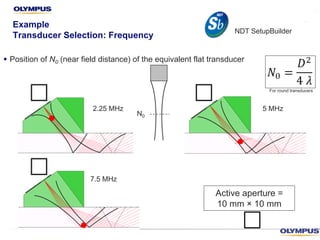
Transducer Selection: Frequency
§ Position of N0 (near field distance) of the equivalent flat transducer
2.25 MHz 5 MHz
7.5 MHz
Active aperture =
10 mm × 10 mm
For round transducers
N0
NDT SetupBuilder
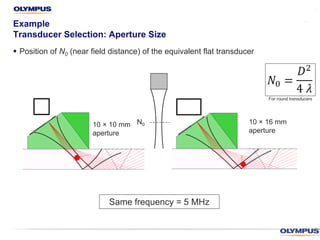
Same frequency = 5 MHz
10 × 16 mm
aperture
10 × 10 mm
aperture
Example
Transducer Selection: Aperture Size
§ Position of N0 (near field distance) of the equivalent flat transducer
For round transducers
N0
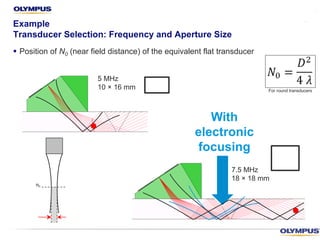
With
electronic
focusing
7.5 MHz
18 × 18 mm
5 MHz
10 × 16 mm
Example
Transducer Selection: Frequency and Aperture Size
§ Position of N0 (near field distance) of the equivalent flat transducer
For round transducers
N0
Focal
Point
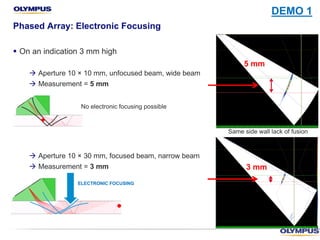
§ On an indication 3 mm high
à Aperture 10 × 10 mm, unfocused beam, wide beam
à Measurement = 5 mm
à Aperture 10 × 30 mm, focused beam, narrow beam
à Measurement = 3 mm
Phased Array: Electronic Focusing
Same side wall lack of fusion
3 mm
5 mm
No electronic focusing possible
ELECTRONIC FOCUSING
DEMO 1
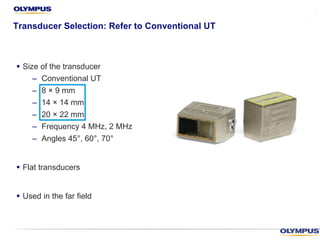
§ Size of the transducer
– Conventional UT
– 8 × 9 mm
– 14 × 14 mm
– 20 × 22 mm
– Frequency 4 MHz, 2 MHz
– Angles 45°, 60°, 70°
§ Flat transducers
§ Used in the far field
Transducer Selection: Refer to Conventional UT
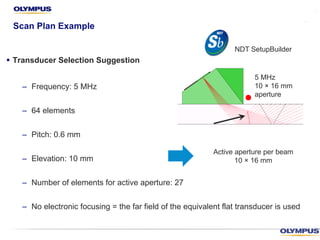
§ Transducer Selection Suggestion
– Frequency: 5 MHz
– 64 elements
– Pitch: 0.6 mm
– Elevation: 10 mm
– Number of elements for active aperture: 27
– No electronic focusing = the far field of the equivalent flat transducer is used
5 MHz
10 × 16 mm
aperture
Active aperture per beam
10 × 16 mm
Scan Plan Example
NDT SetupBuilder
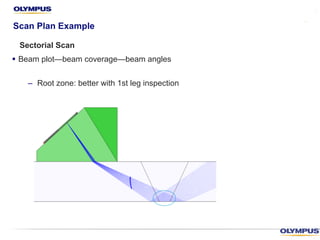
§ Beam plot—beam coverage—beam angles
– Root zone: better with 1st leg inspection
Scan Plan Example
Sectorial Scan
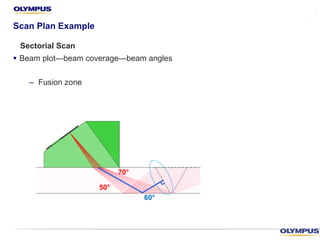
§ Beam plot—beam coverage—beam angles
– Fusion zone
50°
70°
60°
Scan Plan Example
Sectorial Scan
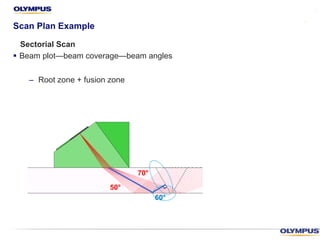
§ Beam plot—beam coverage—beam angles
– Root zone + fusion zone
50°
70°
60°
Scan Plan Example
Sectorial Scan
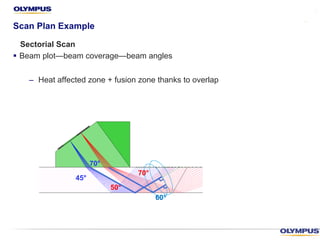
§ Beam plot—beam coverage—beam angles
– Heat affected zone + fusion zone thanks to overlap
50°
70°
60°
45°
70°
Scan Plan Example
Sectorial Scan
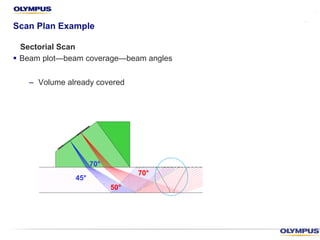
§ Beam plot—beam coverage—beam angles
– Volume already covered
50°
70°
45°
70°
Scan Plan Example
Sectorial Scan
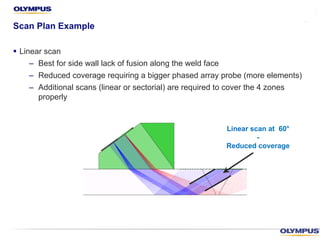
§ Linear scan
– Best for side wall lack of fusion along the weld face
– Reduced coverage requiring a bigger phased array probe (more elements)
– Additional scans (linear or sectorial) are required to cover the 4 zones
properly
Linear scan at 60°
-
Reduced coverage
Scan Plan Example
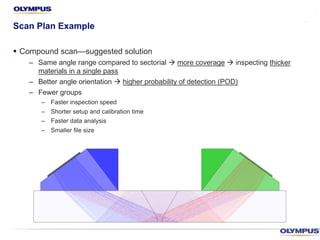
§ Compound scan—suggested solution
– Same angle range compared to sectorial à more coverage à inspecting thicker
materials in a single pass
– Better angle orientation à higher probability of detection (POD)
– Fewer groups
– Faster inspection speed
– Shorter setup and calibration time
– Faster data analysis
– Smaller file size
Scan Plan Example
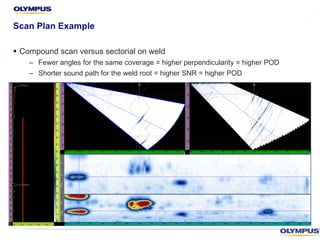
§ Compound scan versus sectorial on weld
– Fewer angles for the same coverage = higher perpendicularity = higher POD
– Shorter sound path for weld root = higher signal-to-noise ratio (SNR) = higher POD
Scan Plan Example
§ Compound scan versus sectorial on weld
– Fewer angles for the same coverage = higher perpendicularity = higher POD
– Shorter sound path for the weld root = higher SNR = higher POD
Scan Plan Example
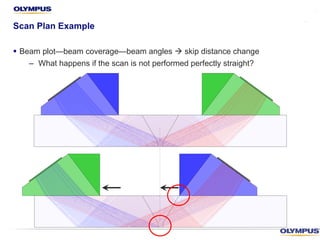
§ Beam plot—beam coverage—beam angles à skip distance change
– What happens if the scan is not performed perfectly straight?
Scan Plan Example
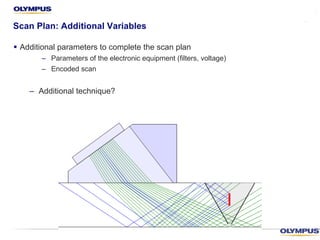
Scan Plan: Additional Variables
§ Additional parameters to complete the scan plan
– Parameters of the electronic equipment (filters, voltage)
– Encoded scan
– Additional technique?
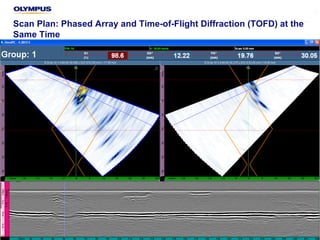
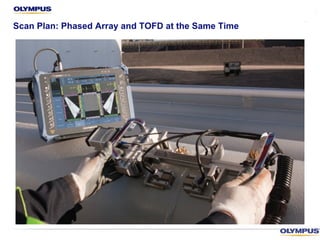
Scan Plan: Phased Array and Time-of-Flight Diffraction (TOFD) at the
Same Time
Scan Plan: TOFD
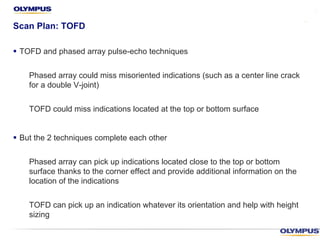
§ TOFD and phased array pulse-echo techniques
Phased array could miss misoriented indications (such as a center line crack
for a double V-joint)
TOFD could miss indications located at the top or bottom surface
§ But the 2 techniques complete each other
Phased array can pick up indications located close to the top or bottom
surface thanks to the corner effect and provide additional information on the
location of the indications
TOFD can pick up an indication whatever its orientation and help with height
sizing
Scan Plan: Phased Array and TOFD at the Same Time
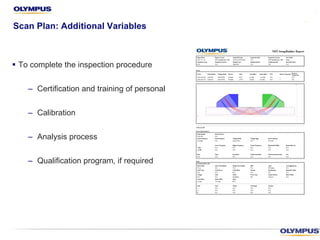
Scan Plan: Additional Variables
§ To complete the inspection procedure
– Certification and training of personal
– Calibration
– Analysis process
– Qualification program, if required
Importance of Scan Plans for Phased Array
§ Sectorial, linear, or compound scanning
§ Distance to weld center line
§ Thickness
§ Material
§ Transducer selection—frequency and beam considerations
§ Encoded vs. manual
§ Aperture determination
§ Multichannel / grouping
§ Focusing effects
§ Angle selection
Scan Plan: Conclusion
§ Phased array is not magic
– Select your transducer
– Select sectorial, linear, or compound scan
– Think about defect orientation
§ Please consider these essential variables
– Frequency, aperture size, focusing
– Coverage and beam angles
§ Following these steps, you should get a good scan plan
Thank You

Phased Array Scan Planning and Modeling for Weld inspection

  • 1.
    June 2018 12th ECNDT – Gothenburg, Sweden 2018 Phased Array Scan Planning and Modeling for Weld inspection Thierry Couturier Olympus Europa
  • 2.
    Advanced Scan PlanMethodologies for Weld Inspection § Why is scan planning required? § Basic scan plan requirements § Basic methodology—example § Complementary method to phased array
  • 3.
    § Before anyphased array inspection is performed, a scan plan should be built § Like conventional ultrasonic testing—considered by the operator during a manual scan Why Is a Scan Plan Required ?
  • 4.
    Why Is aScan Plan Required? LINEAR scan = Same angle Different elements along the long probe SECTORIAL scan = Different angles with the Same elements Linear scan Sectorial scan
  • 5.
    COMPOUND scan =a mix of LINEAR and SECTORIAL scans The angle changes as the beam moves along the long probe Why Is a Scan Plan Required? Sectorial scan angle: increasing Linear scan elements: increasing
  • 6.
    COMPOUND scan =a mix of LINEAR and SECTORIAL scans The angle changes as the beam moves along the long probe Why Is a Scan Plan Required ? Sectorial scan angle: increasing Linear scan elements: increasing
  • 7.
    Why Is aScan Plan Required? § “The coverage is there, so my inspection is correct”
  • 8.
    § You mayhave the coverage and not have the inspection be correct; the wrong angle might be used – The wrong angle versus the indication angle, and the response does not come back to the probe Why Is a Scan Plan Required? Dessin de soudure
  • 9.
    § Another potentialerror is that you might select the wrong number of elements – The focus point is not far enough – The beam spread is too wide at the area of interest – Detection will be very poor Why Is a Scan Plan Required?
  • 10.
    Scan Plan Definition Ascan plan is a documented inspection strategy to provide repeatability for weld inspections
  • 11.
    Importance of ScanPlans for Phased Array PROBLEM How do we deal with the different variables of a phased array examination?
  • 12.
    Importance of ScanPlans for Phased Array § Sectorial, linear, or compound scanning § Distance to the weld center line § Thickness § Material § Encoded vs. manual § Transducer selection—frequency and beam considerations § Aperture determination § Multichannel / grouping § Focusing effects § Angle selection
  • 13.
    Scan Plans andCodes § Existing codes – ASME – API 1104 – AWS – ISO17640 – EN 13588 - Nondestructive testing of welds § Codes – They require a scan plan be built – Nothing in the codes about how to build a scan plan
  • 14.
    § Carbon steel §Thickness = 25 mm § Single-V design § 30° bevel 30° 25 mm Scan Plan Example
  • 15.
    Scan Plan Example §Typical areas of concern and their defects 1. Root: most critical area – Lack of penetration – Root or ID crack 2. Fusion zone – Lack of side wall fusion (LOSWF) – Side wall crack 3. Heat affected zone – Cracking 4. Volume: typically omni-directional reflectors – Slag – Porosities
  • 16.
    How to Dealwith a Scan Plan § Essential variables – Transducer selection – Frequency – Aperture size – Focusing – Coverage and beam angle selection
  • 17.
    Example Transducer Selection: Frequency §Position of N0 (near field distance) of the equivalent flat transducer 2.25 MHz 5 MHz 7.5 MHz Active aperture = 10 mm × 10 mm For round transducers N0 NDT SetupBuilder
  • 18.
    Same frequency =5 MHz 10 × 16 mm aperture 10 × 10 mm aperture Example Transducer Selection: Aperture Size § Position of N0 (near field distance) of the equivalent flat transducer For round transducers N0
  • 19.
    With electronic focusing 7.5 MHz 18 ×18 mm 5 MHz 10 × 16 mm Example Transducer Selection: Frequency and Aperture Size § Position of N0 (near field distance) of the equivalent flat transducer For round transducers N0 Focal Point
  • 20.
    § On anindication 3 mm high à Aperture 10 × 10 mm, unfocused beam, wide beam à Measurement = 5 mm à Aperture 10 × 30 mm, focused beam, narrow beam à Measurement = 3 mm Phased Array: Electronic Focusing Same side wall lack of fusion 3 mm 5 mm No electronic focusing possible ELECTRONIC FOCUSING DEMO 1
  • 21.
    § Size ofthe transducer – Conventional UT – 8 × 9 mm – 14 × 14 mm – 20 × 22 mm – Frequency 4 MHz, 2 MHz – Angles 45°, 60°, 70° § Flat transducers § Used in the far field Transducer Selection: Refer to Conventional UT
  • 22.
    § Transducer SelectionSuggestion – Frequency: 5 MHz – 64 elements – Pitch: 0.6 mm – Elevation: 10 mm – Number of elements for active aperture: 27 – No electronic focusing = the far field of the equivalent flat transducer is used 5 MHz 10 × 16 mm aperture Active aperture per beam 10 × 16 mm Scan Plan Example NDT SetupBuilder
  • 23.
    § Beam plot—beamcoverage—beam angles – Root zone: better with 1st leg inspection Scan Plan Example Sectorial Scan
  • 24.
    § Beam plot—beamcoverage—beam angles – Fusion zone 50° 70° 60° Scan Plan Example Sectorial Scan
  • 25.
    § Beam plot—beamcoverage—beam angles – Root zone + fusion zone 50° 70° 60° Scan Plan Example Sectorial Scan
  • 26.
    § Beam plot—beamcoverage—beam angles – Heat affected zone + fusion zone thanks to overlap 50° 70° 60° 45° 70° Scan Plan Example Sectorial Scan
  • 27.
    § Beam plot—beamcoverage—beam angles – Volume already covered 50° 70° 45° 70° Scan Plan Example Sectorial Scan
  • 28.
    § Linear scan –Best for side wall lack of fusion along the weld face – Reduced coverage requiring a bigger phased array probe (more elements) – Additional scans (linear or sectorial) are required to cover the 4 zones properly Linear scan at 60° - Reduced coverage Scan Plan Example
  • 29.
    § Compound scan—suggestedsolution – Same angle range compared to sectorial à more coverage à inspecting thicker materials in a single pass – Better angle orientation à higher probability of detection (POD) – Fewer groups – Faster inspection speed – Shorter setup and calibration time – Faster data analysis – Smaller file size Scan Plan Example
  • 30.
    § Compound scanversus sectorial on weld – Fewer angles for the same coverage = higher perpendicularity = higher POD – Shorter sound path for weld root = higher signal-to-noise ratio (SNR) = higher POD Scan Plan Example
  • 31.
    § Compound scanversus sectorial on weld – Fewer angles for the same coverage = higher perpendicularity = higher POD – Shorter sound path for the weld root = higher SNR = higher POD Scan Plan Example
  • 32.
    § Beam plot—beamcoverage—beam angles à skip distance change – What happens if the scan is not performed perfectly straight? Scan Plan Example
  • 33.
    Scan Plan: AdditionalVariables § Additional parameters to complete the scan plan – Parameters of the electronic equipment (filters, voltage) – Encoded scan – Additional technique?
  • 34.
    Scan Plan: PhasedArray and Time-of-Flight Diffraction (TOFD) at the Same Time
  • 35.
    Scan Plan: TOFD §TOFD and phased array pulse-echo techniques Phased array could miss misoriented indications (such as a center line crack for a double V-joint) TOFD could miss indications located at the top or bottom surface § But the 2 techniques complete each other Phased array can pick up indications located close to the top or bottom surface thanks to the corner effect and provide additional information on the location of the indications TOFD can pick up an indication whatever its orientation and help with height sizing
  • 36.
    Scan Plan: PhasedArray and TOFD at the Same Time
  • 37.
    Scan Plan: AdditionalVariables § To complete the inspection procedure – Certification and training of personal – Calibration – Analysis process – Qualification program, if required
  • 38.
    Importance of ScanPlans for Phased Array § Sectorial, linear, or compound scanning § Distance to weld center line § Thickness § Material § Transducer selection—frequency and beam considerations § Encoded vs. manual § Aperture determination § Multichannel / grouping § Focusing effects § Angle selection
  • 39.
    Scan Plan: Conclusion §Phased array is not magic – Select your transducer – Select sectorial, linear, or compound scan – Think about defect orientation § Please consider these essential variables – Frequency, aperture size, focusing – Coverage and beam angles § Following these steps, you should get a good scan plan
  • 40.