A2 G&P
US Government and Politics
Campaign Finance
UNIT 3A: OUTLINE: KEY CONCEPTS
KEY CONCEPTS
 Open, closed and invisible primaries
 The caucus system
 The balanced ticket
 Candidate and issue centred campaigns
 Momentum
 Soft and hard money
 Negative campaigning
 Insider and outsider candidates
 Fixed terms
 Swing states
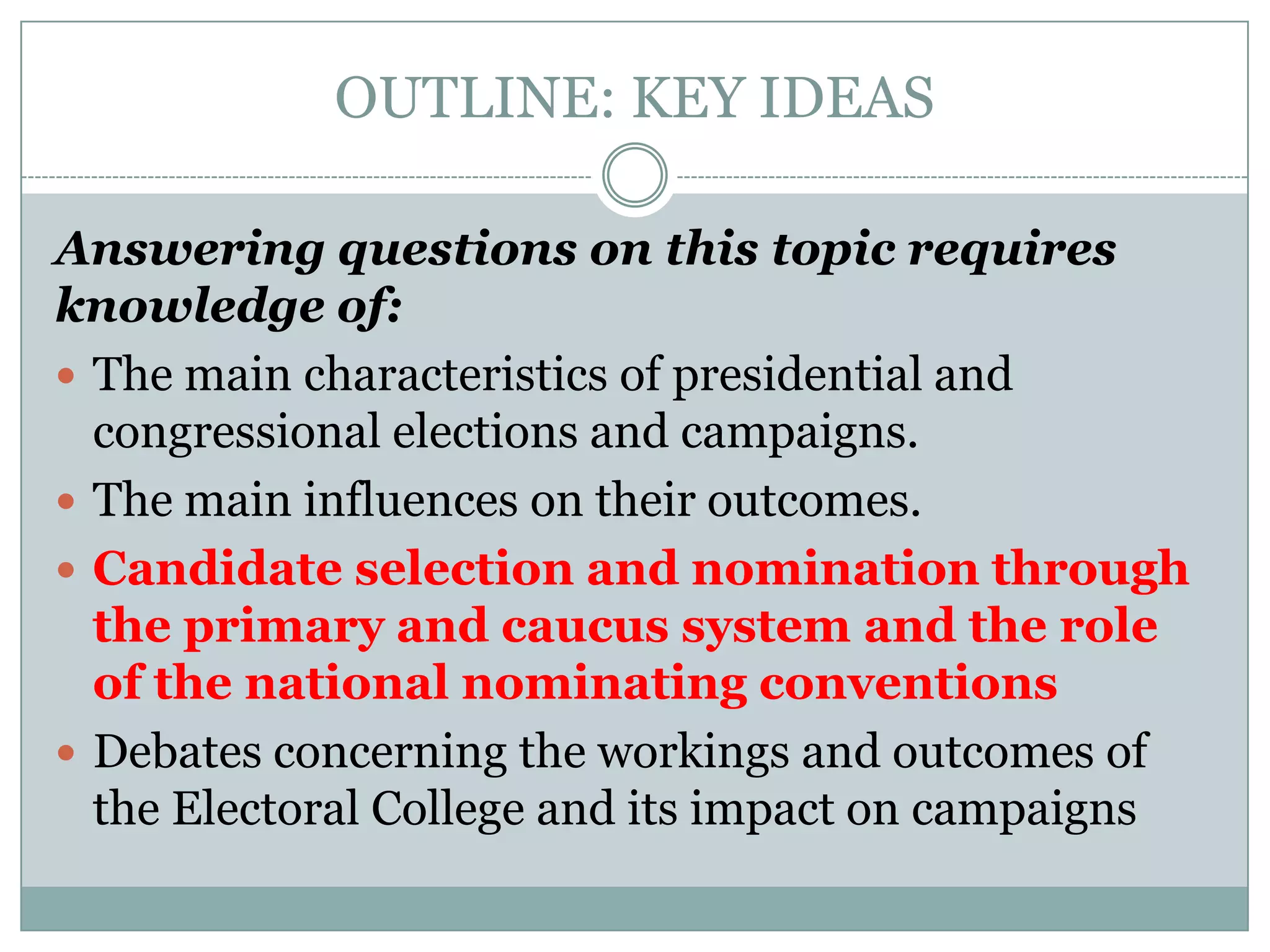
OUTLINE: KEY IDEAS
Answering questions on this topic requires
knowledge of:
 The main characteristics of presidential and
congressional elections and campaigns.
 The main influences on their outcomes.
 Candidate selection and nomination through
the primary and caucus system and the role
of the national nominating conventions
 Debates concerning the workings and outcomes of
the Electoral College and its impact on campaigns
OUTLINE: KEY IDEAS
Answering questions on this topic requires
knowledge of:
 The significance of money as a factor in electoral
success.
 The impact of the media on campaigns and candidates
 Direct democracy at State level through the use of
referendums
 Initiatives, propositions and recall elections, and
debates concerning their use
 Comparisons with the UK electoral process to illustrate
arguments
Campaign Finance
 By the 1970s there were increasing concerns about the
amount of money being spent in presidential elections
 In the 1972 presidential election, Nixon formed his own re-
election committee (CRP).
 Through CRP he managed to raise vast sums of money
(much more than Democrat contender George McGovern)
 It was through CRP that the break-in and bugging at
Watergate complex was masterminded.
Watergate Explained
Campaign Finance
 The Watergate affair gave much needed impetus to
reforming the campaign finance system.
 Congress has begun to pass campaign finance reform
legislation in 1971, but the year in which Nixon resigned
1974, saw a much more significant set of reforms.
 The Federal Election Campaign Act of 1974 made a number
of significant changes hoping to reduce reliance on a
few, very wealthy donors – known as ‘fat cats’ – and
equalise the amount of money spent by both major parties.
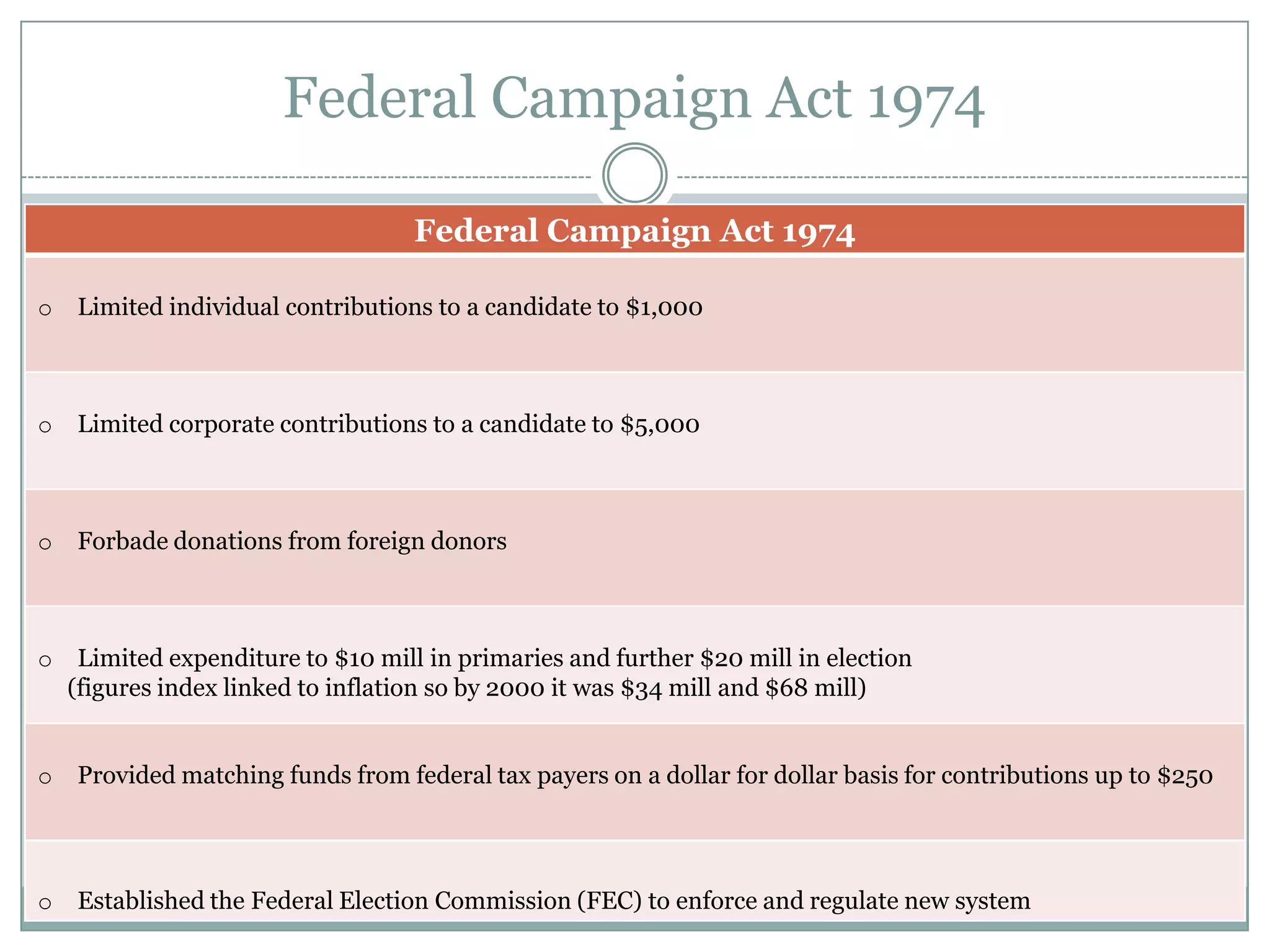
Federal Campaign Act 1974
o Limited individual contributions to a candidate to $1,000
o Limited corporate contributions to a candidate to $5,000
o Forbade donations from foreign donors
o Limited expenditure to $10 mill in primaries and further $20 mill in election
(figures index linked to inflation so by 2000 it was $34 mill and $68 mill)
o Provided matching funds from federal tax payers on a dollar for dollar basis for contributions up to $250
o Established the Federal Election Commission (FEC) to enforce and regulate new system
Campaign Finance
 The objectives of these reforms were praiseworthy and they
were partly successful . But the law was found to have too
many loopholes and was weakened by both the Supreme
Court and Congress.
 In 1976, in Buckley v Valeo, the Supreme Court rules that
limitations on what individuals or Political Action
Committees could spent either supporting or opposing a
candidate infringed 1st Amendment rights and were
therefore unconstitutional.
Campaign Finance
 In 1979, Congress further weakened the law by allowing
parties to raise money for such aspects as voter registration
and get-out-the-vote drives as well as ‘party building’
activities. This is the so-called ‘soft money’ that would
soon be regarded by most observers to be out of control.
 In 2000, Senator John McCain made campaign finance
reform a focal point of his bid for the Republican
nomination and this gave increased momentum to attempts
both in the House of Representatives and in the Senate to
pass a Campaign Finance Reform Bill.
Campaign Finance
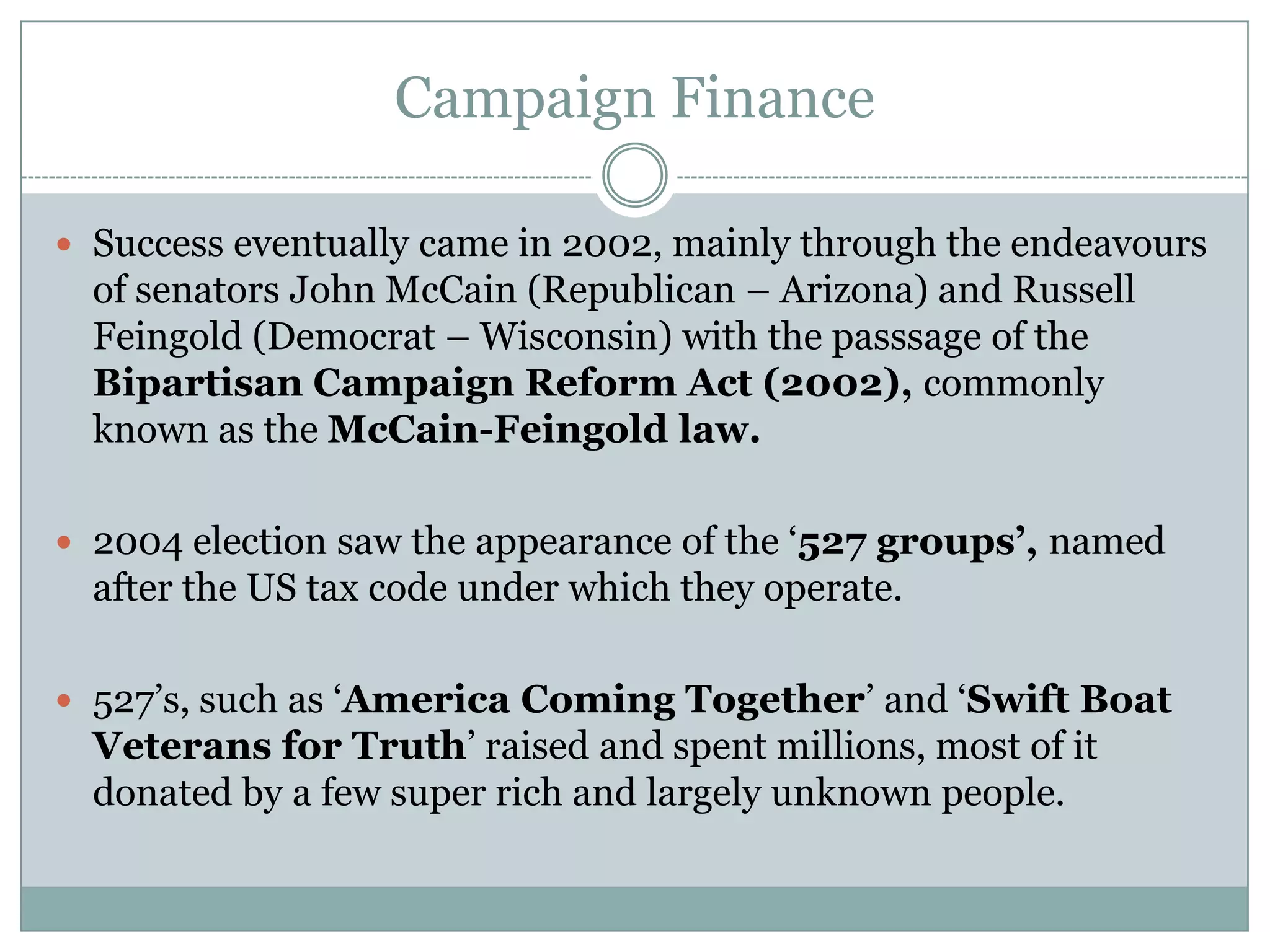
 Success eventually came in 2002, mainly through the endeavours
of senators John McCain (Republican – Arizona) and Russell
Feingold (Democrat – Wisconsin) with the passsage of the
Bipartisan Campaign Reform Act (2002), commonly
known as the McCain-Feingold law.
 2004 election saw the appearance of the ‘527 groups’, named
after the US tax code under which they operate.
 527’s, such as ‘America Coming Together’ and ‘Swift Boat
Veterans for Truth’ raised and spent millions, most of it
donated by a few super rich and largely unknown people.
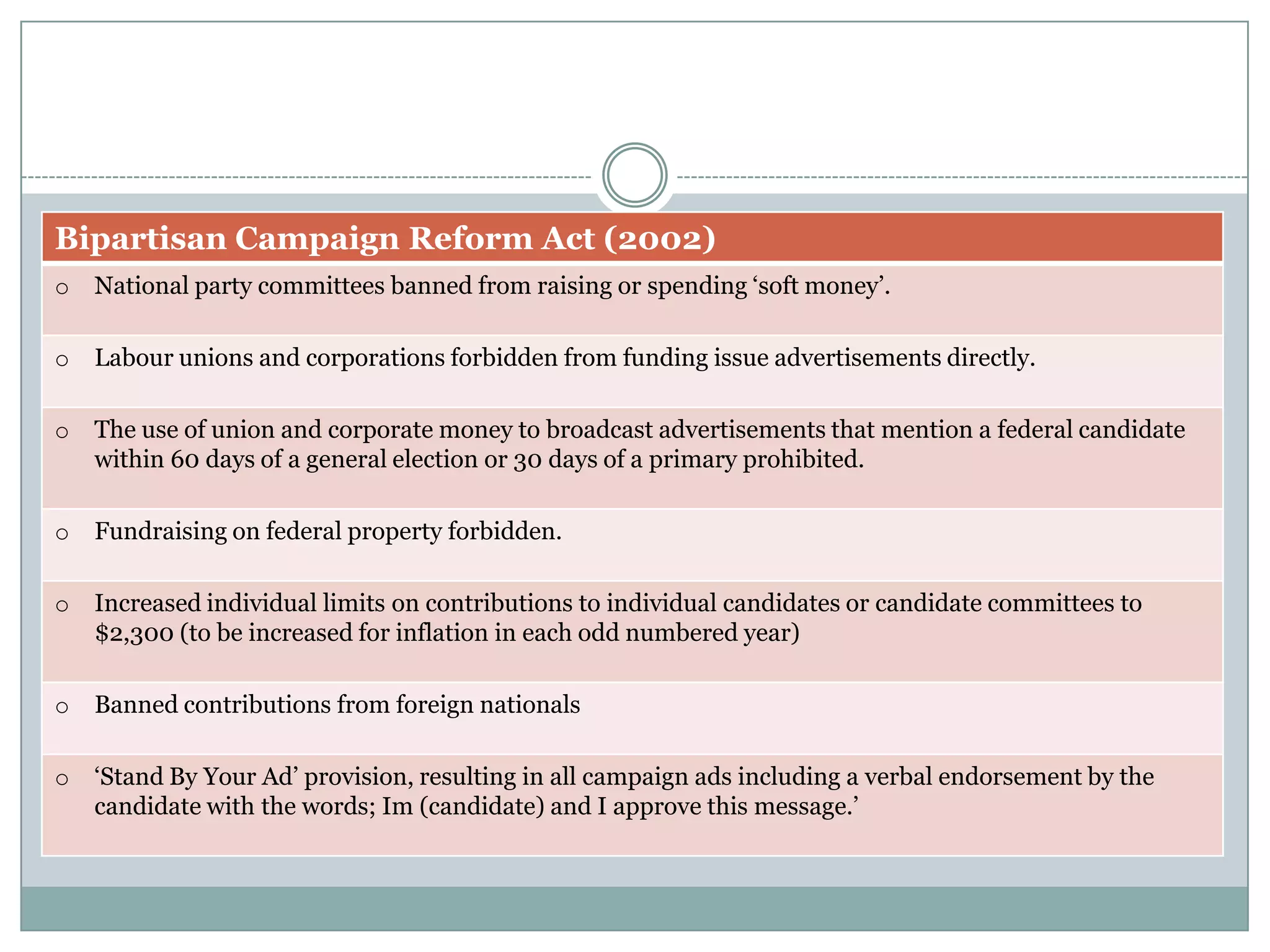
Bipartisan Campaign Reform Act (2002)
o National party committees banned from raising or spending ‘soft money’.
o Labour unions and corporations forbidden from funding issue advertisements directly.
o The use of union and corporate money to broadcast advertisements that mention a federal candidate
within 60 days of a general election or 30 days of a primary prohibited.
o Fundraising on federal property forbidden.
o Increased individual limits on contributions to individual candidates or candidate committees to
$2,300 (to be increased for inflation in each odd numbered year)
o Banned contributions from foreign nationals
o ‘Stand By Your Ad’ provision, resulting in all campaign ads including a verbal endorsement by the
candidate with the words; Im (candidate) and I approve this message.’
Campaign Finance
 In the 2008 election, Barack Obama raised huge amounts
of money through the internet from small donors.
 The huge success of his electronic fundraising may well
ensure that this becomes a model for future presidential
campaigns.
 Obama became the first major party presidential candidate
to forego the federal matching funds – worth $84 million in
2008 – during the general election campaign.
Campaign Finance
 McCain took the federal money, but in doing so had to limit
himself to that as a cap for his general election spending.
 With Obama raising huge amounts of money during the
final weeks of the campaign – he raised over $150 million
in September along – McCain was at a significant
disadvantage, and it showed.
 It showed in the final weeks by the fact that Obama had far
more money to spend on campaigning and on opening
offices in swing states than McCain could afford.
Campaign Finance
 In October, Obama spent over $5 million on TV ads in
North Carolina. McCain had spent just over £790,000.
 During that same time, McCain’s 11-percentage point lead
in the state disappeared.
 In Missouri, another swing state, Obama opened up 41 field
offices compared to McCains 16. McCain’s early 7 point
lead, disappeared.
 McCain trying to have conversation with a man with a
‘megaphone!’.
Exam Questions
ESSAY QUESTION
What are the major concerns regarding campaign finance in
presidential elections?
What are the reforms of 1974 and 2002 to campaign finance
and how effective have they been?

A2 G&P campaign finance

  • 1.
    A2 G&P US Governmentand Politics Campaign Finance
  • 2.
    UNIT 3A: OUTLINE:KEY CONCEPTS KEY CONCEPTS  Open, closed and invisible primaries  The caucus system  The balanced ticket  Candidate and issue centred campaigns  Momentum  Soft and hard money  Negative campaigning  Insider and outsider candidates  Fixed terms  Swing states
  • 3.
    OUTLINE: KEY IDEAS Answeringquestions on this topic requires knowledge of:  The main characteristics of presidential and congressional elections and campaigns.  The main influences on their outcomes.  Candidate selection and nomination through the primary and caucus system and the role of the national nominating conventions  Debates concerning the workings and outcomes of the Electoral College and its impact on campaigns
  • 4.
    OUTLINE: KEY IDEAS Answeringquestions on this topic requires knowledge of:  The significance of money as a factor in electoral success.  The impact of the media on campaigns and candidates  Direct democracy at State level through the use of referendums  Initiatives, propositions and recall elections, and debates concerning their use  Comparisons with the UK electoral process to illustrate arguments
  • 5.
    Campaign Finance  Bythe 1970s there were increasing concerns about the amount of money being spent in presidential elections  In the 1972 presidential election, Nixon formed his own re- election committee (CRP).  Through CRP he managed to raise vast sums of money (much more than Democrat contender George McGovern)  It was through CRP that the break-in and bugging at Watergate complex was masterminded.
  • 6.
  • 7.
    Campaign Finance  TheWatergate affair gave much needed impetus to reforming the campaign finance system.  Congress has begun to pass campaign finance reform legislation in 1971, but the year in which Nixon resigned 1974, saw a much more significant set of reforms.  The Federal Election Campaign Act of 1974 made a number of significant changes hoping to reduce reliance on a few, very wealthy donors – known as ‘fat cats’ – and equalise the amount of money spent by both major parties.
  • 8.
    Federal Campaign Act1974 Federal Campaign Act 1974 o Limited individual contributions to a candidate to $1,000 o Limited corporate contributions to a candidate to $5,000 o Forbade donations from foreign donors o Limited expenditure to $10 mill in primaries and further $20 mill in election (figures index linked to inflation so by 2000 it was $34 mill and $68 mill) o Provided matching funds from federal tax payers on a dollar for dollar basis for contributions up to $250 o Established the Federal Election Commission (FEC) to enforce and regulate new system
  • 9.
    Campaign Finance  Theobjectives of these reforms were praiseworthy and they were partly successful . But the law was found to have too many loopholes and was weakened by both the Supreme Court and Congress.  In 1976, in Buckley v Valeo, the Supreme Court rules that limitations on what individuals or Political Action Committees could spent either supporting or opposing a candidate infringed 1st Amendment rights and were therefore unconstitutional.
  • 10.
    Campaign Finance  In1979, Congress further weakened the law by allowing parties to raise money for such aspects as voter registration and get-out-the-vote drives as well as ‘party building’ activities. This is the so-called ‘soft money’ that would soon be regarded by most observers to be out of control.  In 2000, Senator John McCain made campaign finance reform a focal point of his bid for the Republican nomination and this gave increased momentum to attempts both in the House of Representatives and in the Senate to pass a Campaign Finance Reform Bill.
  • 11.
    Campaign Finance  Successeventually came in 2002, mainly through the endeavours of senators John McCain (Republican – Arizona) and Russell Feingold (Democrat – Wisconsin) with the passsage of the Bipartisan Campaign Reform Act (2002), commonly known as the McCain-Feingold law.  2004 election saw the appearance of the ‘527 groups’, named after the US tax code under which they operate.  527’s, such as ‘America Coming Together’ and ‘Swift Boat Veterans for Truth’ raised and spent millions, most of it donated by a few super rich and largely unknown people.
  • 12.
    Bipartisan Campaign ReformAct (2002) o National party committees banned from raising or spending ‘soft money’. o Labour unions and corporations forbidden from funding issue advertisements directly. o The use of union and corporate money to broadcast advertisements that mention a federal candidate within 60 days of a general election or 30 days of a primary prohibited. o Fundraising on federal property forbidden. o Increased individual limits on contributions to individual candidates or candidate committees to $2,300 (to be increased for inflation in each odd numbered year) o Banned contributions from foreign nationals o ‘Stand By Your Ad’ provision, resulting in all campaign ads including a verbal endorsement by the candidate with the words; Im (candidate) and I approve this message.’
  • 13.
    Campaign Finance  Inthe 2008 election, Barack Obama raised huge amounts of money through the internet from small donors.  The huge success of his electronic fundraising may well ensure that this becomes a model for future presidential campaigns.  Obama became the first major party presidential candidate to forego the federal matching funds – worth $84 million in 2008 – during the general election campaign.
  • 14.
    Campaign Finance  McCaintook the federal money, but in doing so had to limit himself to that as a cap for his general election spending.  With Obama raising huge amounts of money during the final weeks of the campaign – he raised over $150 million in September along – McCain was at a significant disadvantage, and it showed.  It showed in the final weeks by the fact that Obama had far more money to spend on campaigning and on opening offices in swing states than McCain could afford.
  • 15.
    Campaign Finance  InOctober, Obama spent over $5 million on TV ads in North Carolina. McCain had spent just over £790,000.  During that same time, McCain’s 11-percentage point lead in the state disappeared.  In Missouri, another swing state, Obama opened up 41 field offices compared to McCains 16. McCain’s early 7 point lead, disappeared.  McCain trying to have conversation with a man with a ‘megaphone!’.
  • 16.
    Exam Questions ESSAY QUESTION Whatare the major concerns regarding campaign finance in presidential elections? What are the reforms of 1974 and 2002 to campaign finance and how effective have they been?