
Robotic sacrocolpopexy
rob
OLV technique

G. De Naeyer, P. Schatteman, P. Carpentier, A. Mottrie
Department of Urology

Onze-Lieve-Vrouwclinic, Aalst
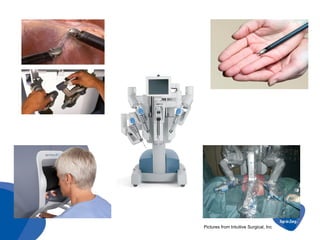
Pictures from Intuitive Surgical, Inc
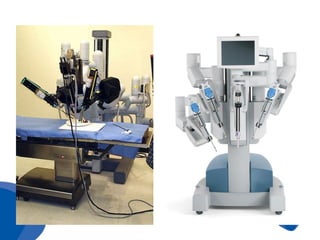
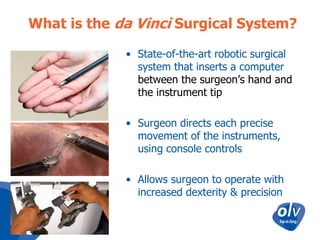
What is the da Vinci Surgical System?
• State-of-the-art robotic surgical
system that inserts a computer
between the surgeon’s hand and
the instrument tip
• Surgeon directs each precise
movement of the instruments,
using console controls
• Allows surgeon to operate with
increased dexterity & precision
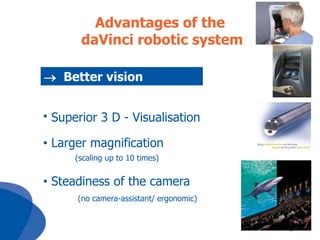
Advantages of the
daVinci robotic system
 Better vision
• Superior 3 D - Visualisation
• Larger magnification
(scaling up to 10 times)

• Steadiness of the camera
(no camera-assistant/ ergonomic)
Advantages of the
daVinci robotic system
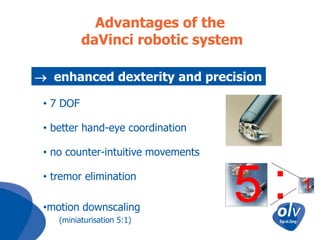
 enhanced dexterity and precision
• 7 DOF
• better hand-eye coordination
• no counter-intuitive movements
• tremor elimination
•motion downscaling
(miniaturisation 5:1)

5:

1
Advantages of the daVinci robotic
system
• In performing surgical tasks, 3-D vision allows for significant
improvement in performance times and error rates.
• Blavier A Impact of 2D and 3D vision on performance of novice subjects
using da Vinci robotic system. Acta Chir Belg. 2006 Nov-Dec; 106(6):662-4.

• Robotic knot tying and suturing, has a shorter learning curve
compared to conventional laparoscopy
• Sarle R. Surgical robotics and laparoscopic training drills. J Endourol. 2004
Feb;18(1):63-6.

• Studies on skill training suggest that robotics increase
ambidexterity by improving non-dominant hand performance.
• Maniar HS. Comparison of skill training with robotic systems and
traditional endoscopy: implications on training and adoption. J Surg Res
2005 May 1;125(1):23-9.
Advantages of the daVinci robotic
system in RASC
•

Analysis of robotic performance times to improve operative efficiency.
Geller EJ .
–

J Minim Invasive Gynecol. 2013 Jan-Feb;20(1):43-8.

•

estimate the efficiency of procedural steps in robotic sacrocolpopexy

•

Retrospective study with 147 patients

•

Comparison of the first 20 procedures with the subsequent 127 demonstrated that there
was considerable improvement in time of cuff closure (p = .04); sacral dissection (p =
.004); anterior (p = .006), posterior, (p = .003), and sacral (p = .003) mesh attachment;
peritoneal closure (p < .001); total docked time (p = .02); and total incision time (p <
.001).

•
•

CONCLUSION: Robotic efficiency improves over a short learning period, with
greatest differences in intracorporeal suturing and overall times.
Disadvantages of the
robotic approach in pelvic surgery
• Procedure Time ?
• Patient positioning:
– extreme Trendelenburg AND lithotomy

• Team-work: experience of table side assistant and nurse
– Tension on the mesh ?

• Specific robotic system related complications
• Robotic system failure
• Cost ?
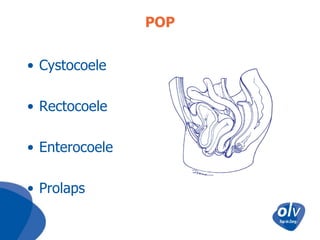
POP
• Cystocoele
• Rectocoele

• Enterocoele
• Prolaps
POP repair
• Colporaphy / Transvaginal mesh repair
– Transvaginal techniques are widely used but are characterized by
high recurrence rates, likely due to poor apical support.
•

Benson JT, Lucente V, McClellan E. Vaginal versus abdominal reconstructive surgery for the
treatment of pelvic support defects: a prospective randomized study with long-term outcome
evaluation. Am J Obstet Gynecol. 1996;175:1418-21;

• Abdominal sacral colpopexy with synthetic mesh
– considered the gold standard for surgical correction of vaginal vault
prolapse
– with long-term efficacy (to level 1 studies)
– Open, lap or robotic

Maher C et al. Surgical management of pelvic organ prolapse in women. Cochrane Database Syst Rev. 2010.
Nygaard IE et al. Abdominal sacrocolpopexy: a comprehensive review. Obstet Gynecol. 2004;104:805-23.
Principles for POP repair
1. Repositioning of different organs with respect to their
anatomical relationship
2. Repair and/or preservation of urinary and anal
continence

3. Preservation of satisfying sexual activity
4. Achieve a durable result

5. As minimal invasive as possible
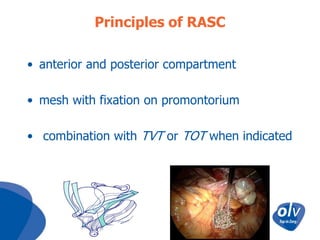
Principles of RASC
• anterior and posterior compartment
• mesh with fixation on promontorium
• combination with TVT or TOT when indicated
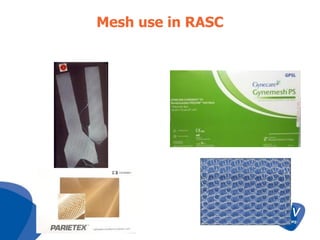
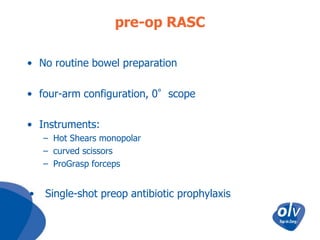
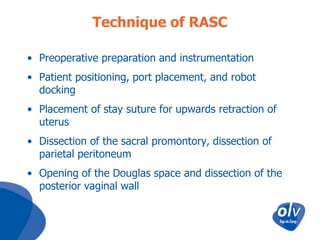
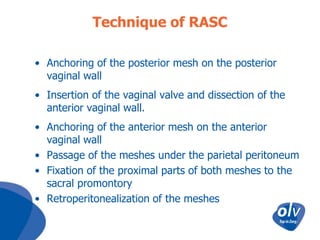
Mesh use in RASC
pre-op RASC
• No routine bowel preparation

• four-arm configuration, 0°scope
• Instruments:
– Hot Shears monopolar
– curved scissors
– ProGrasp forceps

•

Single-shot preop antibiotic prophylaxis
Technique of RASC
• Preoperative preparation and instrumentation
• Patient positioning, port placement, and robot
docking
• Placement of stay suture for upwards retraction of
uterus
• Dissection of the sacral promontory, dissection of
parietal peritoneum
• Opening of the Douglas space and dissection of the
posterior vaginal wall
Technique of RASC
• Anchoring of the posterior mesh on the posterior
vaginal wall
• Insertion of the vaginal valve and dissection of the
anterior vaginal wall.
• Anchoring of the anterior mesh on the anterior
vaginal wall
• Passage of the meshes under the parietal peritoneum
• Fixation of the proximal parts of both meshes to the
sacral promontory
• Retroperitonealization of the meshes
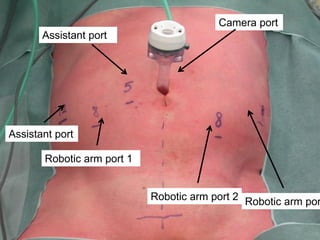
Camera port
Assistant port

Assistant port
Robotic arm port 1

Robotic arm port 2 Robotic arm por
• Video RASC
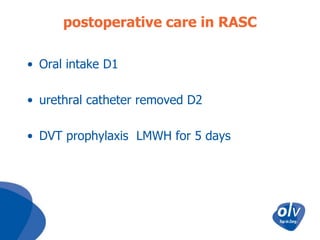
postoperative care in RASC
• Oral intake D1

• urethral catheter removed D2
• DVT prophylaxis LMWH for 5 days
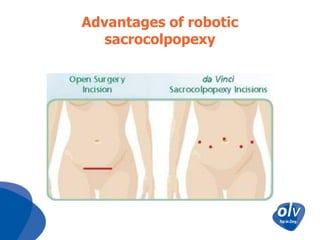
Advantages of robotic
sacrocolpopexy
Advantages of RASC

• Posterior dissection
• Large rectocoeles
• Tile-pro and Fourth-arm to increase consolesurgeon autonomy and better exposure.
Complications of robotic
sacrocolpopexy
• Same as open or lap
• surgeon or technique related
–
–
–
–

Vascular injury (promontory)
Bladderperforation
Vaginal wall perforation
Ureteral injury

• related to robotic system:
– Table-assistant/nurse related injuries
– Robotic failure
– Specific complications
Lavery et al J Endourol 2008
Fischer B et al. World J Urol 2008
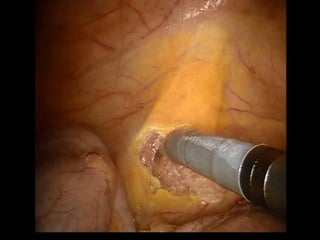
• Video darm in endowrist
Corneal abrasions

•

Incidence of corneal abrasions during pelvic reconstructive surgery.
–

Antosh DD. Eur J Obstet Gynecol Reprod Biol. 2013 Feb;166(2):226-8.

•

More corneal abrasions occurred with laparoscopic and robotic sacral colpopexy compared
to vaginal apical suspension procedures.

•

Risk factors could not be identified in this study.
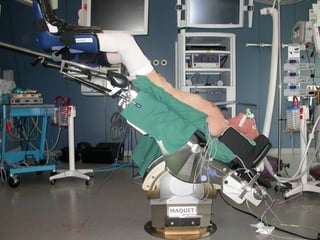
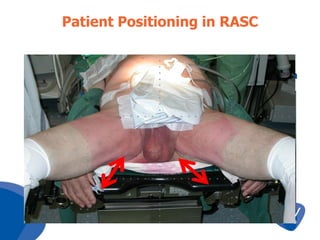
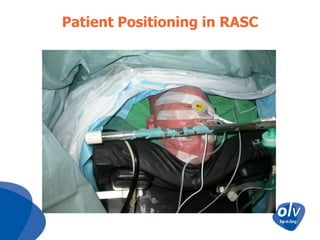
Patient Positioning in RASC

Steep Trendelenburg + Modified Lithotomy position

40

°
Patient Positioning in RASC

•

Trendelenburg position in gynecologic robotic-assisted surgery.
–

•

Ghomi A et al. J Minim Invasive Gynecol. 2012 Jul-Aug;19(4):485-9

CONCLUSION: Robotic-assisted benign gynecologic surgery can be
effectively performed without use of the steep Trendelenburg position.
The practice of routine adherence to steep Trendelenburg positioning
in benign gynecologicrobotic surgery should be questioned.
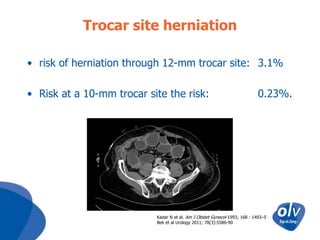
Trocar site herniation
• risk of herniation through 12-mm trocar site: 3.1%

• Risk at a 10-mm trocar site the risk:

0.23%.

Kadar N et al. Am J Obstet Gynecol 1993; 168 : 1493–5
Bek et al Urology 2011; 78(3):5586-90
• Video re art iliaca
RASC: own study results
• retrospective review 95 consecutive patients who
underwent RASC for POP
• from April 2006 to December 2011.
• RASC with use of polypropylene meshes
• standardized technique using the “Da Vinci surgical
system” in a four-arm configuration.
RASC: own study results
• Median operative time: 101 minutes.
• No conversion to open surgery
• One vaginal and two bladder injuries occurred and were
repaired intraoperatively.
• Only one Clavien grade III postoperative complication was
observed (bowel obstruction treated laparoscopically).
• 34 months follow-up:
– persistent POP in 4 cases (4.2%).
– One mesh erosion, robot–assisted removal of the mesh.
– Ten (10.5%) patients de novo urgency
– No significant de novo bowel or sexual symptoms were reported.
Demographics, clinical characteristics and frequency
of symptoms at presentation in our series
Age (years)
iBMI
ASA Score

Pelvic heaviness
Urgency
Stress urinary incontinence
Dysuria
Constipation
Urinary tract infection

Median
67
29
1

IQR
[63-73]
[28-32]
[1-2]

No
90
31

%
94.7
32.6

20

21.1

17
12
8

17.9
12.6
8.4
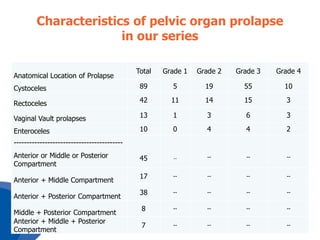
Characteristics of pelvic organ prolapse
in our series
Total

Grade 1

Grade 2

Grade 3

Grade 4

Cystoceles

89

5

19

55

10

Rectoceles

42

11

14

15

3

Vaginal Vault prolapses

13

1

3

6

3

Enteroceles

10

0

4

4

2

45

..

--

--

--

17

--

--

--

--

38

--

--

--

--

8

--

--

--

--

7

--

--

--

--

Anatomical Location of Prolapse

-----------------------------------------Anterior or Middle or Posterior
Compartment
Anterior + Middle Compartment
Anterior + Posterior Compartment
Middle + Posterior Compartment
Anterior + Middle + Posterior
Compartment
RASC versus open
•

single-institution, retrospective studies

•

suggesting minimal morbidity, technical feasibility, and short-term efficacy
comparable to open abdominal sacrocolpopexy.

•

series of RASC: relatively small sample size

•

No published randomized, controlled trials comparing robotic with open or
laparoscopic sacrocolpopexy,

•

superior to the other established minimally invasive transvaginal and
laparoscopic approaches ?
Kim JH et al. Is robotic sacrocolpopexy a marketing gimmick or a technological advancement? Curr
Opin Urol. 2010 Jul;20(4):280-4.
Geller EJ et al. Robotic vs abdominal sacrocolpopexy: 44-month pelvic floor outcomes. Urology.
2012;79:532-6.
Gilleran JP Robotic-assisted laparoscopic mesh sacrocolpopexy. Ther Adv Urol. 2010;2:195-208.
Eliot D et al. Long-term results of robotic asssited laparoscopic sacrocolpopexy for the treatment of
high grade vaginal vault prolapse. J Urol. 2006;176:655-9.
Germain A et al. Long-term outcomes after totally robotic sacrocolpopexy for treatment of pelvic organ
prolapse. Surg Endosc. 2013;27:525-9.
Oshiro EO et al. Long-term outcomes after robotic sacrocolpopexy in pelvic organ prolapse:
prospective analysis. Urol Int. 2011;86:414-8.
RASC versus lap

•

equivalent to LSCP in terms of functional outcome and superior in
terms of blood loss and strict operative time. (47 LSCP and 20 RASC)
–

•

The mid-term functional results obtained after RALSCP were equivalent
to those obtained with the LSCP approach.
–

•

Seror J et al. Prospective comparison of short-term functional outcomes obtained after pure laparoscopic and
robot-assisted laparoscopic sacrocolpopexy. World J Urol. 2012 Jun;30(3):393-8.

Meta-analysis of 12 series (350 patients) Prog Urol. 2012 Mar;22(3):146-53.

longer operating time and increased pain and cost compared with the
conventional laparoscopic approach
–

Paraiso MF et al Laparoscopic compared with robotic sacrocolpopexy for vaginal prolapse: a randomized
controlled trial. Obstet Gynecol. 2011 Nov;118(5):1005-13.
Cost of RASC
• Robotic sacrocolpopexy costs less but takes slightly longer to
perform than the open procedure
–

Hoyte L et al. Cost analysis of open versus robotic-assisted sacrocolpopexy. Female Pelvic Med
Reconstr Surg. 2012 Nov-Dec;18(6):335-9.

• robot-assisted approach to sacrocolpopexy can be equally or
less costly than an open approach
–

Elliott CS et al. Robot-assisted versus open sacrocolpopexy: a cost-minimization analysis. J Urol.
2012 Feb;187(2):638-43.

• Similar perioperative outcomes compared to LSC with increased
surgical time resulting in increased costs.
–

Tan-Kim J. Robotic-assisted and laparoscopic sacrocolpopexy: comparing operative times,costs and
outcomes. Female Pelvic Med Reconstr Surg. 2011 Jan;17(1):44-9.
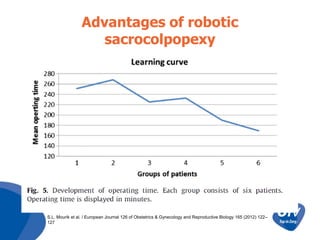
Advantages of robotic
sacrocolpopexy

S.L. Mourik et al. / European Journal 126 of Obstetrics & Gynecology and Reproductive Biology 165 (2012) 122–
127
Advantages of robotic
sacrocolpopexy
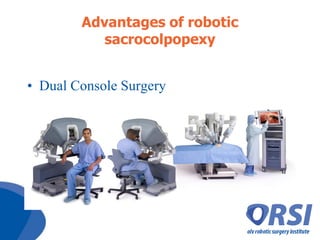
• Dual Console Surgery
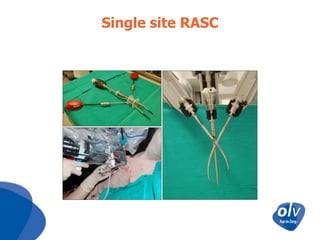
Single site RASC
conclusion
• Minimally invasive technique
• Feasible & reproducible
• Single approach to a complete correction of the 3 compartments
of the pelvic floor
• Excellent functional & anatomical results

• limited risk of complications and good long-term results in the
treatment of all types of POP.
• Shorter learning curve than conventional laparoscopy

Robotic Sacrocolpopexy OLV

  • 1.
    Robotic sacrocolpopexy rob OLV technique G.De Naeyer, P. Schatteman, P. Carpentier, A. Mottrie Department of Urology Onze-Lieve-Vrouwclinic, Aalst
  • 4.
  • 6.
    What is theda Vinci Surgical System? • State-of-the-art robotic surgical system that inserts a computer between the surgeon’s hand and the instrument tip • Surgeon directs each precise movement of the instruments, using console controls • Allows surgeon to operate with increased dexterity & precision
  • 7.
    Advantages of the daVincirobotic system  Better vision • Superior 3 D - Visualisation • Larger magnification (scaling up to 10 times) • Steadiness of the camera (no camera-assistant/ ergonomic)
  • 8.
    Advantages of the daVincirobotic system  enhanced dexterity and precision • 7 DOF • better hand-eye coordination • no counter-intuitive movements • tremor elimination •motion downscaling (miniaturisation 5:1) 5: 1
  • 9.
    Advantages of thedaVinci robotic system • In performing surgical tasks, 3-D vision allows for significant improvement in performance times and error rates. • Blavier A Impact of 2D and 3D vision on performance of novice subjects using da Vinci robotic system. Acta Chir Belg. 2006 Nov-Dec; 106(6):662-4. • Robotic knot tying and suturing, has a shorter learning curve compared to conventional laparoscopy • Sarle R. Surgical robotics and laparoscopic training drills. J Endourol. 2004 Feb;18(1):63-6. • Studies on skill training suggest that robotics increase ambidexterity by improving non-dominant hand performance. • Maniar HS. Comparison of skill training with robotic systems and traditional endoscopy: implications on training and adoption. J Surg Res 2005 May 1;125(1):23-9.
  • 10.
    Advantages of thedaVinci robotic system in RASC • Analysis of robotic performance times to improve operative efficiency. Geller EJ . – J Minim Invasive Gynecol. 2013 Jan-Feb;20(1):43-8. • estimate the efficiency of procedural steps in robotic sacrocolpopexy • Retrospective study with 147 patients • Comparison of the first 20 procedures with the subsequent 127 demonstrated that there was considerable improvement in time of cuff closure (p = .04); sacral dissection (p = .004); anterior (p = .006), posterior, (p = .003), and sacral (p = .003) mesh attachment; peritoneal closure (p < .001); total docked time (p = .02); and total incision time (p < .001). • • CONCLUSION: Robotic efficiency improves over a short learning period, with greatest differences in intracorporeal suturing and overall times.
  • 11.
    Disadvantages of the roboticapproach in pelvic surgery • Procedure Time ? • Patient positioning: – extreme Trendelenburg AND lithotomy • Team-work: experience of table side assistant and nurse – Tension on the mesh ? • Specific robotic system related complications • Robotic system failure • Cost ?
  • 12.
  • 13.
    POP repair • Colporaphy/ Transvaginal mesh repair – Transvaginal techniques are widely used but are characterized by high recurrence rates, likely due to poor apical support. • Benson JT, Lucente V, McClellan E. Vaginal versus abdominal reconstructive surgery for the treatment of pelvic support defects: a prospective randomized study with long-term outcome evaluation. Am J Obstet Gynecol. 1996;175:1418-21; • Abdominal sacral colpopexy with synthetic mesh – considered the gold standard for surgical correction of vaginal vault prolapse – with long-term efficacy (to level 1 studies) – Open, lap or robotic Maher C et al. Surgical management of pelvic organ prolapse in women. Cochrane Database Syst Rev. 2010. Nygaard IE et al. Abdominal sacrocolpopexy: a comprehensive review. Obstet Gynecol. 2004;104:805-23.
  • 14.
    Principles for POPrepair 1. Repositioning of different organs with respect to their anatomical relationship 2. Repair and/or preservation of urinary and anal continence 3. Preservation of satisfying sexual activity 4. Achieve a durable result 5. As minimal invasive as possible
  • 15.
    Principles of RASC •anterior and posterior compartment • mesh with fixation on promontorium • combination with TVT or TOT when indicated
  • 16.
  • 17.
    pre-op RASC • Noroutine bowel preparation • four-arm configuration, 0°scope • Instruments: – Hot Shears monopolar – curved scissors – ProGrasp forceps • Single-shot preop antibiotic prophylaxis
  • 18.
    Technique of RASC •Preoperative preparation and instrumentation • Patient positioning, port placement, and robot docking • Placement of stay suture for upwards retraction of uterus • Dissection of the sacral promontory, dissection of parietal peritoneum • Opening of the Douglas space and dissection of the posterior vaginal wall
  • 19.
    Technique of RASC •Anchoring of the posterior mesh on the posterior vaginal wall • Insertion of the vaginal valve and dissection of the anterior vaginal wall. • Anchoring of the anterior mesh on the anterior vaginal wall • Passage of the meshes under the parietal peritoneum • Fixation of the proximal parts of both meshes to the sacral promontory • Retroperitonealization of the meshes
  • 21.
    Camera port Assistant port Assistantport Robotic arm port 1 Robotic arm port 2 Robotic arm por
  • 22.
  • 23.
    postoperative care inRASC • Oral intake D1 • urethral catheter removed D2 • DVT prophylaxis LMWH for 5 days
  • 24.
  • 25.
    Advantages of RASC •Posterior dissection • Large rectocoeles • Tile-pro and Fourth-arm to increase consolesurgeon autonomy and better exposure.
  • 26.
    Complications of robotic sacrocolpopexy •Same as open or lap • surgeon or technique related – – – – Vascular injury (promontory) Bladderperforation Vaginal wall perforation Ureteral injury • related to robotic system: – Table-assistant/nurse related injuries – Robotic failure – Specific complications Lavery et al J Endourol 2008 Fischer B et al. World J Urol 2008
  • 27.
    • Video darmin endowrist
  • 28.
    Corneal abrasions • Incidence ofcorneal abrasions during pelvic reconstructive surgery. – Antosh DD. Eur J Obstet Gynecol Reprod Biol. 2013 Feb;166(2):226-8. • More corneal abrasions occurred with laparoscopic and robotic sacral colpopexy compared to vaginal apical suspension procedures. • Risk factors could not be identified in this study.
  • 29.
    Patient Positioning inRASC Steep Trendelenburg + Modified Lithotomy position 40 °
  • 30.
  • 31.
    Patient Positioning inRASC • Trendelenburg position in gynecologic robotic-assisted surgery. – • Ghomi A et al. J Minim Invasive Gynecol. 2012 Jul-Aug;19(4):485-9 CONCLUSION: Robotic-assisted benign gynecologic surgery can be effectively performed without use of the steep Trendelenburg position. The practice of routine adherence to steep Trendelenburg positioning in benign gynecologicrobotic surgery should be questioned.
  • 32.
    Trocar site herniation •risk of herniation through 12-mm trocar site: 3.1% • Risk at a 10-mm trocar site the risk: 0.23%. Kadar N et al. Am J Obstet Gynecol 1993; 168 : 1493–5 Bek et al Urology 2011; 78(3):5586-90
  • 33.
    • Video reart iliaca
  • 34.
    RASC: own studyresults • retrospective review 95 consecutive patients who underwent RASC for POP • from April 2006 to December 2011. • RASC with use of polypropylene meshes • standardized technique using the “Da Vinci surgical system” in a four-arm configuration.
  • 35.
    RASC: own studyresults • Median operative time: 101 minutes. • No conversion to open surgery • One vaginal and two bladder injuries occurred and were repaired intraoperatively. • Only one Clavien grade III postoperative complication was observed (bowel obstruction treated laparoscopically). • 34 months follow-up: – persistent POP in 4 cases (4.2%). – One mesh erosion, robot–assisted removal of the mesh. – Ten (10.5%) patients de novo urgency – No significant de novo bowel or sexual symptoms were reported.
  • 36.
    Demographics, clinical characteristicsand frequency of symptoms at presentation in our series Age (years) iBMI ASA Score Pelvic heaviness Urgency Stress urinary incontinence Dysuria Constipation Urinary tract infection Median 67 29 1 IQR [63-73] [28-32] [1-2] No 90 31 % 94.7 32.6 20 21.1 17 12 8 17.9 12.6 8.4
  • 37.
    Characteristics of pelvicorgan prolapse in our series Total Grade 1 Grade 2 Grade 3 Grade 4 Cystoceles 89 5 19 55 10 Rectoceles 42 11 14 15 3 Vaginal Vault prolapses 13 1 3 6 3 Enteroceles 10 0 4 4 2 45 .. -- -- -- 17 -- -- -- -- 38 -- -- -- -- 8 -- -- -- -- 7 -- -- -- -- Anatomical Location of Prolapse -----------------------------------------Anterior or Middle or Posterior Compartment Anterior + Middle Compartment Anterior + Posterior Compartment Middle + Posterior Compartment Anterior + Middle + Posterior Compartment
  • 39.
    RASC versus open • single-institution,retrospective studies • suggesting minimal morbidity, technical feasibility, and short-term efficacy comparable to open abdominal sacrocolpopexy. • series of RASC: relatively small sample size • No published randomized, controlled trials comparing robotic with open or laparoscopic sacrocolpopexy, • superior to the other established minimally invasive transvaginal and laparoscopic approaches ? Kim JH et al. Is robotic sacrocolpopexy a marketing gimmick or a technological advancement? Curr Opin Urol. 2010 Jul;20(4):280-4. Geller EJ et al. Robotic vs abdominal sacrocolpopexy: 44-month pelvic floor outcomes. Urology. 2012;79:532-6. Gilleran JP Robotic-assisted laparoscopic mesh sacrocolpopexy. Ther Adv Urol. 2010;2:195-208. Eliot D et al. Long-term results of robotic asssited laparoscopic sacrocolpopexy for the treatment of high grade vaginal vault prolapse. J Urol. 2006;176:655-9. Germain A et al. Long-term outcomes after totally robotic sacrocolpopexy for treatment of pelvic organ prolapse. Surg Endosc. 2013;27:525-9. Oshiro EO et al. Long-term outcomes after robotic sacrocolpopexy in pelvic organ prolapse: prospective analysis. Urol Int. 2011;86:414-8.
  • 40.
    RASC versus lap • equivalentto LSCP in terms of functional outcome and superior in terms of blood loss and strict operative time. (47 LSCP and 20 RASC) – • The mid-term functional results obtained after RALSCP were equivalent to those obtained with the LSCP approach. – • Seror J et al. Prospective comparison of short-term functional outcomes obtained after pure laparoscopic and robot-assisted laparoscopic sacrocolpopexy. World J Urol. 2012 Jun;30(3):393-8. Meta-analysis of 12 series (350 patients) Prog Urol. 2012 Mar;22(3):146-53. longer operating time and increased pain and cost compared with the conventional laparoscopic approach – Paraiso MF et al Laparoscopic compared with robotic sacrocolpopexy for vaginal prolapse: a randomized controlled trial. Obstet Gynecol. 2011 Nov;118(5):1005-13.
  • 41.
    Cost of RASC •Robotic sacrocolpopexy costs less but takes slightly longer to perform than the open procedure – Hoyte L et al. Cost analysis of open versus robotic-assisted sacrocolpopexy. Female Pelvic Med Reconstr Surg. 2012 Nov-Dec;18(6):335-9. • robot-assisted approach to sacrocolpopexy can be equally or less costly than an open approach – Elliott CS et al. Robot-assisted versus open sacrocolpopexy: a cost-minimization analysis. J Urol. 2012 Feb;187(2):638-43. • Similar perioperative outcomes compared to LSC with increased surgical time resulting in increased costs. – Tan-Kim J. Robotic-assisted and laparoscopic sacrocolpopexy: comparing operative times,costs and outcomes. Female Pelvic Med Reconstr Surg. 2011 Jan;17(1):44-9.
  • 42.
    Advantages of robotic sacrocolpopexy S.L.Mourik et al. / European Journal 126 of Obstetrics & Gynecology and Reproductive Biology 165 (2012) 122– 127
  • 43.
  • 44.
  • 45.
    conclusion • Minimally invasivetechnique • Feasible & reproducible • Single approach to a complete correction of the 3 compartments of the pelvic floor • Excellent functional & anatomical results • limited risk of complications and good long-term results in the treatment of all types of POP. • Shorter learning curve than conventional laparoscopy