Communicating and Packaging Research Arnaldo Pellini and Jeff Knezovich Workshop for University of Dar es Salaam at ESRF 26 August 2008, Dar es Salaam
Today’s Agenda Wrap up 4:00-5:00 Tea 3:30-4:00 Group work and planning sessions 2:00-3:30 Lunch 1:00-2:00 Writing policy briefs (Arnaldo) 11:30-1:00 Basics of communications strategies (Jeff) 10:15-11:30 Introductions 10:00-10:15
Brief intro to ODI/RAPID The RAPID group at ODI works with partners in the north and south to transform research-based evidence into pro-poor policy. We do this by: Researching the connections (or lack there of) between research and policy in different contexts, sectors and knowledge generation Using this knowledge to help ourselves and other researchers and civil society organisations influence policy founded in evidence
Planning for impact: Basic communication strategies Jeff Knezovich Presentation for University of Dar es Salaam and ESRF 26 August 2008, Dar es Salaam
What is communication? Memorable Engagement Dialogue Interesting Amplification Translation Entertaining Sticky
What is communication? M emorable E ngagement D ialogue I nteresting A mplification T ranslation E ntertaining S ticky
Communication is NOT: Just about formatting publications Just about creating an output  (that’s just the beginning!) Something that only happens at the end of research Something that happens overnight Without costs: both in terms of time and money Linear and simple A substitute for project management Necessarily easy to trace impact
Why communicate? To disseminate research results To provide information  To aid the research process To engage with specific groups To facilitate (public) discussion To lead to change
The challenge of effective communication Turning this:
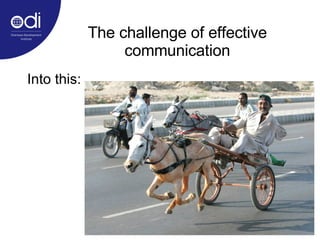
The challenge of effective communication Into this:
Effective communication: Lightens the load Highlights key information Sends information in the right direction Makes sure the right information goes to the right audience Figures out the best means of transport Packaging and presenting information in the right way for the intended audience Learns from experience Establishes ways of monitoring progress
Communications Tools Planning Tools Social Network Analysis  Problem Tree Analysis  Communications Strategies  Packaging Tools Scenarios Storytelling   Targeting Tools Policy Papers  Communities of Practice Websites & Blogs TV/Radio etc Monitoring Tools Most Significant Change (MSC)  Outcome Mapping  Researcher Checklist
What is a communication strategy? Communication strategies: Are basic plans that help to think through the full communication cycle of a paper / project / programme Help to establish communications goals for a project and map out how these goals are best achieved Consider the internal and external challenges and opportunities to having the most impact Aid in establishing systems for learning from experience
Characteristics of a communications strategy Communication strategies are: Scalable They can be detailed or act as a general guide They can be used for a single report, an entire project or even a group or organisation  Not set in stone They should be changed to reflect the evolution of a project An art not a science There is no one ‘best way’ to  communicate in every situation.
Common parts of a communication strategy Objectives Audiences Issues Messages Tools and activities Resources Timescales Evaluation and learning
Tracer example International Migrants Day engagement from ODI What is International Migrants Day? Held on 18 December of every year A day sponsored by the UN in recognition of the growing number of migrants around the world It ‘invites member States, intergovernmental and non-governmental organisations to disseminate of information on the human rights and fundamental freedoms of migrants.’
1. Communication objectives What do you want your communication activities to achieve in an ideal world? Communication objectives are not necessarily the same as project or organisational objectives, but there should be clear links between the two Objectives should be reasonable and  realistic based on the size, scope and  timeframe of a project
1. Communication objectives: example Organisations working on migration and remittances are aware of, and have read, the latest briefing papers and blogs from ODI  on the topic Media pick up and profile ODI work ODI staff know what has been released for International Migrants Day
2. Audiences Who are you trying to reach? There are many tools available to help choose who the best audiences might be  (like stakeholder analysis, social network analysis and the AIIM) Remember that the most obvious audiences might not be the most strategic Try to highlight two or three key audiences where more attention can be focused, even if you have a longer list
Nested spheres Adapted from: Steff Deprez VVOB-CEGO, Nov 2006 sphere of  control sphere of influence sphere of interest Project Boundary partners Ultimate beneficiaries
2. Audiences: example UK and International organisations working on migration International media ODI staff and partners Key policy makers, practitioners and opinion formers on migration and remittances
3. Issues What challenges and opportunities are there to achieving your desired objectives, both internally and externally? ‘ Issues’ can be big or small, positive or negative or even just background information A place to list known constraints and opportunities so everyone involved in a project team is ‘on the same page’
4. Messages What do you want to say, and to whom? Messages can be broken down into ‘background messages’ and ‘key messages’ to help show how a specific project fits into a larger programme Messages should be designed with audiences in mind and tailored to fit their needs Limit key messages to a  maximum of three
4. Characteristics of effectives messages Make messages memorable Simple Limited in number Make messages engaging Answer the question: why should the intended audience be interested? If a background message, the who, what and how should be addressed Keys to making it stick: S imple U nexpected C oncrete C redible E motional S tories
4. Messages: example Background messages Due to the unprecedented increase in migration (both within countries and across borders) over the last decade, migration has become a major policy priority in many countries.  International Migrants Day  is an annual event to  recognise  the enormous role that migrant workers play in the global economy and to share experiences to ensure their continued protection.
4. Messages: example Key messages  ODI is among a number of UK organisations contributing to policy discussions on migration – especially as it relates to poverty and development Short-term, non-permanent migration from under-developed regions to more prosperous regions can offer people an important opportunity to diversify and exit from poverty. However, current policy and institutional structures allow neither the sending area nor the receiving one to maximise the benefits from migration. ODI is developing social protection measures for poor and vulnerable migrants especially women, girls, children and ethnic minorities; and developing safe and efficient remittance mechanisms
5. Tools and activities How will you get your message to your intended audience? Tools and activities depend heavily on the target audience, the messages conveyed, or both There are a wide variety of tools and activities available from print, to face-to-face interactions, events, other media (TV, radio), online communications, etc., so don’t narrow your choices too quickly  A table that lists activities and their corresponding messages and audiences is a helpful way to organise all of the information
5. Tools and activities: example Date Channel(s) Audience(s) Messages Owner 18 Dec ODI theme page on migration transferred and updated All 1, 4, 5, 7  CK and NS 18 Dec ODI website – front page  All New blog, theme page NS 18 Dec ODInet front page ODI staff 1, 6, blog CK 17 Dec Blog: A blind spot in the migration debate: who’s being left out in the cold? All 1, 2, 3, 6  PD and CK 18 Dec Blog media release media 1, 2, 3, 6 AT and SM Early Jan ODI-enewsletter All New blog, theme page NS
6. Resources  What materials, skills, knowledge, time and funding is available to help achieve the communications objectives? Looking at the available resources is a good check to make sure objectives are reasonable and realistic Listing available resources is also a good way to see if any are missing The key is  to deliver what you promise and never over promise
7. Timescales How long will activities take to accomplish? When, and in what order, will they take place? A calendar of planned activities can be very useful here As above, it is essential to be realistic in what you promise
8. Evaluation and learning Have you achieved your objectives? What has worked well and what hasn’t? There are many tools available to help assess and learn from strategies (outcome mapping, after action reviews)
8. Evaluation and learning: example Number of blog hits Number of visits to migration page Amount of pick up from media  After action review on what went well and what didn’t
The results

Planning for impact: Basic communication strategies

  • 1.
    Communicating and PackagingResearch Arnaldo Pellini and Jeff Knezovich Workshop for University of Dar es Salaam at ESRF 26 August 2008, Dar es Salaam
  • 2.
    Today’s Agenda Wrapup 4:00-5:00 Tea 3:30-4:00 Group work and planning sessions 2:00-3:30 Lunch 1:00-2:00 Writing policy briefs (Arnaldo) 11:30-1:00 Basics of communications strategies (Jeff) 10:15-11:30 Introductions 10:00-10:15
  • 3.
    Brief intro toODI/RAPID The RAPID group at ODI works with partners in the north and south to transform research-based evidence into pro-poor policy. We do this by: Researching the connections (or lack there of) between research and policy in different contexts, sectors and knowledge generation Using this knowledge to help ourselves and other researchers and civil society organisations influence policy founded in evidence
  • 4.
    Planning for impact:Basic communication strategies Jeff Knezovich Presentation for University of Dar es Salaam and ESRF 26 August 2008, Dar es Salaam
  • 5.
    What is communication?Memorable Engagement Dialogue Interesting Amplification Translation Entertaining Sticky
  • 6.
    What is communication?M emorable E ngagement D ialogue I nteresting A mplification T ranslation E ntertaining S ticky
  • 7.
    Communication is NOT:Just about formatting publications Just about creating an output (that’s just the beginning!) Something that only happens at the end of research Something that happens overnight Without costs: both in terms of time and money Linear and simple A substitute for project management Necessarily easy to trace impact
  • 8.
    Why communicate? Todisseminate research results To provide information To aid the research process To engage with specific groups To facilitate (public) discussion To lead to change
  • 9.
    The challenge ofeffective communication Turning this:
  • 10.
    The challenge ofeffective communication Into this:
  • 11.
    Effective communication: Lightensthe load Highlights key information Sends information in the right direction Makes sure the right information goes to the right audience Figures out the best means of transport Packaging and presenting information in the right way for the intended audience Learns from experience Establishes ways of monitoring progress
  • 12.
    Communications Tools PlanningTools Social Network Analysis Problem Tree Analysis Communications Strategies Packaging Tools Scenarios Storytelling Targeting Tools Policy Papers Communities of Practice Websites & Blogs TV/Radio etc Monitoring Tools Most Significant Change (MSC) Outcome Mapping Researcher Checklist
  • 13.
    What is acommunication strategy? Communication strategies: Are basic plans that help to think through the full communication cycle of a paper / project / programme Help to establish communications goals for a project and map out how these goals are best achieved Consider the internal and external challenges and opportunities to having the most impact Aid in establishing systems for learning from experience
  • 14.
    Characteristics of acommunications strategy Communication strategies are: Scalable They can be detailed or act as a general guide They can be used for a single report, an entire project or even a group or organisation Not set in stone They should be changed to reflect the evolution of a project An art not a science There is no one ‘best way’ to communicate in every situation.
  • 15.
    Common parts ofa communication strategy Objectives Audiences Issues Messages Tools and activities Resources Timescales Evaluation and learning
  • 16.
    Tracer example InternationalMigrants Day engagement from ODI What is International Migrants Day? Held on 18 December of every year A day sponsored by the UN in recognition of the growing number of migrants around the world It ‘invites member States, intergovernmental and non-governmental organisations to disseminate of information on the human rights and fundamental freedoms of migrants.’
  • 17.
    1. Communication objectivesWhat do you want your communication activities to achieve in an ideal world? Communication objectives are not necessarily the same as project or organisational objectives, but there should be clear links between the two Objectives should be reasonable and realistic based on the size, scope and timeframe of a project
  • 18.
    1. Communication objectives:example Organisations working on migration and remittances are aware of, and have read, the latest briefing papers and blogs from ODI on the topic Media pick up and profile ODI work ODI staff know what has been released for International Migrants Day
  • 19.
    2. Audiences Whoare you trying to reach? There are many tools available to help choose who the best audiences might be (like stakeholder analysis, social network analysis and the AIIM) Remember that the most obvious audiences might not be the most strategic Try to highlight two or three key audiences where more attention can be focused, even if you have a longer list
  • 20.
    Nested spheres Adaptedfrom: Steff Deprez VVOB-CEGO, Nov 2006 sphere of control sphere of influence sphere of interest Project Boundary partners Ultimate beneficiaries
  • 21.
    2. Audiences: exampleUK and International organisations working on migration International media ODI staff and partners Key policy makers, practitioners and opinion formers on migration and remittances
  • 22.
    3. Issues Whatchallenges and opportunities are there to achieving your desired objectives, both internally and externally? ‘ Issues’ can be big or small, positive or negative or even just background information A place to list known constraints and opportunities so everyone involved in a project team is ‘on the same page’
  • 23.
    4. Messages Whatdo you want to say, and to whom? Messages can be broken down into ‘background messages’ and ‘key messages’ to help show how a specific project fits into a larger programme Messages should be designed with audiences in mind and tailored to fit their needs Limit key messages to a maximum of three
  • 24.
    4. Characteristics ofeffectives messages Make messages memorable Simple Limited in number Make messages engaging Answer the question: why should the intended audience be interested? If a background message, the who, what and how should be addressed Keys to making it stick: S imple U nexpected C oncrete C redible E motional S tories
  • 25.
    4. Messages: exampleBackground messages Due to the unprecedented increase in migration (both within countries and across borders) over the last decade, migration has become a major policy priority in many countries. International Migrants Day is an annual event to recognise the enormous role that migrant workers play in the global economy and to share experiences to ensure their continued protection.
  • 26.
    4. Messages: exampleKey messages ODI is among a number of UK organisations contributing to policy discussions on migration – especially as it relates to poverty and development Short-term, non-permanent migration from under-developed regions to more prosperous regions can offer people an important opportunity to diversify and exit from poverty. However, current policy and institutional structures allow neither the sending area nor the receiving one to maximise the benefits from migration. ODI is developing social protection measures for poor and vulnerable migrants especially women, girls, children and ethnic minorities; and developing safe and efficient remittance mechanisms
  • 27.
    5. Tools andactivities How will you get your message to your intended audience? Tools and activities depend heavily on the target audience, the messages conveyed, or both There are a wide variety of tools and activities available from print, to face-to-face interactions, events, other media (TV, radio), online communications, etc., so don’t narrow your choices too quickly A table that lists activities and their corresponding messages and audiences is a helpful way to organise all of the information
  • 28.
    5. Tools andactivities: example Date Channel(s) Audience(s) Messages Owner 18 Dec ODI theme page on migration transferred and updated All 1, 4, 5, 7 CK and NS 18 Dec ODI website – front page All New blog, theme page NS 18 Dec ODInet front page ODI staff 1, 6, blog CK 17 Dec Blog: A blind spot in the migration debate: who’s being left out in the cold? All 1, 2, 3, 6 PD and CK 18 Dec Blog media release media 1, 2, 3, 6 AT and SM Early Jan ODI-enewsletter All New blog, theme page NS
  • 29.
    6. Resources What materials, skills, knowledge, time and funding is available to help achieve the communications objectives? Looking at the available resources is a good check to make sure objectives are reasonable and realistic Listing available resources is also a good way to see if any are missing The key is to deliver what you promise and never over promise
  • 30.
    7. Timescales Howlong will activities take to accomplish? When, and in what order, will they take place? A calendar of planned activities can be very useful here As above, it is essential to be realistic in what you promise
  • 31.
    8. Evaluation andlearning Have you achieved your objectives? What has worked well and what hasn’t? There are many tools available to help assess and learn from strategies (outcome mapping, after action reviews)
  • 32.
    8. Evaluation andlearning: example Number of blog hits Number of visits to migration page Amount of pick up from media After action review on what went well and what didn’t
  • 33.