REPRODUCTION PROFILES OF
SHEEP
PREPARED BY NUR ARIANI BINTI
DZULKARNAIN
SMALL RUMINANT PRODUCTION
1.0 INTRODUCTION
• Reproduction is the propagation and
continuation of a species through a
sequence of events that involves the
production of hormones and the
development of the reproductive system to
carry out germ cell development,
fertilization, pregnancy and eventually
parturition.
• The female sheep is referred to as the
ewe while the male sheep is called a ram.
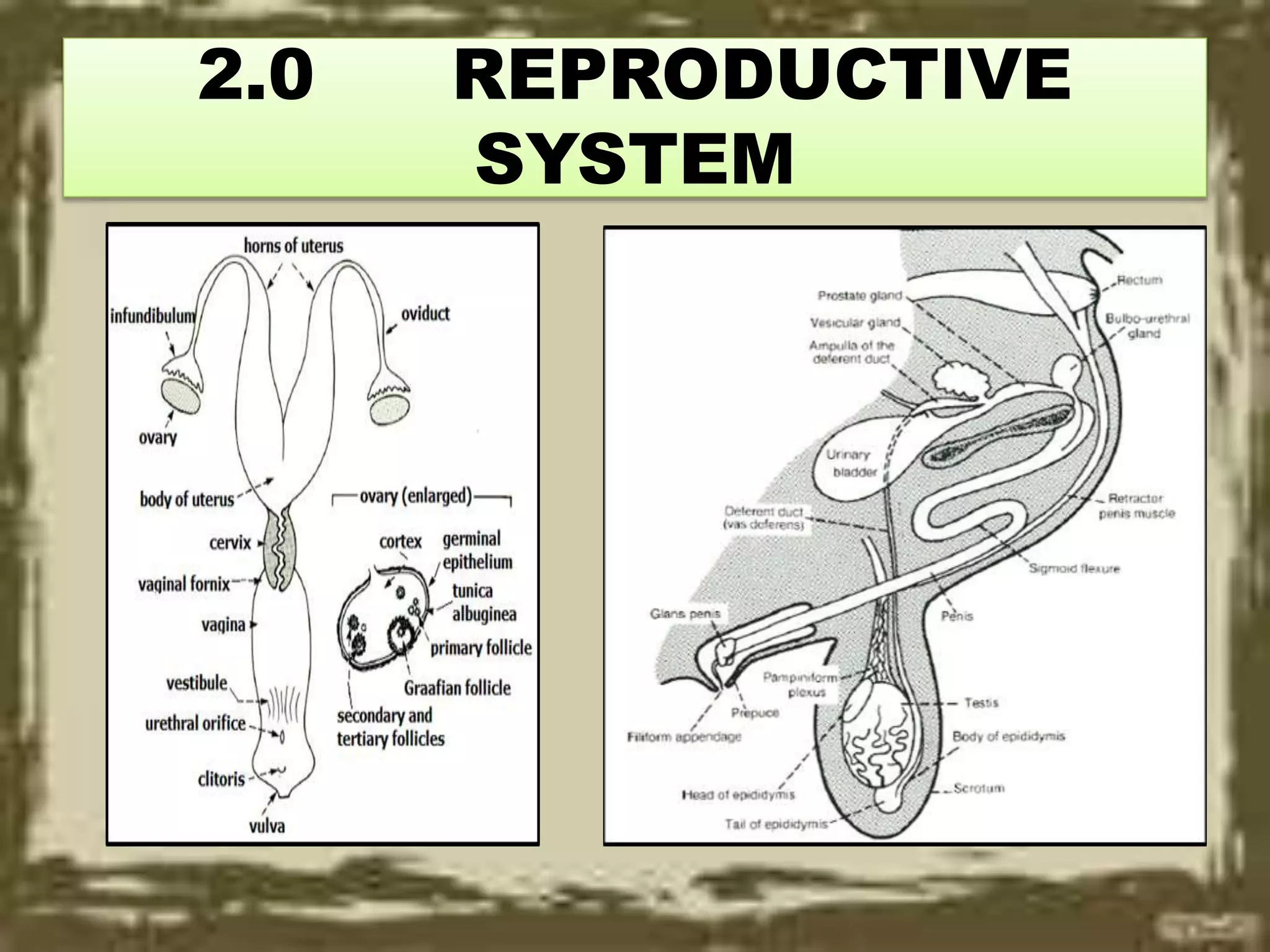
2.0 REPRODUCTIVE
SYSTEM
3.0 PUBERTY IN RAM
AND EWE
• Most ewe lambs will reach puberty by the
time they have developed to 50-70% of
their body weight which is between 5 to 12
months of age.
• Ram reach puberty may occur as early as
5 months, however, full reproductive
competence may not occur until 15
months of age.
4.0 ESTROUS CYCLE
• The estrous cycle, defined as the number
of days between two consecutive periods
of estrus (heat), is on average 17 days in
ewes.
5.0 ESTRUS AND SIGN OF
ESTRUS
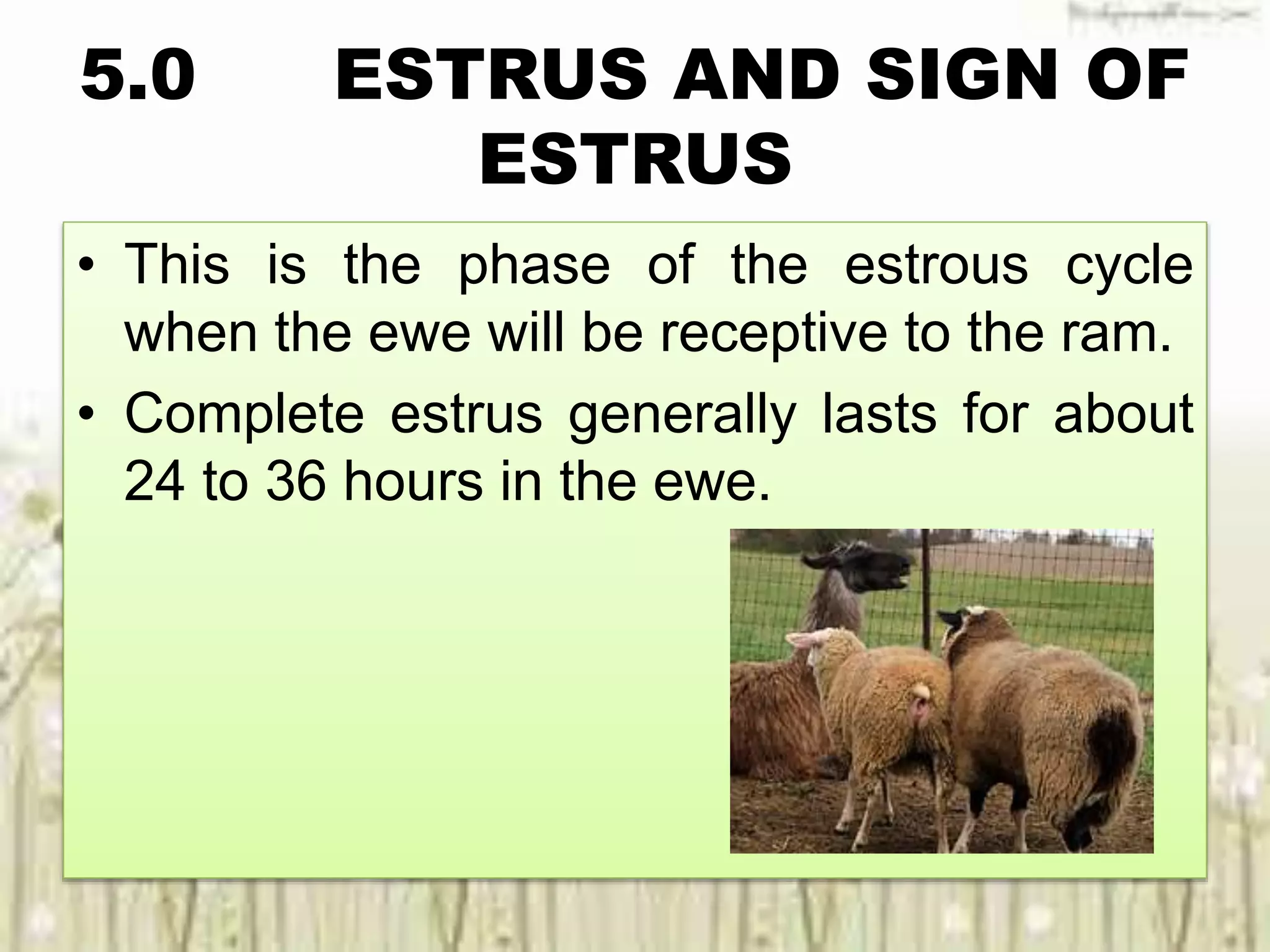
• This is the phase of the estrous cycle
when the ewe will be receptive to the ram.
• Complete estrus generally lasts for about
24 to 36 hours in the ewe.
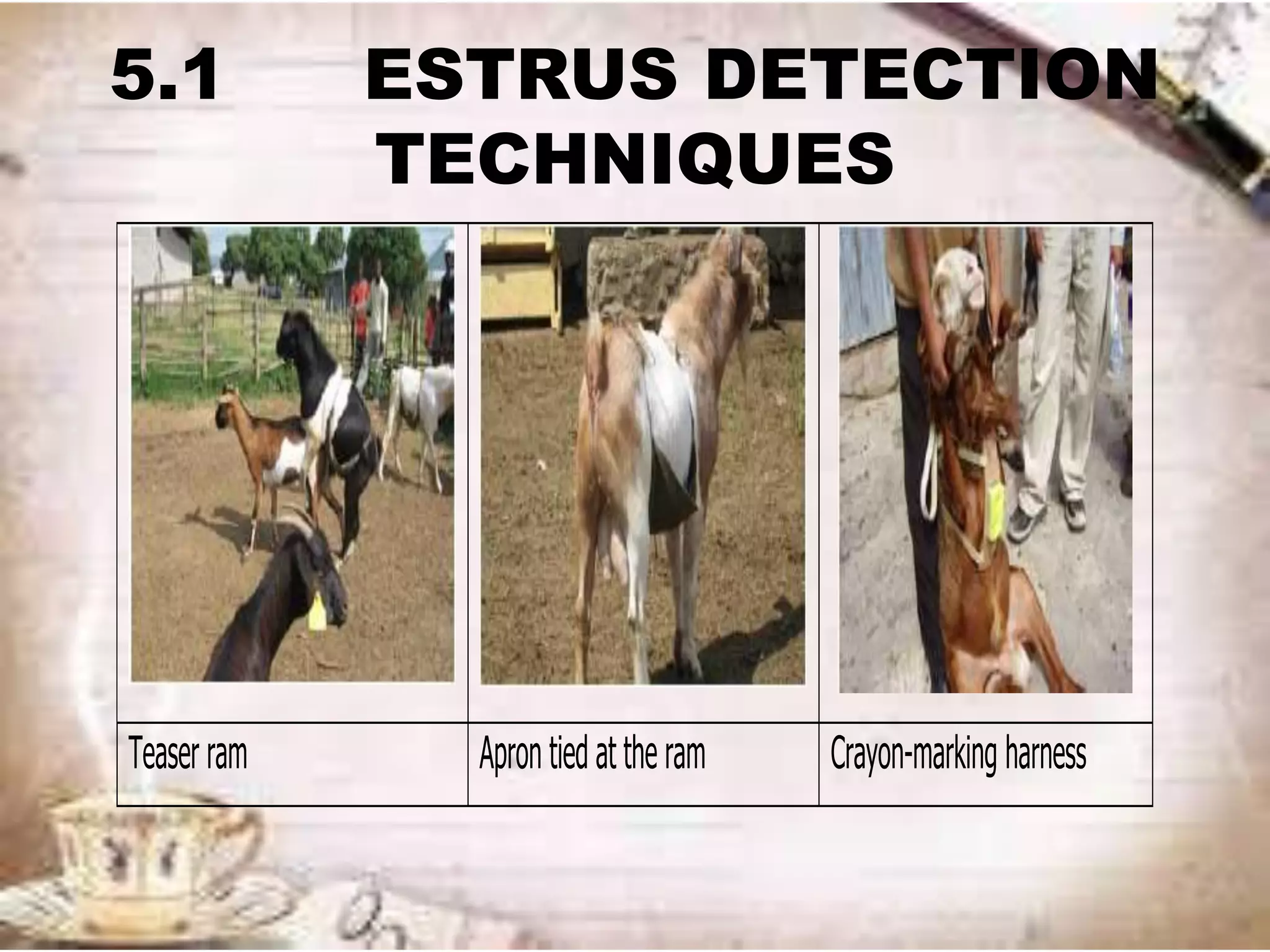
5.1 ESTRUS DETECTION
TECHNIQUES
Teaser ram Apron tied at the ram Crayon-marking harness
6.0 LIBIDO (SEXUAL
DESIRE)
• Libido is a male’s desire to mate.
• The willingness to breed ewes is highly
variable among rams and can have a
major impact on sheep production,
especially in a single-sire mating scheme.
• This behavior is regulated by the release
of testosterone, produced by specialized
cells in the testes.
• Mounting and thrusting
behavior, sniffing of the
genital region and
Flehmen reaction (curling
of the upper lip of the male
in response to detecting
sexual readiness of the
female) are well
established common
behaviors of normal
sheep.
8.0 RAM-TO-EWE RATIO
• Maintaining the correct ratio of fertile rams
and ewes is important as it can affect the
overall reproductive efficiency.
• The appropriate ratio is either one ram to
20–25 ewes or 3 per 100 ewes in a year-
round mating.
9.0DETERMINE THE
PREGNANCY
a) Non-return to estrus
– Using teaser ram
b) Progesterone test
– If the progesterone level is between 11‐13 nmol/l
(it is between 7‐8.5 nmol/l at ewe lambs) on the
30th day after the impregnation then the
probability of the pregnancy is 95%.
c) Ultrasonography
– Ultrasonography examination can be done as
early as 28–30 days using intra-rectal
examination.
– Trans-abdominal ultrasonography is done after
40 days post-breeding.
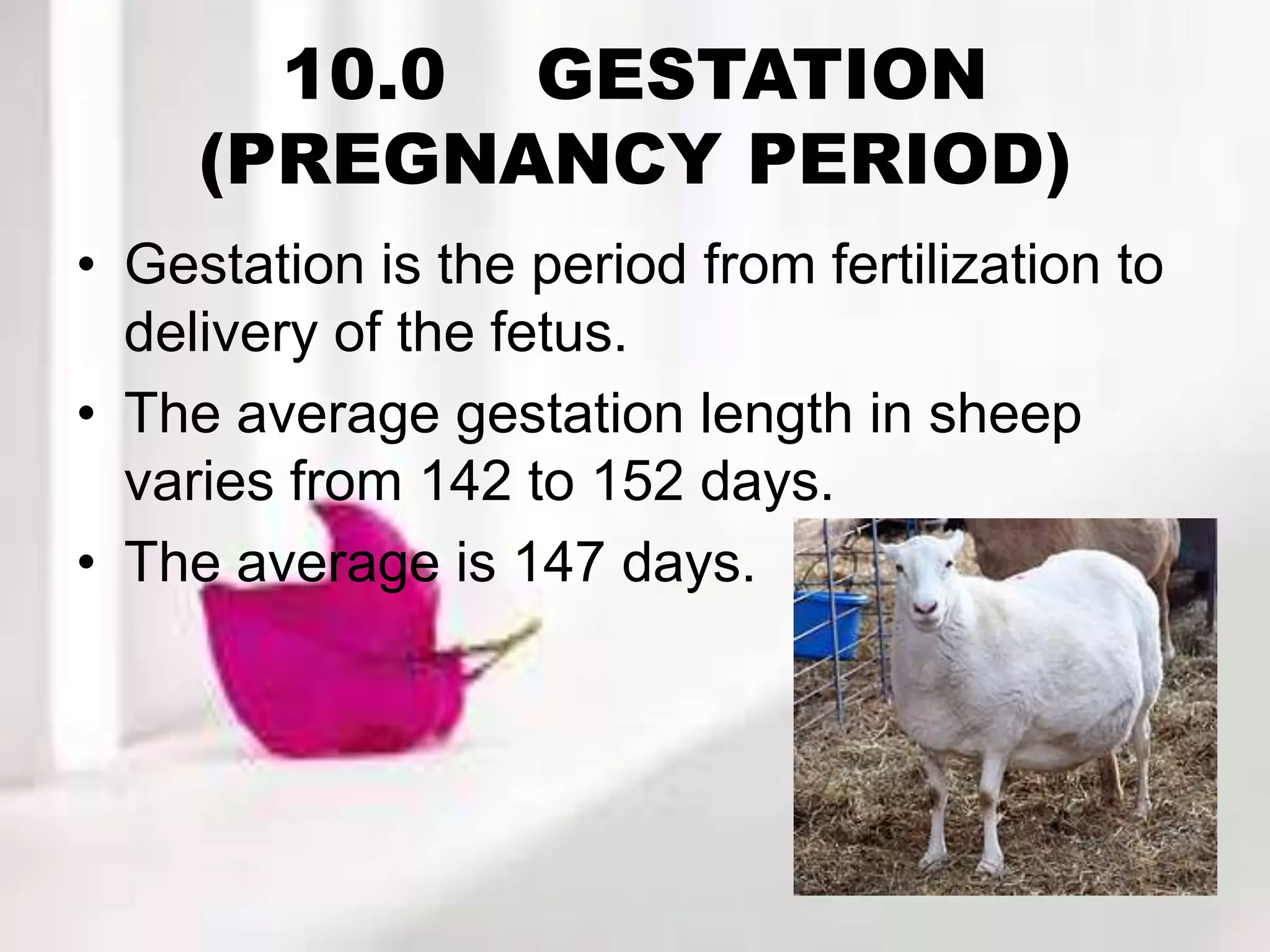
10.0 GESTATION
(PREGNANCY PERIOD)
• Gestation is the period from fertilization to
delivery of the fetus.
• The average gestation length in sheep
varies from 142 to 152 days.
• The average is 147 days.
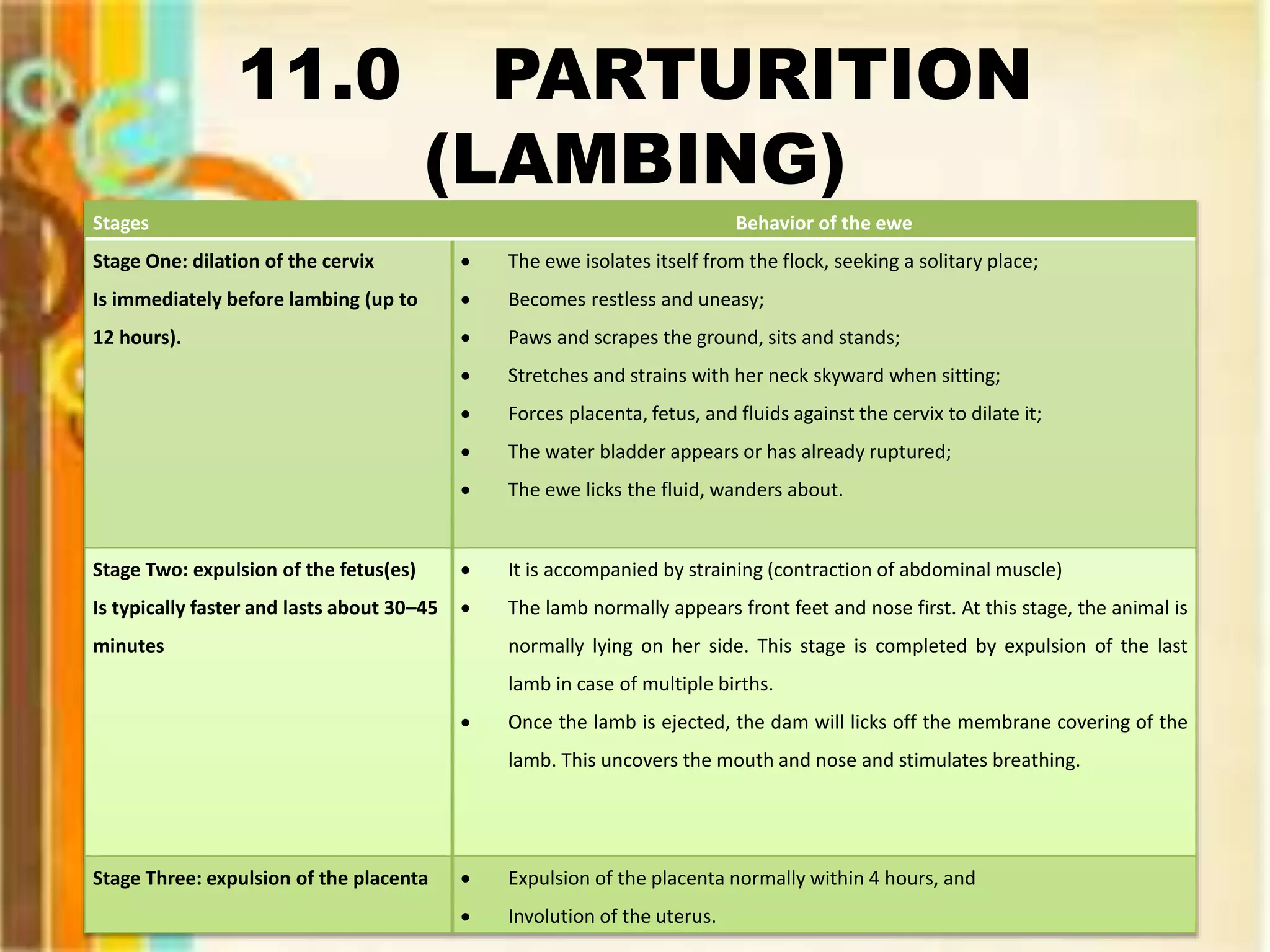
11.0 PARTURITION
(LAMBING)
Stages Behavior of the ewe
Stage One: dilation of the cervix
Is immediately before lambing (up to
12 hours).
 The ewe isolates itself from the flock, seeking a solitary place;
 Becomes restless and uneasy;
 Paws and scrapes the ground, sits and stands;
 Stretches and strains with her neck skyward when sitting;
 Forces placenta, fetus, and fluids against the cervix to dilate it;
 The water bladder appears or has already ruptured;
 The ewe licks the fluid, wanders about.
Stage Two: expulsion of the fetus(es)
Is typically faster and lasts about 30–45
minutes
 It is accompanied by straining (contraction of abdominal muscle)
 The lamb normally appears front feet and nose first. At this stage, the animal is
normally lying on her side. This stage is completed by expulsion of the last
lamb in case of multiple births.
 Once the lamb is ejected, the dam will licks off the membrane covering of the
lamb. This uncovers the mouth and nose and stimulates breathing.
Stage Three: expulsion of the placenta  Expulsion of the placenta normally within 4 hours, and
 Involution of the uterus.
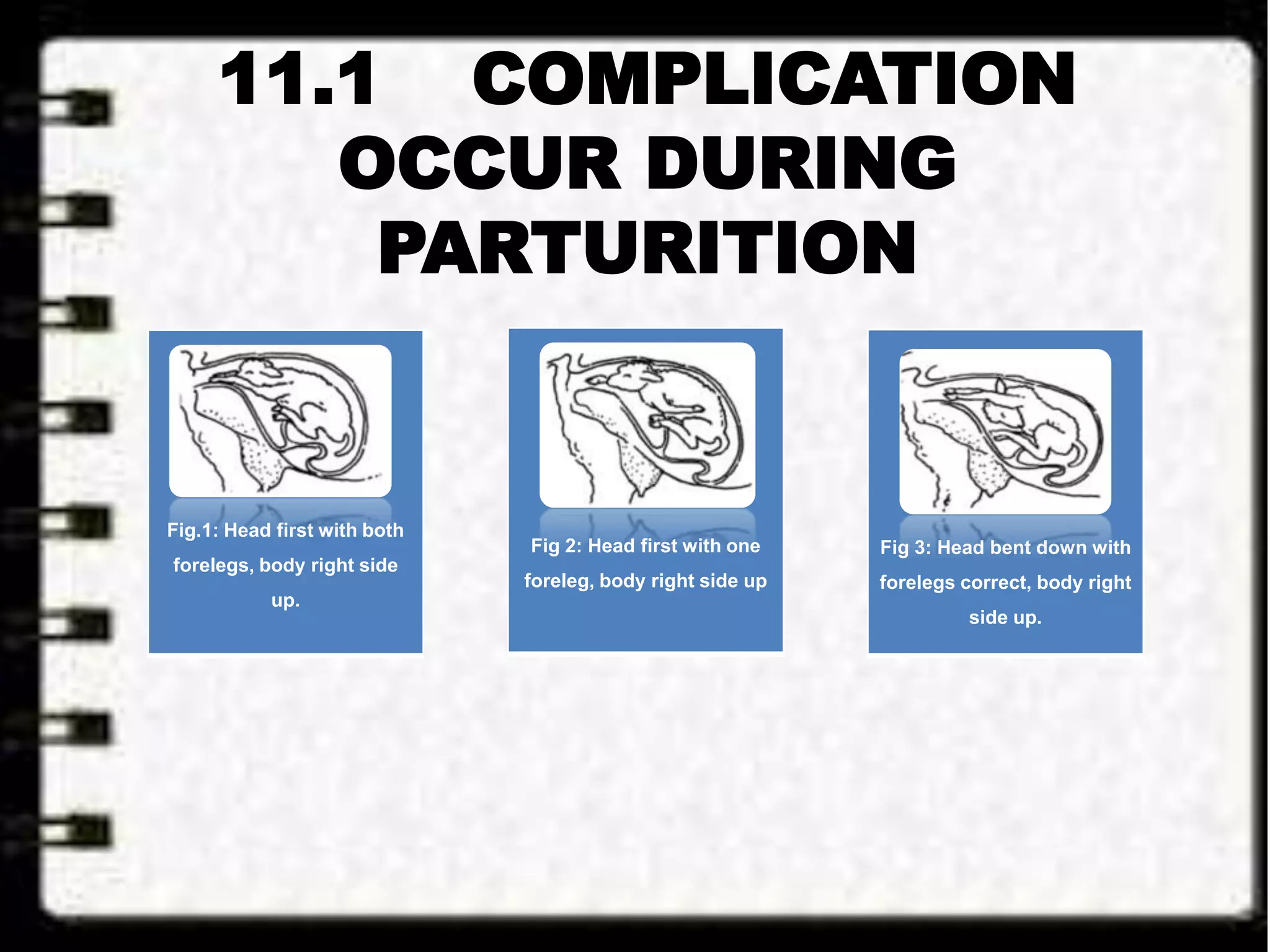
11.1 COMPLICATION
OCCUR DURING
PARTURITION
Fig.1: Head first with both
forelegs, body right side
up.
Fig 2: Head first with one
foreleg, body right side up
Fig 3: Head bent down with
forelegs correct, body right
side up.
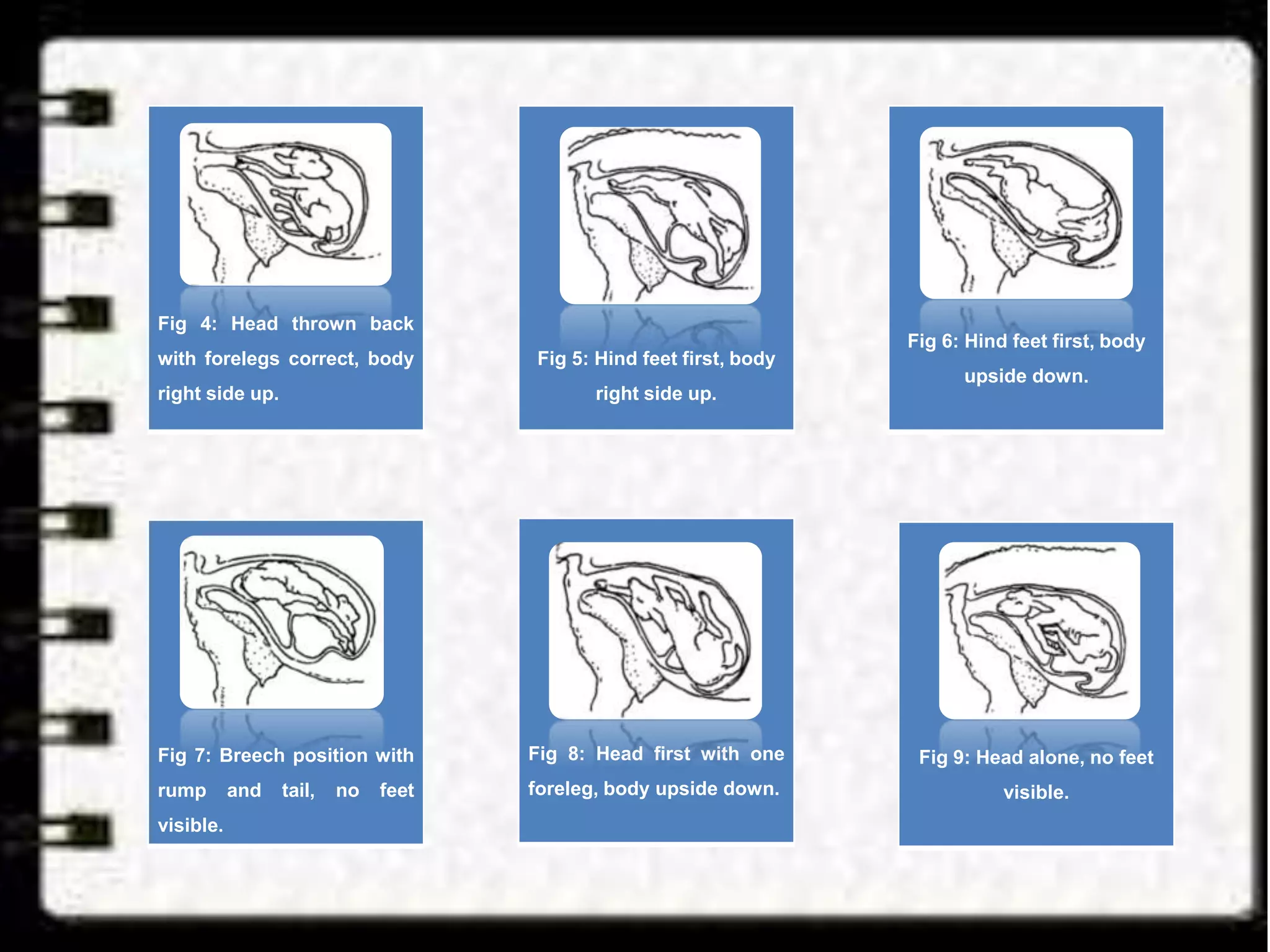
Fig 6: Hind feet first, body
upside down.
Fig 4: Head thrown back
with forelegs correct, body
right side up.
Fig 5: Hind feet first, body
right side up.
Fig 7: Breech position with
rump and tail, no feet
visible.
Fig 8: Head first with one
foreleg, body upside down.
Fig 9: Head alone, no feet
visible.
13.0 CONCLUSION
• Reproduction determines several aspects of
sheep production and an understanding of
reproduction is crucial in reproductive
management.
• A high rate of reproductive efficiency is
important for:
– Perpetuation of the species,
– Production of meat, milk, skin and fiber, and
– Replacement of breeding stock.
14.0 REFERENCE
• Abebe, G. (n.d.). Sheep and Goat Production Handbook for
Ethiopia. Reproduction of Sheep and Goat, 60-79.
• Brester, G. (April 2012). International Lamb Profile.
Agricultural Marketing Resource Center.
• Chemineau, P., Malpaux, B., Delgadillo, J.A., Guérin, Y.,
Ravault, J.P., Thimonier, J., Pelletier, J.,. (1992.). Control of
sheep and goats reproduction: use of light and melatonin.
Anim. Reprod. Sci. 30, 157–184.
• Diego Gimenez, S. R. (July 2007). Reproductive
Management OF Sheep and Goat. Alabama Cooperative
Extension System.
• Gordon, I. (1997). Controlled Reproduction in Sheep and
Goats. Wallingford, UK.: Cambridge University Press.
THE END…

Reproduction profiles of sheep slide

  • 1.
    REPRODUCTION PROFILES OF SHEEP PREPAREDBY NUR ARIANI BINTI DZULKARNAIN SMALL RUMINANT PRODUCTION
  • 2.
    1.0 INTRODUCTION • Reproductionis the propagation and continuation of a species through a sequence of events that involves the production of hormones and the development of the reproductive system to carry out germ cell development, fertilization, pregnancy and eventually parturition. • The female sheep is referred to as the ewe while the male sheep is called a ram.
  • 3.
  • 4.
    3.0 PUBERTY INRAM AND EWE • Most ewe lambs will reach puberty by the time they have developed to 50-70% of their body weight which is between 5 to 12 months of age. • Ram reach puberty may occur as early as 5 months, however, full reproductive competence may not occur until 15 months of age.
  • 5.
    4.0 ESTROUS CYCLE •The estrous cycle, defined as the number of days between two consecutive periods of estrus (heat), is on average 17 days in ewes.
  • 6.
    5.0 ESTRUS ANDSIGN OF ESTRUS • This is the phase of the estrous cycle when the ewe will be receptive to the ram. • Complete estrus generally lasts for about 24 to 36 hours in the ewe.
  • 7.
    5.1 ESTRUS DETECTION TECHNIQUES Teaserram Apron tied at the ram Crayon-marking harness
  • 8.
    6.0 LIBIDO (SEXUAL DESIRE) •Libido is a male’s desire to mate. • The willingness to breed ewes is highly variable among rams and can have a major impact on sheep production, especially in a single-sire mating scheme. • This behavior is regulated by the release of testosterone, produced by specialized cells in the testes.
  • 9.
    • Mounting andthrusting behavior, sniffing of the genital region and Flehmen reaction (curling of the upper lip of the male in response to detecting sexual readiness of the female) are well established common behaviors of normal sheep.
  • 10.
    8.0 RAM-TO-EWE RATIO •Maintaining the correct ratio of fertile rams and ewes is important as it can affect the overall reproductive efficiency. • The appropriate ratio is either one ram to 20–25 ewes or 3 per 100 ewes in a year- round mating.
  • 11.
    9.0DETERMINE THE PREGNANCY a) Non-returnto estrus – Using teaser ram b) Progesterone test – If the progesterone level is between 11‐13 nmol/l (it is between 7‐8.5 nmol/l at ewe lambs) on the 30th day after the impregnation then the probability of the pregnancy is 95%. c) Ultrasonography – Ultrasonography examination can be done as early as 28–30 days using intra-rectal examination. – Trans-abdominal ultrasonography is done after 40 days post-breeding.
  • 12.
    10.0 GESTATION (PREGNANCY PERIOD) •Gestation is the period from fertilization to delivery of the fetus. • The average gestation length in sheep varies from 142 to 152 days. • The average is 147 days.
  • 13.
    11.0 PARTURITION (LAMBING) Stages Behaviorof the ewe Stage One: dilation of the cervix Is immediately before lambing (up to 12 hours).  The ewe isolates itself from the flock, seeking a solitary place;  Becomes restless and uneasy;  Paws and scrapes the ground, sits and stands;  Stretches and strains with her neck skyward when sitting;  Forces placenta, fetus, and fluids against the cervix to dilate it;  The water bladder appears or has already ruptured;  The ewe licks the fluid, wanders about. Stage Two: expulsion of the fetus(es) Is typically faster and lasts about 30–45 minutes  It is accompanied by straining (contraction of abdominal muscle)  The lamb normally appears front feet and nose first. At this stage, the animal is normally lying on her side. This stage is completed by expulsion of the last lamb in case of multiple births.  Once the lamb is ejected, the dam will licks off the membrane covering of the lamb. This uncovers the mouth and nose and stimulates breathing. Stage Three: expulsion of the placenta  Expulsion of the placenta normally within 4 hours, and  Involution of the uterus.
  • 14.
    11.1 COMPLICATION OCCUR DURING PARTURITION Fig.1:Head first with both forelegs, body right side up. Fig 2: Head first with one foreleg, body right side up Fig 3: Head bent down with forelegs correct, body right side up.
  • 15.
    Fig 6: Hindfeet first, body upside down. Fig 4: Head thrown back with forelegs correct, body right side up. Fig 5: Hind feet first, body right side up. Fig 7: Breech position with rump and tail, no feet visible. Fig 8: Head first with one foreleg, body upside down. Fig 9: Head alone, no feet visible.
  • 16.
    13.0 CONCLUSION • Reproductiondetermines several aspects of sheep production and an understanding of reproduction is crucial in reproductive management. • A high rate of reproductive efficiency is important for: – Perpetuation of the species, – Production of meat, milk, skin and fiber, and – Replacement of breeding stock.
  • 17.
    14.0 REFERENCE • Abebe,G. (n.d.). Sheep and Goat Production Handbook for Ethiopia. Reproduction of Sheep and Goat, 60-79. • Brester, G. (April 2012). International Lamb Profile. Agricultural Marketing Resource Center. • Chemineau, P., Malpaux, B., Delgadillo, J.A., Guérin, Y., Ravault, J.P., Thimonier, J., Pelletier, J.,. (1992.). Control of sheep and goats reproduction: use of light and melatonin. Anim. Reprod. Sci. 30, 157–184. • Diego Gimenez, S. R. (July 2007). Reproductive Management OF Sheep and Goat. Alabama Cooperative Extension System. • Gordon, I. (1997). Controlled Reproduction in Sheep and Goats. Wallingford, UK.: Cambridge University Press.
  • 18.