The document provides an overview of computer hardware, detailing its various components such as the motherboard, CPU, RAM, hard disk, and graphics card. It explains the functions and importance of each part in a computer system, including how power is supplied and the roles of input devices like the mouse and keyboard. Additionally, it covers the significance of the heat sink and UPS for cooling and backup power, respectively.
What is computerhardware?
Computer hardware is the collection of physical parts
of a computer system
Computer hardware is what you can physically
touch.
This includes the computer case, monitor, keyboard,
and mouse. It also includes all the parts inside the
computer case, such as the hard disk drive,
motherboard, video card, and many others
3.
Components of Hardware
MOTHER BOARD
PROCESSOR
HEAT SINK
COOLER
RAM
SMPS
HARD DISK
POWER CABLES
GRAPHICS CARD
UPS
MOUSE
KEYBOARD
MONITOR
4.
MOTHERBOARD
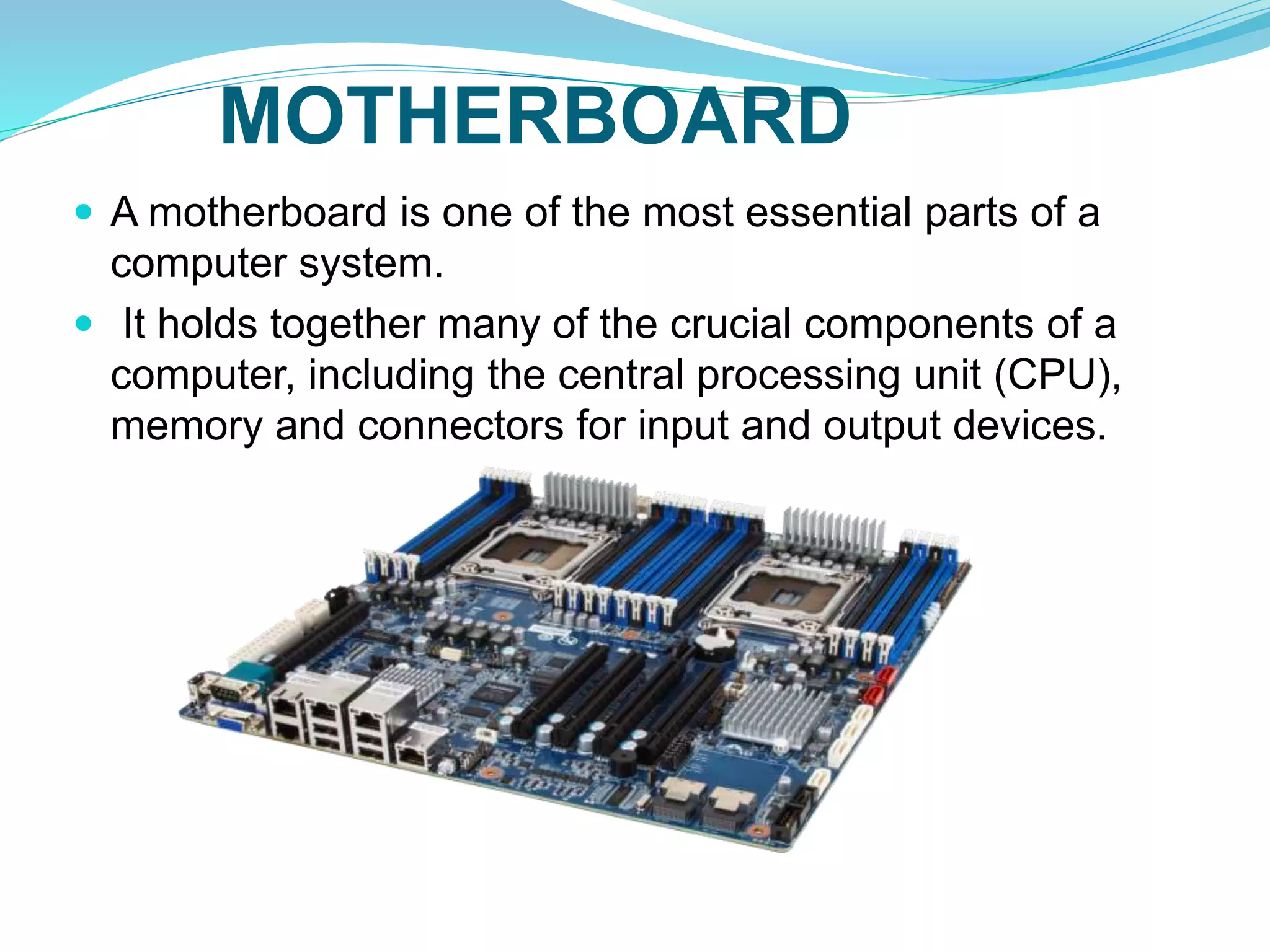
A motherboardis one of the most essential parts of a
computer system.
It holds together many of the crucial components of a
computer, including the central processing unit (CPU),
memory and connectors for input and output devices.
5.
Parts of aMotherboard
A CPU socket - the actual CPU is directly soldered onto
the socket.
A power connector to distribute power to the CPU and
other components.
Slots for the system's RAM
Several connectors, which provide the physical interface
between input and output devices and the motherboard
Slots for one or more hard drives to store files.
A read-only memory (ROM) chip
A slot for a video or graphics card
Additional slots for connect other hardware
6.
PROCESSOR
The centralprocessing unit (CPU) of a computer is a
piece of hardware that carries out the instructions of a
computer program.
It performs the basic arithmetical, logical, and input/output
operations of a computer system.
The CPU is sometimes also referred to as the central
processor unit, or processor for short.
7.
COMPONENTS PROCESSOR
The firstis the arithmetic logic unit (ALU), which performs
simple arithmetic and logical operations.
Second is the control unit (CU), which manages the
various components of the computer.
Third is the cache, which serves as high-speed memory
where instructions can be copied to and retrieved
Early CPUs consisted of many separate components, but
since the 1970s, they have been constructed as a single
integrated unit called a microprocessor.
This CPU is about two inches by two inches in size.
8.
HEAT SINK
Aheat sink is a passive heat exchanger that transfers the
heat generated by the CPU
In computers, heat sinks are used to cool central
processing units and also to cool graphics processors.
Mostly cooler is attached with the heat sink
9.
RAM
RAM stands forRandom Access Memory
RAM is used to store data and instructions temporarily.
Random access means that each individual bytein entire
memory can be access directly.
A program must be loaded into RAM before execution.
RAM is volatile memory. It means that its contents are
lost when the power is turned off. RAM is read/write
memory.
10.
SMPS
SMPS standsfor switch-mode power supply
It is used to converters AC to various DC voltage
It has different DC output voltages betveen 5v to 12v
The SMPS convert the input AC voltage to a Set of fixed
DC Voltage and supplies the necessary power to
motherboard, disk drives and all expansion cards.
Because of SMPS, Computer is called as an electronic
device
11.
Hard Disk
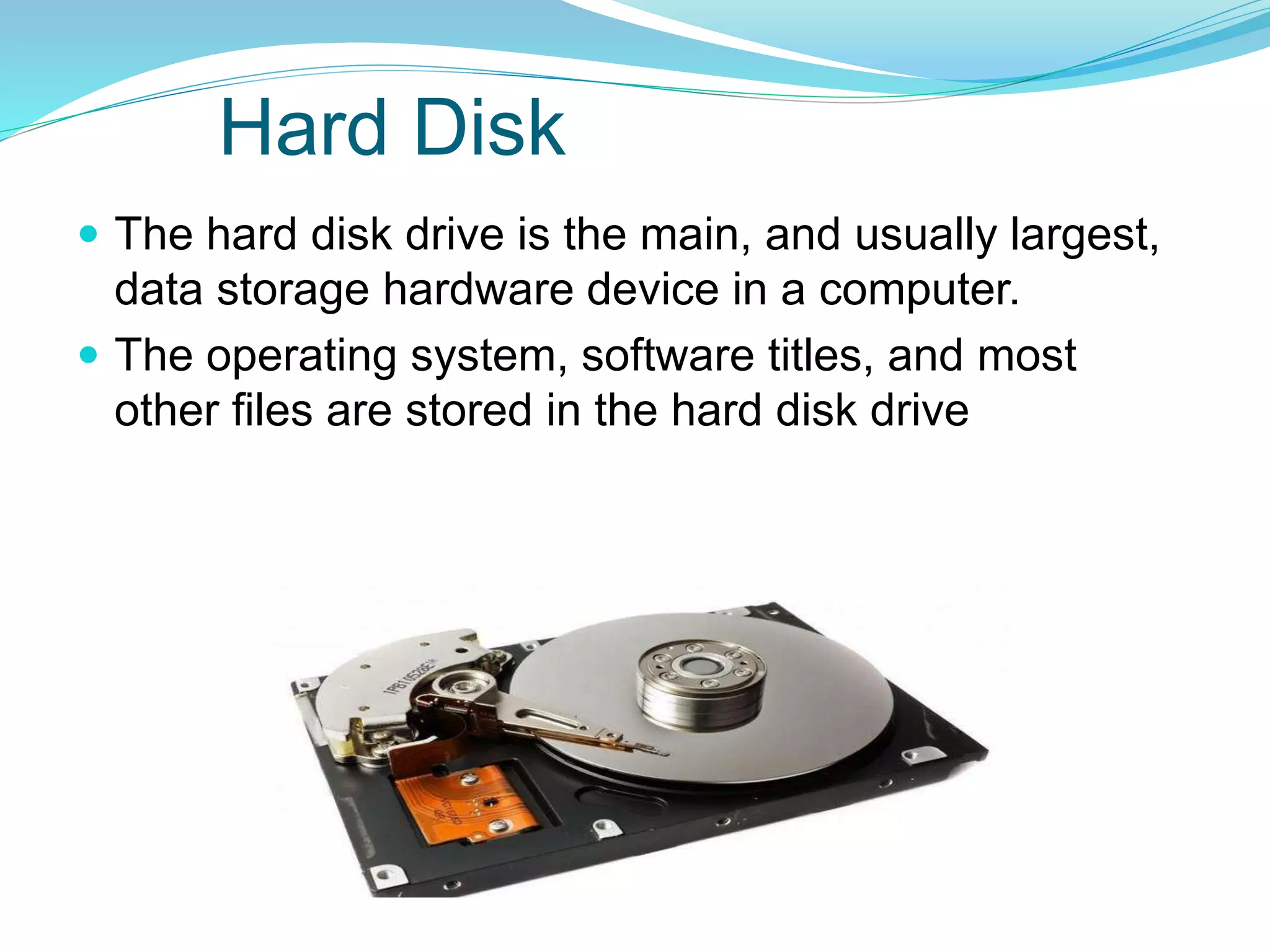
Thehard disk drive is the main, and usually largest,
data storage hardware device in a computer.
The operating system, software titles, and most
other files are stored in the hard disk drive
12.
POWER CABLES
Thesecables are used to distribute electricity from the
power supply to the motherboard and other components.
Here we can see some types of power cables such as
1. ATX (24 or 20 PIN): Just like other components,
motherboard requires power for successful operation.
ATX ( Advanced Technology Extended)gives the power
the motherboard.
13.
cables
2. AUX(4or 6 pin) : To allow for additional power supply
to the motherboard for display purposes there may be
also a 4-pin or 6-pin Auxilliary Power Connector (AUX)
that connects the motherboard.
14.
cables
3. SATA(15 pin) : 15 pin Serial Advanced Technology Attachment
(SATA) power connectors are used to connect the hard disk drives,
optical drives.
15.
cables
4. MOLEX(4 pin) : 4 pin MOLEX power cable is used to
give power to hard disk drives and optical drives that do
not have SATA arrangements.
16.
cables
5. BERG(4 pin) : 4-pin BERG power connector is used to
power up the floppy disk drive.
17.
GRAPHICS CARD
Theprocessing power of a graphics card or video
card enables a computer to produce images in faster
motion and better detail, a necessity for some
computer games and video software.
A graphics card has its own processor, a GPU
(graphical processing unit)
18.
UPS
A devicethat provides battery backup when the
electrical power fails or drops to an unacceptable
voltage level.
Small UPS systems provide power for a few minutes.
19.
MOUSE
A mouseis a handheld pointing device used to position a
cursor on a computer screen.
It points and click on icons, menus, command buttons or
activates something on a computer.
The GUI (Graphical user interface) of current
applications and programs are user friendly and easier to
navigate using computer mouse.
20.
KEYBOARD
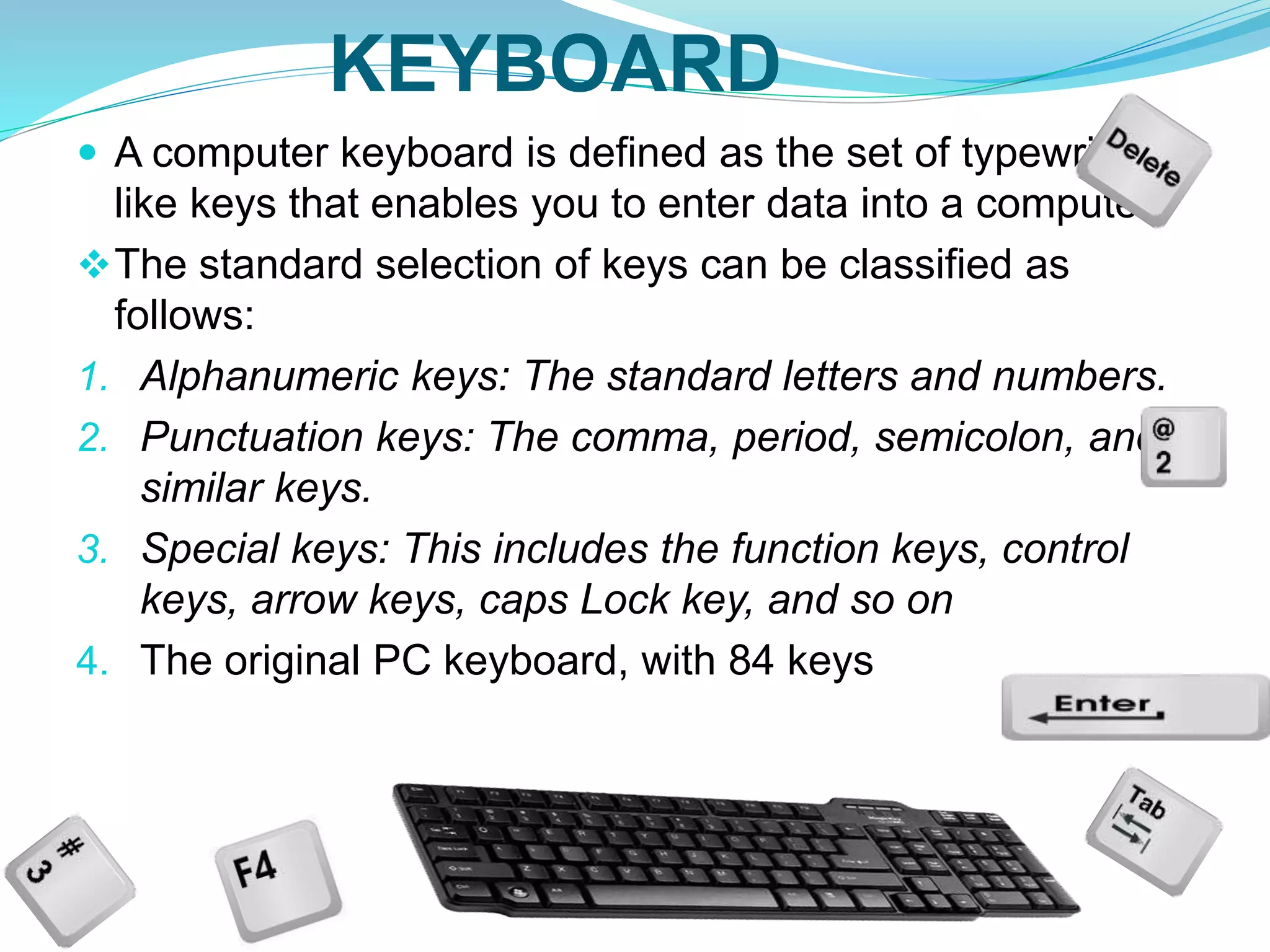
A computerkeyboard is defined as the set of typewriter-
like keys that enables you to enter data into a computer
The standard selection of keys can be classified as
follows:
1. Alphanumeric keys: The standard letters and numbers.
2. Punctuation keys: The comma, period, semicolon, and
similar keys.
3. Special keys: This includes the function keys, control
keys, arrow keys, caps Lock key, and so on
4. The original PC keyboard, with 84 keys
21.
MONITOR
A displayscreen used to provide visual output from a
computer
Computer monitors use CRT and LCD technology
Software that monitors the progress of activities within a
computer system