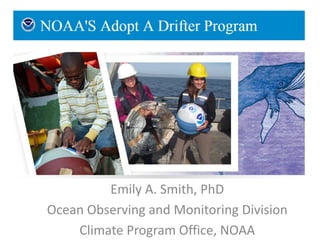
Emily A. Smith, PhD
Ocean Observing and Monitoring Division
Climate Program Office, NOAA
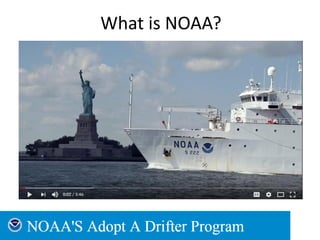
What is NOAA?
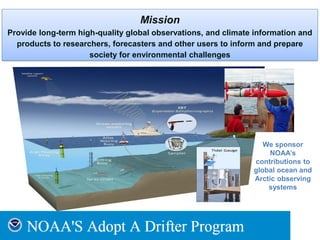
What do we do?Mission
Provide long-term high-quality global observations, and climate information and
products to researchers, forecasters and other users to inform and prepare
society for environmental challenges
We work from deployment to delivery of information and services
We sponsor
NOAA’s
contributions to
global ocean and
Arctic observing
systems
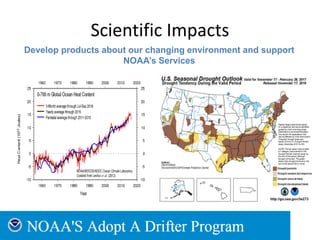
Scientific Impacts
Develop products about our changing environment and support
NOAA’s Services
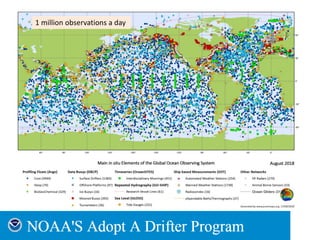
1 million observations a day
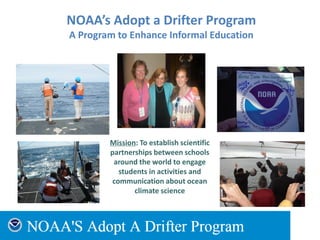
NOAA’s Adopt a Drifter Program
A Program to Enhance Informal Education
Mission: To establish scientific
partnerships between schools
around the world to engage
students in activities and
communication about ocean
climate science
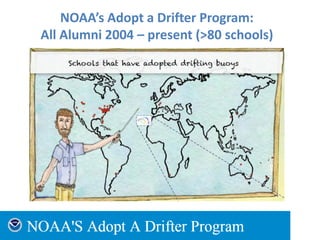
NOAA’s Adopt a Drifter Program:
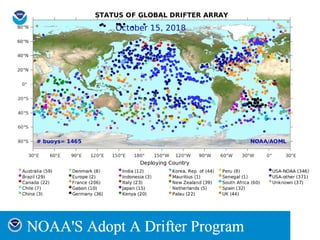
All Alumni 2004 – present (>80 schools)
● World map here showing all participant
locations
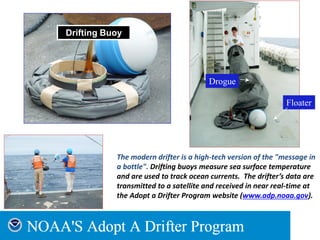
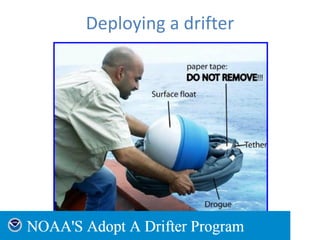
Drifting Buoy
The modern drifter is a high-tech version of the "message in
a bottle". Drifting buoys measure sea surface temperature
and are used to track ocean currents. The drifter’s data are
transmitted to a satellite and received in near real-time at
the Adopt a Drifter Program website (www.adp.noaa.gov).
Floater
Drogue
Deploying a drifter
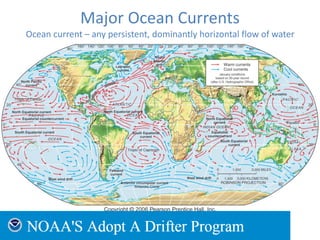
Major Ocean Currents
Ocean current – any persistent, dominantly horizontal flow of water
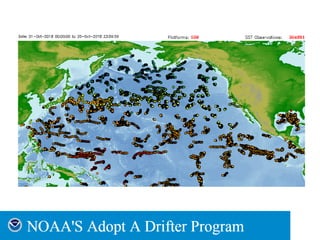
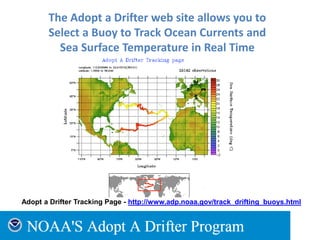
The Adopt a Drifter web site allows you to
Select a Buoy to Track Ocean Currents and
Sea Surface Temperature in Real Time
Adopt a Drifter Tracking Page - http://www.adp.noaa.gov/track_drifting_buoys.html
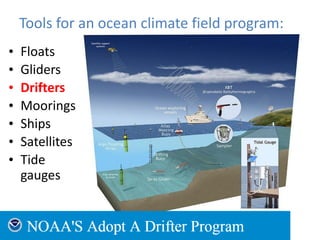
Tools for an ocean climate field program:
• Floats
• Gliders
• Drifters
• Moorings
• Ships
• Satellites
• Tide
gauges
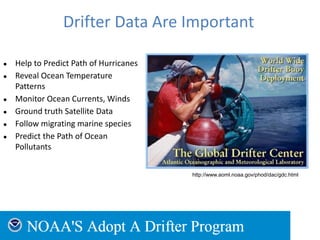
Drifter Data Are Important
● Help to Predict Path of Hurricanes
● Reveal Ocean Temperature
Patterns
● Monitor Ocean Currents, Winds
● Ground truth Satellite Data
● Follow migrating marine species
● Predict the Path of Ocean
Pollutants
http://www.aoml.noaa.gov/phod/dac/gdc.html
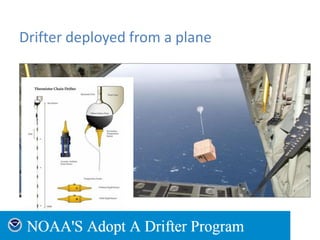
Drifter deployed from a plane
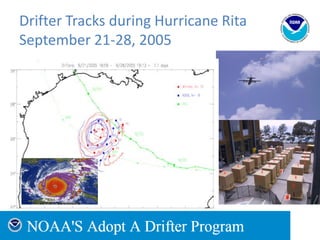
Drifter Tracks during Hurricane Rita
September 21-28, 2005
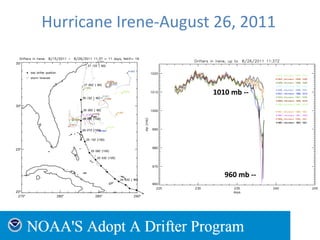
1010 mb --
960 mb --
Hurricane Irene-August 26, 2011
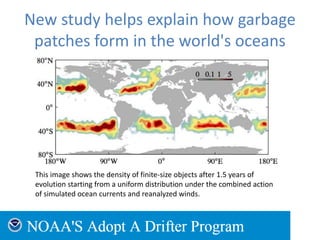
New study helps explain how garbage
patches form in the world's oceans
This image shows the density of finite-size objects after 1.5 years of
evolution starting from a uniform distribution under the combined action
of simulated ocean currents and reanalyzed winds.
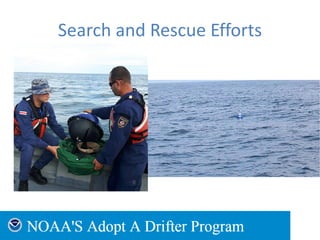
Search and Rescue Efforts
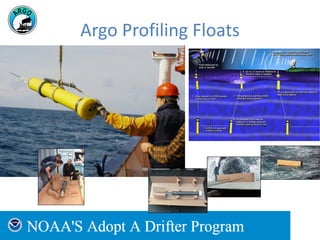
Argo Profiling Floats
•
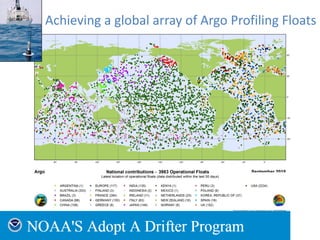
Achieving a global array of Argo Profiling Floats
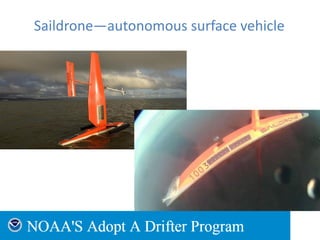
Saildrone—autonomous surface vehicle
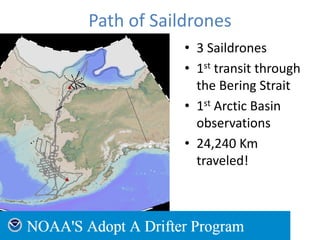
Path of Saildrones
• 3 Saildrones
• 1st transit through
the Bering Strait
• 1st Arctic Basin
observations
• 24,240 Km
traveled!
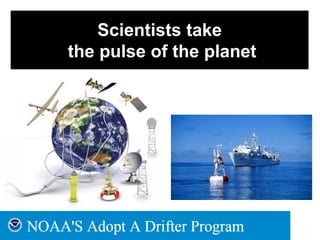
Scientists take
the pulse of the planet
Help keep the planet healthy!

Adopt a drifter presentation

  • 1.
    Emily A. Smith,PhD Ocean Observing and Monitoring Division Climate Program Office, NOAA
  • 2.
  • 3.
    What do wedo?Mission Provide long-term high-quality global observations, and climate information and products to researchers, forecasters and other users to inform and prepare society for environmental challenges We work from deployment to delivery of information and services We sponsor NOAA’s contributions to global ocean and Arctic observing systems
  • 4.
    Scientific Impacts Develop productsabout our changing environment and support NOAA’s Services
  • 5.
  • 6.
    NOAA’s Adopt aDrifter Program A Program to Enhance Informal Education Mission: To establish scientific partnerships between schools around the world to engage students in activities and communication about ocean climate science
  • 7.
    NOAA’s Adopt aDrifter Program: All Alumni 2004 – present (>80 schools) ● World map here showing all participant locations
  • 8.
    Drifting Buoy The moderndrifter is a high-tech version of the "message in a bottle". Drifting buoys measure sea surface temperature and are used to track ocean currents. The drifter’s data are transmitted to a satellite and received in near real-time at the Adopt a Drifter Program website (www.adp.noaa.gov). Floater Drogue
  • 9.
  • 11.
    Major Ocean Currents Oceancurrent – any persistent, dominantly horizontal flow of water
  • 13.
    The Adopt aDrifter web site allows you to Select a Buoy to Track Ocean Currents and Sea Surface Temperature in Real Time Adopt a Drifter Tracking Page - http://www.adp.noaa.gov/track_drifting_buoys.html
  • 14.
    Tools for anocean climate field program: • Floats • Gliders • Drifters • Moorings • Ships • Satellites • Tide gauges
  • 15.
    Drifter Data AreImportant ● Help to Predict Path of Hurricanes ● Reveal Ocean Temperature Patterns ● Monitor Ocean Currents, Winds ● Ground truth Satellite Data ● Follow migrating marine species ● Predict the Path of Ocean Pollutants http://www.aoml.noaa.gov/phod/dac/gdc.html
  • 16.
  • 17.
    Drifter Tracks duringHurricane Rita September 21-28, 2005
  • 18.
    1010 mb -- 960mb -- Hurricane Irene-August 26, 2011
  • 19.
    New study helpsexplain how garbage patches form in the world's oceans This image shows the density of finite-size objects after 1.5 years of evolution starting from a uniform distribution under the combined action of simulated ocean currents and reanalyzed winds.
  • 20.
  • 21.
  • 22.
    Achieving a globalarray of Argo Profiling Floats
  • 23.
  • 24.
    Path of Saildrones •3 Saildrones • 1st transit through the Bering Strait • 1st Arctic Basin observations • 24,240 Km traveled!
  • 25.
  • 26.
    Help keep theplanet healthy!