Addressing Climate Change and Variability in the Development of Environmental Flows Paul Leonard , Lauren Elmore and Lawrence Wise Climate Change and Environmental Flows
Some important questions: What is climate change? What is the relevance of climate change to environmental flows? How incorporate climate change predictions into streamflow management?  How have we been adapting to recent climate change-like patterns? What are some impediments to incorporating climate change into environmental flow? How can we incorporate uncertainty, risk management, and adaptive management?
What is climate change? … .a significant variation in either the mean state of the climate or in its  variability , persisting for an extended period (typically decades or longer) Change Variability  √  Oscillations  √  Drought   √  IPCC  - climate change refers to any change in climate over time, whether due to natural variability or as a result of human activity.
Climate change in the California? Increased air temperatures Overall precipitation unknown, but more variability expected Increased frequency of heavy rainfall events  Increased frequency and severity of droughts  Decreased snowpack, more precipitation as rain in mountains  Earlier runoff Decreased soil moisture and runoff in summer Warmer water temperatures Rising sea level
Five Riverine Flow Components  (Instream Flow Council 2008)   Hydrology & Hydraulics Water Quality Biology Physical Processes Connectivity Relevance of climate change to environmental flows:  focus on hydrology
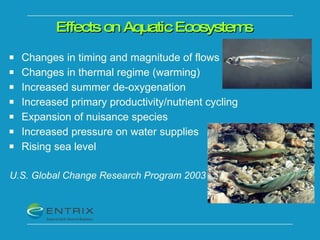
Effects on Aquatic Ecosystems  Changes in timing and magnitude of flows Changes in thermal regime (warming) Increased summer de-oxygenation Increased primary productivity/nutrient cycling Expansion of nuisance species Increased pressure on water supplies  Rising sea level U.S. Global Change Research Program 2003
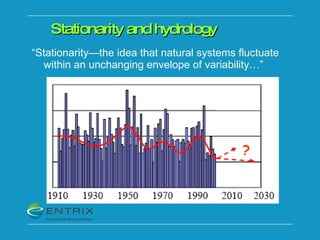
Stationarity and hydrology “ Stationarity—the idea that natural systems fluctuate within an unchanging envelope of variability…”
Changing hydrology and environmental flows   Analysis of historical flow records is central to most environmental flow  methods Flow time series, flow duration curves, habitat time series are  widely used Assumption of “stationarity” no longer valid Need a new paradigm and models to simulate changing baseline and future climate scenarios
Incorporating climate change into streamflow management   Climate change simulations and scenario-based assessments using global and regional modeling Pragmatic approaches focusing on drought management; inflow protocols Risk-based assessments to address uncertainty Adaptive management
Uncertainty?  Availability? Global Climate Model Projections GHG Emission Trajectories Downscaling, Regional Models Hydrologic Models Hydrologic Scenarios Planning / Impact Assessment based on Projected “Futures” Scenario-Based Climate Change Assessments
Climate change streamflow scenarios for water planning… “ Without additional effort on the part of the academic community to translate information about regional climate change into a form compatible with the tools and objectives of the water resources management community, however, water planning studies are unlikely to address the implications of climate change in any more than a very cursory manner in the near term.” Climate-Change Scenarios for Water Planning Studies 2003, Snover et al. 2003
Risk-Based Assessment Approaches Knowledge of potential impacts and an associated probability of occurrence, enabling them to make informed, risk-based adaptation and planning decisions.  Uses scenario analysis, but considers climate probabilities, system modification options, adaptive capacities, resource threats, costs, and timing to suggest management priorities through time… Probability-based planning and management –  strongly interdisciplinary
How has California been adapting to recent climate change-like patterns? Have historically managed consumptive uses and environmental flows based on water year type Inflow-based operational and flow release rules Identifying and incorporating known climate oscillations Hydrologic or weather forecasting Emphasis on drought management, water recycling, conservation Development of new local supplies,  Identification of new storage opportunities
Hydrologicially Contingent Flow Releases
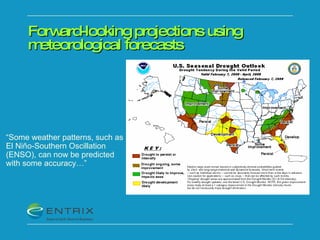
Forward-looking projections using meteorological forecasts “ Some weather patterns, such as El Niño-Southern Oscillation (ENSO), can now be predicted with some accuracy…”
Some Projects Incorporating Climate Change CVP and SWP Long-term Operations Plan Delta Vision Bay Delta Conservation Plan San Joaquin River Restoration Habitat Effects of Climate Change
Potential impediments Uncertain climate predictions; acceptance Availability and uncertainty of regional climate downscaling models and predicted hydrology Environmental flow standards based on historical hydrology Need for basin hydrologic models vs. historical hydrology Regulatory framework
Some practical considerations Adequacy of existing instream/minimum flows  Effects will vary regulated vs. unregulated systems Impacts may vary widely in regulated systems with low versus high storage ratios  Real-time operational and decision management is becoming critical Existing regulations and requirements will need to be revisited Planning vs. Permitting
Planning vs. permitting considerations   Climate change scenarios in permitting/impact assessment Permanence of allocations Infrastructure costs & ecosystem services  Cost-benefit analysis Availability of accepted climate change projections Term of license or permit
Can we incorporate risk management?   Risk management fundamentals: Thresholds for the system of interest  Understanding response of system to climate variability and/or change Understanding probabilities associated with different climate futures One or more management options or strategies for reducing risk   Being much more widely used in water resources
Risk management & adaptive management   Adaptive management – “contingent collaborative agreements” (Susskind) Wide range of adaptive and risk management strategies available More a part of the planning realm than the science realm
Final thoughts…   Explicitly consider climate change in hydrology, thermal regime, water quality in environmental  flows…scenario assessment Water resource managers need to be able to understand and communicate about  aquatic system risk management Regional research and consensus agreement on  climate projections and streamflow scenarios are needed! Integrated water planning is essential, as is the ability to address uncertainty,  risk management , and adaptive management Partnership of  science, planning, and engineering  to address risk and minimize risk in water resource planning Real time monitoring  will be critical
 

Wise Sess11 102509

  • 1.
    Addressing Climate Changeand Variability in the Development of Environmental Flows Paul Leonard , Lauren Elmore and Lawrence Wise Climate Change and Environmental Flows
  • 2.
    Some important questions:What is climate change? What is the relevance of climate change to environmental flows? How incorporate climate change predictions into streamflow management? How have we been adapting to recent climate change-like patterns? What are some impediments to incorporating climate change into environmental flow? How can we incorporate uncertainty, risk management, and adaptive management?
  • 3.
    What is climatechange? … .a significant variation in either the mean state of the climate or in its variability , persisting for an extended period (typically decades or longer) Change Variability √ Oscillations √ Drought √ IPCC - climate change refers to any change in climate over time, whether due to natural variability or as a result of human activity.
  • 4.
    Climate change inthe California? Increased air temperatures Overall precipitation unknown, but more variability expected Increased frequency of heavy rainfall events Increased frequency and severity of droughts Decreased snowpack, more precipitation as rain in mountains Earlier runoff Decreased soil moisture and runoff in summer Warmer water temperatures Rising sea level
  • 5.
    Five Riverine FlowComponents (Instream Flow Council 2008) Hydrology & Hydraulics Water Quality Biology Physical Processes Connectivity Relevance of climate change to environmental flows: focus on hydrology
  • 6.
    Effects on AquaticEcosystems Changes in timing and magnitude of flows Changes in thermal regime (warming) Increased summer de-oxygenation Increased primary productivity/nutrient cycling Expansion of nuisance species Increased pressure on water supplies Rising sea level U.S. Global Change Research Program 2003
  • 7.
    Stationarity and hydrology“ Stationarity—the idea that natural systems fluctuate within an unchanging envelope of variability…”
  • 8.
    Changing hydrology andenvironmental flows Analysis of historical flow records is central to most environmental flow methods Flow time series, flow duration curves, habitat time series are widely used Assumption of “stationarity” no longer valid Need a new paradigm and models to simulate changing baseline and future climate scenarios
  • 9.
    Incorporating climate changeinto streamflow management Climate change simulations and scenario-based assessments using global and regional modeling Pragmatic approaches focusing on drought management; inflow protocols Risk-based assessments to address uncertainty Adaptive management
  • 10.
    Uncertainty? Availability?Global Climate Model Projections GHG Emission Trajectories Downscaling, Regional Models Hydrologic Models Hydrologic Scenarios Planning / Impact Assessment based on Projected “Futures” Scenario-Based Climate Change Assessments
  • 11.
    Climate change streamflowscenarios for water planning… “ Without additional effort on the part of the academic community to translate information about regional climate change into a form compatible with the tools and objectives of the water resources management community, however, water planning studies are unlikely to address the implications of climate change in any more than a very cursory manner in the near term.” Climate-Change Scenarios for Water Planning Studies 2003, Snover et al. 2003
  • 12.
    Risk-Based Assessment ApproachesKnowledge of potential impacts and an associated probability of occurrence, enabling them to make informed, risk-based adaptation and planning decisions. Uses scenario analysis, but considers climate probabilities, system modification options, adaptive capacities, resource threats, costs, and timing to suggest management priorities through time… Probability-based planning and management – strongly interdisciplinary
  • 13.
    How has Californiabeen adapting to recent climate change-like patterns? Have historically managed consumptive uses and environmental flows based on water year type Inflow-based operational and flow release rules Identifying and incorporating known climate oscillations Hydrologic or weather forecasting Emphasis on drought management, water recycling, conservation Development of new local supplies, Identification of new storage opportunities
  • 14.
  • 15.
    Forward-looking projections usingmeteorological forecasts “ Some weather patterns, such as El Niño-Southern Oscillation (ENSO), can now be predicted with some accuracy…”
  • 16.
    Some Projects IncorporatingClimate Change CVP and SWP Long-term Operations Plan Delta Vision Bay Delta Conservation Plan San Joaquin River Restoration Habitat Effects of Climate Change
  • 17.
    Potential impediments Uncertainclimate predictions; acceptance Availability and uncertainty of regional climate downscaling models and predicted hydrology Environmental flow standards based on historical hydrology Need for basin hydrologic models vs. historical hydrology Regulatory framework
  • 18.
    Some practical considerationsAdequacy of existing instream/minimum flows Effects will vary regulated vs. unregulated systems Impacts may vary widely in regulated systems with low versus high storage ratios Real-time operational and decision management is becoming critical Existing regulations and requirements will need to be revisited Planning vs. Permitting
  • 19.
    Planning vs. permittingconsiderations Climate change scenarios in permitting/impact assessment Permanence of allocations Infrastructure costs & ecosystem services Cost-benefit analysis Availability of accepted climate change projections Term of license or permit
  • 20.
    Can we incorporaterisk management? Risk management fundamentals: Thresholds for the system of interest Understanding response of system to climate variability and/or change Understanding probabilities associated with different climate futures One or more management options or strategies for reducing risk Being much more widely used in water resources
  • 21.
    Risk management &adaptive management Adaptive management – “contingent collaborative agreements” (Susskind) Wide range of adaptive and risk management strategies available More a part of the planning realm than the science realm
  • 22.
    Final thoughts… Explicitly consider climate change in hydrology, thermal regime, water quality in environmental flows…scenario assessment Water resource managers need to be able to understand and communicate about aquatic system risk management Regional research and consensus agreement on climate projections and streamflow scenarios are needed! Integrated water planning is essential, as is the ability to address uncertainty, risk management , and adaptive management Partnership of science, planning, and engineering to address risk and minimize risk in water resource planning Real time monitoring will be critical
  • 23.

Editor's Notes

  • #17 In the past thee years alone, ENTRIX has led or participated in some of the most prominent river basin studies in the Southeastern United States The largest reservoir operations planning and EIS project One of the first Section 206 AER Studies Instream flow studies and fish habitat requirements for some of the largest rivers