6/19/20201
Student will able to understand:
 What is stimulus & response ?
 What are the receptor & effector ?
 What is synapse?
 What is reflex action & its important ?
 Nervous system & human brain structure .
 Question & answer .
 Homework
6/19/20202
STIMULI
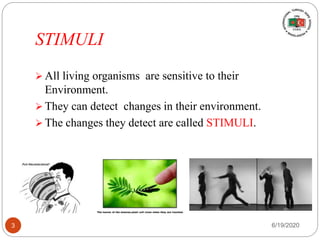
 All living organisms are sensitive to their
Environment.
 They can detect changes in their environment.
 The changes they detect are called STIMULI.
6/19/20203
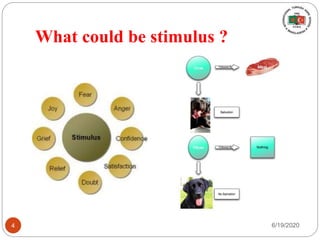
What could be stimulus ?
6/19/20204
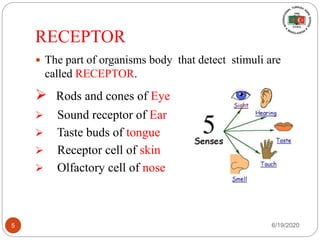
RECEPTOR
 The part of organisms body that detect stimuli are
called RECEPTOR.
 Rods and cones of Eye
 Sound receptor of Ear
 Taste buds of tongue
 Receptor cell of skin
 Olfactory cell of nose
6/19/20205
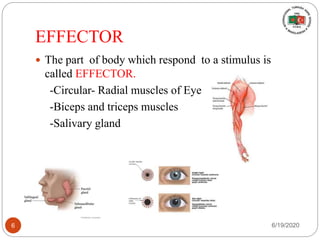
EFFECTOR
 The part of body which respond to a stimulus is
called EFFECTOR.
-Circular- Radial muscles of Eye
-Biceps and triceps muscles
-Salivary gland
6/19/20206
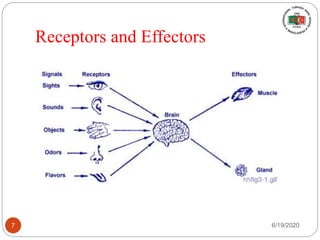
Receptors and Effectors
6/19/20207
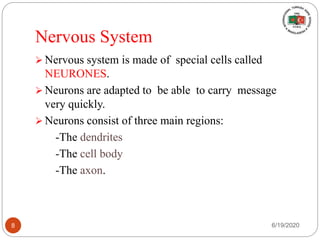
Nervous System
 Nervous system is made of special cells called
NEURONES.
 Neurons are adapted to be able to carry message
very quickly.
 Neurons consist of three main regions:
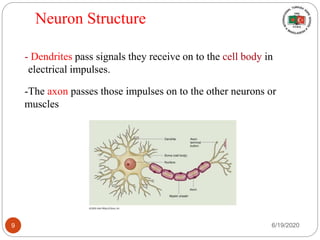
-The dendrites
-The cell body
-The axon.
6/19/20208
Neuron Structure
- Dendrites pass signals they receive on to the cell body in
electrical impulses.
-The axon passes those impulses on to the other neurons or
muscles
6/19/20209
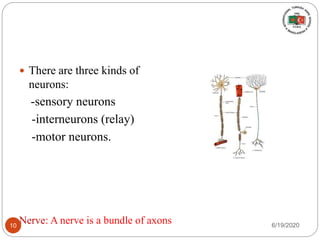
Nerve: A nerve is a bundle of axons
 There are three kinds of
neurons:
-sensory neurons
-interneurons (relay)
-motor neurons.
6/19/202010
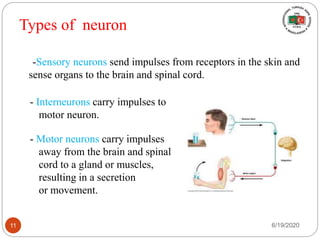
Types of neuron
-Sensory neurons send impulses from receptors in the skin and
sense organs to the brain and spinal cord.
- Interneurons carry impulses to
motor neuron.
- Motor neurons carry impulses
away from the brain and spinal
cord to a gland or muscles,
resulting in a secretion
or movement.
6/19/202011
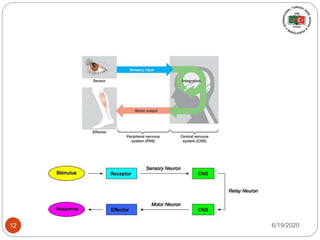
6/19/202012
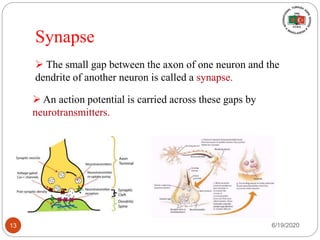
Synapse
 The small gap between the axon of one neuron and the
dendrite of another neuron is called a synapse.
 An action potential is carried across these gaps by
neurotransmitters.
6/19/202013
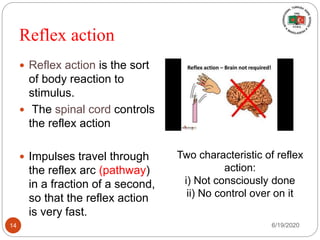
Reflex action
 Reflex action is the sort
of body reaction to
stimulus.
 The spinal cord controls
the reflex action
 Impulses travel through
the reflex arc (pathway)
in a fraction of a second,
so that the reflex action
is very fast.
Two characteristic of reflex
action:
i) Not consciously done
ii) No control over on it
6/19/202014
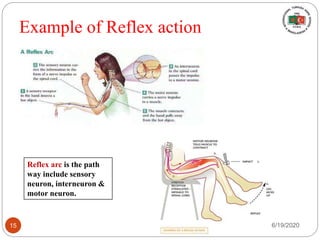
Example of Reflex action
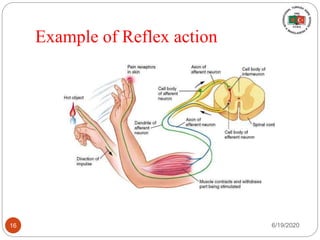
Reflex arc is the path
way include sensory
neuron, interneuron &
motor neuron.
6/19/202015
Example of Reflex action
6/19/202016
Organization of the Nervous System
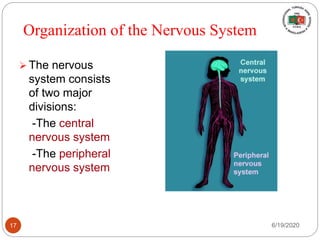
 The nervous
system consists
of two major
divisions:
-The central
nervous system
-The peripheral
nervous system
6/19/202017
Differences
 Central Nervous System:
-The central nervous
system (CNS) is made up
mostly of interneurons.
-Coordinates all of the
body’s activities
-Relays messages,
processes information,
and analyzes responses.
The Peripheral Nervous
System:
-A nerve is a bundle of axons
and may contain sensory and
motor neurons.
-The peripheral nervous
system (PNS) contains all
the neurons that are not part
of the central nervous
system.
6/19/202018
The Ear
6/19/202019
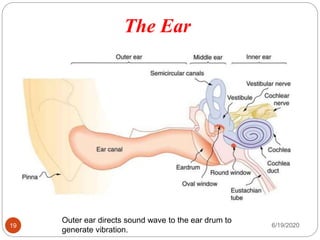
Outer ear directs sound wave to the ear drum to
generate vibration.
6/19/202020
6/19/202021
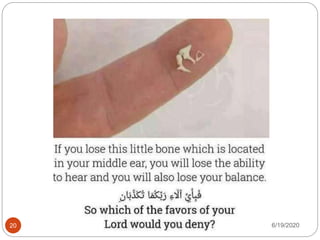
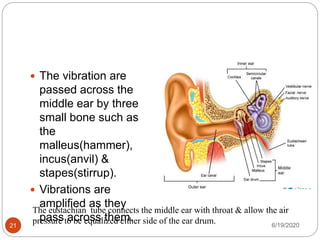
 The vibration are
passed across the
middle ear by three
small bone such as
the
malleus(hammer),
incus(anvil) &
stapes(stirrup).
 Vibrations are
amplified as they
pass across them.
The eustachian tube connects the middle ear with throat & allow the air
pressure to be equalized either side of the ear drum.
6/19/202022
6/19/202023
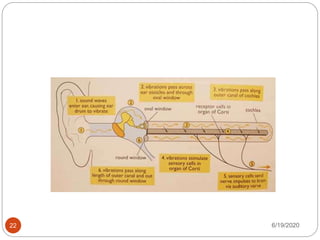
 The receptor cells that convert the vibrations into
nerve impulse are found in the cochlea, in a
structure called the the organ of Corti.
 The receptor cells in the organ of cotri have
sensory “hairs” embedded in membrane.
 Vibrations of the oval window are transmitted to
the fluid in the outer canal causing the sensory
hairs to be stretched.
 Receptor cells respond by producing nerve
impulse in the receptor neurones.
6/19/202024
 The brain determines the frequency of sound by
detecting which hair cells are being stimulated.
 Those nearest the oval window are sensitive to
high-frequency sound.
 Those nearest the round window are sensitive to
low-frequency sound.
Hearing Aid
6/19/202025
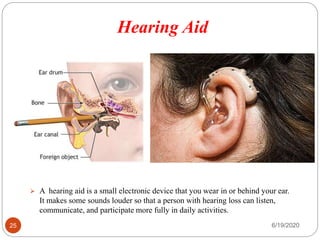
 A hearing aid is a small electronic device that you wear in or behind your ear.
It makes some sounds louder so that a person with hearing loss can listen,
communicate, and participate more fully in daily activities.
Did You Know ?
6/19/202026
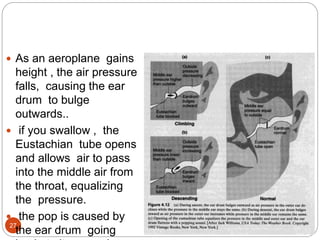
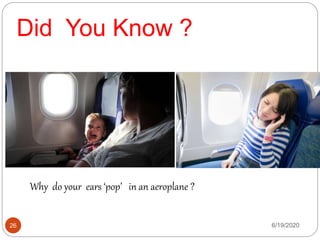
Why do your ears ‘pop’ in an aeroplane ?
6/19/202027
 As an aeroplane gains
height , the air pressure
falls, causing the ear
drum to bulge
outwards..
 if you swallow , the
Eustachian tube opens
and allows air to pass
into the middle air from
the throat, equalizing
the pressure.
 the pop is caused by
the ear drum going
Question & Answer
6/19/202028
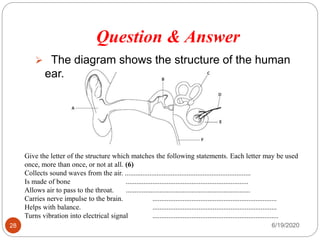
 The diagram shows the structure of the human
ear.
Give the letter of the structure which matches the following statements. Each letter may be used
once, more than once, or not at all. (6)
Collects sound waves from the air. .......................................................................
Is made of bone .....................................................................
Allows air to pass to the throat. ......................................................................
Carries nerve impulse to the brain. ......................................................................
Helps with balance. ......................................................................
Turns vibration into electrical signal .......................................................................
Question & Answer
6/19/202029
 Complete the passage by writing a suitable word or words on
each dotted line. (5)
 The sound of the lion’s roar is directed through the outer ear
by the ............................................................ down to the
...................................................................... which begins to
vibrate. The bones of the middle ear, the malleus, incus and
...................................... of the inner ear called the
................................................ . Tiny hairs inside this structure
move and sound of the lion’s roar reaches the brain via the
...........................................................
Question & Answer
 1.Which is not one of the main parts of a neuron
?
A. axon
B. cell body
C. dendrite
D. nucleus
6/19/202030
Nucleus
Answer
6/19/202031
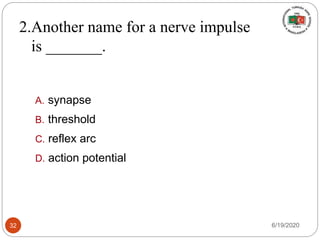
2.Another name for a nerve impulse
is _______.
A. synapse
B. threshold
C. reflex arc
D. action potential
6/19/202032
Action potential
Answer
6/19/202033
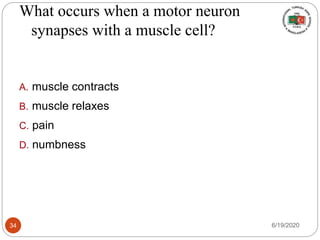
What occurs when a motor neuron
synapses with a muscle cell?
A. muscle contracts
B. muscle relaxes
C. pain
D. numbness
6/19/202034
Muscle contraction
Answer
6/19/202035
What type of neuron begins a reflex arc?
A. interneuron
B. motor neuron
C. sensory neuron
D. transmitter neuron
6/19/202036
Sensory neuron
Answer
6/19/202037
What is another name for nerve impulse?
A. synapses
B. threshold
C. action potential
D. neurotransmitter
6/19/202038
Action potential
Answer
6/19/202039
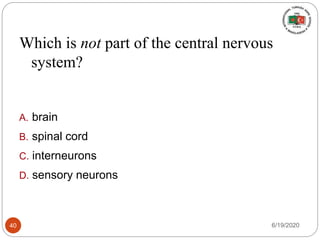
Which is not part of the central nervous
system?
A. brain
B. spinal cord
C. interneurons
D. sensory neurons
6/19/202040
Sensory neuron
Answer
6/19/202041
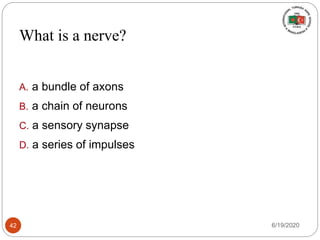
What is a nerve?
A. a bundle of axons
B. a chain of neurons
C. a sensory synapse
D. a series of impulses
6/19/202042
A bundle of axon
Answer
6/19/202043
What are sensory receptors?
A. cells that create action
potentials and thresholds
B. localized areas of the
central nervous system
C. chemicals that cross a
synapse between two
nerve cells
D. specialized neurons for
detecting the world
around you
6/19/202044
specialized neurons for
detecting the world
around you
Answer
6/19/202045
What carries signals from the axon of one
neuron to the dendrite of another neuron?
A. interneurons
B. ion channels
C. neural nodes
D. neurotransmitters
6/19/202046
Answer
Neurotransmitters
6/19/202047
Homework
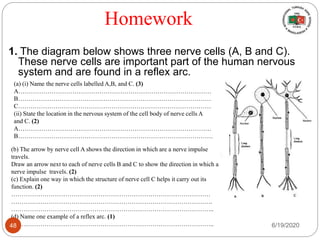
1. The diagram below shows three nerve cells (A, B and C).
These nerve cells are important part of the human nervous
system and are found in a reflex arc.
(a) (i) Name the nerve cells labelled A,B, and C. (3)
A…………………………………………………………………………………
B…………………………………………………………………………………
C…………………………………………………………………………………
(ii) State the location in the nervous system of the cell body of nerve cells A
and C. (2)
A…………………………………………………………………………………
B………………………………………………………………………………….
(b) The arrow by nerve cell A shows the direction in which are a nerve impulse
travels.
Draw an arrow next to each of nerve cells B and C to show the direction in which a
nerve impulse travels. (2)
(c) Explain one way in which the structure of nerve cell C helps it carry out its
function. (2)
……………………………………………………………………………………
…………………………………………………………………………………….
……………………………………………………………………………………..
(d) Name one example of a reflex arc. (1)
…………………………………………………………………………………….. 6/19/202048
Homework
2. This response (when the intensity of light entering the eye of
the iris) is a reflex action. State two characteristics of a reflex
action. (2)
1…………………………………………………………………
……………………….………..……………………………….
2…………………………………………………………………
……………………………..........................................................
6/19/202049
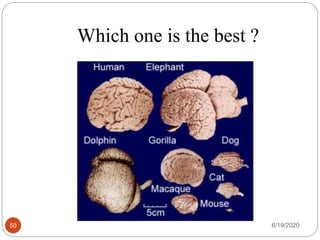
Which one is the best ?
6/19/202050
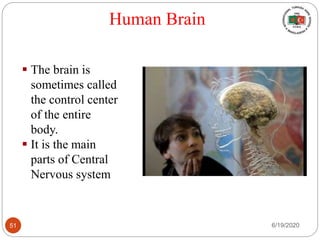
Human Brain
 The brain is
sometimes called
the control center
of the entire
body.
 It is the main
parts of Central
Nervous system
6/19/202051
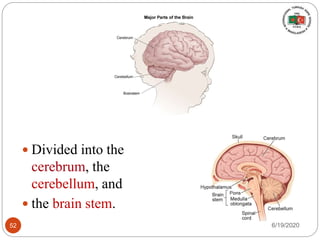
 Divided into the
cerebrum, the
cerebellum, and
 the brain stem.
6/19/202052
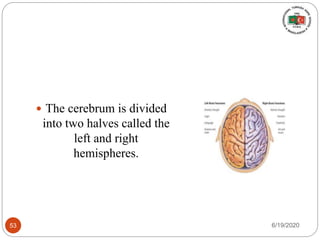
 The cerebrum is divided
into two halves called the
left and right
hemispheres.
6/19/202053
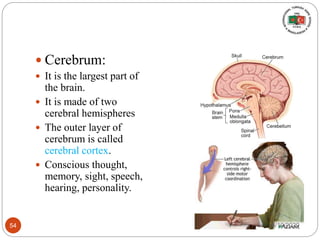
 Cerebrum:
 It is the largest part of
the brain.
 It is made of two
cerebral hemispheres
 The outer layer of
cerebrum is called
cerebral cortex.
 Conscious thought,
memory, sight, speech,
hearing, personality.
6/19/202054
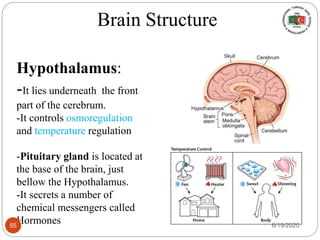
Hypothalamus:
-It lies underneath the front
part of the cerebrum.
-It controls osmoregulation
and temperature regulation
-Pituitary gland is located at
the base of the brain, just
bellow the Hypothalamus.
-It secrets a number of
chemical messengers called
Hormones
Brain Structure
6/19/202055
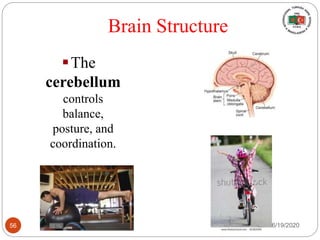
Brain Structure
The
cerebellum
controls
balance,
posture, and
coordination.
6/19/202056
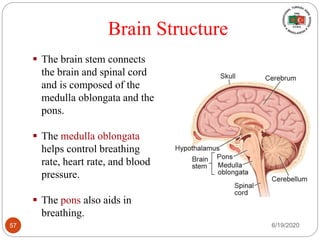
Brain Structure
 The brain stem connects
the brain and spinal cord
and is composed of the
medulla oblongata and the
pons.
 The medulla oblongata
helps control breathing
rate, heart rate, and blood
pressure.
 The pons also aids in
breathing.
6/19/202057
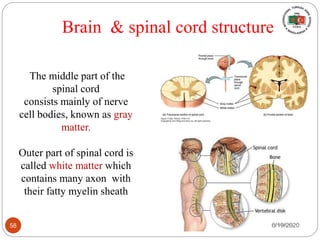
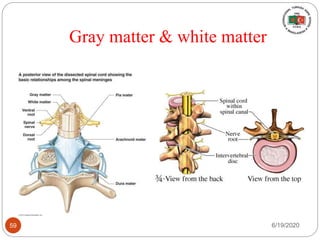
Brain & spinal cord structure
The middle part of the
spinal cord
consists mainly of nerve
cell bodies, known as gray
matter.
Outer part of spinal cord is
called white matter which
contains many axon with
their fatty myelin sheath
6/19/202058
Gray matter & white matter
6/19/202059
6/19/202060
6/19/202061
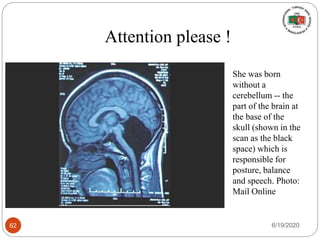
Attention please !
She was born
without a
cerebellum -- the
part of the brain at
the base of the
skull (shown in the
scan as the black
space) which is
responsible for
posture, balance
and speech. Photo:
Mail Online
6/19/202062
 A Chinese woman has lived to the age of 24 with part of her brain missing, before the extremely rare condition was detected.
 Doctors at the Chinese PLA General Hospital of Jinan Military Area Command in the Shandong Province made the discovery
when the woman visited medics complaining of nausea and dizziness.
 Scans revealed the woman had been born with a cerebellum - the part of the brain responsible for posture, balance, motor learning
like kicking a ball, and speech.
 It is located at the base of the skull and contains around half the neurons - cells that transmit information - in the brain, and
represents around 10 per cent of the brain's mass.
 It emerged the woman had experienced problems, not learning to talk until she was six and failing to walk until she was seven.
 While it is not unknown for a person to lose partial function of the cerebellum due to an injury or disease, completely lacking the
region in the first place is extremely rare.
 Physicians believe the woman is only the ninth known case of a living person suffering the condition cerebellar agenesis.
 Advertisement
 Doctors learned the woman had never played or jumped like other children her age, and is unable to walk steadily without support.
 Tests revealed she had no problem understanding words but living without a cerebellum meant she had difficulties with
pronunciation.
 Her voice trembles, her words are slurred and the doctors treating the 24-year-old described her voice tone as “harsh”.
 Specialists discovered the space where the cerebellum should be was empty.
 Instead, the black space was filled with cerebrospinal fluid, which cushions the brain, providing defence against disease.
 Doctors treated her with a dehydration treatment to remove some of the water pressure building up in her brain.
 Mario Manto, who researches cerebellar disorders at the Free University of Brussels in Belgium, told the New Scientist: “These
rare cases are interesting to understand how the brain circuitry works and compensates for missing parts.”
 The doctors looking after the patient, said they believe the normal cerebellar function may have been taken over by the cortex.
 At a follow-up appointment four years later she was showing signs of doing well, it was reported in the journal Brain.
 The woman married, and gave birth to a daughter with no neurological abnormalities.
 While the majority of people born with the rare condition will die in infancy, the patient represents a new opportunity to study the
effects of living without the cerebellum.
6/19/202063
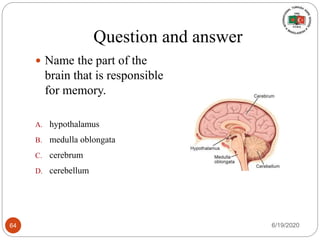
Question and answer
 Name the part of the
brain that is responsible
for memory.
A. hypothalamus
B. medulla oblongata
C. cerebrum
D. cerebellum
6/19/202064
Answer
Cerebrum
6/19/202065
Question and answer
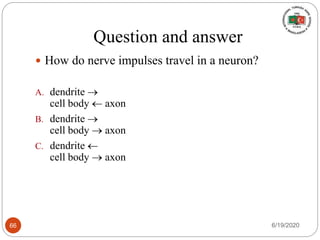
 How do nerve impulses travel in a neuron?
A. dendrite 
cell body  axon
B. dendrite 
cell body  axon
C. dendrite 
cell body  axon
6/19/202066
Answer
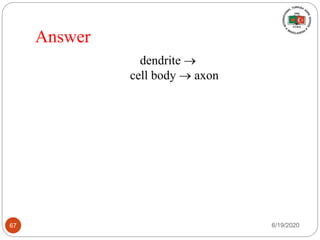
dendrite 
cell body  axon
6/19/202067
Question and answer
Which word best describes the
hypothalamus?
A. processor
B. reflexor
C. regulator
D. transmitter
6/19/202068
Answer
Regulator
6/19/202069
Question and answer
What part of the brain is highly developed
in animals that have finely tuned balance
and complex coordination?
A. cerebellum
B. medulla
C. thalamus
D. temporal lobe
6/19/202070
Answer
 Cerebellum
6/19/202071
Question & Answer
1. (a) In mammals, response to stimuli may involve
hormones or nerves.
(i) Name four of the endocrine glands found in the human
body.
1................................. 2................................
3................................. 4.................................
(ii) For one of the glands you have named, give one hormone
produced and describe its effect.
……………………………………………………………
……………………………………………………………
……………………………………………………………
6/19/202072
2.(iii) Give three ways that hormonal coordination differs from
nervous communication. (3)
……………………………………………………………………
……………………………………………………………………
……………………………………………………………………
(iv) Describe the major components of a reflex arc and give one
example of a reflex action in humans. (6)
……………………………………………………………………
……………………………………………………………………
……………………………………………………………………
Question & Answer
6/19/202073
Question & Answer
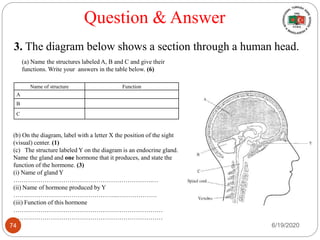
3. The diagram below shows a section through a human head.
(a) Name the structures labeled A, B and C and give their
functions. Write your answers in the table below. (6)
Name of structure Function
A
B
C
(b) On the diagram, label with a letter X the position of the sight
(visual) center. (1)
(c) The structure labeled Y on the diagram is an endocrine gland.
Name the gland and one hormone that it produces, and state the
function of the hormone. (3)
(i) Name of gland Y
………………………………………………………….…
(ii) Name of hormone produced by Y
…………………………………………...……………….
(iii) Function of this hormone
………………………………………………………………
………………………………………………………………
6/19/202074
6/19/202075

coordination and control

  • 1.
  • 2.
    Student will ableto understand:  What is stimulus & response ?  What are the receptor & effector ?  What is synapse?  What is reflex action & its important ?  Nervous system & human brain structure .  Question & answer .  Homework 6/19/20202
  • 3.
    STIMULI  All livingorganisms are sensitive to their Environment.  They can detect changes in their environment.  The changes they detect are called STIMULI. 6/19/20203
  • 4.
    What could bestimulus ? 6/19/20204
  • 5.
    RECEPTOR  The partof organisms body that detect stimuli are called RECEPTOR.  Rods and cones of Eye  Sound receptor of Ear  Taste buds of tongue  Receptor cell of skin  Olfactory cell of nose 6/19/20205
  • 6.
    EFFECTOR  The partof body which respond to a stimulus is called EFFECTOR. -Circular- Radial muscles of Eye -Biceps and triceps muscles -Salivary gland 6/19/20206
  • 7.
  • 8.
    Nervous System  Nervoussystem is made of special cells called NEURONES.  Neurons are adapted to be able to carry message very quickly.  Neurons consist of three main regions: -The dendrites -The cell body -The axon. 6/19/20208
  • 9.
    Neuron Structure - Dendritespass signals they receive on to the cell body in electrical impulses. -The axon passes those impulses on to the other neurons or muscles 6/19/20209
  • 10.
    Nerve: A nerveis a bundle of axons  There are three kinds of neurons: -sensory neurons -interneurons (relay) -motor neurons. 6/19/202010
  • 11.
    Types of neuron -Sensoryneurons send impulses from receptors in the skin and sense organs to the brain and spinal cord. - Interneurons carry impulses to motor neuron. - Motor neurons carry impulses away from the brain and spinal cord to a gland or muscles, resulting in a secretion or movement. 6/19/202011
  • 12.
  • 13.
    Synapse  The smallgap between the axon of one neuron and the dendrite of another neuron is called a synapse.  An action potential is carried across these gaps by neurotransmitters. 6/19/202013
  • 14.
    Reflex action  Reflexaction is the sort of body reaction to stimulus.  The spinal cord controls the reflex action  Impulses travel through the reflex arc (pathway) in a fraction of a second, so that the reflex action is very fast. Two characteristic of reflex action: i) Not consciously done ii) No control over on it 6/19/202014
  • 15.
    Example of Reflexaction Reflex arc is the path way include sensory neuron, interneuron & motor neuron. 6/19/202015
  • 16.
    Example of Reflexaction 6/19/202016
  • 17.
    Organization of theNervous System  The nervous system consists of two major divisions: -The central nervous system -The peripheral nervous system 6/19/202017
  • 18.
    Differences  Central NervousSystem: -The central nervous system (CNS) is made up mostly of interneurons. -Coordinates all of the body’s activities -Relays messages, processes information, and analyzes responses. The Peripheral Nervous System: -A nerve is a bundle of axons and may contain sensory and motor neurons. -The peripheral nervous system (PNS) contains all the neurons that are not part of the central nervous system. 6/19/202018
  • 19.
    The Ear 6/19/202019 Outer eardirects sound wave to the ear drum to generate vibration.
  • 20.
  • 21.
    6/19/202021  The vibrationare passed across the middle ear by three small bone such as the malleus(hammer), incus(anvil) & stapes(stirrup).  Vibrations are amplified as they pass across them. The eustachian tube connects the middle ear with throat & allow the air pressure to be equalized either side of the ear drum.
  • 22.
  • 23.
    6/19/202023  The receptorcells that convert the vibrations into nerve impulse are found in the cochlea, in a structure called the the organ of Corti.  The receptor cells in the organ of cotri have sensory “hairs” embedded in membrane.  Vibrations of the oval window are transmitted to the fluid in the outer canal causing the sensory hairs to be stretched.  Receptor cells respond by producing nerve impulse in the receptor neurones.
  • 24.
    6/19/202024  The braindetermines the frequency of sound by detecting which hair cells are being stimulated.  Those nearest the oval window are sensitive to high-frequency sound.  Those nearest the round window are sensitive to low-frequency sound.
  • 25.
    Hearing Aid 6/19/202025  Ahearing aid is a small electronic device that you wear in or behind your ear. It makes some sounds louder so that a person with hearing loss can listen, communicate, and participate more fully in daily activities.
  • 26.
    Did You Know? 6/19/202026 Why do your ears ‘pop’ in an aeroplane ?
  • 27.
    6/19/202027  As anaeroplane gains height , the air pressure falls, causing the ear drum to bulge outwards..  if you swallow , the Eustachian tube opens and allows air to pass into the middle air from the throat, equalizing the pressure.  the pop is caused by the ear drum going
  • 28.
    Question & Answer 6/19/202028 The diagram shows the structure of the human ear. Give the letter of the structure which matches the following statements. Each letter may be used once, more than once, or not at all. (6) Collects sound waves from the air. ....................................................................... Is made of bone ..................................................................... Allows air to pass to the throat. ...................................................................... Carries nerve impulse to the brain. ...................................................................... Helps with balance. ...................................................................... Turns vibration into electrical signal .......................................................................
  • 29.
    Question & Answer 6/19/202029 Complete the passage by writing a suitable word or words on each dotted line. (5)  The sound of the lion’s roar is directed through the outer ear by the ............................................................ down to the ...................................................................... which begins to vibrate. The bones of the middle ear, the malleus, incus and ...................................... of the inner ear called the ................................................ . Tiny hairs inside this structure move and sound of the lion’s roar reaches the brain via the ...........................................................
  • 30.
    Question & Answer 1.Which is not one of the main parts of a neuron ? A. axon B. cell body C. dendrite D. nucleus 6/19/202030
  • 31.
  • 32.
    2.Another name fora nerve impulse is _______. A. synapse B. threshold C. reflex arc D. action potential 6/19/202032
  • 33.
  • 34.
    What occurs whena motor neuron synapses with a muscle cell? A. muscle contracts B. muscle relaxes C. pain D. numbness 6/19/202034
  • 35.
  • 36.
    What type ofneuron begins a reflex arc? A. interneuron B. motor neuron C. sensory neuron D. transmitter neuron 6/19/202036
  • 37.
  • 38.
    What is anothername for nerve impulse? A. synapses B. threshold C. action potential D. neurotransmitter 6/19/202038
  • 39.
  • 40.
    Which is notpart of the central nervous system? A. brain B. spinal cord C. interneurons D. sensory neurons 6/19/202040
  • 41.
  • 42.
    What is anerve? A. a bundle of axons B. a chain of neurons C. a sensory synapse D. a series of impulses 6/19/202042
  • 43.
    A bundle ofaxon Answer 6/19/202043
  • 44.
    What are sensoryreceptors? A. cells that create action potentials and thresholds B. localized areas of the central nervous system C. chemicals that cross a synapse between two nerve cells D. specialized neurons for detecting the world around you 6/19/202044
  • 45.
    specialized neurons for detectingthe world around you Answer 6/19/202045
  • 46.
    What carries signalsfrom the axon of one neuron to the dendrite of another neuron? A. interneurons B. ion channels C. neural nodes D. neurotransmitters 6/19/202046
  • 47.
  • 48.
    Homework 1. The diagrambelow shows three nerve cells (A, B and C). These nerve cells are important part of the human nervous system and are found in a reflex arc. (a) (i) Name the nerve cells labelled A,B, and C. (3) A………………………………………………………………………………… B………………………………………………………………………………… C………………………………………………………………………………… (ii) State the location in the nervous system of the cell body of nerve cells A and C. (2) A………………………………………………………………………………… B…………………………………………………………………………………. (b) The arrow by nerve cell A shows the direction in which are a nerve impulse travels. Draw an arrow next to each of nerve cells B and C to show the direction in which a nerve impulse travels. (2) (c) Explain one way in which the structure of nerve cell C helps it carry out its function. (2) …………………………………………………………………………………… ……………………………………………………………………………………. …………………………………………………………………………………….. (d) Name one example of a reflex arc. (1) …………………………………………………………………………………….. 6/19/202048
  • 49.
    Homework 2. This response(when the intensity of light entering the eye of the iris) is a reflex action. State two characteristics of a reflex action. (2) 1………………………………………………………………… ……………………….………..………………………………. 2………………………………………………………………… …………………………….......................................................... 6/19/202049
  • 50.
    Which one isthe best ? 6/19/202050
  • 51.
    Human Brain  Thebrain is sometimes called the control center of the entire body.  It is the main parts of Central Nervous system 6/19/202051
  • 52.
     Divided intothe cerebrum, the cerebellum, and  the brain stem. 6/19/202052
  • 53.
     The cerebrumis divided into two halves called the left and right hemispheres. 6/19/202053
  • 54.
     Cerebrum:  Itis the largest part of the brain.  It is made of two cerebral hemispheres  The outer layer of cerebrum is called cerebral cortex.  Conscious thought, memory, sight, speech, hearing, personality. 6/19/202054
  • 55.
    Hypothalamus: -It lies underneaththe front part of the cerebrum. -It controls osmoregulation and temperature regulation -Pituitary gland is located at the base of the brain, just bellow the Hypothalamus. -It secrets a number of chemical messengers called Hormones Brain Structure 6/19/202055
  • 56.
  • 57.
    Brain Structure  Thebrain stem connects the brain and spinal cord and is composed of the medulla oblongata and the pons.  The medulla oblongata helps control breathing rate, heart rate, and blood pressure.  The pons also aids in breathing. 6/19/202057
  • 58.
    Brain & spinalcord structure The middle part of the spinal cord consists mainly of nerve cell bodies, known as gray matter. Outer part of spinal cord is called white matter which contains many axon with their fatty myelin sheath 6/19/202058
  • 59.
    Gray matter &white matter 6/19/202059
  • 60.
  • 61.
  • 62.
    Attention please ! Shewas born without a cerebellum -- the part of the brain at the base of the skull (shown in the scan as the black space) which is responsible for posture, balance and speech. Photo: Mail Online 6/19/202062
  • 63.
     A Chinesewoman has lived to the age of 24 with part of her brain missing, before the extremely rare condition was detected.  Doctors at the Chinese PLA General Hospital of Jinan Military Area Command in the Shandong Province made the discovery when the woman visited medics complaining of nausea and dizziness.  Scans revealed the woman had been born with a cerebellum - the part of the brain responsible for posture, balance, motor learning like kicking a ball, and speech.  It is located at the base of the skull and contains around half the neurons - cells that transmit information - in the brain, and represents around 10 per cent of the brain's mass.  It emerged the woman had experienced problems, not learning to talk until she was six and failing to walk until she was seven.  While it is not unknown for a person to lose partial function of the cerebellum due to an injury or disease, completely lacking the region in the first place is extremely rare.  Physicians believe the woman is only the ninth known case of a living person suffering the condition cerebellar agenesis.  Advertisement  Doctors learned the woman had never played or jumped like other children her age, and is unable to walk steadily without support.  Tests revealed she had no problem understanding words but living without a cerebellum meant she had difficulties with pronunciation.  Her voice trembles, her words are slurred and the doctors treating the 24-year-old described her voice tone as “harsh”.  Specialists discovered the space where the cerebellum should be was empty.  Instead, the black space was filled with cerebrospinal fluid, which cushions the brain, providing defence against disease.  Doctors treated her with a dehydration treatment to remove some of the water pressure building up in her brain.  Mario Manto, who researches cerebellar disorders at the Free University of Brussels in Belgium, told the New Scientist: “These rare cases are interesting to understand how the brain circuitry works and compensates for missing parts.”  The doctors looking after the patient, said they believe the normal cerebellar function may have been taken over by the cortex.  At a follow-up appointment four years later she was showing signs of doing well, it was reported in the journal Brain.  The woman married, and gave birth to a daughter with no neurological abnormalities.  While the majority of people born with the rare condition will die in infancy, the patient represents a new opportunity to study the effects of living without the cerebellum. 6/19/202063
  • 64.
    Question and answer Name the part of the brain that is responsible for memory. A. hypothalamus B. medulla oblongata C. cerebrum D. cerebellum 6/19/202064
  • 65.
  • 66.
    Question and answer How do nerve impulses travel in a neuron? A. dendrite  cell body  axon B. dendrite  cell body  axon C. dendrite  cell body  axon 6/19/202066
  • 67.
    Answer dendrite  cell body axon 6/19/202067
  • 68.
    Question and answer Whichword best describes the hypothalamus? A. processor B. reflexor C. regulator D. transmitter 6/19/202068
  • 69.
  • 70.
    Question and answer Whatpart of the brain is highly developed in animals that have finely tuned balance and complex coordination? A. cerebellum B. medulla C. thalamus D. temporal lobe 6/19/202070
  • 71.
  • 72.
    Question & Answer 1.(a) In mammals, response to stimuli may involve hormones or nerves. (i) Name four of the endocrine glands found in the human body. 1................................. 2................................ 3................................. 4................................. (ii) For one of the glands you have named, give one hormone produced and describe its effect. …………………………………………………………… …………………………………………………………… …………………………………………………………… 6/19/202072
  • 73.
    2.(iii) Give threeways that hormonal coordination differs from nervous communication. (3) …………………………………………………………………… …………………………………………………………………… …………………………………………………………………… (iv) Describe the major components of a reflex arc and give one example of a reflex action in humans. (6) …………………………………………………………………… …………………………………………………………………… …………………………………………………………………… Question & Answer 6/19/202073
  • 74.
    Question & Answer 3.The diagram below shows a section through a human head. (a) Name the structures labeled A, B and C and give their functions. Write your answers in the table below. (6) Name of structure Function A B C (b) On the diagram, label with a letter X the position of the sight (visual) center. (1) (c) The structure labeled Y on the diagram is an endocrine gland. Name the gland and one hormone that it produces, and state the function of the hormone. (3) (i) Name of gland Y ………………………………………………………….… (ii) Name of hormone produced by Y …………………………………………...………………. (iii) Function of this hormone ……………………………………………………………… ……………………………………………………………… 6/19/202074
  • 75.