Control & Coordination
By-Dhruv
Class-10th pacific
Content
 Introduction
 Human Nervous system
 Working of Nervous system
 Human Brain
 Parts of Human Brain
 Spinal Cord
 Endocrine system & Reflex action
 Hormones in Humans
 Functions of Hormones
 Hormonal Diseases
 Coordination in Plants
 Hormones in Plants
 Importance of Coordination
 Bibliography
Introduction
A living being does not live in isolation. It
has to constantly interact with its
external environment and has to respond
properly for its survival. The responses
which a living being makes in relation to
external stimuli are controlled and
coordinated by a system.
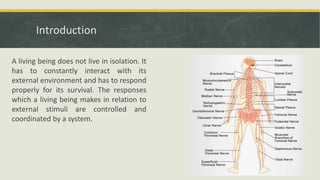
Human Nervous System
Central Nervous System (CNS)
 It is dorsally placed structure lying
along mid-dorsal axis of the body
 Includes-
 Brain
 Spinal Cord
Peripheral Nervous System (PNS)
 The nerves arising from the CNS
contribute PNS.
 Two types-
 Voluntary
 Involuntary
 Includes-
 Cranial Nerve (from Brain and
Spinal Cord)
 Spinal nerve (from Spinal Cord)
Nervous system
 Components of nervous system
 Brain
 Spinal Cord
 Nerves
How does nervous system works?
Receptors
• Senses the situation
• Thee are the sense
organs
Nerve cells
• Also called Sensory
neuron
• Transfers the signals
to brain or spinal
cord
Effectors
• Analyze the situation
• Order what is to be
done
• These are brain or
Spinal cord
Motor cells
• These take up the
action by making
movement of the
body
Other parts
 Neuron- Structural and functional unit of nervous system. It is the longest cell in
human body and humans comprise of billions of these neurons. Majority of
neurons are in the human brain. They carry electrical messages called IMPULSES
throughout the body.
 There are 3 types of neurons-
 Sensory Neuron
 Motor Neuron
 Relay Neuron(Inter Neuron)
 Synapsis- It is an area of functional contact between neuron and another for
purpose of transferring information either to neuron or gland or Skeletal muscle.
Human Brain
 It weighs about 1220gm to 1400gm.
 It is locates at anterior post part which consist of 100 billion neurons.
 The for-brain is the main thinking part of the brain. It has regions which receive
sensory impulses from various receptors. Separate areas of the fore-brain are
specialised for hearing, smell, sight and so on.
 There is another set of muscles which we do not any control. Many of the
involuntary actions are controlled by the mid & hind brain. For example, Blood
pressure, salivation and vomiting.
Parts of human brain
 Fore Brain
 Olfactory lobe
 Cerebrum
 Frontal lobe
 Parietal lobe
 Temporial lobe
 Occipital lobe
 Dincephalon
 Epitheliums
 Hypothalamus
 Mid- brain
 Hind brain
Spinal Cord
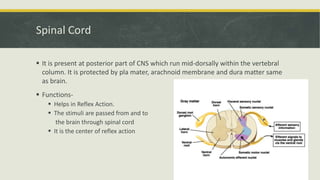
 It is present at posterior part of CNS which run mid-dorsally within the vertebral
column. It is protected by pla mater, arachnoid membrane and dura matter same
as brain.
 Functions-
 Helps in Reflex Action.
 The stimuli are passed from and to
the brain through spinal cord
 It is the center of reflex action
Endocrine system & Reflex action
 Endocrine system- Endocrine glands are the ductless glands which secrete
chemical substances called hormones for Control and coordination.
 Reflex Action- The animal behaviour in which the stimulation of sensory organs
result in activity of some organ without will power of animal or it is sudden
action without will which is controlled by SPINAL CORD
Hormones in Humans
 Hormones are chemicals that essentially function as messengers of the body.
These chemicals are secreted by special glands known as the endocrine glands
 They are of many types and have many different functions-
 Hypothalamus: It regulates the body temperature, controls thirst, sleep, hunger,
emotions, moods and allow the release of hormones.
 Pineal: Pineal is also known as the thalamus, it develops serotonin derivatives of
melatonin, which can affect sleep.
 Parathyroid: This gland helps in controlling the amount of calcium present in the
body.
 Thymus: It helps in the functioning of the adaptive immune system, produces T-cells and
maturity of the thymus.
 Thyroid: It produces hormones that affect the heart rate and how calories are burnt.
 Adrenal: This gland produces the hormones that control the sex drive, cortisol and stress
hormone.
 Pituitary: It is also termed as the “master control gland,”. This is because the pituitary gland
helps in controlling other glands. Moreover, it develops the hormones that trigger growth and
development.
 Pancreas: This gland produces insulin crucial to maintain blood sugar levels.
 Testes: In men, the testes secrete the male sex hormone, testosterone. It also produces
sperm.
 Ovaries: In women, the ovaries secrete estrogen, progesterone, testosterone, and other
female sex hormones.
 Estrogen-This is the main sex hormone present in women which bring about puberty,
prepares the uterus and body for pregnancy and even regulates the menstrual cycle.
Estrogen level changes during menopause because of which women experience many
uncomfortable symptoms.
 Progesterone – It is a female sex hormone also responsible for menstrual cycle,
pregnancy and embryo genesis.
 Cortisol – It has been named as the “stress hormone” as it helps the body in responding
to stress. This is done by increasing the heart rate, elevating blood sugar levels etc.
 Melatonin – It primarily controls the circadian rhythm or sleep cycles.
 Testosterone – This is the main sex hormone present in men which cause puberty,
muscle mass growth, and strength, increases bone density and handles facial hair
growth.
Functions of Hormones
 Food metabolism.
 Growth and development.
 Controlling thirst and hunger.
 Maintaining body temperature.
 Regulating mood and cognitive functions.
 Initiating and maintaining sexual development and reproduction
Hormonal Diseases
 Several hormonal diseases arise when the endocrine glands malfunctions.
Common hormonal issues are associated with hypothalamus, adrenal
and pituitary glands. An increase or decrease in the secretion of these hormones
can severely affect growth, metabolism and development.
 Diseases such as hyperthyroidism, osteoporosis, and diabetes are caused due to
hormonal imbalance. The factors responsible for hormonal diseases can be
genetic, environmental, or related to diet.
Coordination in Plants
 Types of movements by the plants
 Dependent on growth- The movement that a plant makes while growing are
considered of this type.
 Phototropism- Movement towards light
 Geotropism- Root’s movement towards gravity
 Hydrotropism- Movement towards water source
 Thigmotropism- movement towards solid support by tendrils.
 Independent of growth- These movements are not connected by the growth of the
plant
 Response to stimuli- The plant cells change their shape by changing the
amount of water in them, resulting in swelling or shrinking, and therefore in
changing shapes.
Hormones in Plants
 Plants need sunlight, water, oxygen, minerals for their growth and development.
These are external factors. Apart from these, there are some intrinsic factors that
regulate the growth and development of plants. These are called plant hormones
or “Phytohormones”.
 Types of Hormones and their functions:
 Auxin Hormone: Auxin means “to grow”. They are widely used in agricultural and
horticultural practices. They are found in growing apices of roots and stems and then
migrate to other parts to act.
 Gibberellins Hormone:They are acidic in nature. These are found in higher plants
and fungi.
 Cytokinins Hormone: Cytokinins play an important role in cytokinesis process.
Cytokinins are naturally synthesised in the plants where rapid cell division occurs
e.g. root apices, shoot buds, young fruits, etc. Movement of cytokinins is
basipetal and polar.
 Abscisic Acid Function: It is a growth-inhibiting hormone. ABAs act as an
antagonist to GAs. It inhibits plant metabolism and regulates abscission and
dormancy. It is also called “stress hormone” as it increases tolerance of plants.
Importance of Control & Coordination
 Control and coordination is required for survival of any organism. It is necessary for each
biotic organism to obtain its nutrients and conditions to survive in which could be made
possible with the presence of the control and coordination systems. Example- If a plant is
deprived of water most of the time. it could thus show hydrotropic adaptation when very
little water becomes available by positioning its roots in the direction of the water.
 Control and coordination is required by organisms to interact with their ever-changing
external environment and respond to is appropriately. It serves to be of significance in an
organism's life in situations of danger, excitement, anger, enthusiasm, urgency etc. and thus
prepare one's own body to deal with the environment.
 Control and coordination is necessary for any organism to carry out basic growth and
development of the living organism's body. Example- Growth hormones are required for
development and growth of all organs properly in our body.
Bibliography
 https://brainly.in/
 https://www.slideshare.net/
 NCERT SCIENCE TEXT BOOK
Control & Coordination

Control & Coordination

  • 1.
  • 2.
    Content  Introduction  HumanNervous system  Working of Nervous system  Human Brain  Parts of Human Brain  Spinal Cord  Endocrine system & Reflex action  Hormones in Humans  Functions of Hormones  Hormonal Diseases  Coordination in Plants  Hormones in Plants  Importance of Coordination  Bibliography
  • 3.
    Introduction A living beingdoes not live in isolation. It has to constantly interact with its external environment and has to respond properly for its survival. The responses which a living being makes in relation to external stimuli are controlled and coordinated by a system.
  • 4.
    Human Nervous System CentralNervous System (CNS)  It is dorsally placed structure lying along mid-dorsal axis of the body  Includes-  Brain  Spinal Cord Peripheral Nervous System (PNS)  The nerves arising from the CNS contribute PNS.  Two types-  Voluntary  Involuntary  Includes-  Cranial Nerve (from Brain and Spinal Cord)  Spinal nerve (from Spinal Cord)
  • 5.
    Nervous system  Componentsof nervous system  Brain  Spinal Cord  Nerves
  • 6.
    How does nervoussystem works? Receptors • Senses the situation • Thee are the sense organs Nerve cells • Also called Sensory neuron • Transfers the signals to brain or spinal cord Effectors • Analyze the situation • Order what is to be done • These are brain or Spinal cord Motor cells • These take up the action by making movement of the body
  • 8.
    Other parts  Neuron-Structural and functional unit of nervous system. It is the longest cell in human body and humans comprise of billions of these neurons. Majority of neurons are in the human brain. They carry electrical messages called IMPULSES throughout the body.  There are 3 types of neurons-  Sensory Neuron  Motor Neuron  Relay Neuron(Inter Neuron)  Synapsis- It is an area of functional contact between neuron and another for purpose of transferring information either to neuron or gland or Skeletal muscle.
  • 9.
    Human Brain  Itweighs about 1220gm to 1400gm.  It is locates at anterior post part which consist of 100 billion neurons.  The for-brain is the main thinking part of the brain. It has regions which receive sensory impulses from various receptors. Separate areas of the fore-brain are specialised for hearing, smell, sight and so on.  There is another set of muscles which we do not any control. Many of the involuntary actions are controlled by the mid & hind brain. For example, Blood pressure, salivation and vomiting.
  • 10.
    Parts of humanbrain  Fore Brain  Olfactory lobe  Cerebrum  Frontal lobe  Parietal lobe  Temporial lobe  Occipital lobe  Dincephalon  Epitheliums  Hypothalamus  Mid- brain  Hind brain
  • 11.
    Spinal Cord  Itis present at posterior part of CNS which run mid-dorsally within the vertebral column. It is protected by pla mater, arachnoid membrane and dura matter same as brain.  Functions-  Helps in Reflex Action.  The stimuli are passed from and to the brain through spinal cord  It is the center of reflex action
  • 12.
    Endocrine system &Reflex action  Endocrine system- Endocrine glands are the ductless glands which secrete chemical substances called hormones for Control and coordination.  Reflex Action- The animal behaviour in which the stimulation of sensory organs result in activity of some organ without will power of animal or it is sudden action without will which is controlled by SPINAL CORD
  • 13.
    Hormones in Humans Hormones are chemicals that essentially function as messengers of the body. These chemicals are secreted by special glands known as the endocrine glands  They are of many types and have many different functions-  Hypothalamus: It regulates the body temperature, controls thirst, sleep, hunger, emotions, moods and allow the release of hormones.  Pineal: Pineal is also known as the thalamus, it develops serotonin derivatives of melatonin, which can affect sleep.  Parathyroid: This gland helps in controlling the amount of calcium present in the body.
  • 14.
     Thymus: Ithelps in the functioning of the adaptive immune system, produces T-cells and maturity of the thymus.  Thyroid: It produces hormones that affect the heart rate and how calories are burnt.  Adrenal: This gland produces the hormones that control the sex drive, cortisol and stress hormone.  Pituitary: It is also termed as the “master control gland,”. This is because the pituitary gland helps in controlling other glands. Moreover, it develops the hormones that trigger growth and development.  Pancreas: This gland produces insulin crucial to maintain blood sugar levels.  Testes: In men, the testes secrete the male sex hormone, testosterone. It also produces sperm.  Ovaries: In women, the ovaries secrete estrogen, progesterone, testosterone, and other female sex hormones.
  • 15.
     Estrogen-This isthe main sex hormone present in women which bring about puberty, prepares the uterus and body for pregnancy and even regulates the menstrual cycle. Estrogen level changes during menopause because of which women experience many uncomfortable symptoms.  Progesterone – It is a female sex hormone also responsible for menstrual cycle, pregnancy and embryo genesis.  Cortisol – It has been named as the “stress hormone” as it helps the body in responding to stress. This is done by increasing the heart rate, elevating blood sugar levels etc.  Melatonin – It primarily controls the circadian rhythm or sleep cycles.  Testosterone – This is the main sex hormone present in men which cause puberty, muscle mass growth, and strength, increases bone density and handles facial hair growth.
  • 16.
    Functions of Hormones Food metabolism.  Growth and development.  Controlling thirst and hunger.  Maintaining body temperature.  Regulating mood and cognitive functions.  Initiating and maintaining sexual development and reproduction
  • 17.
    Hormonal Diseases  Severalhormonal diseases arise when the endocrine glands malfunctions. Common hormonal issues are associated with hypothalamus, adrenal and pituitary glands. An increase or decrease in the secretion of these hormones can severely affect growth, metabolism and development.  Diseases such as hyperthyroidism, osteoporosis, and diabetes are caused due to hormonal imbalance. The factors responsible for hormonal diseases can be genetic, environmental, or related to diet.
  • 18.
    Coordination in Plants Types of movements by the plants  Dependent on growth- The movement that a plant makes while growing are considered of this type.  Phototropism- Movement towards light  Geotropism- Root’s movement towards gravity  Hydrotropism- Movement towards water source  Thigmotropism- movement towards solid support by tendrils.  Independent of growth- These movements are not connected by the growth of the plant  Response to stimuli- The plant cells change their shape by changing the amount of water in them, resulting in swelling or shrinking, and therefore in changing shapes.
  • 19.
    Hormones in Plants Plants need sunlight, water, oxygen, minerals for their growth and development. These are external factors. Apart from these, there are some intrinsic factors that regulate the growth and development of plants. These are called plant hormones or “Phytohormones”.  Types of Hormones and their functions:  Auxin Hormone: Auxin means “to grow”. They are widely used in agricultural and horticultural practices. They are found in growing apices of roots and stems and then migrate to other parts to act.  Gibberellins Hormone:They are acidic in nature. These are found in higher plants and fungi.
  • 20.
     Cytokinins Hormone:Cytokinins play an important role in cytokinesis process. Cytokinins are naturally synthesised in the plants where rapid cell division occurs e.g. root apices, shoot buds, young fruits, etc. Movement of cytokinins is basipetal and polar.  Abscisic Acid Function: It is a growth-inhibiting hormone. ABAs act as an antagonist to GAs. It inhibits plant metabolism and regulates abscission and dormancy. It is also called “stress hormone” as it increases tolerance of plants.
  • 21.
    Importance of Control& Coordination  Control and coordination is required for survival of any organism. It is necessary for each biotic organism to obtain its nutrients and conditions to survive in which could be made possible with the presence of the control and coordination systems. Example- If a plant is deprived of water most of the time. it could thus show hydrotropic adaptation when very little water becomes available by positioning its roots in the direction of the water.  Control and coordination is required by organisms to interact with their ever-changing external environment and respond to is appropriately. It serves to be of significance in an organism's life in situations of danger, excitement, anger, enthusiasm, urgency etc. and thus prepare one's own body to deal with the environment.  Control and coordination is necessary for any organism to carry out basic growth and development of the living organism's body. Example- Growth hormones are required for development and growth of all organs properly in our body.
  • 22.