Data processing
Presented by
Dr.M.Muthulakshmi
Assistant professor of commerce
A.P.C Mahalaxmi College for Women
Thoothukudi
Introduction
• Data in real world often comes with large quantum and in a variety of formats that any meaningful
interpretation of data cannot be achieved straight away.
• Social science researches to be very specific draw conclusions using both primary and secondary data.
• To arrive at a meaningful interpretation on the research hypothesis the researcher has to prepare is date
off for this purpose.
• This preparation involves the identification of data structure, the coding of data and the grouping of
data for preliminary research interpretation.
• This data preparation for research analysis is termed as processing of data.
• Further selection of tools for analysis would to a large extent depend on the results of this data
processing
Data processing
• Data processing is an intermediary stage of work between data collection and data
interpretation.
• The data gathered in the form of questionnaires/interview schedules/field
notes/data sheets is mostly in the form of large volume of research variables.
• Processing of data requires advance planning and this planning may cover such
aspects as identification of variables, hypothetical relationship among the variables
and the tentative research hypothesis.
Steps in processing of data
• Identifying the data structures
• Editing the data
• Coding and classifying the data
• Transcription of data
• Tabulation of data
Identifying the data structure
• In the data preparation step the data are prepared in the data format which allows
the analyst use modern analysis software such as SPSS. The major criterion in this is
to define the data structure.
• A data structure is a dynamic collection of related variables and can be conveniently
represented as a graph whose nodes are labeled by variables.
• Most data structure can be graphically represented to give clarity as to the framed
research hypothesis.
Editing
• Editing is a process of checking to detect and correct errors and omissions.
• Editing happens at two stages:
1. At the time of recording of data
2. At the time of Analysis of data
Coding and classification
• coding
• The edited data are then subject to codification and classification.
• Coding p
• rocess assigns numericals on other symbols for the several response of the data set.
• Types of coding:
1. Numeric coding
2. Alphabetic coding
3. Zero coding
• Classification
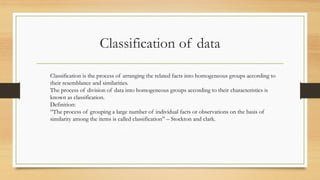
Classification of data
Classification is the process of arranging the related facts into homogeneous groups according to
their resemblance and similarities.
The process of division of data into homogeneous groups according to their characteristics is
known as classification.
Definition:
“The process of grouping a large number of individual facts or observations on the basis of
similarity among the items is called classification” – Stockton and clark.
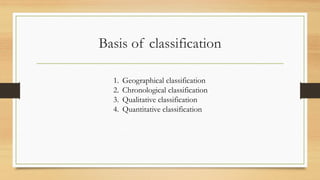
Basis of classification
1. Geographical classification
2. Chronological classification
3. Qualitative classification
4. Quantitative classification
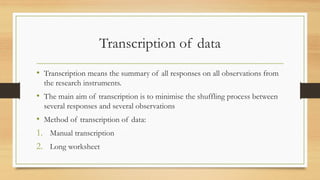
Transcription of data
• Transcription means the summary of all responses on all observations from
the research instruments.
• The main aim of transcription is to minimise the shuffling process between
several responses and several observations
• Method of transcription of data:
1. Manual transcription
2. Long worksheet
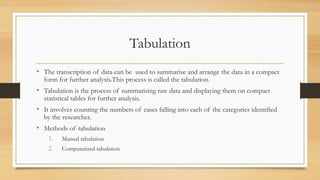
Tabulation
• The transcription of data can be used to summarise and arrange the data in a compact
form for further analysis.This process is called the tabulation.
• Tabulation is the process of summarising raw data and displaying them on compact
statistical tables for further analysis.
• It involves counting the numbers of cases falling into each of the categories identified
by the researcher.
• Methods of tabulation
1. Manual tabulation
2. Computerized tabulation
Types of table
1. Simple tables
2. Complex tables
i) Two way tables
ii) Three way tables
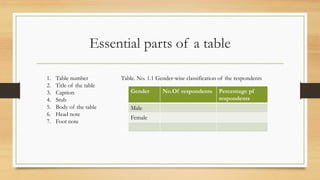
Essential parts of a table
1. Table number
2. Title of the table
3. Caption
4. Stub
5. Body of the table
6. Head note
7. Foot note
Gender No.Of respondents Percentage pf
respondents
Male
Female
Table. No. 1.1 Gender-wise classification of the respondents
Thank you

Data processing.pdf

  • 1.
    Data processing Presented by Dr.M.Muthulakshmi Assistantprofessor of commerce A.P.C Mahalaxmi College for Women Thoothukudi
  • 2.
    Introduction • Data inreal world often comes with large quantum and in a variety of formats that any meaningful interpretation of data cannot be achieved straight away. • Social science researches to be very specific draw conclusions using both primary and secondary data. • To arrive at a meaningful interpretation on the research hypothesis the researcher has to prepare is date off for this purpose. • This preparation involves the identification of data structure, the coding of data and the grouping of data for preliminary research interpretation. • This data preparation for research analysis is termed as processing of data. • Further selection of tools for analysis would to a large extent depend on the results of this data processing
  • 3.
    Data processing • Dataprocessing is an intermediary stage of work between data collection and data interpretation. • The data gathered in the form of questionnaires/interview schedules/field notes/data sheets is mostly in the form of large volume of research variables. • Processing of data requires advance planning and this planning may cover such aspects as identification of variables, hypothetical relationship among the variables and the tentative research hypothesis.
  • 4.
    Steps in processingof data • Identifying the data structures • Editing the data • Coding and classifying the data • Transcription of data • Tabulation of data
  • 5.
    Identifying the datastructure • In the data preparation step the data are prepared in the data format which allows the analyst use modern analysis software such as SPSS. The major criterion in this is to define the data structure. • A data structure is a dynamic collection of related variables and can be conveniently represented as a graph whose nodes are labeled by variables. • Most data structure can be graphically represented to give clarity as to the framed research hypothesis.
  • 6.
    Editing • Editing isa process of checking to detect and correct errors and omissions. • Editing happens at two stages: 1. At the time of recording of data 2. At the time of Analysis of data
  • 7.
    Coding and classification •coding • The edited data are then subject to codification and classification. • Coding p • rocess assigns numericals on other symbols for the several response of the data set. • Types of coding: 1. Numeric coding 2. Alphabetic coding 3. Zero coding • Classification
  • 8.
    Classification of data Classificationis the process of arranging the related facts into homogeneous groups according to their resemblance and similarities. The process of division of data into homogeneous groups according to their characteristics is known as classification. Definition: “The process of grouping a large number of individual facts or observations on the basis of similarity among the items is called classification” – Stockton and clark.
  • 9.
    Basis of classification 1.Geographical classification 2. Chronological classification 3. Qualitative classification 4. Quantitative classification
  • 10.
    Transcription of data •Transcription means the summary of all responses on all observations from the research instruments. • The main aim of transcription is to minimise the shuffling process between several responses and several observations • Method of transcription of data: 1. Manual transcription 2. Long worksheet
  • 11.
    Tabulation • The transcriptionof data can be used to summarise and arrange the data in a compact form for further analysis.This process is called the tabulation. • Tabulation is the process of summarising raw data and displaying them on compact statistical tables for further analysis. • It involves counting the numbers of cases falling into each of the categories identified by the researcher. • Methods of tabulation 1. Manual tabulation 2. Computerized tabulation
  • 12.
    Types of table 1.Simple tables 2. Complex tables i) Two way tables ii) Three way tables
  • 13.
    Essential parts ofa table 1. Table number 2. Title of the table 3. Caption 4. Stub 5. Body of the table 6. Head note 7. Foot note Gender No.Of respondents Percentage pf respondents Male Female Table. No. 1.1 Gender-wise classification of the respondents
  • 14.