Liquid-Liquid Extraction
Mass Transfer
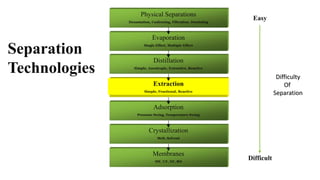
Physical Separations
Decantation, Coalescing, Filtration, Demisting
Evaporation
Single Effect, Multiple Effect
Distillation
Simple, Azeotropic, Extractive, Reactive
Extraction
Simple, Fractional, Reactive
Adsorption
Pressure Swing, Temperature Swing
Crystallization
Melt, Solvent
Membranes
MF, UF, NF, RO
Easy
Difficult
Difficulty
Of
Separation
Separation
Technologies
Typical Applications
•Remove products and pollutants from dilute aqueous streams
•Wash polar compounds or acids/bases from organic streams
•Heat sensitive products
•Non-volatile materials
•Azeotropic and close boiling mixtures
•Alternative to high cost distillations
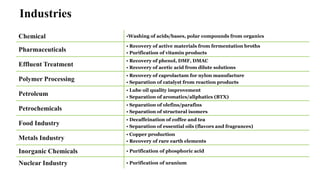
Chemical •Washing of acids/bases, polar compounds from organics
Pharmaceuticals
• Recovery of active materials from fermentation broths
• Purification of vitamin products
Effluent Treatment
• Recovery of phenol, DMF, DMAC
• Recovery of acetic acid from dilute solutions
Polymer Processing
• Recovery of caprolactam for nylon manufacture
• Separation of catalyst from reaction products
Petroleum
• Lube oil quality improvement
• Separation of aromatics/aliphatics (BTX)
Petrochemicals
• Separation of olefins/parafins
• Separation of structural isomers
Food Industry
• Decaffeination of coffee and tea
• Separation of essential oils (flavors and fragrances)
Metals Industry
• Copper production
• Recovery of rare earth elements
Inorganic Chemicals • Purification of phosphoric acid
Nuclear Industry • Purification of uranium
Industries
Distillation vs. Extraction
Organic Compound BP [°C]
Water Solu.
[%]
Azeotrope
B.P. [°C]
Azeotrope
Water [%]
Typical Reduction Level
Methylene Chloride 40 2.0 38.1 1.5 < 50 ppb
Acetone 56.2 Infinite Non Azeotropic < 50 ppb
Methanol 64.5 Infinite Non Azeotropic < 50 ppb
Benzene 80.1 0.18 69.4 8.9 < 50 ppb
Toluene 110.8 0.05 85.0 20.2 < 50 ppb
Formaldehyde -21 Infinite Non Azeotropic < 1,000 ppm
Formic Acid 100.8 Infinite 107.1 22.5 < 500 ppm
Acetic Acid 118.0 Infinite Non Azeotropic < 500 ppm
Pyridine 115.5 57 92.6 43 < 10 ppm
Aniline 181.4 3.60 99.0 80.8 < 10 ppm
Phenol 181.4 8.20 99.5 90.8 < 10 ppm
Nitrobenzene 210.9 0.04 98.6 88.0 < 10 ppm
Dinitrotoluene (2,4) 300.0 0.03 99 – 100 > 90 < 10 ppm
Dimethyl Formamide 153.0 Infinite Non Azeotropic < 10 ppm
Dimethyl Acetamide 166.1 Infinite Non Azeotropic < 10 ppm
n-Methylpyrrolidone 202.0 Infinite Non Azeotropic < 10 ppm
ExtractionDistillation
LLE extraction Principle
The separation of the components of a liquid mixture by treatment with a solvent in
which one or more of the desired components is preferentially soluble is known as
liquid-liquid extraction.
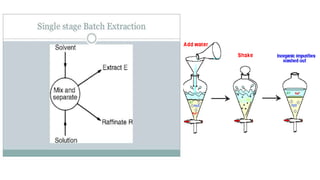
(a) Bringing the feed mixture and the solvent into intimate contact,
(b) Separation of the resulting two phases, and
(c) Removal and recovery of the solvent from each phase.
The Solute present in the aqueous phase gets partitioned or distributed in both the
phases
If the solute has solubility in the organic solvent, more of the solute would be present
in the organic phase at equilibrium and extraction is said to be more efficient
LLE Extraction
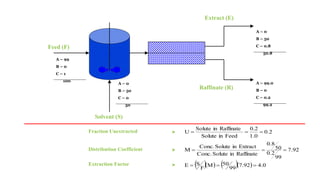
A – 99
B – 0
C – 1
100
Feed (F)
A – 0
B – 50
C – 0
50
Solvent (S)
A – 0
B – 50
C – 0.8
50.8
Extract (E)
A – 99.0
B – 0
C – 0.2
99.2
Raffinate (R)
      4.07.92
99
50M
F
SE
7.92
99
0.2
50
0.8
RaffinateinSoluteConc.
ExtractinSoluteConc.
M
0.2
1.0
0.2
FeedinSolute
RaffinateinSolute
U


Fraction Unextracted
Distribution Coefficient
Extraction Factor
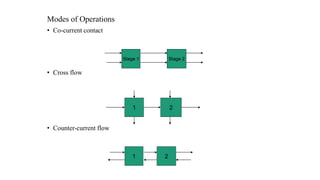
Stage 1 Stage 2
1 2
1 2
Modes of Operations
• Co-current contact
• Cross flow
• Counter-current flow
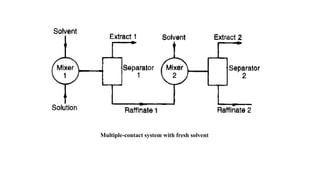
Multiple-contact system with fresh solvent
Parameters of LLE Process
• Solvent
• Operation Condition
• Mode of Operation
• Extractor Type
• Design Criteria
Points need to be considered
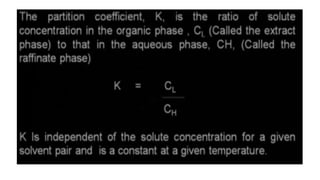
1. Higher the partition coefficient greater will be the extraction efficiency
2. Large density differences between the extractant and raffinate = better
separation if the separation is by gravity alone
3. High viscosity of solvent affect the phase separation.
4. Should have negligible miscibility/ solubility in the aqueous feed to minimize
solvent loss
5. Easily recovered and purified for recycling after extraction.
6. Should be easily available and cost effective
7. Low interfacial tension between the phases facilitates the dispersion of phases
and improves mass transfer
8. Physio-chemical properties such as boiling point, density, interfacial tension,
viscosity, corrosiveness, flammability, stability compatibility with product,
availability should be satisfactory
Equipment for extraction
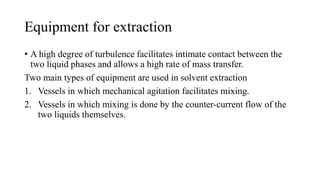
• A high degree of turbulence facilitates intimate contact between the
two liquid phases and allows a high rate of mass transfer.
Two main types of equipment are used in solvent extraction
1. Vessels in which mechanical agitation facilitates mixing.
2. Vessels in which mixing is done by the counter-current flow of the
two liquids themselves.
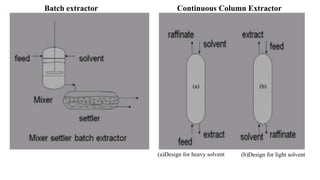
Batch extractor Continuous Column Extractor
(a)Design for heavy solvent (b)Design for light solvent
(a) (b)
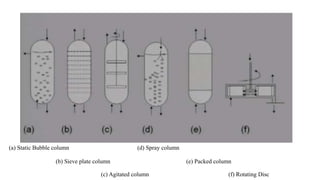
(a) Static Bubble column
(b) Sieve plate column
(c) Agitated column
(d) Spray column
(e) Packed column
(f) Rotating Disc
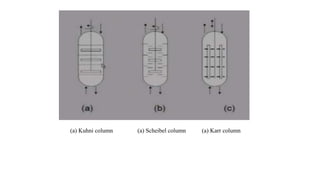
(a) Kuhni column (a) Scheibel column (a) Karr column
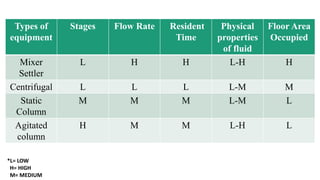
Types of
equipment
Stages Flow Rate Resident
Time
Physical
properties
of fluid
Floor Area
Occupied
Mixer
Settler
L H H L-H H
Centrifugal L L L L-M M
Static
Column
M M M L-M L
Agitated
column
H M M L-H L
*L= LOW
H= HIGH
M= MEDIUM
THANK YOU!

Liquid liquid extraction

  • 2.
  • 3.
    Physical Separations Decantation, Coalescing,Filtration, Demisting Evaporation Single Effect, Multiple Effect Distillation Simple, Azeotropic, Extractive, Reactive Extraction Simple, Fractional, Reactive Adsorption Pressure Swing, Temperature Swing Crystallization Melt, Solvent Membranes MF, UF, NF, RO Easy Difficult Difficulty Of Separation Separation Technologies
  • 4.
    Typical Applications •Remove productsand pollutants from dilute aqueous streams •Wash polar compounds or acids/bases from organic streams •Heat sensitive products •Non-volatile materials •Azeotropic and close boiling mixtures •Alternative to high cost distillations
  • 5.
    Chemical •Washing ofacids/bases, polar compounds from organics Pharmaceuticals • Recovery of active materials from fermentation broths • Purification of vitamin products Effluent Treatment • Recovery of phenol, DMF, DMAC • Recovery of acetic acid from dilute solutions Polymer Processing • Recovery of caprolactam for nylon manufacture • Separation of catalyst from reaction products Petroleum • Lube oil quality improvement • Separation of aromatics/aliphatics (BTX) Petrochemicals • Separation of olefins/parafins • Separation of structural isomers Food Industry • Decaffeination of coffee and tea • Separation of essential oils (flavors and fragrances) Metals Industry • Copper production • Recovery of rare earth elements Inorganic Chemicals • Purification of phosphoric acid Nuclear Industry • Purification of uranium Industries
  • 6.
    Distillation vs. Extraction OrganicCompound BP [°C] Water Solu. [%] Azeotrope B.P. [°C] Azeotrope Water [%] Typical Reduction Level Methylene Chloride 40 2.0 38.1 1.5 < 50 ppb Acetone 56.2 Infinite Non Azeotropic < 50 ppb Methanol 64.5 Infinite Non Azeotropic < 50 ppb Benzene 80.1 0.18 69.4 8.9 < 50 ppb Toluene 110.8 0.05 85.0 20.2 < 50 ppb Formaldehyde -21 Infinite Non Azeotropic < 1,000 ppm Formic Acid 100.8 Infinite 107.1 22.5 < 500 ppm Acetic Acid 118.0 Infinite Non Azeotropic < 500 ppm Pyridine 115.5 57 92.6 43 < 10 ppm Aniline 181.4 3.60 99.0 80.8 < 10 ppm Phenol 181.4 8.20 99.5 90.8 < 10 ppm Nitrobenzene 210.9 0.04 98.6 88.0 < 10 ppm Dinitrotoluene (2,4) 300.0 0.03 99 – 100 > 90 < 10 ppm Dimethyl Formamide 153.0 Infinite Non Azeotropic < 10 ppm Dimethyl Acetamide 166.1 Infinite Non Azeotropic < 10 ppm n-Methylpyrrolidone 202.0 Infinite Non Azeotropic < 10 ppm ExtractionDistillation
  • 9.
    LLE extraction Principle Theseparation of the components of a liquid mixture by treatment with a solvent in which one or more of the desired components is preferentially soluble is known as liquid-liquid extraction. (a) Bringing the feed mixture and the solvent into intimate contact, (b) Separation of the resulting two phases, and (c) Removal and recovery of the solvent from each phase. The Solute present in the aqueous phase gets partitioned or distributed in both the phases If the solute has solubility in the organic solvent, more of the solute would be present in the organic phase at equilibrium and extraction is said to be more efficient LLE Extraction
  • 11.
    A – 99 B– 0 C – 1 100 Feed (F) A – 0 B – 50 C – 0 50 Solvent (S) A – 0 B – 50 C – 0.8 50.8 Extract (E) A – 99.0 B – 0 C – 0.2 99.2 Raffinate (R)       4.07.92 99 50M F SE 7.92 99 0.2 50 0.8 RaffinateinSoluteConc. ExtractinSoluteConc. M 0.2 1.0 0.2 FeedinSolute RaffinateinSolute U   Fraction Unextracted Distribution Coefficient Extraction Factor
  • 12.
    Stage 1 Stage2 1 2 1 2 Modes of Operations • Co-current contact • Cross flow • Counter-current flow
  • 13.
  • 15.
    Parameters of LLEProcess • Solvent • Operation Condition • Mode of Operation • Extractor Type • Design Criteria
  • 16.
    Points need tobe considered 1. Higher the partition coefficient greater will be the extraction efficiency 2. Large density differences between the extractant and raffinate = better separation if the separation is by gravity alone 3. High viscosity of solvent affect the phase separation. 4. Should have negligible miscibility/ solubility in the aqueous feed to minimize solvent loss 5. Easily recovered and purified for recycling after extraction. 6. Should be easily available and cost effective 7. Low interfacial tension between the phases facilitates the dispersion of phases and improves mass transfer 8. Physio-chemical properties such as boiling point, density, interfacial tension, viscosity, corrosiveness, flammability, stability compatibility with product, availability should be satisfactory
  • 17.
    Equipment for extraction •A high degree of turbulence facilitates intimate contact between the two liquid phases and allows a high rate of mass transfer. Two main types of equipment are used in solvent extraction 1. Vessels in which mechanical agitation facilitates mixing. 2. Vessels in which mixing is done by the counter-current flow of the two liquids themselves.
  • 18.
    Batch extractor ContinuousColumn Extractor (a)Design for heavy solvent (b)Design for light solvent (a) (b)
  • 19.
    (a) Static Bubblecolumn (b) Sieve plate column (c) Agitated column (d) Spray column (e) Packed column (f) Rotating Disc
  • 20.
    (a) Kuhni column(a) Scheibel column (a) Karr column
  • 21.
    Types of equipment Stages FlowRate Resident Time Physical properties of fluid Floor Area Occupied Mixer Settler L H H L-H H Centrifugal L L L L-M M Static Column M M M L-M L Agitated column H M M L-H L *L= LOW H= HIGH M= MEDIUM
  • 23.