STKT3243
LIQUID-LIQUID
EXTRACTION
Purpose of Extraction
• To separate closed-boiling point mixture
• Mixture that cannot withstand high temperature of distillation
• Example:
- recovery of penicillin from fermentation broth
solvent: butyl acetate
- recovery of acetic acid from dilute aqueous solutions
solvent: ethyl-acetate
•Liquid-Liquid extraction is a mass transfer operation in which a
liquid solution (the feed) is contacted with an immiscible or nearly
immiscible liquid (solvent) that exhibits preferential affinity or
selectivity towards one or more of the components in the feed.
Definition of Extraction
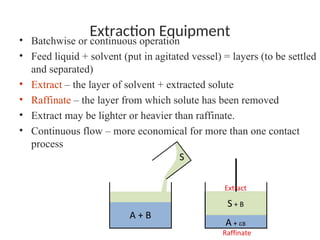
Extraction Equipment
• Batchwise or continuous operation
• Feed liquid + solvent (put in agitated vessel) = layers (to be settled
and separated)
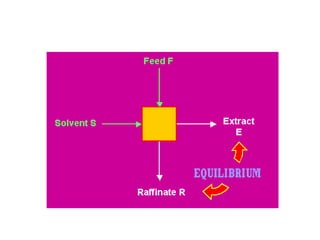
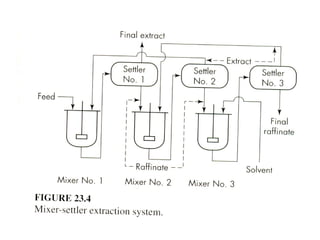
• Extract – the layer of solvent + extracted solute
• Raffinate – the layer from which solute has been removed
• Extract may be lighter or heavier than raffinate.
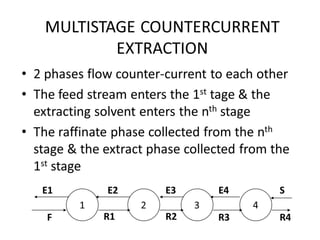
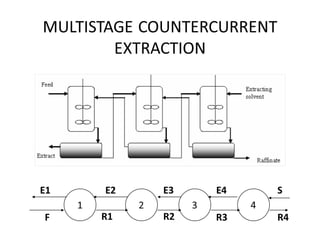
• Continuous flow – more economical for more than one contact
process
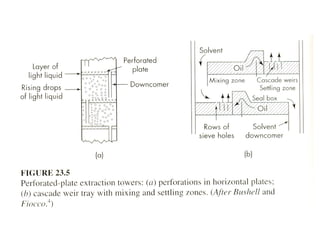
• Extraction Equipments:
- Mixer settlers
- Packed extraction towers
- Perforated plate towers
- Baffle towers
- Agitated tower extractors
• Auxiliary equipment:
- stills, evaporators, heaters and condenser
SINGLE STAGE EXTRACTION
• Mixer and settler in separate units or same unit
• Mixer - a tank contains propeller agitator
• At the end of mixing: agitator shut off, layers allowed
to separate, extract & raffinate drawn off to separate
receivers
• Afterwards: distillation, crystallization, evaporation,
reextraction
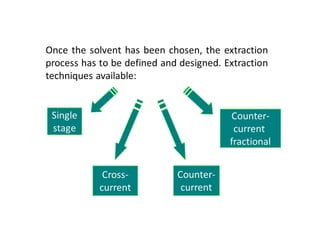
• Often times, several extraction stages are required
Extraction of Dilute Solution
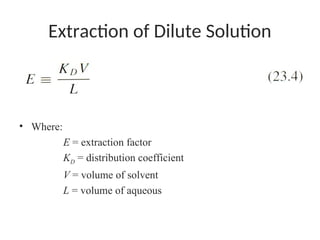
• Extraction factor is defined as:
• Where:
E = extraction factor
KD = distribution coefficient
V = volume of solvent
L = volume of aqueous
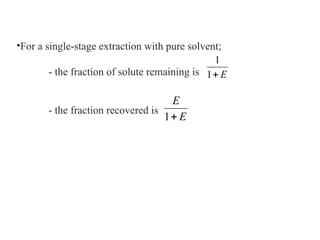
•For a single-stage extraction with pure solvent;
- the fraction of solute remaining is
- the fraction recovered is
E

1
1
E
E

1
Extraction of Concentrated Solution
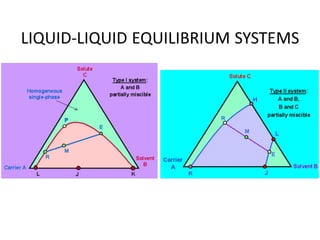
• Equilibrium relationship are more complicated – 3 or more
components present in each phase
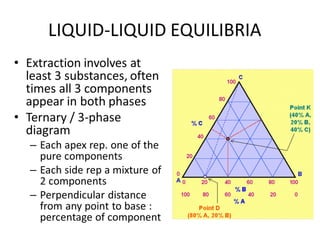
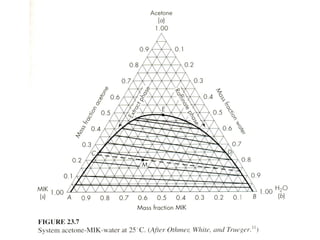
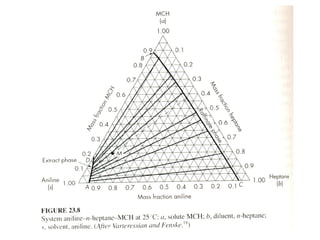
• Equilibrium data are often presented on a triangular diagram
such as Fig 23.7 and 23.8
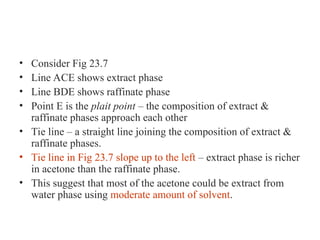
• Consider Fig 23.7
• Line ACE shows extract phase
• Line BDE shows raffinate phase
• Point E is the plait point – the composition of extract &
raffinate phases approach each other
• Tie line – a straight line joining the composition of extract &
raffinate phases.
• Tie line in Fig 23.7 slope up to the left – extract phase is richer
in acetone than the raffinate phase.
• This suggest that most of the acetone could be extract from
water phase using moderate amount of solvent.
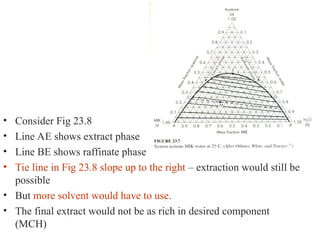
• Consider Fig 23.8
• Line AE shows extract phase
• Line BE shows raffinate phase
• Tie line in Fig 23.8 slope up to the right – extraction would still be
possible
• But more solvent would have to use.
• The final extract would not be as rich in desired component
(MCH)
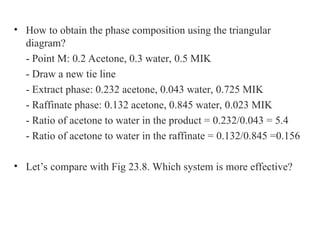
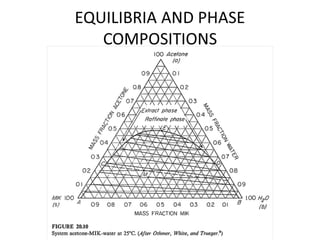
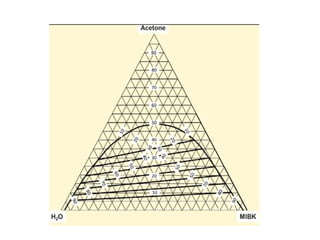
• How to obtain the phase composition using the triangular
diagram?
- Point M: 0.2 Acetone, 0.3 water, 0.5 MIK
- Draw a new tie line
- Extract phase: 0.232 acetone, 0.043 water, 0.725 MIK
- Raffinate phase: 0.132 acetone, 0.845 water, 0.023 MIK
- Ratio of acetone to water in the product = 0.232/0.043 = 5.4
- Ratio of acetone to water in the raffinate = 0.132/0.845 =0.156
• Let’s compare with Fig 23.8. Which system is more effective?
Tutorial
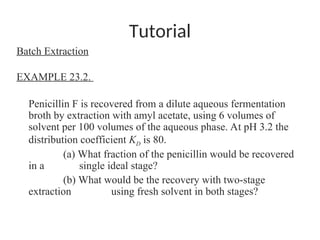
Batch Extraction
EXAMPLE 23.2.
Penicillin F is recovered from a dilute aqueous fermentation
broth by extraction with amyl acetate, using 6 volumes of
solvent per 100 volumes of the aqueous phase. At pH 3.2 the
distribution coefficient KD is 80.
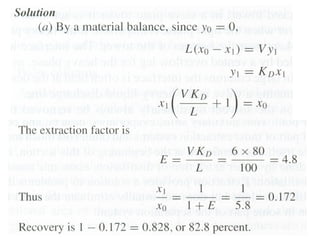
(a) What fraction of the penicillin would be recovered
in a single ideal stage?
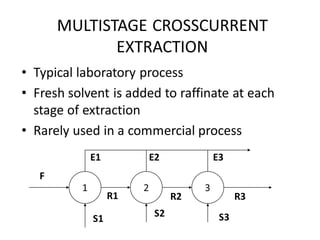
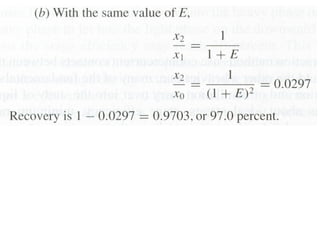
(b) What would be the recovery with two-stage
extraction using fresh solvent in both stages?
stkt 3243 Liquid-  liquid extraction.ppt

stkt 3243 Liquid- liquid extraction.ppt

  • 1.
  • 2.
    Purpose of Extraction •To separate closed-boiling point mixture • Mixture that cannot withstand high temperature of distillation • Example: - recovery of penicillin from fermentation broth solvent: butyl acetate - recovery of acetic acid from dilute aqueous solutions solvent: ethyl-acetate •Liquid-Liquid extraction is a mass transfer operation in which a liquid solution (the feed) is contacted with an immiscible or nearly immiscible liquid (solvent) that exhibits preferential affinity or selectivity towards one or more of the components in the feed. Definition of Extraction
  • 3.
    Extraction Equipment • Batchwiseor continuous operation • Feed liquid + solvent (put in agitated vessel) = layers (to be settled and separated) • Extract – the layer of solvent + extracted solute • Raffinate – the layer from which solute has been removed • Extract may be lighter or heavier than raffinate. • Continuous flow – more economical for more than one contact process
  • 5.
    • Extraction Equipments: -Mixer settlers - Packed extraction towers - Perforated plate towers - Baffle towers - Agitated tower extractors • Auxiliary equipment: - stills, evaporators, heaters and condenser
  • 6.
    SINGLE STAGE EXTRACTION •Mixer and settler in separate units or same unit • Mixer - a tank contains propeller agitator • At the end of mixing: agitator shut off, layers allowed to separate, extract & raffinate drawn off to separate receivers • Afterwards: distillation, crystallization, evaporation, reextraction • Often times, several extraction stages are required
  • 13.
    Extraction of DiluteSolution • Extraction factor is defined as: • Where: E = extraction factor KD = distribution coefficient V = volume of solvent L = volume of aqueous
  • 14.
    •For a single-stageextraction with pure solvent; - the fraction of solute remaining is - the fraction recovered is E  1 1 E E  1
  • 15.
    Extraction of ConcentratedSolution • Equilibrium relationship are more complicated – 3 or more components present in each phase • Equilibrium data are often presented on a triangular diagram such as Fig 23.7 and 23.8
  • 19.
    • Consider Fig23.7 • Line ACE shows extract phase • Line BDE shows raffinate phase • Point E is the plait point – the composition of extract & raffinate phases approach each other • Tie line – a straight line joining the composition of extract & raffinate phases. • Tie line in Fig 23.7 slope up to the left – extract phase is richer in acetone than the raffinate phase. • This suggest that most of the acetone could be extract from water phase using moderate amount of solvent.
  • 21.
    • Consider Fig23.8 • Line AE shows extract phase • Line BE shows raffinate phase • Tie line in Fig 23.8 slope up to the right – extraction would still be possible • But more solvent would have to use. • The final extract would not be as rich in desired component (MCH)
  • 22.
    • How toobtain the phase composition using the triangular diagram? - Point M: 0.2 Acetone, 0.3 water, 0.5 MIK - Draw a new tie line - Extract phase: 0.232 acetone, 0.043 water, 0.725 MIK - Raffinate phase: 0.132 acetone, 0.845 water, 0.023 MIK - Ratio of acetone to water in the product = 0.232/0.043 = 5.4 - Ratio of acetone to water in the raffinate = 0.132/0.845 =0.156 • Let’s compare with Fig 23.8. Which system is more effective?
  • 31.
    Tutorial Batch Extraction EXAMPLE 23.2. PenicillinF is recovered from a dilute aqueous fermentation broth by extraction with amyl acetate, using 6 volumes of solvent per 100 volumes of the aqueous phase. At pH 3.2 the distribution coefficient KD is 80. (a) What fraction of the penicillin would be recovered in a single ideal stage? (b) What would be the recovery with two-stage extraction using fresh solvent in both stages?