Application of Matrices
Presented By:
Mohammedi Limdiwala
Matrix
▪ A matrix is a rectangular arrangement of ‘mn’ elements.
▪ It consists of rows and columns arrangements.
▪ It is a systematic arrangement of elements and may represent
vectorial or scalar quantity.
Some of the applications of Matrix
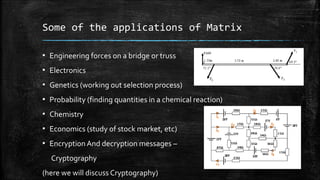
▪ Engineering forces on a bridge or truss
▪ Electronics
▪ Genetics (working out selection process)
▪ Probability (finding quantities in a chemical reaction)
▪ Chemistry
▪ Economics (study of stock market, etc)
▪ Encryption And decryption messages –
Cryptography
(here we will discuss Cryptography)
Encryption and Decryption (Cryptography)
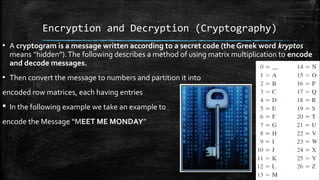
▪ A cryptogram is a message written according to a secret code (the Greek word kryptos
means “hidden”).The following describes a method of using matrix multiplication to encode
and decode messages.
▪ Then convert the message to numbers and partition it into
encoded row matrices, each having entries
 In the following example we take an example to
encode the Message “MEET ME MONDAY”
Encoding Process
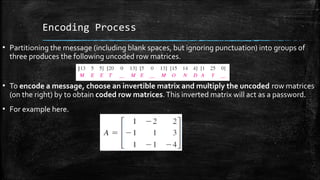
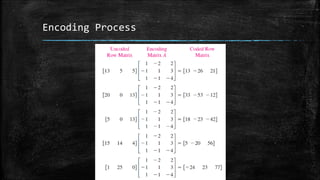
▪ Partitioning the message (including blank spaces, but ignoring punctuation) into groups of
three produces the following uncoded row matrices.
▪ To encode a message, choose an invertible matrix and multiply the uncoded row matrices
(on the right) by to obtain coded row matrices.This inverted matrix will act as a password.
▪ For example here.
Encoding Process
Encoding Process
▪ The sequence of coded row matrices is
▪ Finally, removing the matrix notation produces the following cryptogram
▪ For those who do not know the encoding matrix A, decoding the cryptogram is possible.
▪ But for an authorized receiver who knows the encoding matrix decoding is relatively simple.
The receiver just needs to multiply the coded row matrices by A-1
to retrieve the uncoded row
matrices. In other words, if
▪ is an uncoded 1×n matrix, then Y=XA is the corresponding encoded matrix.The receiver of
the encoded matrix can decode by Y multiplying on the right by A-1
.
Decoding Process
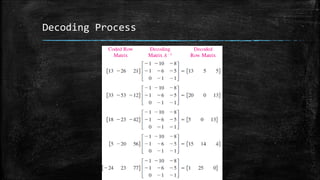
▪ Begin by using Gauss-Jordan elimination to find A-1
▪ Now, to decode the message, partition the message into groups of three to form the coded
row matrices
▪ To obtain the decoded row matrices, multiply each coded row matrix by A-1
Decoding Process
Decoding Process
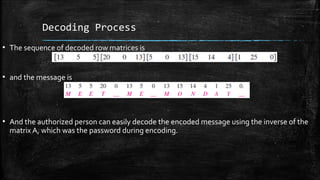
▪ The sequence of decoded row matrices is
▪ and the message is
▪ And the authorized person can easily decode the encoded message using the inverse of the
matrix A, which was the password during encoding.
Application of Matrices

Application of Matrices

  • 1.
    Application of Matrices PresentedBy: Mohammedi Limdiwala
  • 2.
    Matrix ▪ A matrixis a rectangular arrangement of ‘mn’ elements. ▪ It consists of rows and columns arrangements. ▪ It is a systematic arrangement of elements and may represent vectorial or scalar quantity.
  • 3.
    Some of theapplications of Matrix ▪ Engineering forces on a bridge or truss ▪ Electronics ▪ Genetics (working out selection process) ▪ Probability (finding quantities in a chemical reaction) ▪ Chemistry ▪ Economics (study of stock market, etc) ▪ Encryption And decryption messages – Cryptography (here we will discuss Cryptography)
  • 4.
    Encryption and Decryption(Cryptography) ▪ A cryptogram is a message written according to a secret code (the Greek word kryptos means “hidden”).The following describes a method of using matrix multiplication to encode and decode messages. ▪ Then convert the message to numbers and partition it into encoded row matrices, each having entries  In the following example we take an example to encode the Message “MEET ME MONDAY”
  • 5.
    Encoding Process ▪ Partitioningthe message (including blank spaces, but ignoring punctuation) into groups of three produces the following uncoded row matrices. ▪ To encode a message, choose an invertible matrix and multiply the uncoded row matrices (on the right) by to obtain coded row matrices.This inverted matrix will act as a password. ▪ For example here.
  • 6.
  • 7.
    Encoding Process ▪ Thesequence of coded row matrices is ▪ Finally, removing the matrix notation produces the following cryptogram ▪ For those who do not know the encoding matrix A, decoding the cryptogram is possible. ▪ But for an authorized receiver who knows the encoding matrix decoding is relatively simple. The receiver just needs to multiply the coded row matrices by A-1 to retrieve the uncoded row matrices. In other words, if ▪ is an uncoded 1×n matrix, then Y=XA is the corresponding encoded matrix.The receiver of the encoded matrix can decode by Y multiplying on the right by A-1 .
  • 8.
    Decoding Process ▪ Beginby using Gauss-Jordan elimination to find A-1 ▪ Now, to decode the message, partition the message into groups of three to form the coded row matrices ▪ To obtain the decoded row matrices, multiply each coded row matrix by A-1
  • 9.
  • 10.
    Decoding Process ▪ Thesequence of decoded row matrices is ▪ and the message is ▪ And the authorized person can easily decode the encoded message using the inverse of the matrix A, which was the password during encoding.