Ship Motion & Stresses
01/04/19 1
STATIC FORCES
These are due to
 Internal forces resulting from structural
weight, cargo and machinery weight.
 External static forces including the hydrostatic
pressure of the water on the hull.
Vessel at rest
Static force
DYNAMIC FORCES
They result from
 The ship’s motion at sea.
 The action of wind and waves.
 The effects of operating machinery.
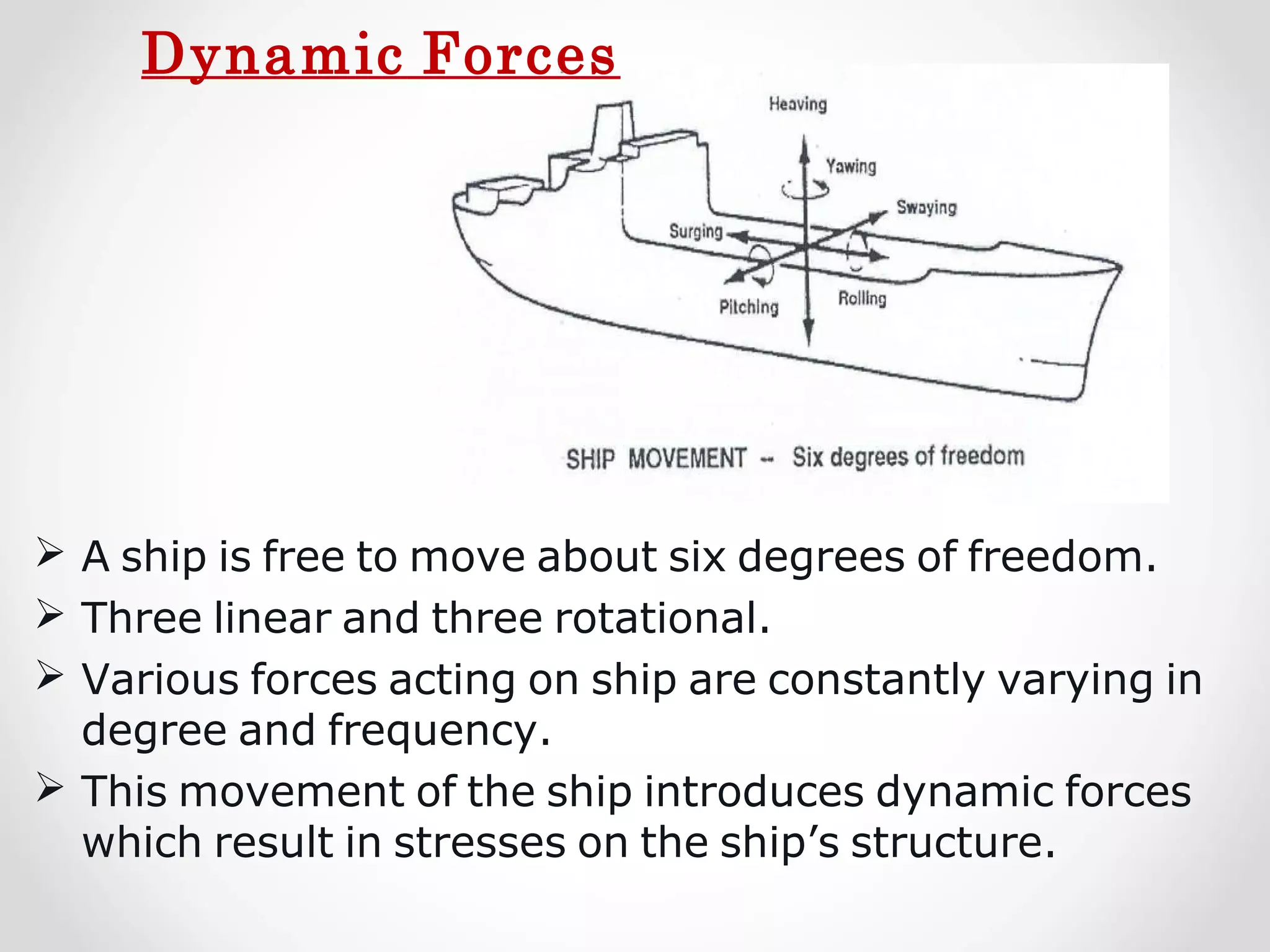
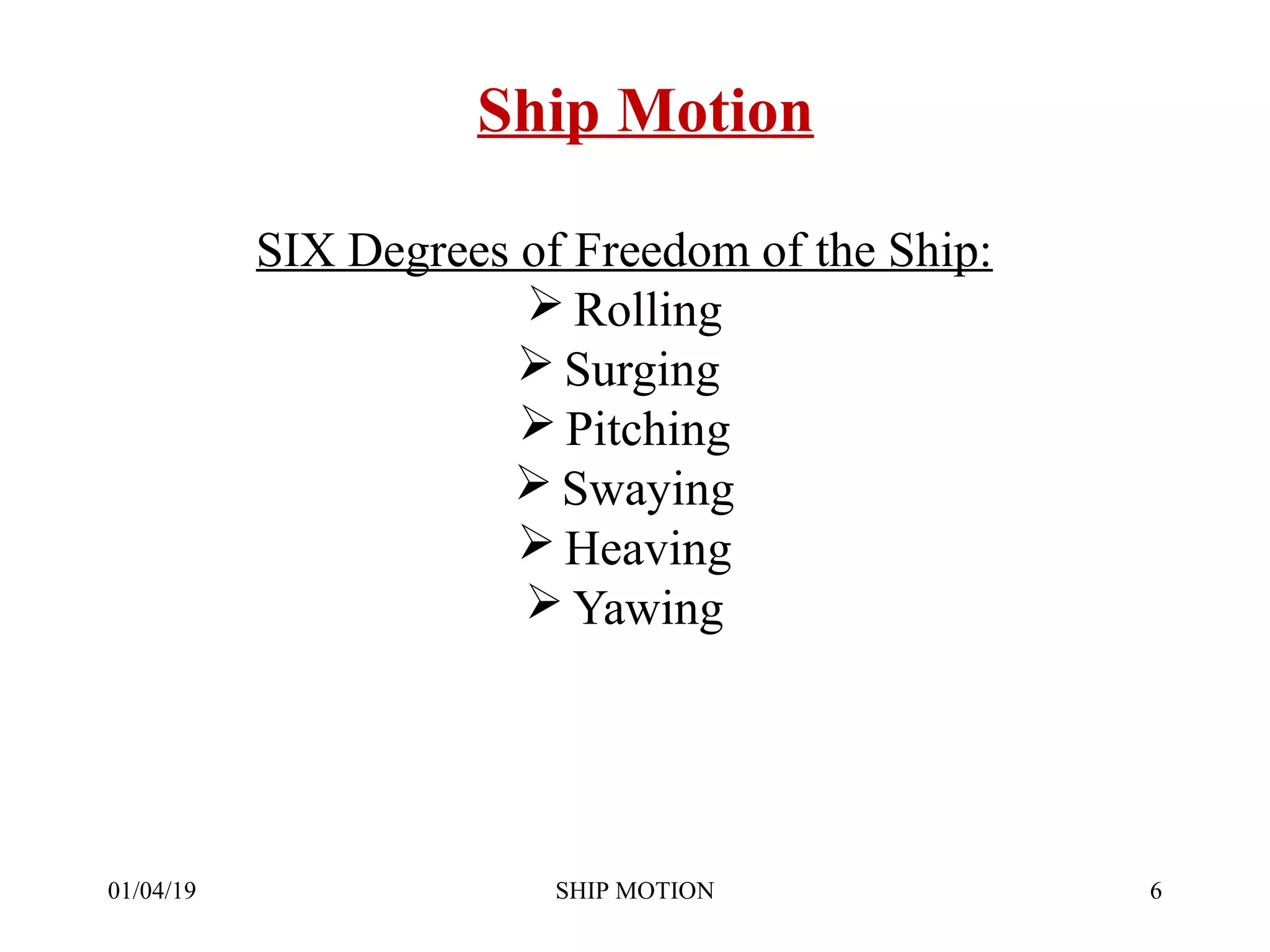
 A ship is free to move about six degrees of freedom.
 Three linear and three rotational.
 Various forces acting on ship are constantly varying in
degree and frequency.
 This movement of the ship introduces dynamic forces
which result in stresses on the ship’s structure.
Dynamic Forces
01/04/19 SHIP MOTION 6
Ship Motion
SIX Degrees of Freedom of the Ship:
 Rolling
 Surging
 Pitching
 Swaying
 Heaving
 Yawing
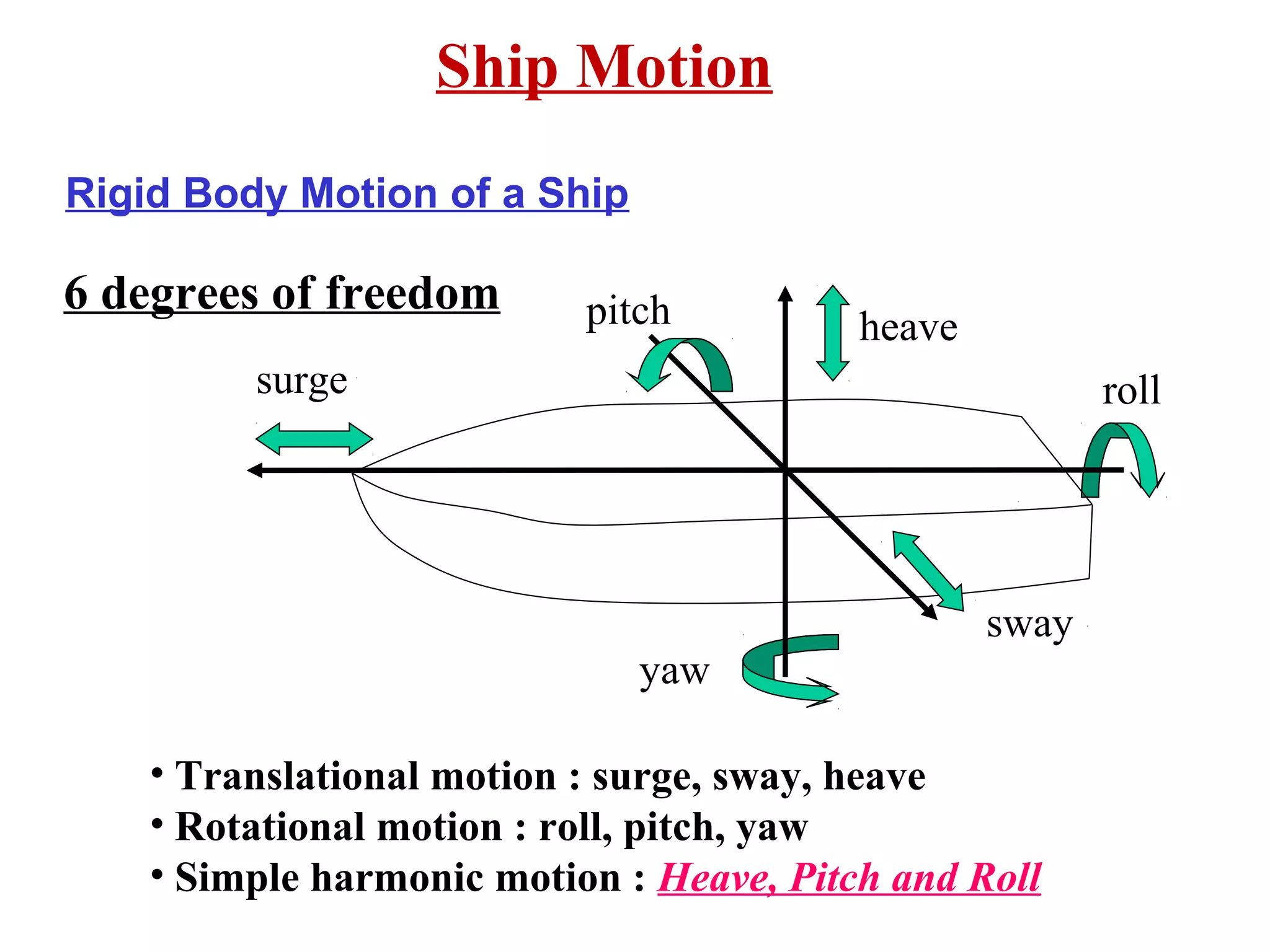
Rigid Body Motion of a Ship
• Translational motion : surge, sway, heave
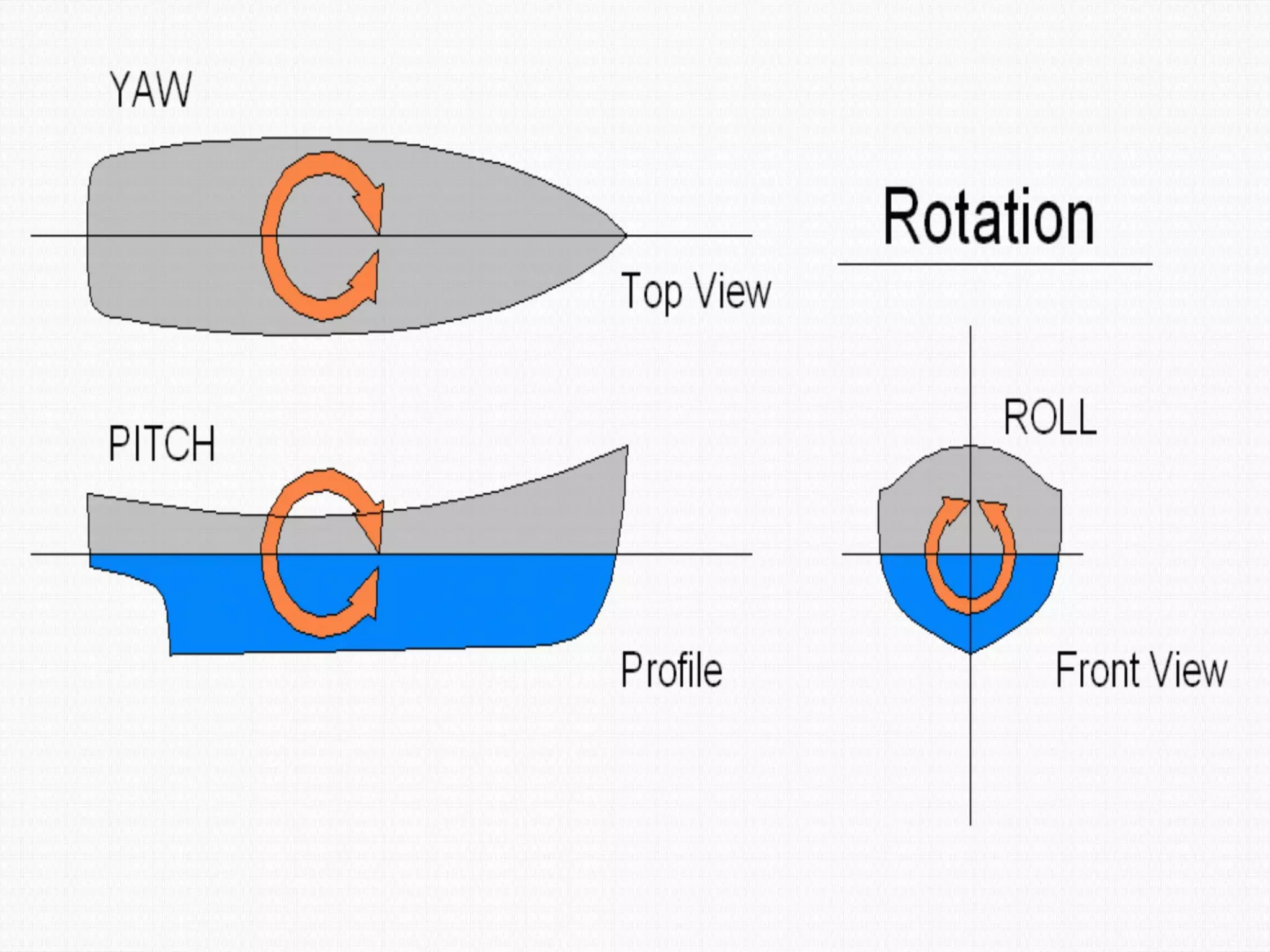
• Rotational motion : roll, pitch, yaw
• Simple harmonic motion : Heave, Pitch and Roll
surge roll
pitch heave
sway
yaw
6 degrees of freedom
Ship Motion
01/04/19 8
Ship Motion
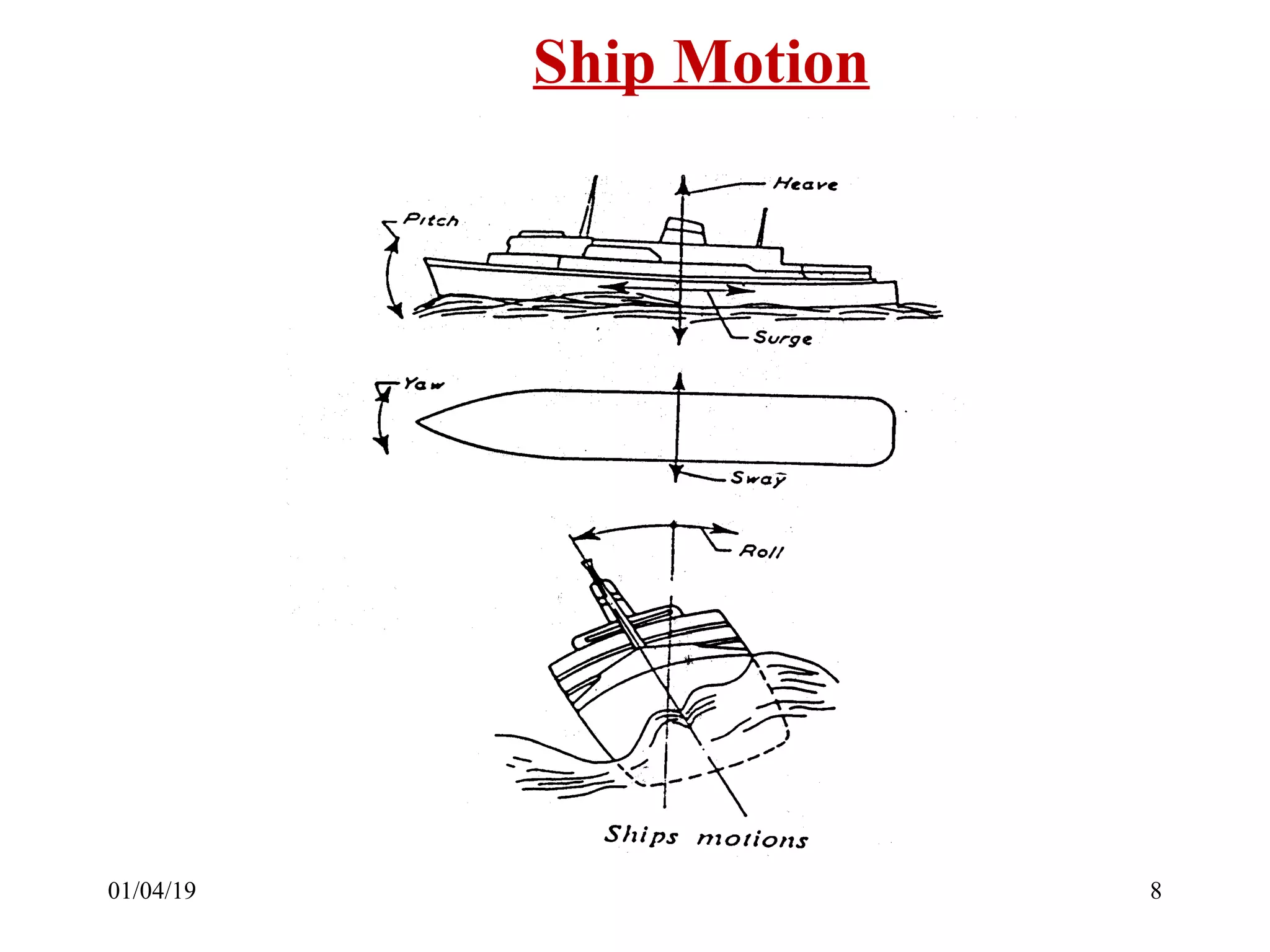
• Pitch is the motion of a ship in rising the
crest of a wave then descending into the
following trough.
Roll is the motion of a ship from side to
side as she moves through the water.
Yaw is where the bow of a ship falls away
or sways erratically from side to side as
the vessel moves through the water.
•
•
• Heave is the motion of the ship when the ship
have being up by a wave or sea.
• Sway is the swing of a mast or bow of a ship from
side to side as the vessel progresses in a heavy
sea.
• Surge is the movement forward as the bow of a
ship rises and dips when it encounter waves which
are strong enough to life it. The ship surge up the
side of a wave, often shipping water as it passes
through the crest, then dips down the other side
of the wave.
 Forces produce stresses in the ship’s
structure which may be divided into
two categories:
 Global stress – affects the whole ship
 Local stress- affects a particular part of
a ship
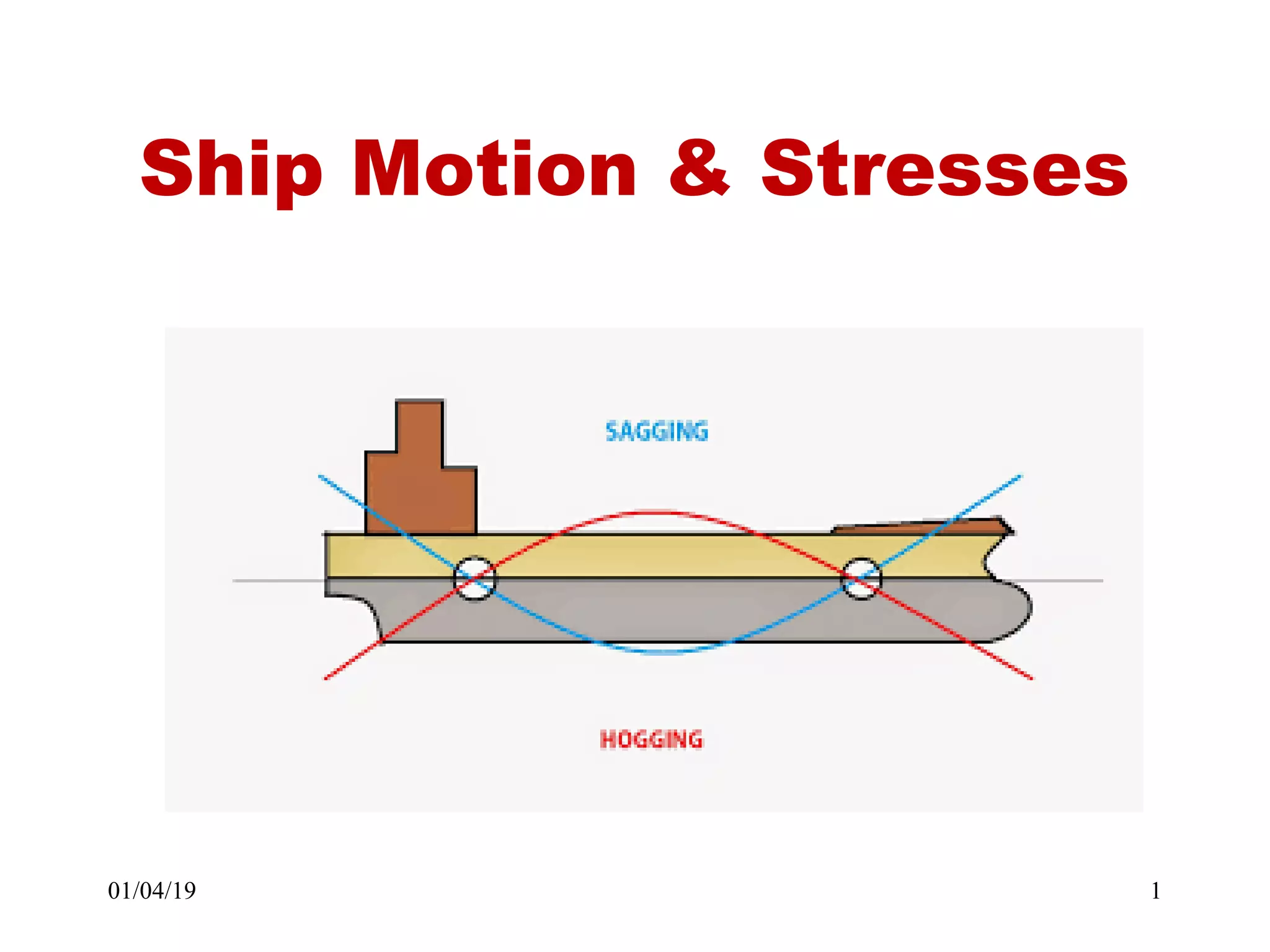
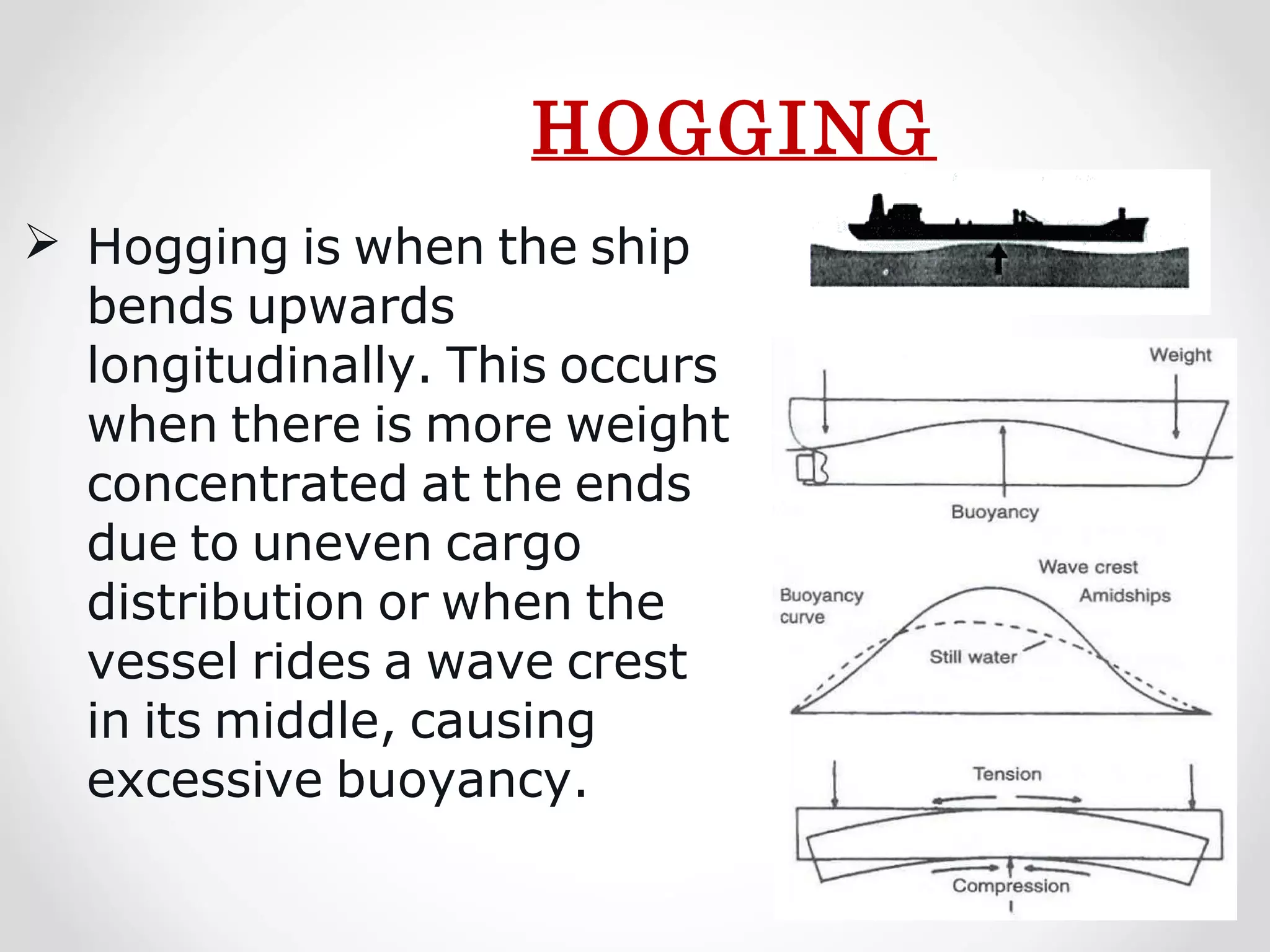
HOGGING
 Hogging is when the ship
bends upwards
longitudinally. This occurs
when there is more weight
concentrated at the ends
due to uneven cargo
distribution or when the
vessel rides a wave crest
in its middle, causing
excessive buoyancy.
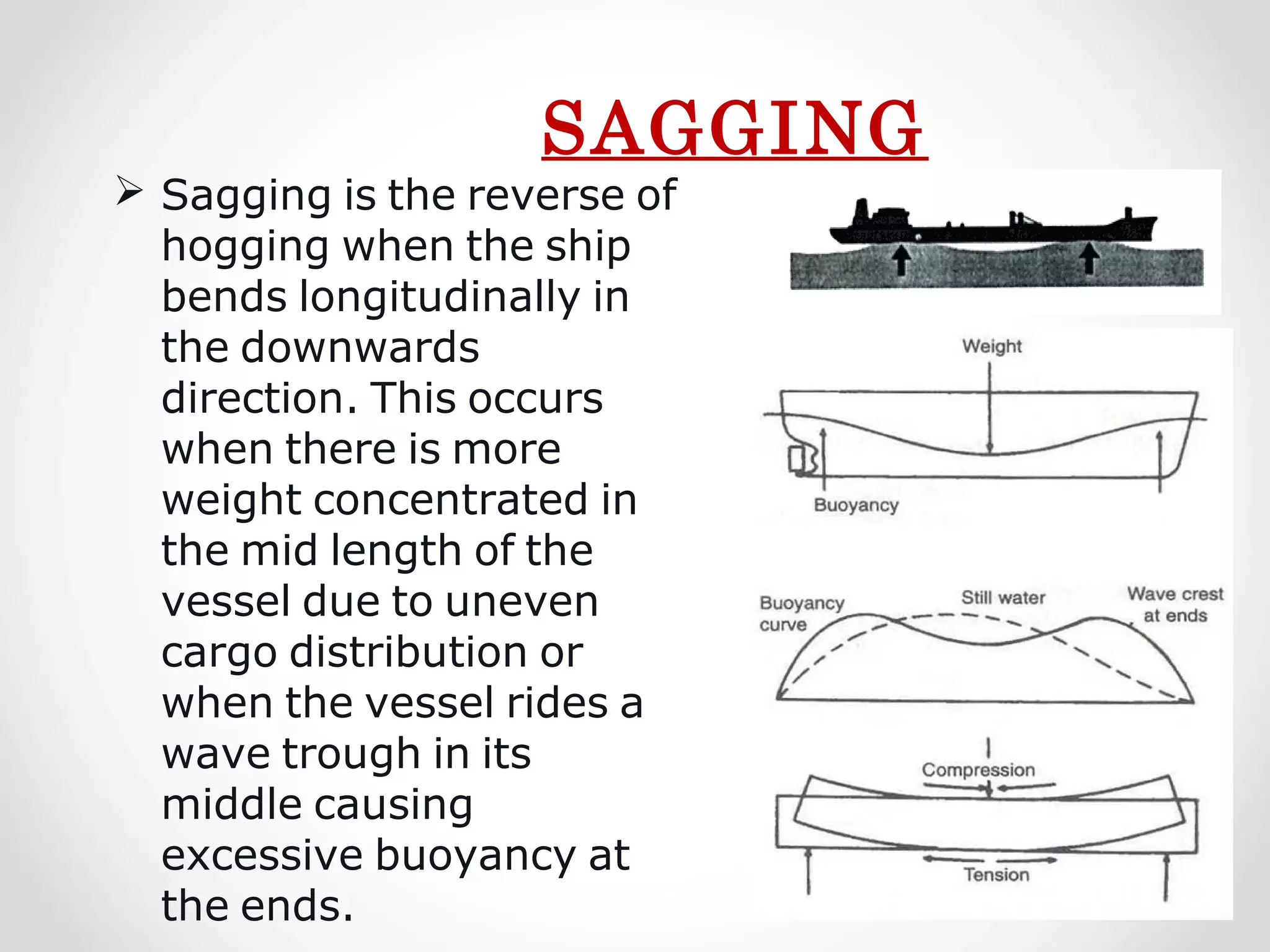
SAGGING
 Sagging is the reverse of
hogging when the ship
bends longitudinally in
the downwards
direction. This occurs
when there is more
weight concentrated in
the mid length of the
vessel due to uneven
cargo distribution or
when the vessel rides a
wave trough in its
middle causing
excessive buoyancy at
the ends.
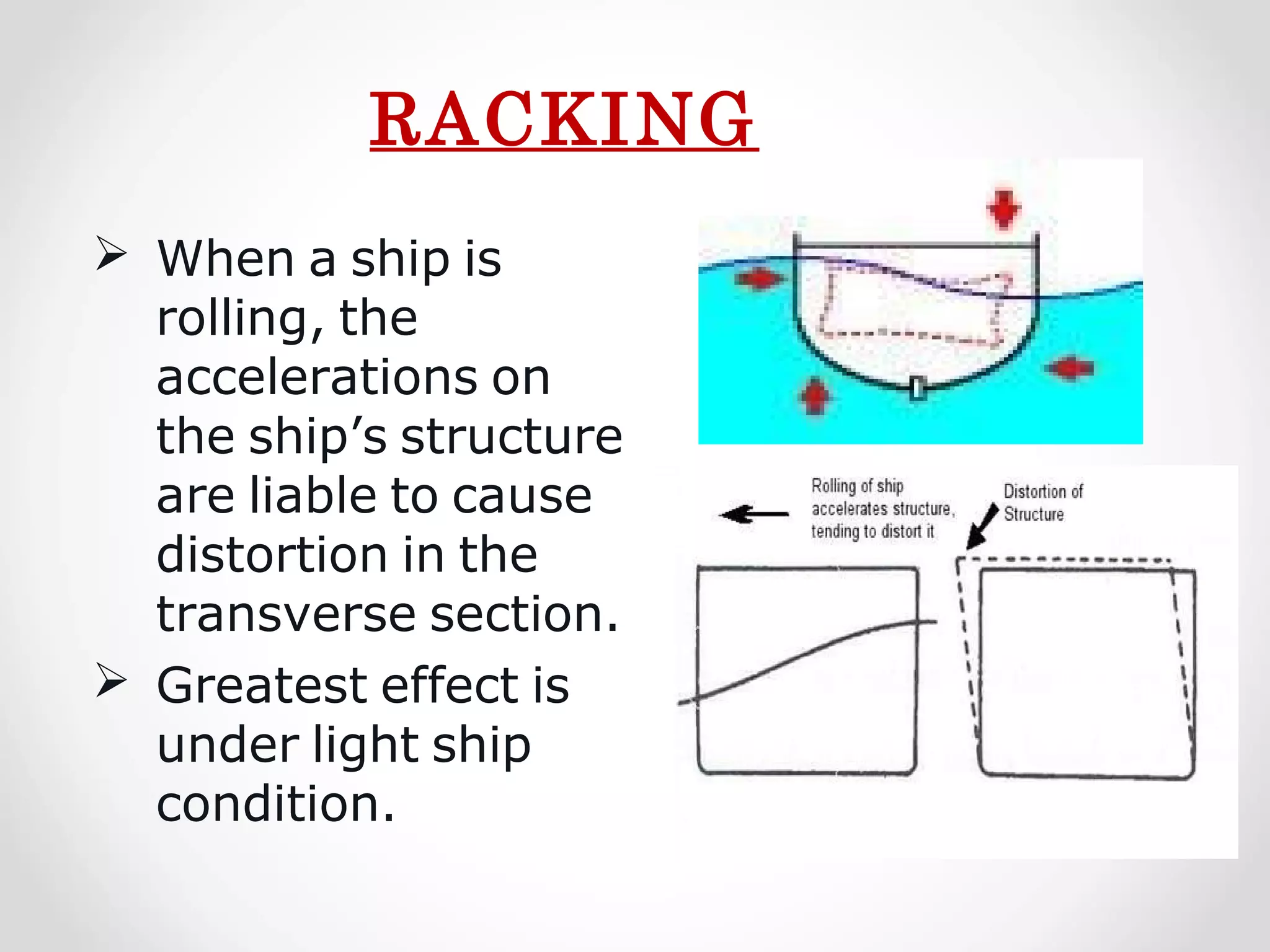
RACKING
 When a ship is
rolling, the
accelerations on
the ship’s structure
are liable to cause
distortion in the
transverse section.
 Greatest effect is
under light ship
condition.
 A ship traversing a
wave train at angle
will be subject to
righting moments of
opposite directions
at its ends.
 The hull is subject to
a twisting moment
and the structure is
in torsion.
TORSION
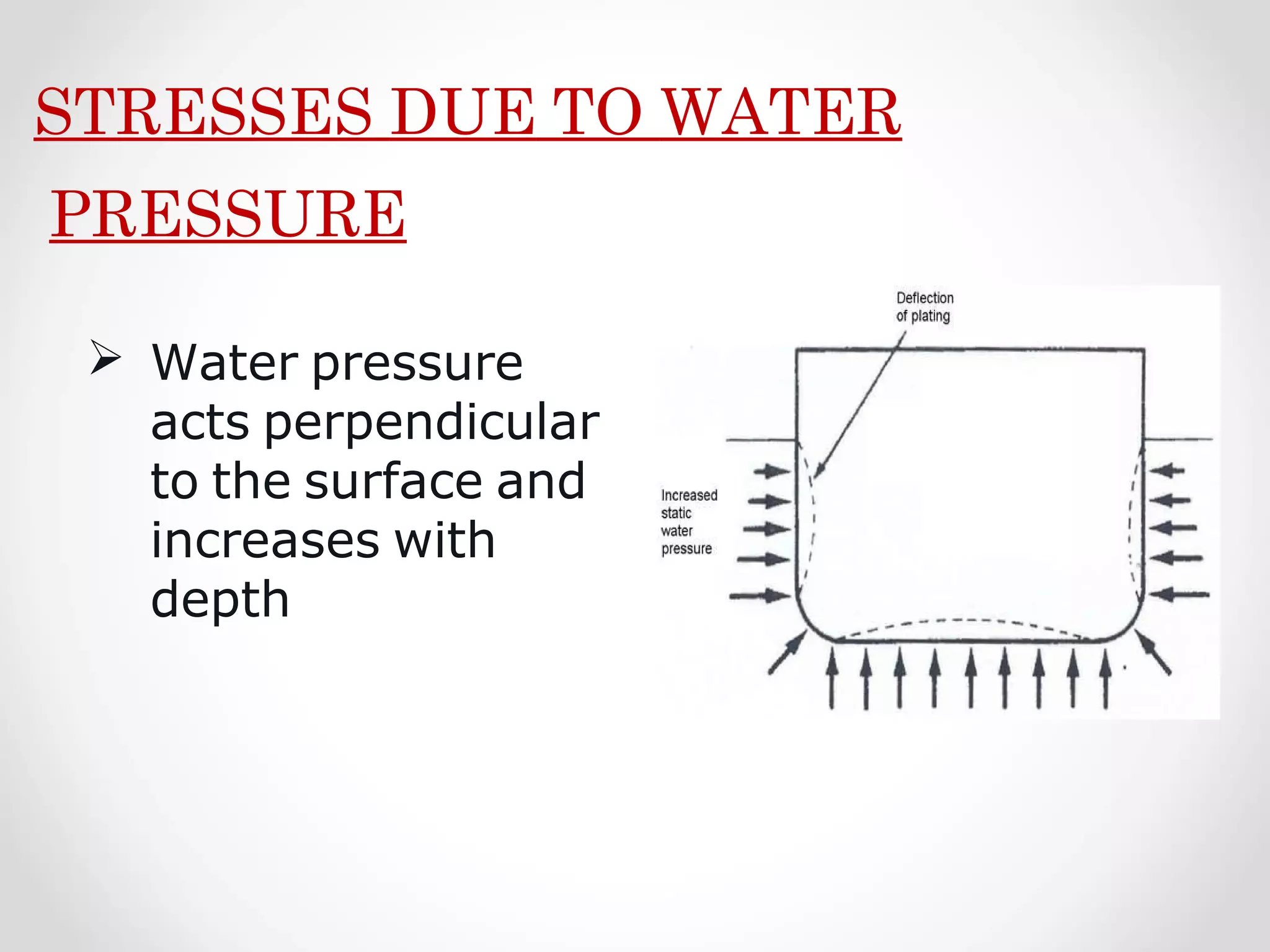
STRESSES DUE TO WATER
PRESSURE
 Water pressure
acts perpendicular
to the surface and
increases with
depth
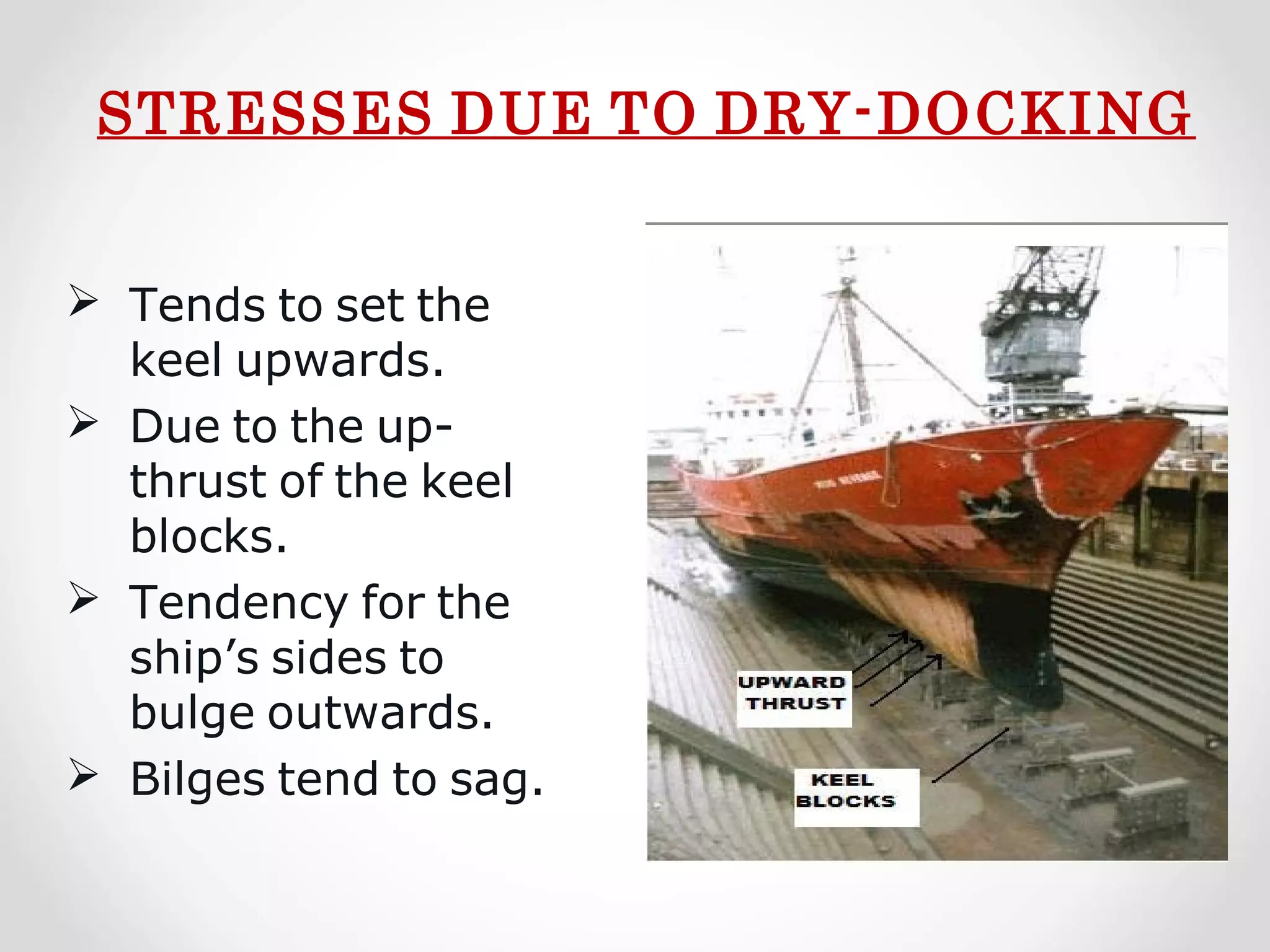
STRESSES DUE TO DRY-DOCKING
 Tends to set the
keel upwards.
 Due to the up-
thrust of the keel
blocks.
 Tendency for the
ship’s sides to
bulge outwards.
 Bilges tend to sag.
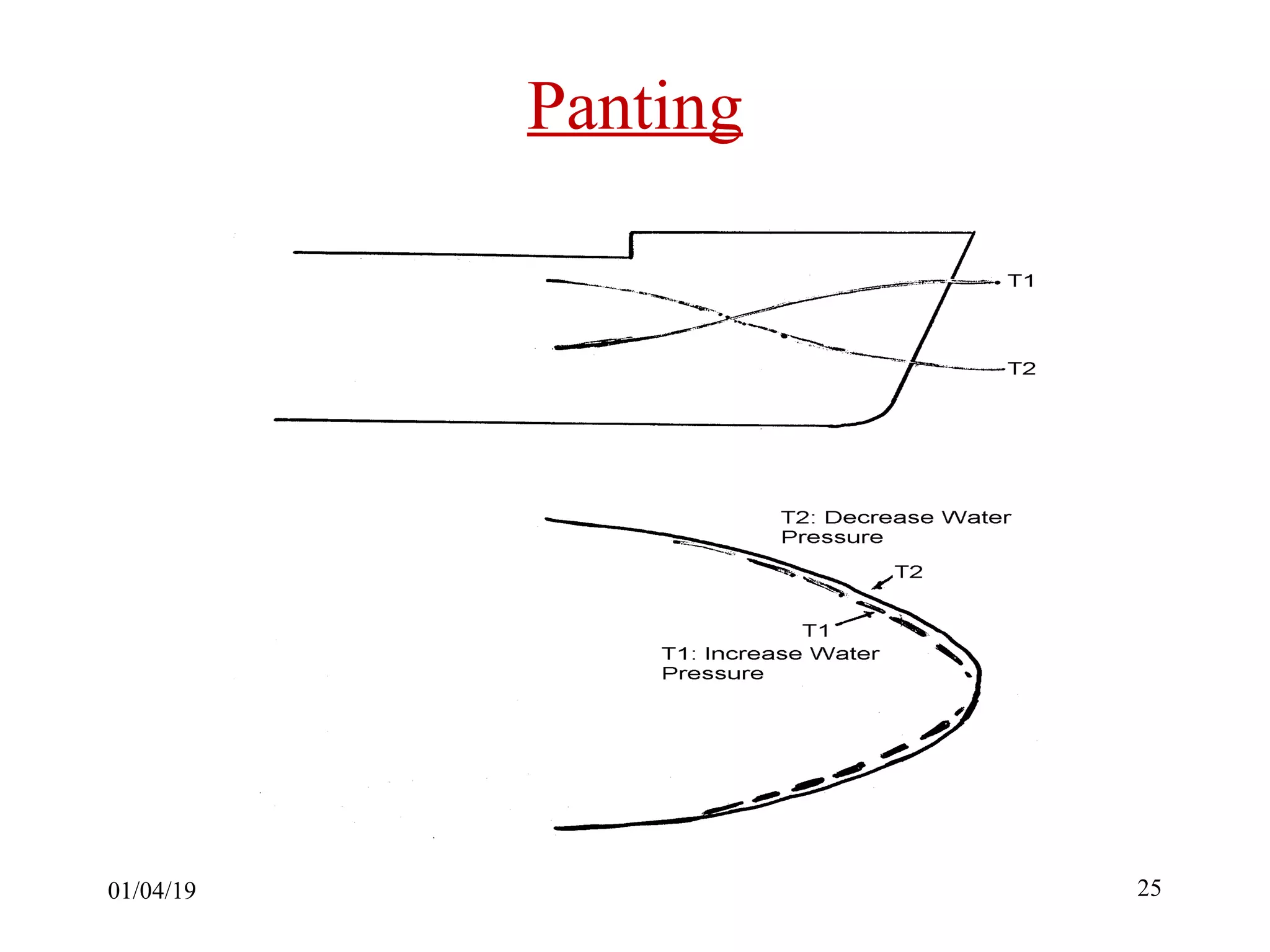
 This is a stress, which occurs at the ends of
a vessel due to variations in water pressure
on the shell plating as the vessel pitches in
a seaway. The effect is accentuated at the
bow when making headway
DMS-DO
PANTING
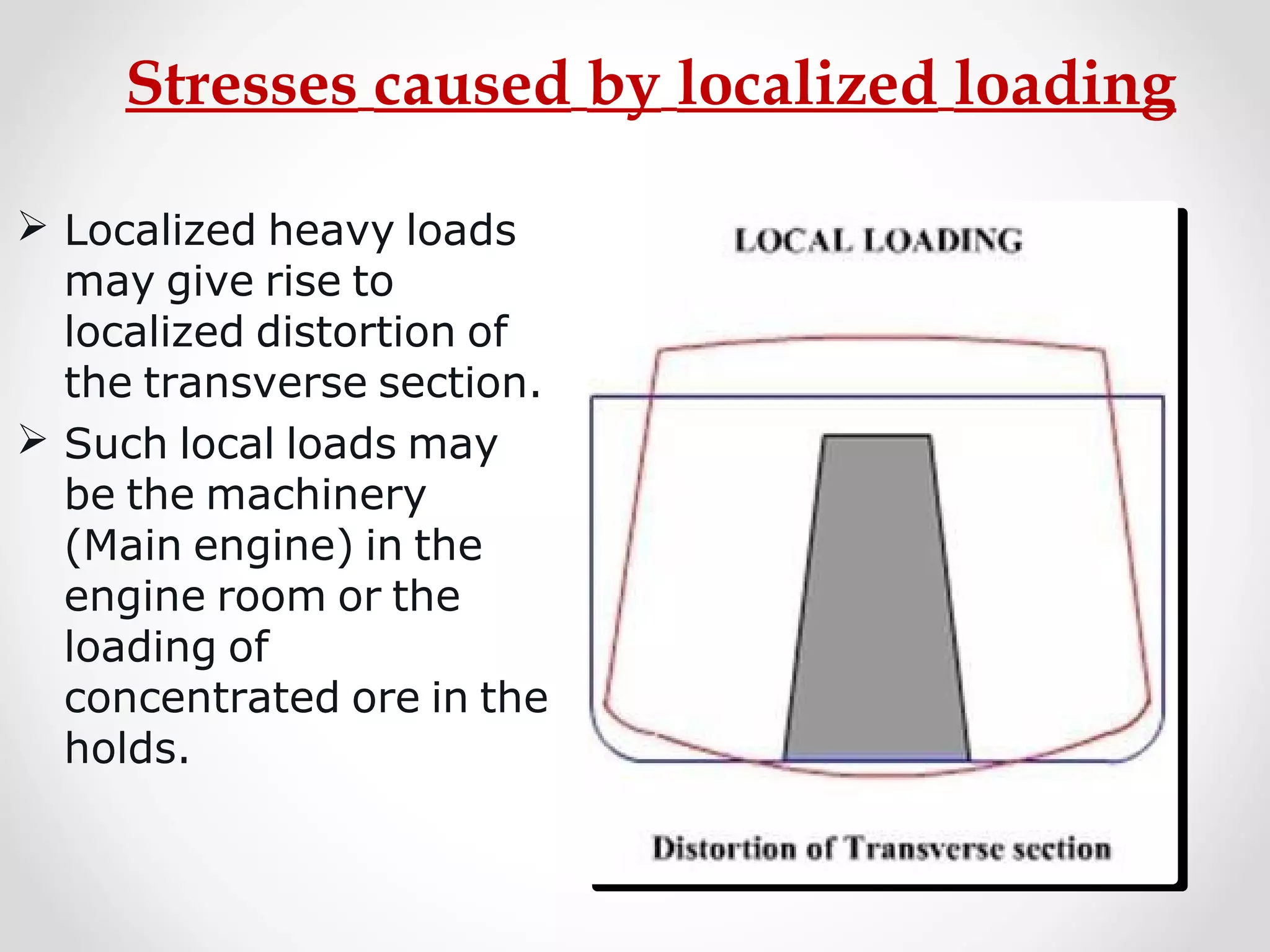
Stresses caused by localized loading
 Localized heavy loads
may give rise to
localized distortion of
the transverse section.
 Such local loads may
be the machinery
(Main engine) in the
engine room or the
loading of
concentrated ore in the
holds.
01/04/19 22
Slamming or Pounding
 Heavy pitching assisted by heaving as the whole
ship is lifted in a seaway.
 May subject the forepart to severe impact from
the sea.
 The greatest effect is experienced in the
lightship condition
 To compensate for this the bottom over 30%
forward is additionally strengthened for ship >
65m length, forward draft <0.045L
01/04/19 23
Slamming or Pounding
01/04/19 24
Panting
 This is a stress which occurs at the
ends of a ship due to variation in
water pressure on the shell plating as
the ship pitches in a seaway.
 The effect is accentuated at the bow
when making headway.
01/04/19 25
Panting
01/04/19 SHIP MOTION 26
Ship Motion
Methods used to Reduce Rolling
Passive
Bilge keel
Passive tank; Controlled Passive tank
Active
Active tank
Fin stabilisers:
a. Fixed Fin
b. Retractable:
• Athwartships
• Folding
01/04/19 27
Ship Motion
Bilge Keel
• 300-600 mm deep
• 1/3 length of ship (midship)
• Mounted at right angle to the bilge radiused
plating either side (at turn of bilge)
• Damp any tendency of the ship’s roll by 25 %
• Constructed of 2 sections
01/04/19 SHIP MOTION 28
Ship Motion
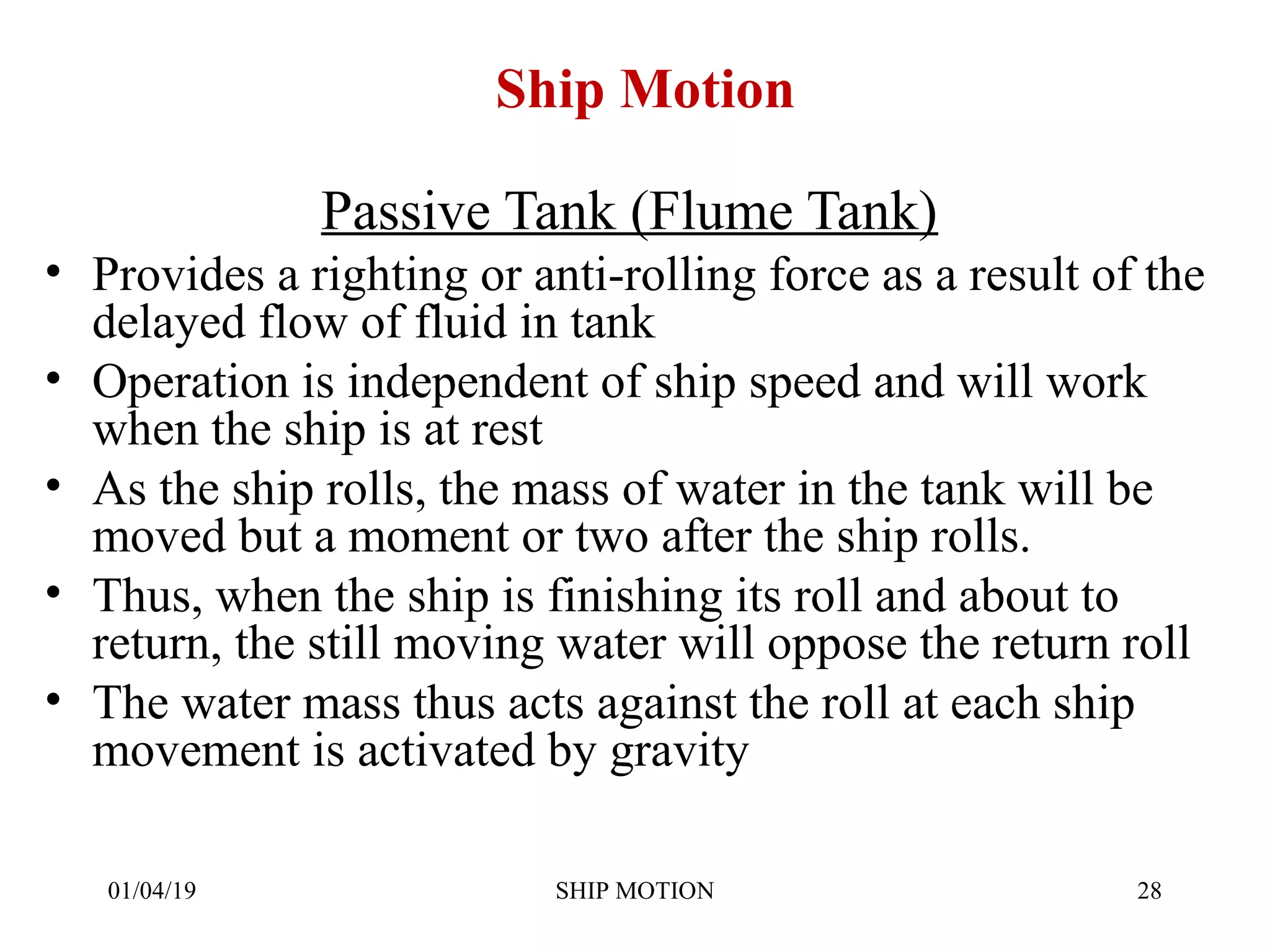
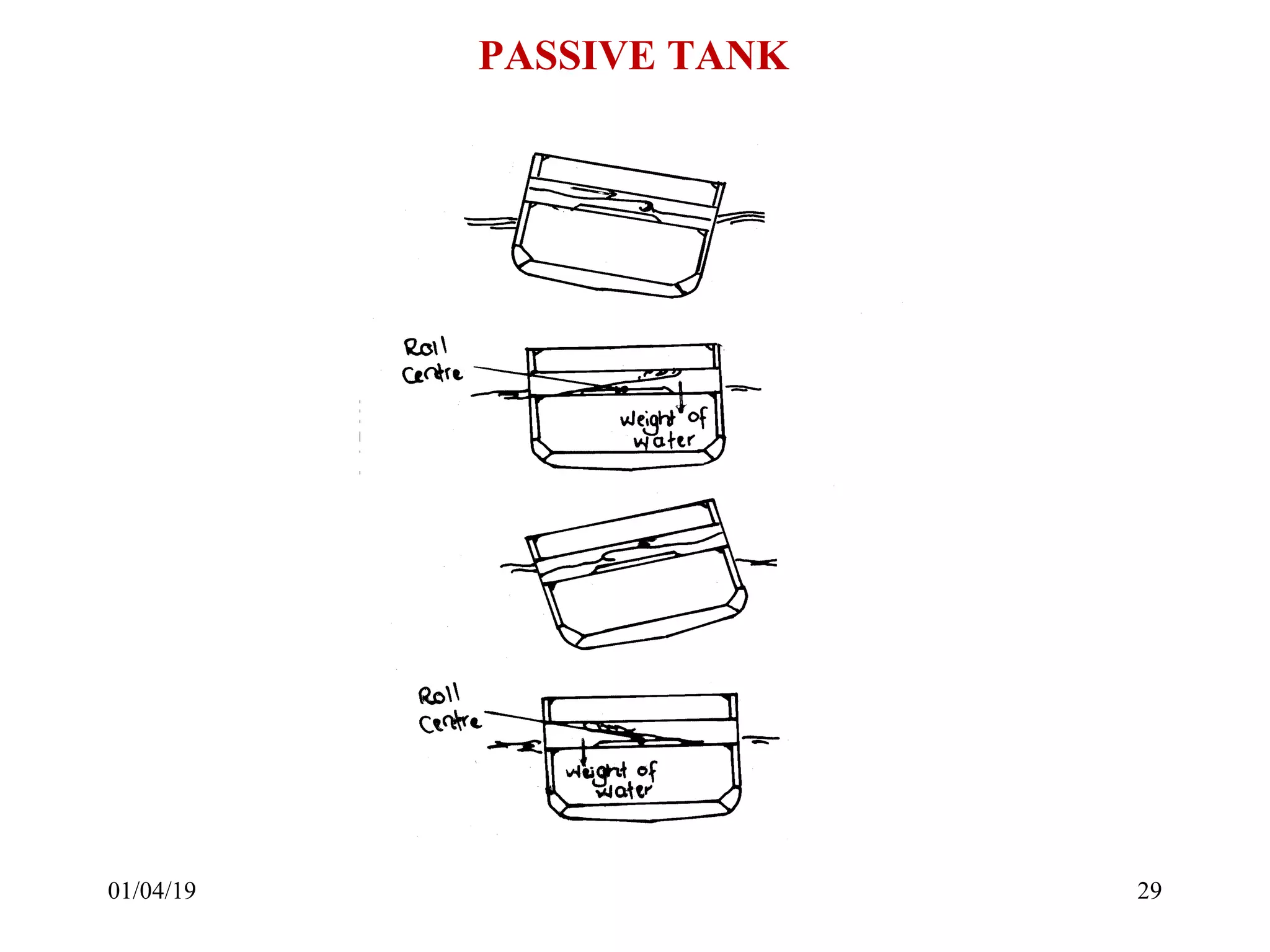
Passive Tank (Flume Tank)
• Provides a righting or anti-rolling force as a result of the
delayed flow of fluid in tank
• Operation is independent of ship speed and will work
when the ship is at rest
• As the ship rolls, the mass of water in the tank will be
moved but a moment or two after the ship rolls.
• Thus, when the ship is finishing its roll and about to
return, the still moving water will oppose the return roll
• The water mass thus acts against the roll at each ship
movement is activated by gravity
01/04/19 29
PASSIVE TANK
01/04/19 SHIP MOTION 30
Ship Motion
Controlled Passive Tank (Winged tank System)
 The greater height of tank at sides permits a large water
build-up
 Thus a greater moment to resist the roll
 The rising fluid level must not however, fill the wing
tank
 The air duct between the two wing tanks contains valves
which are operated by a roll sensing device
 Differential air pressure between tanks is regulated to
allow the fluid flow to be controlled and ‘phased’ for
maximum roll stabilization
01/04/19 31
CONTROLLED PASSIVE TANK
01/04/19 SHIP MOTION 32
Ship Motion
Active Tank
It is made up of motor pump unit and valves
When the ship rolls to starboard, the pump
activates and pump the water to port tank to
provide the anti-rolling moment
When the ship rolls to port, the water is pumped
to starboard to provide the stabilization moment
The valves are activated according to the water
flow direction
01/04/19 SHIP MOTION 33
Active Tank
01/04/19 34
Ship Motion
Fin Stabiliser - General
 One or more pair fitted each side of ship
 Size or area is governed by ship’s breadth, draught,
displacement etc.
 May be retractable or fixed
 They act to apply a righting moment to the ship as it is
inclined by a wave or force on one side
 The angle of tilt of the fin and the resulting moment on the
ship is determined by sensing control system
 The forward speed of the ship enables the fins to generate
thrust which result in righting moment
01/04/19 35
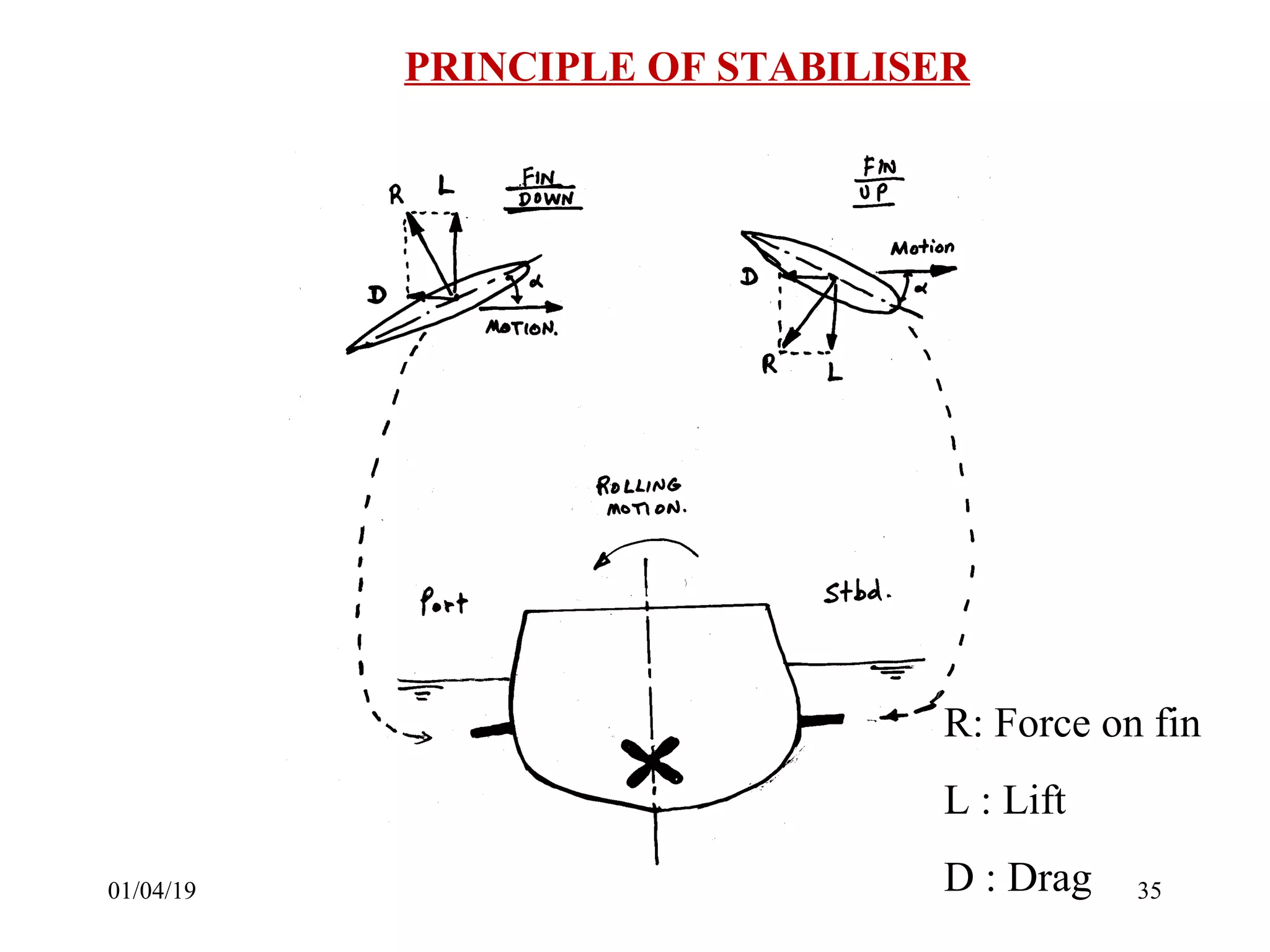
PRINCIPLE OF STABILISER
R: Force on fin
L : Lift
D : Drag

Ship Motion and Stresses

  • 1.
    Ship Motion &Stresses 01/04/19 1
  • 2.
    STATIC FORCES These aredue to  Internal forces resulting from structural weight, cargo and machinery weight.  External static forces including the hydrostatic pressure of the water on the hull.
  • 3.
  • 4.
    DYNAMIC FORCES They resultfrom  The ship’s motion at sea.  The action of wind and waves.  The effects of operating machinery.
  • 5.
     A shipis free to move about six degrees of freedom.  Three linear and three rotational.  Various forces acting on ship are constantly varying in degree and frequency.  This movement of the ship introduces dynamic forces which result in stresses on the ship’s structure. Dynamic Forces
  • 6.
    01/04/19 SHIP MOTION6 Ship Motion SIX Degrees of Freedom of the Ship:  Rolling  Surging  Pitching  Swaying  Heaving  Yawing
  • 7.
    Rigid Body Motionof a Ship • Translational motion : surge, sway, heave • Rotational motion : roll, pitch, yaw • Simple harmonic motion : Heave, Pitch and Roll surge roll pitch heave sway yaw 6 degrees of freedom Ship Motion
  • 8.
  • 10.
    • Pitch isthe motion of a ship in rising the crest of a wave then descending into the following trough. Roll is the motion of a ship from side to side as she moves through the water. Yaw is where the bow of a ship falls away or sways erratically from side to side as the vessel moves through the water. • •
  • 12.
    • Heave isthe motion of the ship when the ship have being up by a wave or sea. • Sway is the swing of a mast or bow of a ship from side to side as the vessel progresses in a heavy sea. • Surge is the movement forward as the bow of a ship rises and dips when it encounter waves which are strong enough to life it. The ship surge up the side of a wave, often shipping water as it passes through the crest, then dips down the other side of the wave.
  • 13.
     Forces producestresses in the ship’s structure which may be divided into two categories:  Global stress – affects the whole ship  Local stress- affects a particular part of a ship
  • 14.
    HOGGING  Hogging iswhen the ship bends upwards longitudinally. This occurs when there is more weight concentrated at the ends due to uneven cargo distribution or when the vessel rides a wave crest in its middle, causing excessive buoyancy.
  • 15.
    SAGGING  Sagging isthe reverse of hogging when the ship bends longitudinally in the downwards direction. This occurs when there is more weight concentrated in the mid length of the vessel due to uneven cargo distribution or when the vessel rides a wave trough in its middle causing excessive buoyancy at the ends.
  • 16.
    RACKING  When aship is rolling, the accelerations on the ship’s structure are liable to cause distortion in the transverse section.  Greatest effect is under light ship condition.
  • 17.
     A shiptraversing a wave train at angle will be subject to righting moments of opposite directions at its ends.  The hull is subject to a twisting moment and the structure is in torsion. TORSION
  • 18.
    STRESSES DUE TOWATER PRESSURE  Water pressure acts perpendicular to the surface and increases with depth
  • 19.
    STRESSES DUE TODRY-DOCKING  Tends to set the keel upwards.  Due to the up- thrust of the keel blocks.  Tendency for the ship’s sides to bulge outwards.  Bilges tend to sag.
  • 20.
     This isa stress, which occurs at the ends of a vessel due to variations in water pressure on the shell plating as the vessel pitches in a seaway. The effect is accentuated at the bow when making headway DMS-DO PANTING
  • 21.
    Stresses caused bylocalized loading  Localized heavy loads may give rise to localized distortion of the transverse section.  Such local loads may be the machinery (Main engine) in the engine room or the loading of concentrated ore in the holds.
  • 22.
    01/04/19 22 Slamming orPounding  Heavy pitching assisted by heaving as the whole ship is lifted in a seaway.  May subject the forepart to severe impact from the sea.  The greatest effect is experienced in the lightship condition  To compensate for this the bottom over 30% forward is additionally strengthened for ship > 65m length, forward draft <0.045L
  • 23.
  • 24.
    01/04/19 24 Panting  Thisis a stress which occurs at the ends of a ship due to variation in water pressure on the shell plating as the ship pitches in a seaway.  The effect is accentuated at the bow when making headway.
  • 25.
  • 26.
    01/04/19 SHIP MOTION26 Ship Motion Methods used to Reduce Rolling Passive Bilge keel Passive tank; Controlled Passive tank Active Active tank Fin stabilisers: a. Fixed Fin b. Retractable: • Athwartships • Folding
  • 27.
    01/04/19 27 Ship Motion BilgeKeel • 300-600 mm deep • 1/3 length of ship (midship) • Mounted at right angle to the bilge radiused plating either side (at turn of bilge) • Damp any tendency of the ship’s roll by 25 % • Constructed of 2 sections
  • 28.
    01/04/19 SHIP MOTION28 Ship Motion Passive Tank (Flume Tank) • Provides a righting or anti-rolling force as a result of the delayed flow of fluid in tank • Operation is independent of ship speed and will work when the ship is at rest • As the ship rolls, the mass of water in the tank will be moved but a moment or two after the ship rolls. • Thus, when the ship is finishing its roll and about to return, the still moving water will oppose the return roll • The water mass thus acts against the roll at each ship movement is activated by gravity
  • 29.
  • 30.
    01/04/19 SHIP MOTION30 Ship Motion Controlled Passive Tank (Winged tank System)  The greater height of tank at sides permits a large water build-up  Thus a greater moment to resist the roll  The rising fluid level must not however, fill the wing tank  The air duct between the two wing tanks contains valves which are operated by a roll sensing device  Differential air pressure between tanks is regulated to allow the fluid flow to be controlled and ‘phased’ for maximum roll stabilization
  • 31.
  • 32.
    01/04/19 SHIP MOTION32 Ship Motion Active Tank It is made up of motor pump unit and valves When the ship rolls to starboard, the pump activates and pump the water to port tank to provide the anti-rolling moment When the ship rolls to port, the water is pumped to starboard to provide the stabilization moment The valves are activated according to the water flow direction
  • 33.
    01/04/19 SHIP MOTION33 Active Tank
  • 34.
    01/04/19 34 Ship Motion FinStabiliser - General  One or more pair fitted each side of ship  Size or area is governed by ship’s breadth, draught, displacement etc.  May be retractable or fixed  They act to apply a righting moment to the ship as it is inclined by a wave or force on one side  The angle of tilt of the fin and the resulting moment on the ship is determined by sensing control system  The forward speed of the ship enables the fins to generate thrust which result in righting moment
  • 35.
    01/04/19 35 PRINCIPLE OFSTABILISER R: Force on fin L : Lift D : Drag