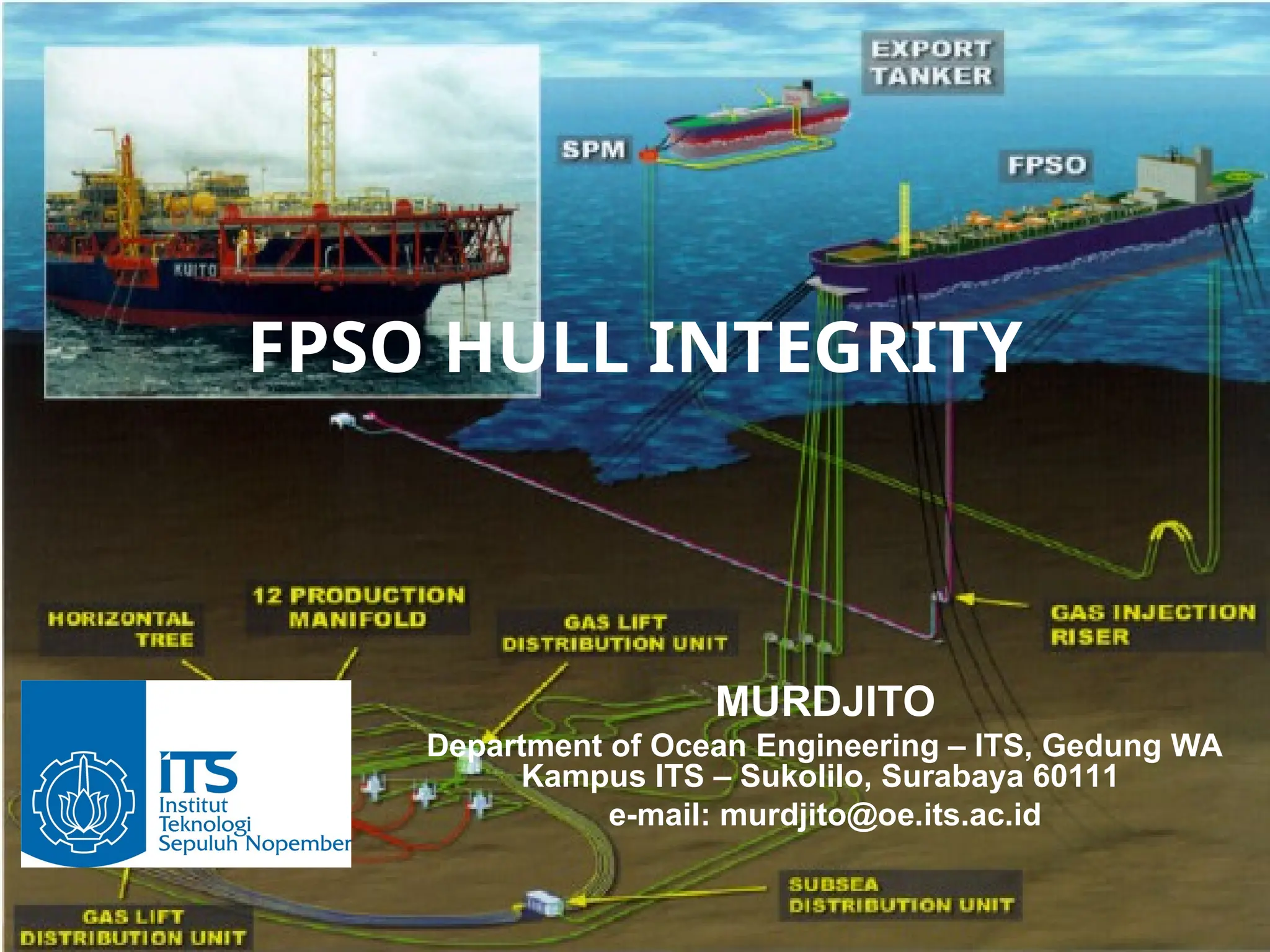
FPSO HULL INTEGRITY
MURDJITO
Department of Ocean Engineering – ITS, Gedung WA
Kampus ITS – Sukolilo, Surabaya 60111
e-mail: murdjito@oe.its.ac.id
RULES & REGULATIONS
• Shipbuilding vs. Offshore Standards
– piping
– selection of materials
– accommodations
– control & safety systems
• Safety
– IMO MODU as a reference
– SOLAS limited to specific items not covered by
MODU
– MARPOL with unified interpretation forFPSO’s
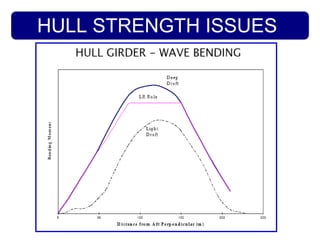
HULL STRENGTH ISSUES
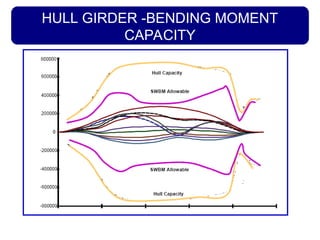
HULL GIRDER -BENDING MOMENT
CAPACITY
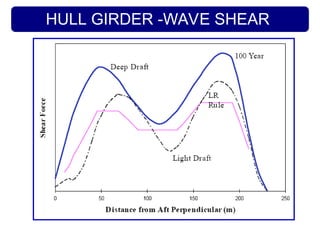
HULL GIRDER -WAVE SHEAR
GLOBAL HULL DESIGN –WAVE BM & SF
• Still water loading conditions often more severe for FPSO
• Wave loading depends upon site environmental criteria:
– harsh environment wave BM and SF are close to and may exceed Ship
Rule requirements
– benign environment wave BM and SF are less than Ship Rules (but not
to be taken less than 70% of unrestricted service Ship Rule
requirement)
• Multi-site operation may require assessment
• Towing, inspection and temporary conditions to be considered
• Rules require assessment of site specific wave loading (100 year
return values)
• Ship rules employ simple parametric equations for wave loading (20
year return values)
• Longitudinal SF and BM determine (mostly) longitudinal material
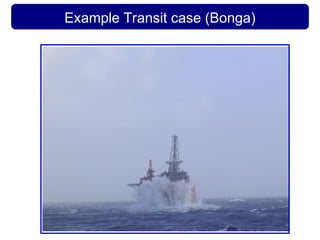
Example Transit case (Bonga)
HULL STRENGTH / FATIGUE –FE MODELS
• Cargo / ballast tank area
• Mooring structure and hull integration (turret and/or
chainstoppers)
• Riser porches and supporting structure
• Topsides support structure and hull integration
• Flare tower support structure
• Offloading station support structure
• Main crane pedestals and support structure
• Helideck structure
• Additional locations depending on vessel function and
owners requirements
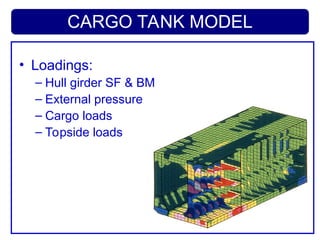
CARGO TANK MODEL
• Loadings:
– Hull girder SF & BM
– External pressure
– Cargo loads
– Topside loads
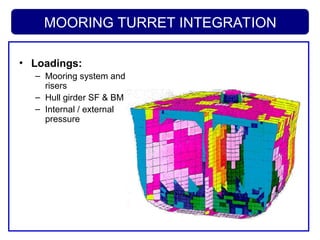
MOORING TURRET INTEGRATION
• Loadings:
– Mooring system and
risers
– Hull girder SF & BM
– Internal / external
pressure
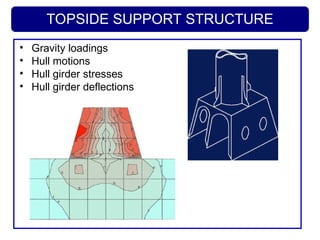
TOPSIDE SUPPORT STRUCTURE
• Gravity loadings
• Hull motions
• Hull girder stresses
• Hull girder deflections
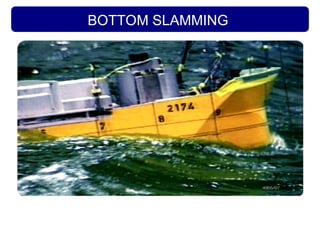
BOTTOM SLAMMING
BOW AREA IMPACT
• Effects forward bottom structure
• Factors affecting slam pressure:
– bluffness of bow
– pitch response / wave length
– wave steepness
– wave height
– breaking waves
– loading condition (draft)
• Model testing advisable
• Rules contain requirements relating to draft,
pressure, extent and scantlings
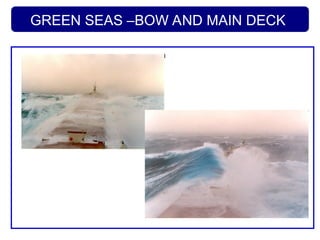
GREEN SEAS –BOW AND MAIN DECK
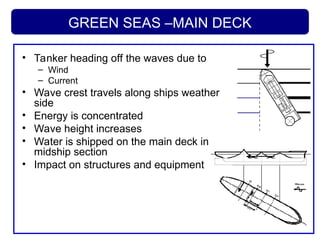
GREEN SEAS –MAIN DECK
• Tanker heading off the waves due to
– Wind
– Current
• Wave crest travels along ships weather
side
• Energy is concentrated
• Wave height increases
• Water is shipped on the main deck in
midship section
• Impact on structures and equipment
GREEN SEAS
• Factors affecting green seas:
– pitch response / wave length
– wave steepness
– wave height
– breaking waves
– loading condition (draft)
– bow shape
• Rules for ships incorporate allowances within
design heads for superstructures, deckhouses,
bulwarks and decks.
• Model testing advisable
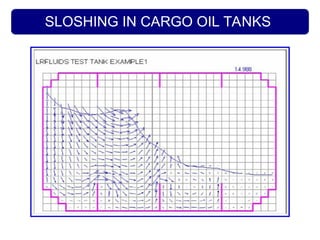
SLOSHING IN CARGO OIL TANKS
• Sloshing is the dynamic magnification of pressures within
cargo/ballast tanks
• Partial fillings the norm for FPSOs (NOT so for trading oil
tankers)
• Influencing Factors:
– Tank size
– Hull form
– Environment / Weathervaning
– Natural periods of both vessel and fluid
– Tank fill levels
• Sloshing analysis required (e.g. LR FLUIDS)
• Analysis may result in an increase in scantlings at tank
tops
• Restrictions may be placed on fill levels in certain tanks
ACCIDENTAL LOADS
• Collision due to supply boat / shuttle
tanker / iceberg
• Dropped object
• Explosion / blast
• Ultimate strength criteria (10000 year
wave?)
FATIGUE –the problem
• The effect on metal of repeated cycles of stress.
• There is no obvious warning, a crack forms
without appreciable deformation of structure
making it difficult to detect the presence of
growing cracks.
• Fractures usually start from small nicks or
scratches or fillets which cause a localized
concentration of stress.
• Failure can be influenced by a number of factors
including size, shape and design of the
component, condition of the surface or operating
environment.
• Fatigue life of structural details need to be
assessed for FPSO
FATIGUE LIFE ASSESSMENT
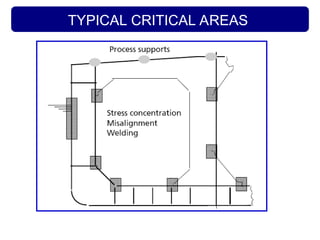
• Identification of critical areas
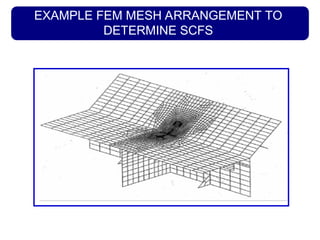
• Detailed finite element analysis to assess Stress
Concentration Factors
• Site specific analysis of dynamic loads
• Previous service history to be assessed (for
conversions)
• Selection of S/N curves
– Other relevant issues:
– Cathodic protection / coatings
– Fabrication, tolerances, welding
– Inspection / Inspectability
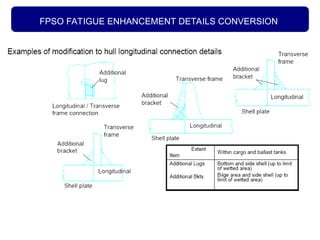
– Repair / structural detail improvement
– Fracture mechanics assessment
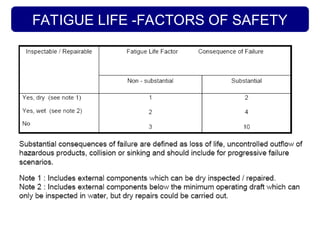
• Note: fatigue is highly sensitive to loading (stress range)
EXAMPLE FEM MESH ARRANGEMENT TO
DETERMINE SCFS
FATIGUE LIFE -FACTORS OF SAFETY
TYPICAL CRITICAL AREAS
FABRICATION TOLERANCES AND WELDING
• Tolerances should be in accordance with good
shipbuilding practice, and agreed with Class
Society
• Special attention given to fatigue sensitive areas
• Enhanced NDE levels will be necessary for
identified fatigue sensitive areas
• Assumptions used in analytical fatigue
assessments to be consistent with construction
FPSO FATIGUE ENHANCEMENT DETAILS CONVERSION
IN SERVICE SURVEY PROGRAM
• Source :
– developed by the owner / operator against list
of surveyable items
– Survey plan to be approved by Class
• To address :
– Class requirements
– Regulatory requirements
– Overall hull structure configuration & critical
areas
STRUCTURAL INSPECTION
• Carried out on location
• Provides detection / monitoring capacity
• Annual, intermediate & major surveys
• Major survey (5 years or continuous)
• IWS in lieu of dry docking
• Internal survey considerations:
– cleaning & gas freeing
– access arrangements/safety
– Lighting / ventilation
– loading conditions for strength
IN WATER SURVEYS
• Requirements for ‘OIWS’ notation
– Cathodic protection and high resistance paint
– Underwater marking
– Tank inspection conditions included in hull
girder analysis
– Venting/isolation arrangements for tank entry
– Arrangements considered for survey/change-
out of thrusters, sea chests, rudder bearing
etc.
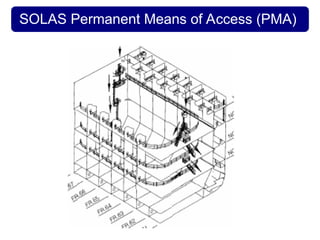
Permanent Means of Access (PMA)
• SOLAS requirements for newbuild
vessels
– All internal tanks
– Eliminate need for staging, rafting or rope
access
– Access for close up examination
– Utilise tanks structural members, or provide
dedicated arrangements
– Standards for ladders, handrails, etc
– Portable equipment may be used for some
SOLAS Permanent Means of Access (PMA)
GENERAL LIFE OF FIELD ISSUES
• ‘Holistic’ approach for good integrated solution
• Offshore instead of Ship maintenance philosophy
• Design for accidental loads, including wave impact
• Compatibility of hull structural, systems and topsides –
interface design
• Fatigue Design (& life to date for conversions)
• Production equipment for extreme weather conditions
• Marine equipment robustness, particularly cargo/ballast
systems
• ‘OIWS’ requirements and corrosion protection
• Access (operability / maintainability / inspectability)
• In-service survey –effect on downtime
• Provision of spare parts
FPSO INCIDENT HISTORY
Examples of problems
• Hull Structure
– Localised fatigue failure
– bow wave impact damage
– shuttle tanker collision
– tank overpressurisation
– seawater caisson preferential corrosion
– integration of surface and subsea corrosion
protection
FPSO INCIDENT HISTORY -STATISTICS (REPORTED)
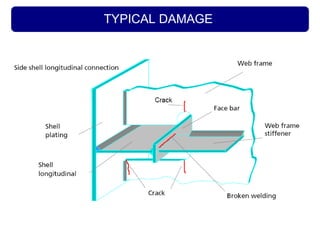
TYPICAL DAMAGE
EXAMPLES OF INTERNAL WELDED REPAIRS
FPSO BOW WAVE IMPACT DAMAGE
FPSO RULE AMENDMENTS FOR FORE END
STRUCTURES
• Basis -Ship Rule requirements using min.
service speed 12 -15 knots
• Site specific assessments required where
expected to be more severe
• Model test measurements of impact pressures
recommended
• Integrated structural design approach to be
adopted using direct calculation methods (LR
Rules for permissible stress requirements)

284019969-Fpso-Hull-Integrity.ppt for training

  • 1.
    FPSO HULL INTEGRITY MURDJITO Departmentof Ocean Engineering – ITS, Gedung WA Kampus ITS – Sukolilo, Surabaya 60111 e-mail: murdjito@oe.its.ac.id
  • 2.
    RULES & REGULATIONS •Shipbuilding vs. Offshore Standards – piping – selection of materials – accommodations – control & safety systems • Safety – IMO MODU as a reference – SOLAS limited to specific items not covered by MODU – MARPOL with unified interpretation forFPSO’s
  • 3.
  • 4.
    HULL GIRDER -BENDINGMOMENT CAPACITY
  • 5.
  • 6.
    GLOBAL HULL DESIGN–WAVE BM & SF • Still water loading conditions often more severe for FPSO • Wave loading depends upon site environmental criteria: – harsh environment wave BM and SF are close to and may exceed Ship Rule requirements – benign environment wave BM and SF are less than Ship Rules (but not to be taken less than 70% of unrestricted service Ship Rule requirement) • Multi-site operation may require assessment • Towing, inspection and temporary conditions to be considered • Rules require assessment of site specific wave loading (100 year return values) • Ship rules employ simple parametric equations for wave loading (20 year return values) • Longitudinal SF and BM determine (mostly) longitudinal material
  • 7.
  • 8.
    HULL STRENGTH /FATIGUE –FE MODELS • Cargo / ballast tank area • Mooring structure and hull integration (turret and/or chainstoppers) • Riser porches and supporting structure • Topsides support structure and hull integration • Flare tower support structure • Offloading station support structure • Main crane pedestals and support structure • Helideck structure • Additional locations depending on vessel function and owners requirements
  • 9.
    CARGO TANK MODEL •Loadings: – Hull girder SF & BM – External pressure – Cargo loads – Topside loads
  • 10.
    MOORING TURRET INTEGRATION •Loadings: – Mooring system and risers – Hull girder SF & BM – Internal / external pressure
  • 11.
    TOPSIDE SUPPORT STRUCTURE •Gravity loadings • Hull motions • Hull girder stresses • Hull girder deflections
  • 12.
  • 13.
    BOW AREA IMPACT •Effects forward bottom structure • Factors affecting slam pressure: – bluffness of bow – pitch response / wave length – wave steepness – wave height – breaking waves – loading condition (draft) • Model testing advisable • Rules contain requirements relating to draft, pressure, extent and scantlings
  • 14.
    GREEN SEAS –BOWAND MAIN DECK
  • 15.
    GREEN SEAS –MAINDECK • Tanker heading off the waves due to – Wind – Current • Wave crest travels along ships weather side • Energy is concentrated • Wave height increases • Water is shipped on the main deck in midship section • Impact on structures and equipment
  • 16.
    GREEN SEAS • Factorsaffecting green seas: – pitch response / wave length – wave steepness – wave height – breaking waves – loading condition (draft) – bow shape • Rules for ships incorporate allowances within design heads for superstructures, deckhouses, bulwarks and decks. • Model testing advisable
  • 17.
  • 18.
    SLOSHING IN CARGOOIL TANKS • Sloshing is the dynamic magnification of pressures within cargo/ballast tanks • Partial fillings the norm for FPSOs (NOT so for trading oil tankers) • Influencing Factors: – Tank size – Hull form – Environment / Weathervaning – Natural periods of both vessel and fluid – Tank fill levels • Sloshing analysis required (e.g. LR FLUIDS) • Analysis may result in an increase in scantlings at tank tops • Restrictions may be placed on fill levels in certain tanks
  • 19.
    ACCIDENTAL LOADS • Collisiondue to supply boat / shuttle tanker / iceberg • Dropped object • Explosion / blast • Ultimate strength criteria (10000 year wave?)
  • 20.
    FATIGUE –the problem •The effect on metal of repeated cycles of stress. • There is no obvious warning, a crack forms without appreciable deformation of structure making it difficult to detect the presence of growing cracks. • Fractures usually start from small nicks or scratches or fillets which cause a localized concentration of stress. • Failure can be influenced by a number of factors including size, shape and design of the component, condition of the surface or operating environment. • Fatigue life of structural details need to be assessed for FPSO
  • 21.
    FATIGUE LIFE ASSESSMENT •Identification of critical areas • Detailed finite element analysis to assess Stress Concentration Factors • Site specific analysis of dynamic loads • Previous service history to be assessed (for conversions) • Selection of S/N curves – Other relevant issues: – Cathodic protection / coatings – Fabrication, tolerances, welding – Inspection / Inspectability – Repair / structural detail improvement – Fracture mechanics assessment • Note: fatigue is highly sensitive to loading (stress range)
  • 22.
    EXAMPLE FEM MESHARRANGEMENT TO DETERMINE SCFS
  • 23.
  • 24.
  • 25.
    FABRICATION TOLERANCES ANDWELDING • Tolerances should be in accordance with good shipbuilding practice, and agreed with Class Society • Special attention given to fatigue sensitive areas • Enhanced NDE levels will be necessary for identified fatigue sensitive areas • Assumptions used in analytical fatigue assessments to be consistent with construction
  • 26.
    FPSO FATIGUE ENHANCEMENTDETAILS CONVERSION
  • 27.
    IN SERVICE SURVEYPROGRAM • Source : – developed by the owner / operator against list of surveyable items – Survey plan to be approved by Class • To address : – Class requirements – Regulatory requirements – Overall hull structure configuration & critical areas
  • 28.
    STRUCTURAL INSPECTION • Carriedout on location • Provides detection / monitoring capacity • Annual, intermediate & major surveys • Major survey (5 years or continuous) • IWS in lieu of dry docking • Internal survey considerations: – cleaning & gas freeing – access arrangements/safety – Lighting / ventilation – loading conditions for strength
  • 29.
    IN WATER SURVEYS •Requirements for ‘OIWS’ notation – Cathodic protection and high resistance paint – Underwater marking – Tank inspection conditions included in hull girder analysis – Venting/isolation arrangements for tank entry – Arrangements considered for survey/change- out of thrusters, sea chests, rudder bearing etc.
  • 30.
    Permanent Means ofAccess (PMA) • SOLAS requirements for newbuild vessels – All internal tanks – Eliminate need for staging, rafting or rope access – Access for close up examination – Utilise tanks structural members, or provide dedicated arrangements – Standards for ladders, handrails, etc – Portable equipment may be used for some
  • 31.
    SOLAS Permanent Meansof Access (PMA)
  • 32.
    GENERAL LIFE OFFIELD ISSUES • ‘Holistic’ approach for good integrated solution • Offshore instead of Ship maintenance philosophy • Design for accidental loads, including wave impact • Compatibility of hull structural, systems and topsides – interface design • Fatigue Design (& life to date for conversions) • Production equipment for extreme weather conditions • Marine equipment robustness, particularly cargo/ballast systems • ‘OIWS’ requirements and corrosion protection • Access (operability / maintainability / inspectability) • In-service survey –effect on downtime • Provision of spare parts
  • 33.
    FPSO INCIDENT HISTORY Examplesof problems • Hull Structure – Localised fatigue failure – bow wave impact damage – shuttle tanker collision – tank overpressurisation – seawater caisson preferential corrosion – integration of surface and subsea corrosion protection
  • 34.
    FPSO INCIDENT HISTORY-STATISTICS (REPORTED)
  • 35.
  • 36.
    EXAMPLES OF INTERNALWELDED REPAIRS
  • 37.
    FPSO BOW WAVEIMPACT DAMAGE
  • 38.
    FPSO RULE AMENDMENTSFOR FORE END STRUCTURES • Basis -Ship Rule requirements using min. service speed 12 -15 knots • Site specific assessments required where expected to be more severe • Model test measurements of impact pressures recommended • Integrated structural design approach to be adopted using direct calculation methods (LR Rules for permissible stress requirements)