Mohammad Mohaiminil Islam
Department of Geography and Environmental Studies
Faculty of Biological Science
University of Chittagong
mmohaiminul@yahoo.com
What is Environmental Management?
 Environmental management is concerned with the man environmental
interface, the complex boundary where bio-physical and socio cultural
systems interact (Hare, 1970).
 An approach which goes beyond natural resource management, to
encompass the political and social as well as the natural environment
(Clarke, 1999).
 It is an attempt to control human impact on and the interaction with the
environment in order to preserve natural resources.
Environmental Management
Associated Issues
Characteristics of Environmental
Management
It deals with the world affected by
human.
It supports sustainable development.
It demands a multidisciplinary approach.
It has to integrate different
developmental points of view.
Characteristics of Environmental
Management
Applied for both short term
and long term concerns.
Integration of natural and
social sciences.
Integration of policy
making and planning.
Significance of Environmental
Management
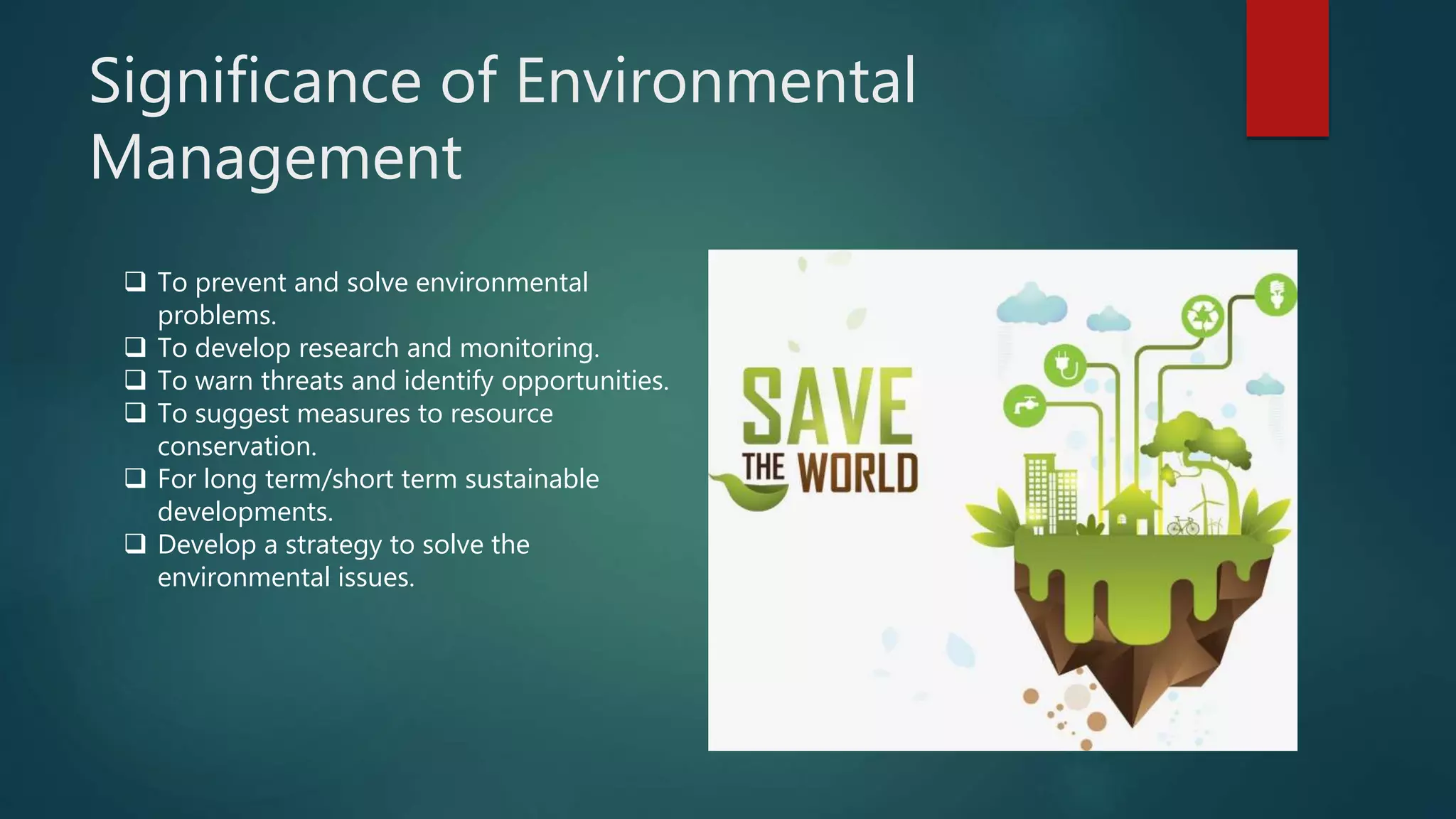
 To prevent and solve environmental
problems.
 To develop research and monitoring.
 To warn threats and identify opportunities.
 To suggest measures to resource
conservation.
 For long term/short term sustainable
developments.
 Develop a strategy to solve the
environmental issues.
General Scheme for Environmental
Management
1. Identification of objectives and define problems
2. Determination of appropriate action plan
3. Implementation and progress evaluation
4. Monitoring and adjust management
5. Future environmental management and planning
Approaches of Environmental
Management
Ecological
EMS
Spatial
There are 3 approaches of
environmental management-
1. Spatial approach
2. Ecological approach
3. Environmental Management
System (EMS) Approach
Spatial Approach
Spatial Approach
Local Regional Global
Spatial Approach considers the management of
environment at 3 levels-
1. Local level
2. Regional level
3. Global level
At global level, the spatial dimension and
management strategies may be chalked out on
the basis of needs, aspirations, perceptions,
priorities and inhibitions of the individuals,
society and government.
Ecological Approach
Ecological
approach
Conservation Preservation
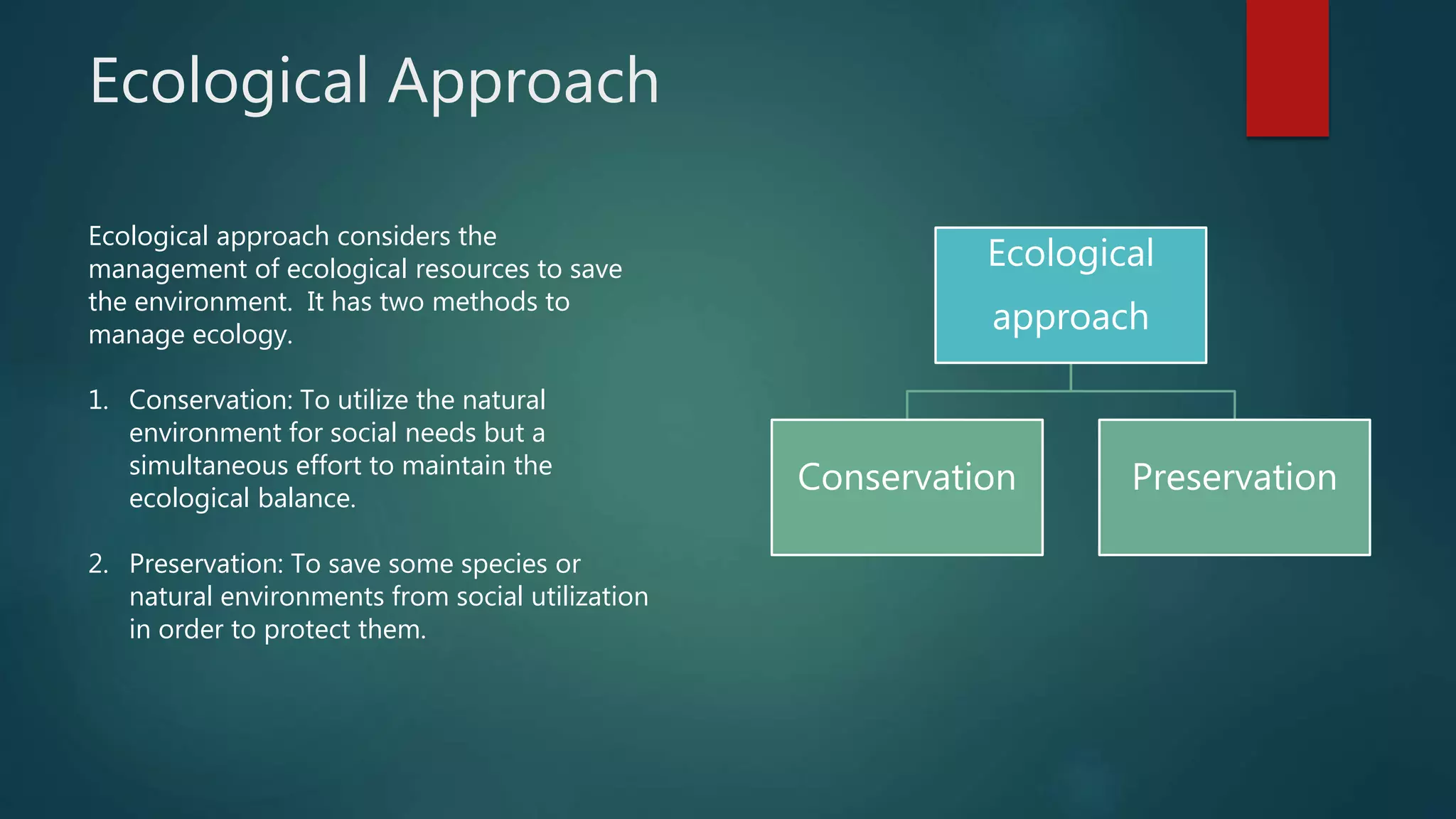
Ecological approach considers the
management of ecological resources to save
the environment. It has two methods to
manage ecology.
1. Conservation: To utilize the natural
environment for social needs but a
simultaneous effort to maintain the
ecological balance.
2. Preservation: To save some species or
natural environments from social utilization
in order to protect them.
Environmental Management System
(EMS) Approach
EMS has been defined by ISO 140001as-
“The part of the overall management
system that includes organizational
structure, planning activities,
responsibilities, practices, procedures,
processes and resources for developing,
implementing achieving and reviewing the
environmental policy.”
4 Elements of EMS
 It has 4 elements such as-
1. Act
2. Plan
3. Do
4. Check.
What EMS does?
An environmental management
system brings together the
people, policies, plans, review
mechanisms, and procedures
used to manage environmental
issues at a facility or in an
organization.
What EMS does?
 Facilitates environmental compliance
 Addresses environmental impacts
 Broadens environmental responsibilities
to all whose work can have a significant
impact on the environment
Workflow of EMS
Implement
Plan
Check
Review
Plan
Implement
Check
Review
Plan
Implement
Framework for Environmental
Management System
 ISO 14001 Standard
 Code of Environmental Management Principles
 Compliance-Focused EMS
 Eco-Management and Audit Scheme
ISO 140001
ISO 14001 is a family of standards
related to environmental
management that exists to help
organizations minimize how their
operations negatively affect the
environment; comply with applicable
laws, regulations, and other
environmentally oriented
requirements; and continually
improve in the above.
Components of ISO 140001
 Environmental Policy
 Planning
 Implementation and Operation
 Checking and Corrective Action
 Management Review
Components of ISO 140001
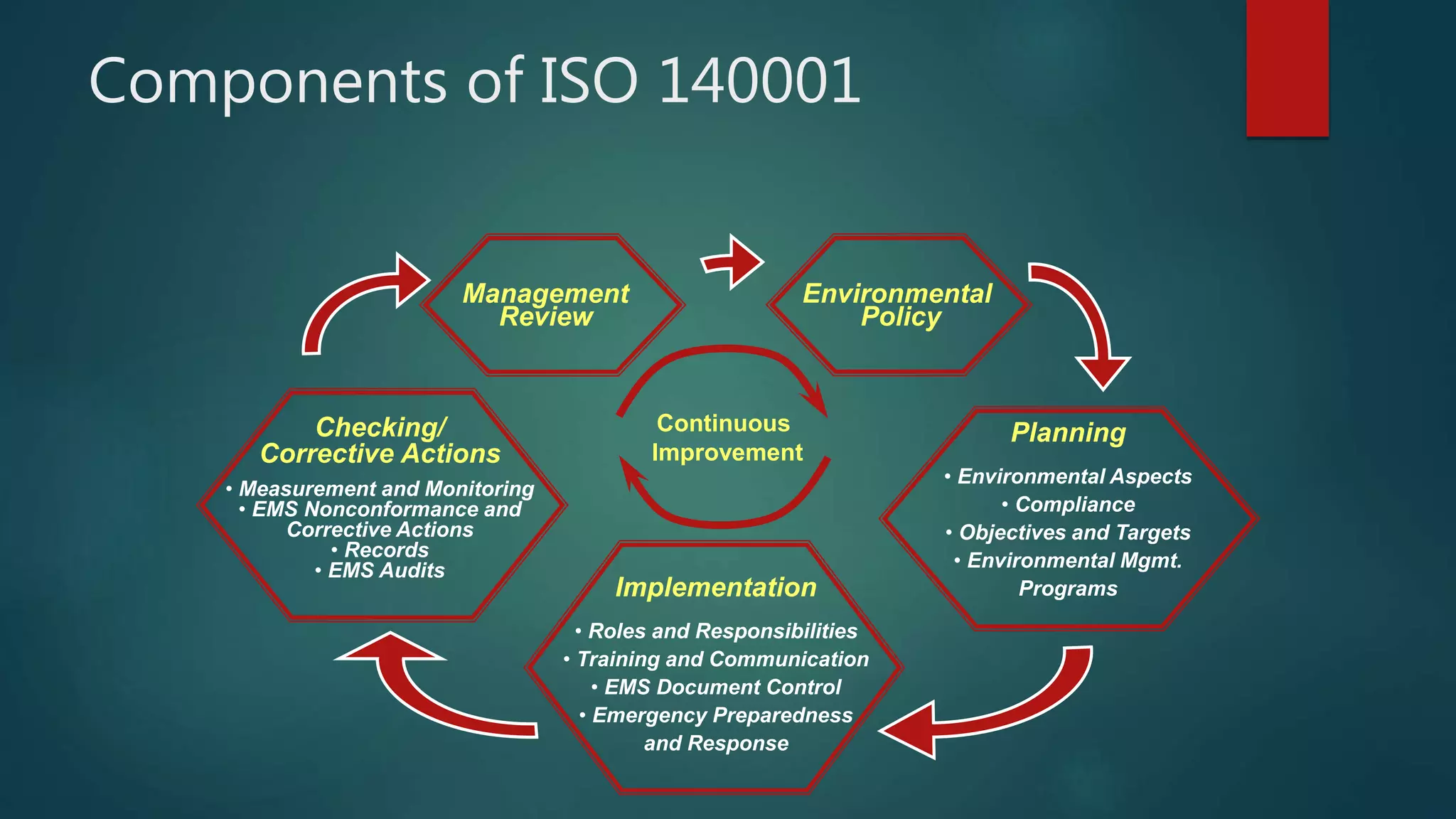
Checking/
Corrective Actions
• Measurement and Monitoring
• EMS Nonconformance and
Corrective Actions
• Records
• EMS Audits
Continuous
Improvement
Implementation
• Roles and Responsibilities
• Training and Communication
• EMS Document Control
• Emergency Preparedness
and Response
Planning
• Environmental Aspects
• Compliance
• Objectives and Targets
• Environmental Mgmt.
Programs
Environmental
Policy
Management
Review
Environmental Policy
An environmental policy is a statement
about an organization's environmental
position and values. The ISO 14001
standard states that an environmental
policy is the organization's overall
environmental performance intentions and
direction formally expressed by top
management.
Environmental Policy Features
 It is Issued with a policy statement signed by
facility manager
 At a minimum, it commits to
 Continual improvement
 Pollution prevention
 Environmental compliance
 Identifies EMS framework
 It is publicly available
Environmental Planning
Environmental Planning is a decision-making
process that considers the environmental,
social, political, economic, and governance
factors that can affect development. Its goal
is to manage the relationship between
natural systems and human systems in the
present and the future.
Features of Environmental Planning
 Identify aspects and impacts
from facility activities,
products, and services
 Review legal requirements
 Set objectives and targets
 Establish formal EMS
program
Scope of Environmental Management
 The awareness regarding environmental problems
and their proper management began in 1970s
through various people movement around many
countries of the world.
 The Green peace movement, The Chipko
movement etc. are some of them.
 The advancement in the field of science and
technology helped to provide various tools and
instrument supported by statistical data to
properly solve environmental problems and help in
its management.
THANK YOU

Environmental Management

  • 1.
    Mohammad Mohaiminil Islam Departmentof Geography and Environmental Studies Faculty of Biological Science University of Chittagong mmohaiminul@yahoo.com
  • 2.
    What is EnvironmentalManagement?  Environmental management is concerned with the man environmental interface, the complex boundary where bio-physical and socio cultural systems interact (Hare, 1970).  An approach which goes beyond natural resource management, to encompass the political and social as well as the natural environment (Clarke, 1999).  It is an attempt to control human impact on and the interaction with the environment in order to preserve natural resources.
  • 3.
  • 4.
    Characteristics of Environmental Management Itdeals with the world affected by human. It supports sustainable development. It demands a multidisciplinary approach. It has to integrate different developmental points of view.
  • 5.
    Characteristics of Environmental Management Appliedfor both short term and long term concerns. Integration of natural and social sciences. Integration of policy making and planning.
  • 6.
    Significance of Environmental Management To prevent and solve environmental problems.  To develop research and monitoring.  To warn threats and identify opportunities.  To suggest measures to resource conservation.  For long term/short term sustainable developments.  Develop a strategy to solve the environmental issues.
  • 7.
    General Scheme forEnvironmental Management 1. Identification of objectives and define problems 2. Determination of appropriate action plan 3. Implementation and progress evaluation 4. Monitoring and adjust management 5. Future environmental management and planning
  • 8.
    Approaches of Environmental Management Ecological EMS Spatial Thereare 3 approaches of environmental management- 1. Spatial approach 2. Ecological approach 3. Environmental Management System (EMS) Approach
  • 9.
    Spatial Approach Spatial Approach LocalRegional Global Spatial Approach considers the management of environment at 3 levels- 1. Local level 2. Regional level 3. Global level At global level, the spatial dimension and management strategies may be chalked out on the basis of needs, aspirations, perceptions, priorities and inhibitions of the individuals, society and government.
  • 10.
    Ecological Approach Ecological approach Conservation Preservation Ecologicalapproach considers the management of ecological resources to save the environment. It has two methods to manage ecology. 1. Conservation: To utilize the natural environment for social needs but a simultaneous effort to maintain the ecological balance. 2. Preservation: To save some species or natural environments from social utilization in order to protect them.
  • 11.
    Environmental Management System (EMS)Approach EMS has been defined by ISO 140001as- “The part of the overall management system that includes organizational structure, planning activities, responsibilities, practices, procedures, processes and resources for developing, implementing achieving and reviewing the environmental policy.”
  • 12.
    4 Elements ofEMS  It has 4 elements such as- 1. Act 2. Plan 3. Do 4. Check.
  • 13.
    What EMS does? Anenvironmental management system brings together the people, policies, plans, review mechanisms, and procedures used to manage environmental issues at a facility or in an organization.
  • 14.
    What EMS does? Facilitates environmental compliance  Addresses environmental impacts  Broadens environmental responsibilities to all whose work can have a significant impact on the environment
  • 15.
  • 16.
    Framework for Environmental ManagementSystem  ISO 14001 Standard  Code of Environmental Management Principles  Compliance-Focused EMS  Eco-Management and Audit Scheme
  • 17.
    ISO 140001 ISO 14001is a family of standards related to environmental management that exists to help organizations minimize how their operations negatively affect the environment; comply with applicable laws, regulations, and other environmentally oriented requirements; and continually improve in the above.
  • 18.
    Components of ISO140001  Environmental Policy  Planning  Implementation and Operation  Checking and Corrective Action  Management Review
  • 19.
    Components of ISO140001 Checking/ Corrective Actions • Measurement and Monitoring • EMS Nonconformance and Corrective Actions • Records • EMS Audits Continuous Improvement Implementation • Roles and Responsibilities • Training and Communication • EMS Document Control • Emergency Preparedness and Response Planning • Environmental Aspects • Compliance • Objectives and Targets • Environmental Mgmt. Programs Environmental Policy Management Review
  • 20.
    Environmental Policy An environmentalpolicy is a statement about an organization's environmental position and values. The ISO 14001 standard states that an environmental policy is the organization's overall environmental performance intentions and direction formally expressed by top management.
  • 21.
    Environmental Policy Features It is Issued with a policy statement signed by facility manager  At a minimum, it commits to  Continual improvement  Pollution prevention  Environmental compliance  Identifies EMS framework  It is publicly available
  • 22.
    Environmental Planning Environmental Planningis a decision-making process that considers the environmental, social, political, economic, and governance factors that can affect development. Its goal is to manage the relationship between natural systems and human systems in the present and the future.
  • 23.
    Features of EnvironmentalPlanning  Identify aspects and impacts from facility activities, products, and services  Review legal requirements  Set objectives and targets  Establish formal EMS program
  • 24.
    Scope of EnvironmentalManagement  The awareness regarding environmental problems and their proper management began in 1970s through various people movement around many countries of the world.  The Green peace movement, The Chipko movement etc. are some of them.  The advancement in the field of science and technology helped to provide various tools and instrument supported by statistical data to properly solve environmental problems and help in its management.
  • 25.