EMS Strategies and
Frameworks
OBJECTIVES
• Further explain the concepts of EMS in general context;
• Enumerate and explain the three important frameworks in EMS; and
• Analyze proposed EMS strategies.
Environmental management can be
considered all of the practices, policies, and
procedures that your facility undertakes in
order to comply with local, state and/or
federal environmental legislation. Generally
speaking, this means monitoring your
releases of chemicals and other by-products
to the local air, water, or waste streams.
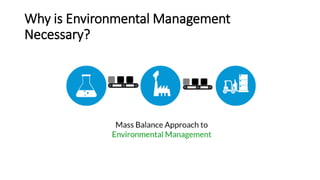
Why is Environmental Management
Necessary?
Essentially, environmental management
focuses on resource consumption and waste
generation. By taking a “measure it to
manage it” approach, EMS can be used to
reduce consumption while finding ways to
divert waste from landfills via repurposing,
reuse, or recycling.
What are the Benefits of Environmental Management?
1. Because EMS puts focus on your material usage (how much of a
material or chemical comes into your facility versus what leaves as
product or waste), it gives you concrete data to measure and
improve your material costs.
2. You can also view the benefit of EMS from a workplace culture
perspective: the workforce is increasingly prioritizing a business's
environmental footprint as part of how they rate job satisfaction
and employee loyalty.
3. On the topic of markets, consumers are also savvy when it comes to
supporting brands that take environmental compliance seriously.
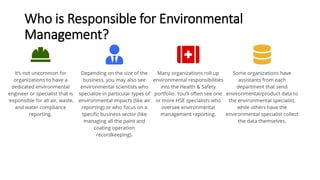
Who is Responsible for Environmental
Management?
What is the Environmental Management
System Framework?
• ISO 14001:2015
• Plan-Do-Check-Act
• EMS Software
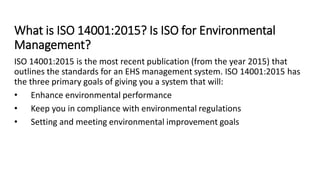
What is ISO 14001:2015? Is ISO for Environmental
Management?
ISO 14001:2015 is the most recent publication (from the year 2015) that
outlines the standards for an EHS management system. ISO 14001:2015 has
the three primary goals of giving you a system that will:
• Enhance environmental performance
• Keep you in compliance with environmental regulations
• Setting and meeting environmental improvement goals
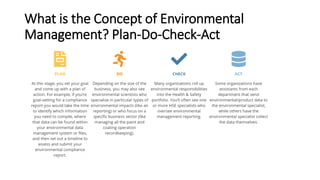
What is the Concept of Environmental
Management? Plan-Do-Check-Act
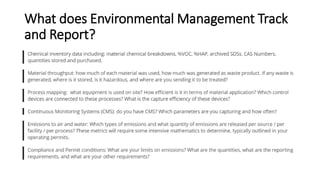
What does Environmental Management Track
and Report?
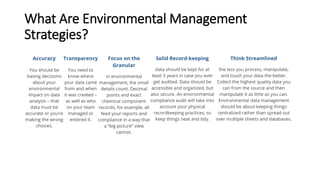
What Are Environmental Management
Strategies?
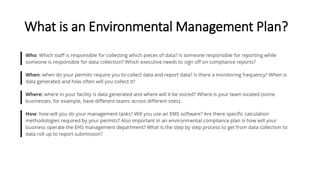
What is an Environmental Management Plan?
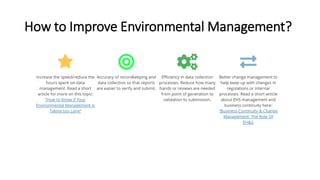
How to Improve Environmental Management?
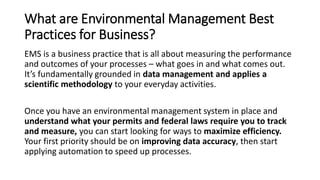
What are Environmental Management Best
Practices for Business?
EMS is a business practice that is all about measuring the performance
and outcomes of your processes – what goes in and what comes out.
It’s fundamentally grounded in data management and applies a
scientific methodology to your everyday activities.
Once you have an environmental management system in place and
understand what your permits and federal laws require you to track
and measure, you can start looking for ways to maximize efficiency.
Your first priority should be on improving data accuracy, then start
applying automation to speed up processes.
EMS Software
EMS Strategies and Frameworks.pdf

EMS Strategies and Frameworks.pdf

  • 1.
  • 2.
    OBJECTIVES • Further explainthe concepts of EMS in general context; • Enumerate and explain the three important frameworks in EMS; and • Analyze proposed EMS strategies.
  • 3.
    Environmental management canbe considered all of the practices, policies, and procedures that your facility undertakes in order to comply with local, state and/or federal environmental legislation. Generally speaking, this means monitoring your releases of chemicals and other by-products to the local air, water, or waste streams.
  • 4.
    Why is EnvironmentalManagement Necessary?
  • 5.
    Essentially, environmental management focuseson resource consumption and waste generation. By taking a “measure it to manage it” approach, EMS can be used to reduce consumption while finding ways to divert waste from landfills via repurposing, reuse, or recycling.
  • 6.
    What are theBenefits of Environmental Management? 1. Because EMS puts focus on your material usage (how much of a material or chemical comes into your facility versus what leaves as product or waste), it gives you concrete data to measure and improve your material costs. 2. You can also view the benefit of EMS from a workplace culture perspective: the workforce is increasingly prioritizing a business's environmental footprint as part of how they rate job satisfaction and employee loyalty. 3. On the topic of markets, consumers are also savvy when it comes to supporting brands that take environmental compliance seriously.
  • 7.
    Who is Responsiblefor Environmental Management?
  • 8.
    What is theEnvironmental Management System Framework? • ISO 14001:2015 • Plan-Do-Check-Act • EMS Software
  • 9.
    What is ISO14001:2015? Is ISO for Environmental Management? ISO 14001:2015 is the most recent publication (from the year 2015) that outlines the standards for an EHS management system. ISO 14001:2015 has the three primary goals of giving you a system that will: • Enhance environmental performance • Keep you in compliance with environmental regulations • Setting and meeting environmental improvement goals
  • 10.
    What is theConcept of Environmental Management? Plan-Do-Check-Act
  • 11.
    What does EnvironmentalManagement Track and Report?
  • 12.
    What Are EnvironmentalManagement Strategies?
  • 13.
    What is anEnvironmental Management Plan?
  • 14.
    How to ImproveEnvironmental Management?
  • 15.
    What are EnvironmentalManagement Best Practices for Business? EMS is a business practice that is all about measuring the performance and outcomes of your processes – what goes in and what comes out. It’s fundamentally grounded in data management and applies a scientific methodology to your everyday activities. Once you have an environmental management system in place and understand what your permits and federal laws require you to track and measure, you can start looking for ways to maximize efficiency. Your first priority should be on improving data accuracy, then start applying automation to speed up processes.
  • 16.