Chapter 3: Principles of Scalable
         Performance

•   Performance measures
•   Speedup laws
•   Scalability principles
•   Scaling up vs. scaling down


                EENG-630 Chapter 3   1
Performance metrics and
               measures

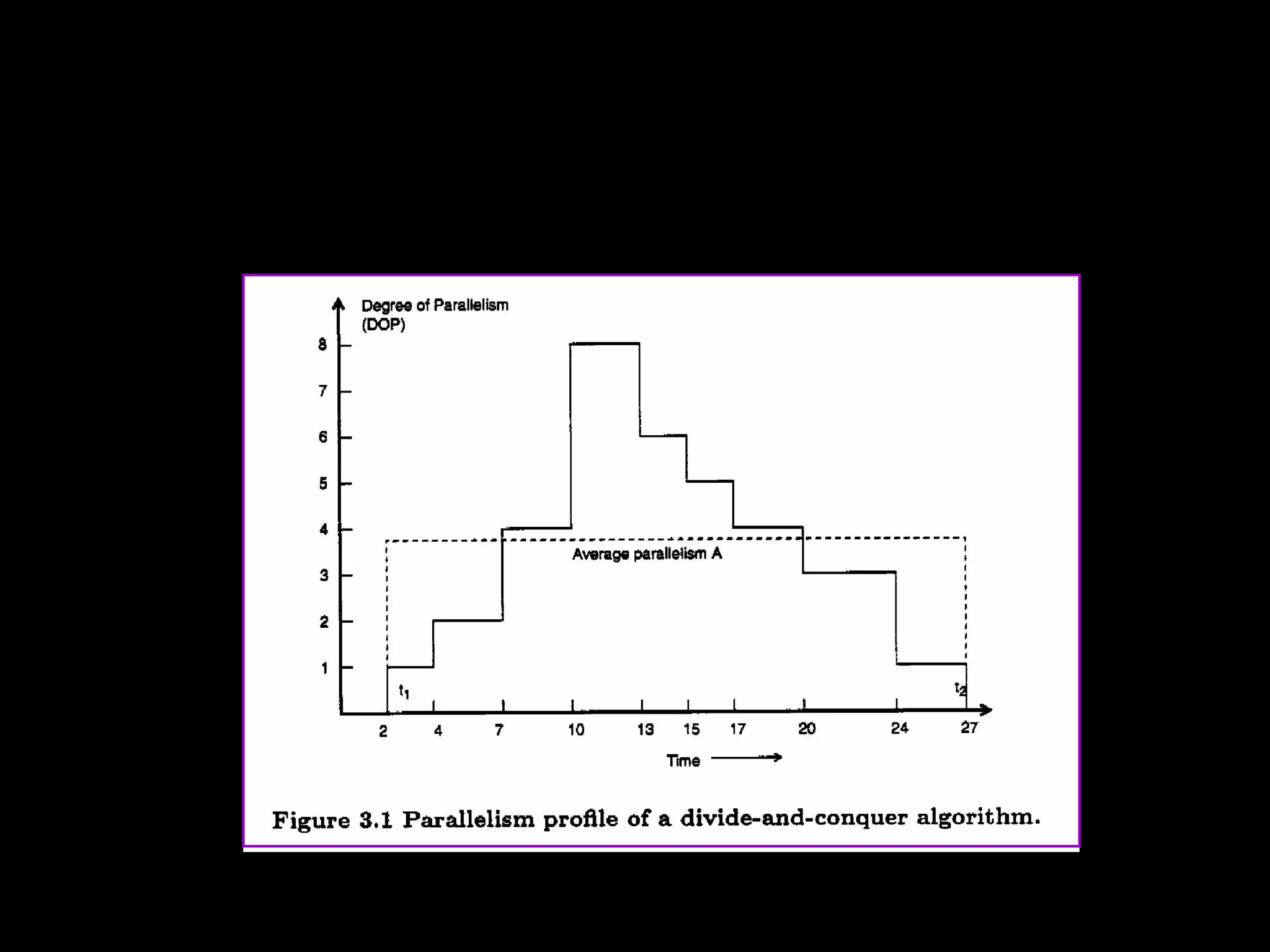
•   Parallelism profiles
•   Asymptotic speedup factor
•   System efficiency, utilization and quality
•   Standard performance measures


                 EENG-630 Chapter 3   2
Degree of parallelism
• Reflects the matching of software and
  hardware parallelism
• Discrete time function – measure, for each
  time period, the # of processors used
• Parallelism profile is a plot of the DOP as a
  function of time
• Ideally have unlimited resources

               EENG-630 Chapter 3    3
Factors affecting parallelism
                profiles
•   Algorithm structure
•   Program optimization
•   Resource utilization
•   Run-time conditions
•   Realistically limited by # of available
    processors, memory, and other
    nonprocessor resources

                 EENG-630 Chapter 3    4
Average parallelism variables
• n – homogeneous processors
• m – maximum parallelism in a profile
∀ ∆ - computing capacity of a single
  processor (execution rate only, no
  overhead)
• DOP=i – # processors busy during an
  observation period

              EENG-630 Chapter 3   5
Average parallelism
• Total amount of work performed is
  proportional to the area under the profile
  curve
                     t2
          W = ∆ ∫ DOP(t )dt
                    t1
                    m
          W = ∆ ∑ i ⋅ ti
                    i =1
               EENG-630 Chapter 3    6
Average parallelism

        1 t2
A=
    t 2 − t1 ∫t1 DOP(t )dt

      m
                   m
                          
A =  ∑ i ⋅ ti  /  ∑ ti 
     i =1        i =1 
        EENG-630 Chapter 3   7
Example: parallelism profile and
     average parallelism


          EENG-630 Chapter 3   8
Asymptotic speedup
                                                     m
         m
T (1) = ∑ ti (1) = ∑
                     m
                        Wi
                                       T (1)       ∑W         i

        i =1       i =1 ∆         S∞ =        =    i =1
                                       T (∞ )     m
          m
T ( ∞ ) = ∑ ti ( ∞ ) = ∑
                          m
                            Wi                    ∑W /i
                                                  i =1
                                                          i


          i =1         i =1 i∆        = A in the ideal case
        (response time)


                     EENG-630 Chapter 3      9
Performance measures
• Consider n processors executing m
  programs in various modes
• Want to define the mean performance of
  these multimode computers:
  – Arithmetic mean performance
  – Geometric mean performance
  – Harmonic mean performance


              EENG-630 Chapter 3   10
Arithmetic mean performance
        m
Ra = ∑ Ri / m             Arithmetic mean execution rate
                          (assumes equal weighting)
       i =1
       m
R = ∑ ( f i Ri )
 *                        Weighted arithmetic mean
 a                        execution rate
       i =1

     -proportional to the sum of the inverses of
      execution times

               EENG-630 Chapter 3           11
Geometric mean performance
        m
Rg = ∏ R       1/ m
               i
                        Geometric mean execution rate

       i =1
          m
R = ∏ Ri
 *
 g
                 fi      Weighted geometric mean
                         execution rate
        i =1
  -does not summarize the real performance since it does
   not have the inverse relation with the total time

                EENG-630 Chapter 3         12
Harmonic mean performance

 Ti = 1 / Ri      Mean execution time per instruction
                  For program i


    1 m    1 m 1
Ta = ∑ Ti = ∑          Arithmetic mean execution time
    m i =1 m i =1 Ri   per instruction


                EENG-630 Chapter 3        13
Harmonic mean performance
                            m
Rh =1 / Ta =          m               Harmonic mean execution rate
                    ∑1 / R )
                     (
                     i=1
                                 i


             1
R =
 *
 h    m
                            Weighted harmonic mean execution rate

      ∑( f
      i =1
             i   / Ri )
                      -corresponds to total # of operations divided by
                       the total time (closest to the real performance)
                          EENG-630 Chapter 3        14
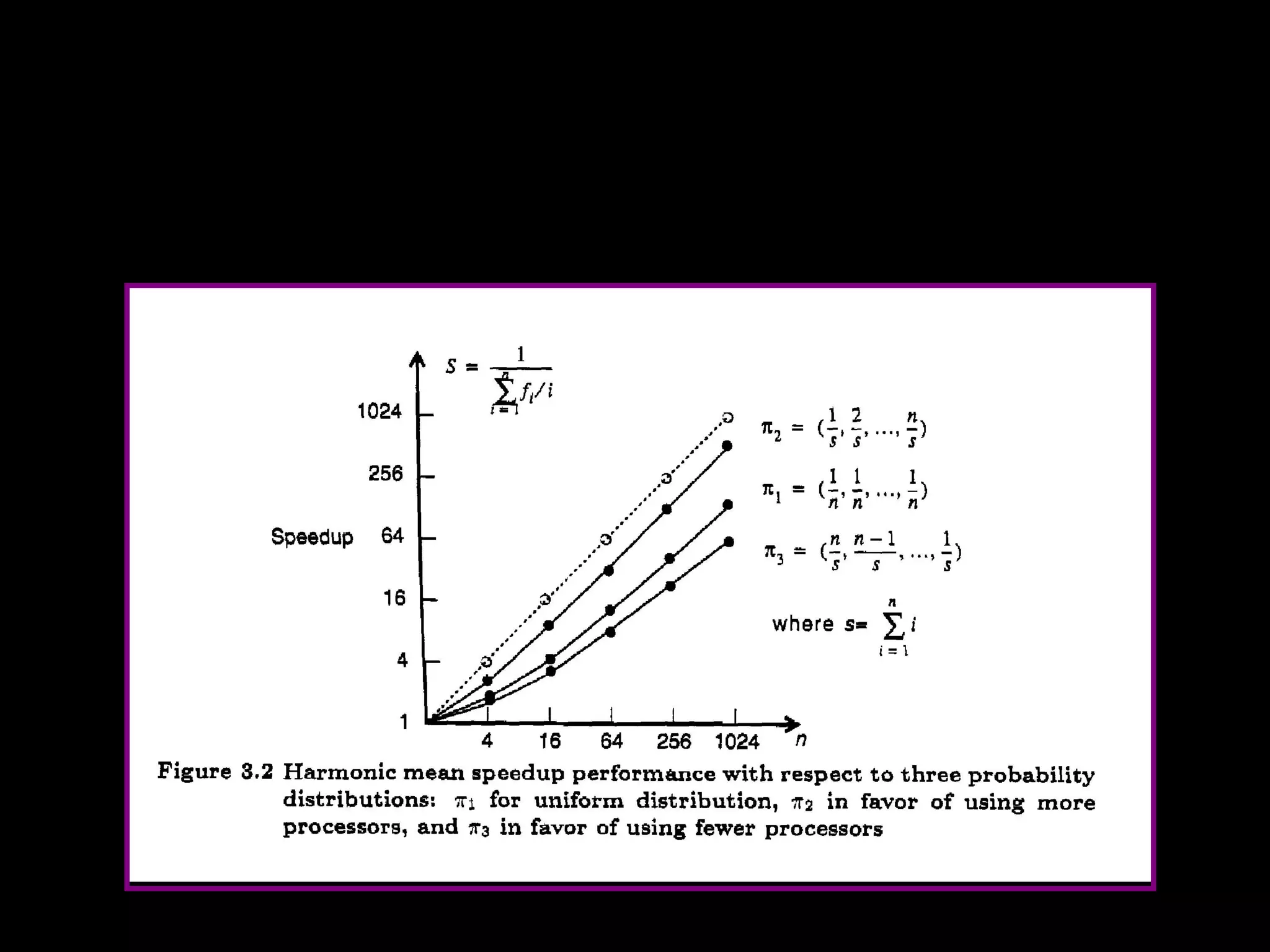
Harmonic Mean Speedup
• Ties the various modes of a program to the
  number of processors used
• Program is in mode i if i processors used
• Sequential execution time T1 = 1/R1 = 1
                                 1
          S = T1 / T =
                   *

                         ∑
                             n
                          i =1
                                 f i / Ri

              EENG-630 Chapter 3            15
Harmonic Mean Speedup
     Performance


     EENG-630 Chapter 3   16
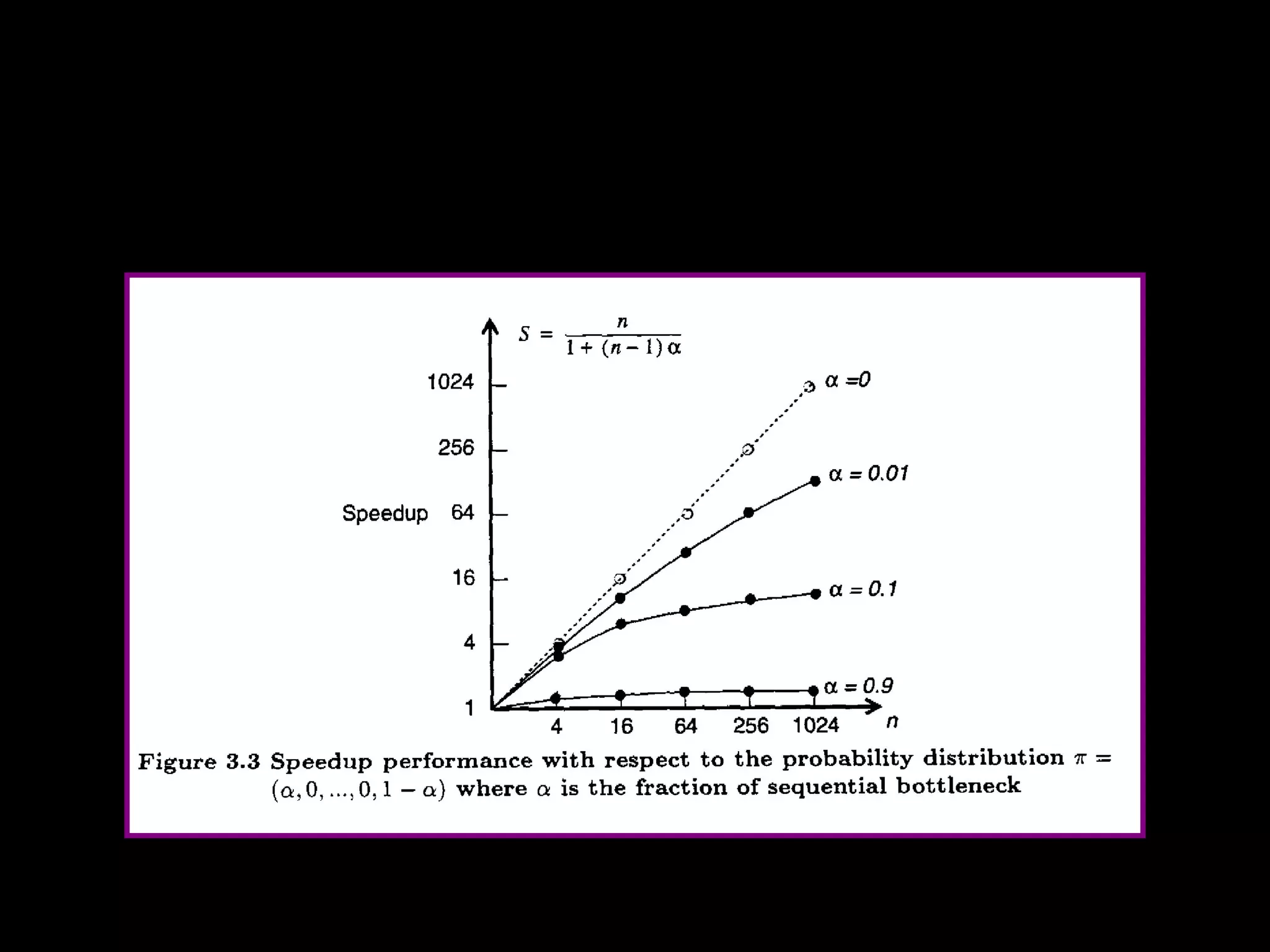
Amdahl’s Law
• Assume Ri = i, w = (α, 0, 0, …, 1- α)
• System is either sequential, with probability
  α, or fully parallel with prob. 1- α
                     n
          Sn =
               1 + (n − 1)α
• Implies S → 1/ α as n → ∞
               EENG-630 Chapter 3   17
Speedup Performance


    EENG-630 Chapter 3   18
System Efficiency
• O(n) is the total # of unit operations
• T(n) is execution time in unit time steps
• T(n) < O(n) and T(1) = O(1)

           S ( N ) = T (1) / T (n)

                   S (n) T (1)
          E ( n) =      =
                     n    nT (n)
               EENG-630 Chapter 3    19
Redundancy and Utilization
• Redundancy signifies the extent of
  matching software and hardware parallelism

         R (n) = O(n) / O(1)
• Utilization indicates the percentage of
  resources kept busy during execution
                                  O ( n)
       U ( n) = R ( n) E ( n) =
                                nT (n20
               EENG-630 Chapter 3
                                        )
Quality of Parallelism
• Directly proportional to the speedup and
  efficiency and inversely related to the
  redundancy
• Upper-bounded by the speedup S(n)

                                   3
             S ( n) E ( n)     T (1)
    Q ( n) =               =   2
                 R ( n)      nT (n)O(n)
              EENG-630 Chapter 3       21
Example of Performance
• Given O(1) = T(1) = n3, O(n) = n3 + n2log n,
  and T(n) = 4 n3/(n+3)
  S(n)    =     (n+3)/4
  E(n)    =     (n+3)/(4n)
  R(n)    =     (n + log n)/n
  U(n)    =     (n+3)(n + log n)/(4n2)
  Q(n)    =     (n+3)2 / (16(n + log n))


               EENG-630 Chapter 3       22
Standard Performance Measures
• MIPS and Mflops
  – Depends on instruction set and program used
• Dhrystone results
  – Measure of integer performance
• Whestone results
  – Measure of floating-point performance
• TPS and KLIPS ratings
  – Transaction performance and reasoning power

               EENG-630 Chapter 3     23
Parallel Processing Applications
•   Drug design
•   High-speed civil transport
•   Ocean modeling
•   Ozone depletion research
•   Air pollution
•   Digital anatomy


                EENG-630 Chapter 3   24
Application Models for Parallel
           Computers
• Fixed-load model
  – Constant workload
• Fixed-time model
  – Demands constant program execution time
• Fixed-memory model
  – Limited by the memory bound


              EENG-630 Chapter 3    25
Algorithm Characteristics
• Deterministic vs. nondeterministic
• Computational granularity
• Parallelism profile
• Communication patterns and
  synchronization requirements
• Uniformity of operations
• Memory requirement and data structures
              EENG-630 Chapter 3   26
Isoefficiency Concept
• Relates workload to machine size n needed
  to maintain a fixed efficiency
                                   workload
                 w( s )
        E=                             overhead
           w( s ) + h( s, n)

• The smaller the power of n, the more
  scalable the system

              EENG-630 Chapter 3      27
Isoefficiency Function
• To maintain a constant E, w(s) should grow
  in proportion to h(s,n)

                   E
         w( s ) =      × h( s, n)
                  1− E
• C = E/(1-E) is constant for fixed E

        f E ( n) = C × h( s, n)
               EENG-630 Chapter 3   28
Speedup Performance Laws
• Amdahl’s law
  – for fixed workload or fixed problem size
• Gustafson’s law
  – for scaled problems (problem size increases
    with increased machine size)
• Speedup model
  – for scaled problems bounded by memory
    capacity

               EENG-630 Chapter 3      29
Amdahl’s Law
• As # of processors increase, the fixed load
  is distributed to more processors
• Minimal turnaround time is primary goal
• Speedup factor is upper-bounded by a
  sequential bottleneck
• Two cases:
   DOP < n
   DOP ≥ n

               EENG-630 Chapter 3   30
Fixed Load Speedup Factor
• Case 1: DOP > n                  • Case 2: DOP < n
            Wi   i 
  ti (i ) =      n                                        Wi
            i∆                     t i ( n ) = t i (∞ ) =
                                                            i∆
            m
               Wi   i
 T ( n) = ∑         n
          i =1 i∆                     m

                        T (1)           ∑W     i
                   Sn =        =        i =i

                        T ( n)      m
                                        Wi     i 
                                   ∑i
                                   i =1
                                               n
                                                
                        EENG-630 Chapter 3            31
Gustafson’s Law
• With Amdahl’s Law, the workload cannot
  scale to match the available computing
  power as n increases
• Gustafson’s Law fixes the time, allowing
  the problem size to increase with higher n
• Not saving time, but increasing accuracy


              EENG-630 Chapter 3   32
Fixed-time Speedup
• As the machine size increases, have
  increased workload and new profile
• In general, Wi’ > Wi for 2 ≤ i ≤ m’ and   W1’
  = W1
• Assume T(1) = T’(n)


               EENG-630 Chapter 3   33
Gustafson’s Scaled Speedup
                             '
 m
            Wi  m
                                 i 
 ∑Wi = ∑ i
 i =1  i =1
                                 n
                                  
                                      + Q ( n)
         m'

         ∑W         i
                        '
                              W1 + nWn
  S ='
     n
         i =1
                            =
           m
                              W1 + Wn
         ∑W
         i =1
                    i

          EENG-630 Chapter 3               34
Memory Bounded Speedup
             Model
• Idea is to solve largest problem, limited by
  memory space
• Results in a scaled workload and higher accuracy
• Each node can handle only a small subproblem for
  distributed memory
• Using a large # of nodes collectively increases the
  memory capacity proportionally


                 EENG-630 Chapter 3      35
Fixed-Memory Speedup
• Let M be the memory requirement and W
  the computational workload: W = g(M)
• g*(nM)=G(n)g(M)=G(n)Wn
                   m*

               ∑W         i
                              *
                                        W1 + G (n)Wn
 S =
  *
  n
                   i =1
                                     =
       m*
            Wi *    i                W1 + G (n)Wn / n
       ∑ i
       i =1
                     n  + Q ( n)
                     
                     EENG-630 Chapter 3       36
Relating Speedup Models
• G(n) reflects the increase in workload as
  memory increases n times

• G(n) = 1 : Fixed problem size (Amdahl)
• G(n) = n : Workload increases n times when

  memory increased n times (Gustafson)

• G(n) > n : workload increases faster than

  memory than the memory requirement

              EENG-630 Chapter 3   37
Scalability Metrics

• Machine size (n) : # of processors
• Clock rate (f) : determines basic m/c cycle
• Problem size (s) : amount of computational
  workload. Directly proportional to T(s,1).
• CPU time (T(s,n)) : actual CPU time for
  execution
• I/O demand (d) : demand in moving the
  program, data, and results for a given run
              EENG-630 Chapter 3   38
Scalability Metrics
• Memory capacity (m) : max # of memory words
  demanded
• Communication overhead (h(s,n)) : amount of
  time for interprocessor communication,
  synchronization, etc.
• Computer cost (c) : total cost of h/w and s/w
  resources required
• Programming overhead (p) : development
  overhead associated with an application program

                EENG-630 Chapter 3     39
Speedup and Efficiency
• The problem size is the independent
  parameter
                         T ( s,1)
      S ( s, n) =
                  T ( s, n) + h( s, n)
                       S ( s, n)
           E ( s, n) =
                           n
              EENG-630 Chapter 3    40
Scalable Systems
• Ideally, if E(s,n)=1 for all algorithms and
  any s and n, system is scalable
• Practically, consider the scalability of a m/c

                     S ( s, n) TI ( s, n)
         Φ ( s, n) =            =
                     S I ( s, n) T ( s, n)


                EENG-630 Chapter 3     41

Parallel computing chapter 3

  • 1.
    Chapter 3: Principlesof Scalable Performance • Performance measures • Speedup laws • Scalability principles • Scaling up vs. scaling down EENG-630 Chapter 3 1
  • 2.
    Performance metrics and measures • Parallelism profiles • Asymptotic speedup factor • System efficiency, utilization and quality • Standard performance measures EENG-630 Chapter 3 2
  • 3.
    Degree of parallelism •Reflects the matching of software and hardware parallelism • Discrete time function – measure, for each time period, the # of processors used • Parallelism profile is a plot of the DOP as a function of time • Ideally have unlimited resources EENG-630 Chapter 3 3
  • 4.
    Factors affecting parallelism profiles • Algorithm structure • Program optimization • Resource utilization • Run-time conditions • Realistically limited by # of available processors, memory, and other nonprocessor resources EENG-630 Chapter 3 4
  • 5.
    Average parallelism variables •n – homogeneous processors • m – maximum parallelism in a profile ∀ ∆ - computing capacity of a single processor (execution rate only, no overhead) • DOP=i – # processors busy during an observation period EENG-630 Chapter 3 5
  • 6.
    Average parallelism • Totalamount of work performed is proportional to the area under the profile curve t2 W = ∆ ∫ DOP(t )dt t1 m W = ∆ ∑ i ⋅ ti i =1 EENG-630 Chapter 3 6
  • 7.
    Average parallelism 1 t2 A= t 2 − t1 ∫t1 DOP(t )dt  m   m  A =  ∑ i ⋅ ti  /  ∑ ti   i =1   i =1  EENG-630 Chapter 3 7
  • 8.
    Example: parallelism profileand average parallelism EENG-630 Chapter 3 8
  • 9.
    Asymptotic speedup m m T (1) = ∑ ti (1) = ∑ m Wi T (1) ∑W i i =1 i =1 ∆ S∞ = = i =1 T (∞ ) m m T ( ∞ ) = ∑ ti ( ∞ ) = ∑ m Wi ∑W /i i =1 i i =1 i =1 i∆ = A in the ideal case (response time) EENG-630 Chapter 3 9
  • 10.
    Performance measures • Considern processors executing m programs in various modes • Want to define the mean performance of these multimode computers: – Arithmetic mean performance – Geometric mean performance – Harmonic mean performance EENG-630 Chapter 3 10
  • 11.
    Arithmetic mean performance m Ra = ∑ Ri / m Arithmetic mean execution rate (assumes equal weighting) i =1 m R = ∑ ( f i Ri ) * Weighted arithmetic mean a execution rate i =1 -proportional to the sum of the inverses of execution times EENG-630 Chapter 3 11
  • 12.
    Geometric mean performance m Rg = ∏ R 1/ m i Geometric mean execution rate i =1 m R = ∏ Ri * g fi Weighted geometric mean execution rate i =1 -does not summarize the real performance since it does not have the inverse relation with the total time EENG-630 Chapter 3 12
  • 13.
    Harmonic mean performance Ti = 1 / Ri Mean execution time per instruction For program i 1 m 1 m 1 Ta = ∑ Ti = ∑ Arithmetic mean execution time m i =1 m i =1 Ri per instruction EENG-630 Chapter 3 13
  • 14.
    Harmonic mean performance m Rh =1 / Ta = m Harmonic mean execution rate ∑1 / R ) ( i=1 i 1 R = * h m Weighted harmonic mean execution rate ∑( f i =1 i / Ri ) -corresponds to total # of operations divided by the total time (closest to the real performance) EENG-630 Chapter 3 14
  • 15.
    Harmonic Mean Speedup •Ties the various modes of a program to the number of processors used • Program is in mode i if i processors used • Sequential execution time T1 = 1/R1 = 1 1 S = T1 / T = * ∑ n i =1 f i / Ri EENG-630 Chapter 3 15
  • 16.
    Harmonic Mean Speedup Performance EENG-630 Chapter 3 16
  • 17.
    Amdahl’s Law • AssumeRi = i, w = (α, 0, 0, …, 1- α) • System is either sequential, with probability α, or fully parallel with prob. 1- α n Sn = 1 + (n − 1)α • Implies S → 1/ α as n → ∞ EENG-630 Chapter 3 17
  • 18.
    Speedup Performance EENG-630 Chapter 3 18
  • 19.
    System Efficiency • O(n)is the total # of unit operations • T(n) is execution time in unit time steps • T(n) < O(n) and T(1) = O(1) S ( N ) = T (1) / T (n) S (n) T (1) E ( n) = = n nT (n) EENG-630 Chapter 3 19
  • 20.
    Redundancy and Utilization •Redundancy signifies the extent of matching software and hardware parallelism R (n) = O(n) / O(1) • Utilization indicates the percentage of resources kept busy during execution O ( n) U ( n) = R ( n) E ( n) = nT (n20 EENG-630 Chapter 3 )
  • 21.
    Quality of Parallelism •Directly proportional to the speedup and efficiency and inversely related to the redundancy • Upper-bounded by the speedup S(n) 3 S ( n) E ( n) T (1) Q ( n) = = 2 R ( n) nT (n)O(n) EENG-630 Chapter 3 21
  • 22.
    Example of Performance •Given O(1) = T(1) = n3, O(n) = n3 + n2log n, and T(n) = 4 n3/(n+3) S(n) = (n+3)/4 E(n) = (n+3)/(4n) R(n) = (n + log n)/n U(n) = (n+3)(n + log n)/(4n2) Q(n) = (n+3)2 / (16(n + log n)) EENG-630 Chapter 3 22
  • 23.
    Standard Performance Measures •MIPS and Mflops – Depends on instruction set and program used • Dhrystone results – Measure of integer performance • Whestone results – Measure of floating-point performance • TPS and KLIPS ratings – Transaction performance and reasoning power EENG-630 Chapter 3 23
  • 24.
    Parallel Processing Applications • Drug design • High-speed civil transport • Ocean modeling • Ozone depletion research • Air pollution • Digital anatomy EENG-630 Chapter 3 24
  • 25.
    Application Models forParallel Computers • Fixed-load model – Constant workload • Fixed-time model – Demands constant program execution time • Fixed-memory model – Limited by the memory bound EENG-630 Chapter 3 25
  • 26.
    Algorithm Characteristics • Deterministicvs. nondeterministic • Computational granularity • Parallelism profile • Communication patterns and synchronization requirements • Uniformity of operations • Memory requirement and data structures EENG-630 Chapter 3 26
  • 27.
    Isoefficiency Concept • Relatesworkload to machine size n needed to maintain a fixed efficiency workload w( s ) E= overhead w( s ) + h( s, n) • The smaller the power of n, the more scalable the system EENG-630 Chapter 3 27
  • 28.
    Isoefficiency Function • Tomaintain a constant E, w(s) should grow in proportion to h(s,n) E w( s ) = × h( s, n) 1− E • C = E/(1-E) is constant for fixed E f E ( n) = C × h( s, n) EENG-630 Chapter 3 28
  • 29.
    Speedup Performance Laws •Amdahl’s law – for fixed workload or fixed problem size • Gustafson’s law – for scaled problems (problem size increases with increased machine size) • Speedup model – for scaled problems bounded by memory capacity EENG-630 Chapter 3 29
  • 30.
    Amdahl’s Law • As# of processors increase, the fixed load is distributed to more processors • Minimal turnaround time is primary goal • Speedup factor is upper-bounded by a sequential bottleneck • Two cases:  DOP < n  DOP ≥ n EENG-630 Chapter 3 30
  • 31.
    Fixed Load SpeedupFactor • Case 1: DOP > n • Case 2: DOP < n Wi i  ti (i ) = n Wi i∆   t i ( n ) = t i (∞ ) = i∆ m Wi i T ( n) = ∑ n i =1 i∆   m T (1) ∑W i Sn = = i =i T ( n) m Wi i  ∑i i =1 n   EENG-630 Chapter 3 31
  • 32.
    Gustafson’s Law • WithAmdahl’s Law, the workload cannot scale to match the available computing power as n increases • Gustafson’s Law fixes the time, allowing the problem size to increase with higher n • Not saving time, but increasing accuracy EENG-630 Chapter 3 32
  • 33.
    Fixed-time Speedup • Asthe machine size increases, have increased workload and new profile • In general, Wi’ > Wi for 2 ≤ i ≤ m’ and W1’ = W1 • Assume T(1) = T’(n) EENG-630 Chapter 3 33
  • 34.
    Gustafson’s Scaled Speedup ' m Wi m i  ∑Wi = ∑ i i =1 i =1 n   + Q ( n) m' ∑W i ' W1 + nWn S =' n i =1 = m W1 + Wn ∑W i =1 i EENG-630 Chapter 3 34
  • 35.
    Memory Bounded Speedup Model • Idea is to solve largest problem, limited by memory space • Results in a scaled workload and higher accuracy • Each node can handle only a small subproblem for distributed memory • Using a large # of nodes collectively increases the memory capacity proportionally EENG-630 Chapter 3 35
  • 36.
    Fixed-Memory Speedup • LetM be the memory requirement and W the computational workload: W = g(M) • g*(nM)=G(n)g(M)=G(n)Wn m* ∑W i * W1 + G (n)Wn S = * n i =1 = m* Wi * i  W1 + G (n)Wn / n ∑ i i =1  n  + Q ( n)   EENG-630 Chapter 3 36
  • 37.
    Relating Speedup Models •G(n) reflects the increase in workload as memory increases n times • G(n) = 1 : Fixed problem size (Amdahl) • G(n) = n : Workload increases n times when memory increased n times (Gustafson) • G(n) > n : workload increases faster than memory than the memory requirement EENG-630 Chapter 3 37
  • 38.
    Scalability Metrics • Machinesize (n) : # of processors • Clock rate (f) : determines basic m/c cycle • Problem size (s) : amount of computational workload. Directly proportional to T(s,1). • CPU time (T(s,n)) : actual CPU time for execution • I/O demand (d) : demand in moving the program, data, and results for a given run EENG-630 Chapter 3 38
  • 39.
    Scalability Metrics • Memorycapacity (m) : max # of memory words demanded • Communication overhead (h(s,n)) : amount of time for interprocessor communication, synchronization, etc. • Computer cost (c) : total cost of h/w and s/w resources required • Programming overhead (p) : development overhead associated with an application program EENG-630 Chapter 3 39
  • 40.
    Speedup and Efficiency •The problem size is the independent parameter T ( s,1) S ( s, n) = T ( s, n) + h( s, n) S ( s, n) E ( s, n) = n EENG-630 Chapter 3 40
  • 41.
    Scalable Systems • Ideally,if E(s,n)=1 for all algorithms and any s and n, system is scalable • Practically, consider the scalability of a m/c S ( s, n) TI ( s, n) Φ ( s, n) = = S I ( s, n) T ( s, n) EENG-630 Chapter 3 41