SUBMITTED BY
MUBASHIRA M
The process of
sending back
the light rays
which falls on
the surface of
an object –
Reflection
The object having
polished , shining
surface reflects
more light than
object having
unpolished, dull
surface
Silver metal is good
reflector of light
Laws of reflection of light
The incident ray , the normal to
the mirror at the point of
incidence and the reflected ray , all
lie in the same plane.
The angle of incidence is equal to
the angle of reflection.
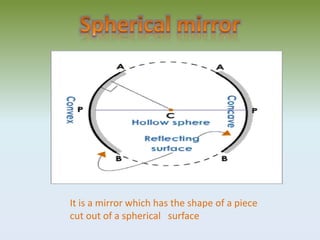
It is a mirror which has the shape of a piece
cut out of a spherical surface
Concave mirror
It is a spherical mirror , whose reflecting surface is curved
inward or faces towards the centre of the sphere.
CONVEX MIRROR
It is a spherical mirror whose reflecting surface is curved outward
 Pole (p) – centre point of the reflecting surface of a spherical
mirror. It lies on the surface of the mirror.
 Centre of curvature (C)- Centre point of the sphere , in which
the reflecting surface of a spherical mirror forms a part of this
sphere
 Radius of curvature (R)- the radius of the sphere of which the
reflecting surface of a spherical mirror forms a part.
 Principal axis – Is a straight line passing through the pole and the
centre of curvature of a spherical mirror.
 Aperture- the diameter of the reflecting surface of spherical
mirror
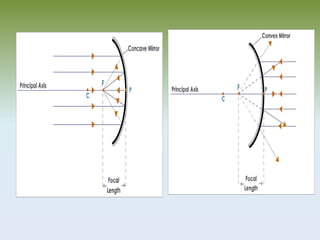
Focal length – the distance between the pole and the principal focus
of a spherical mirror
A number of ray parallel to the principal axis are falling on a
concave mirror and the reflected rays are all intersecting at a
point on the principal axis of the mirror. This point is called the
Principal focus of the concave mirror
Principal focus of the convex mirror – the reflected rays appear to come from
a point on the principal axis
 Rays of light coming from infinity,
making different angles with the
principal axis get focused at different
points.
 The plane formed by these points
is perpendicular to the principal axis
and passes through the principal
focus.
 This plane is the principal axis
For a spherical mirror of small aperture,
 The principal focus F lies midway - between the pole P
and the centre of curvature C
 The radius of curvature is found to be equal to twice the
focal length
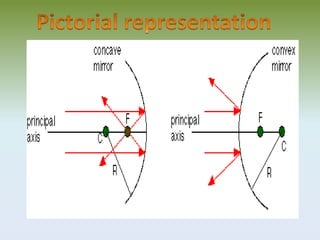
Ray diagram of spherical mirror
Path of incident ray
Path of reflected ray
Concave mirror Convex mirror
Parallel to the principal axis Reflect through the focus Appears to come from the
principal focus
Through the principal
focus/ in the direction of
the principal focus
Reflects parallel to the
principal axis
Reflects parallel to the
principal axis
Through the centre of
curvature/ in the direction
of centre of curvature
Reflects through the same
path
Reflects through the same
path
Ray falling obliquely at the
pole
Reflects in such a way that
the angle of incidence
equal to the angle of
reflection
Reflects in such a way that
the angle of incidence
equal to angle of reflection
Image formation by a Concave mirror for different position of the
Object
Position of the
object
Position of the
image
Size of the image Nature of the
image
At infinity At the focus F Highly
diminished, point
sized
Real and inverted
Beyond C Between F and C diminished Real and inverted
At C At C Same size Real and inverted
Between C and F Beyond C Enlarged Real and enlarged
At F At infinity Highly enlarged Real and enlarged
Between P and F Behind the mirror Enlarged Virtual and erect
Ray diagrams for the image formation by a concave
mirror
Between P and F At F Between C and F
At C Beyond C At infinity
 Commonly used in torches, search lights
 Vehicle headlights to get powerful parallel beams of light
 Often used as shaving mirror to see large image of the face
 Dentists use concave mirror to see large images of the teeth
of patients
 large concave mirrors are used to concentrate sunlight to
produce heat in solar furnace
Image formation by a Convex mirror
Position of the
object
Position of the
image
Size of the image Nature of the
image
At infinity At the focus F,
behind the mirror
Highly
diminished, point
sized
Virtual and erect
Between infinity
and the pole P of
the mirror
Between P and F,
behind the mirror
Diminished Virtual and erect
Commonly used as rear-view mirror in vehicles, because
 Enabling the driver to see traffic behind him to facilitate safe
driving
 They always give an erect, though diminished image
 View as they are curved outward
 Enable the driver to view much larger area than would be
possible with a plane mirror
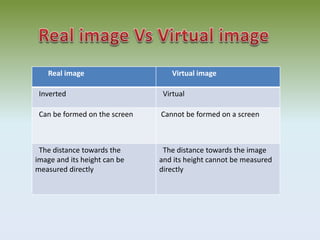
Real image Virtual image
Inverted Virtual
Can be formed on the screen Cannot be formed on a screen
The distance towards the
image and its height can be
measured directly
The distance towards the image
and its height cannot be measured
directly
 It is expressed as the ratio of the height of the image to the
height of the object
 It is usually represented by the letter
 Magnification produced by a spherical mirror gives the relative
extent to which the image of an object is magnified with respect
to the object size
m = Height of the image / Height of the object
Magnification m is also related to the object distance (u ) and
image distance (v)
 Object is taken to be positive as the object is usually placed
above the principal axis
 Height of the image should be taken as positive for virtual
images, however taken as negative for real images
 A negative sign in the value of the magnification indicates
that the image is real
 A positive sign in the value of the magnification indicates that
the image is virtual

Reflection of light in spherical mirror

  • 1.
  • 3.
    The process of sendingback the light rays which falls on the surface of an object – Reflection The object having polished , shining surface reflects more light than object having unpolished, dull surface Silver metal is good reflector of light
  • 4.
    Laws of reflectionof light The incident ray , the normal to the mirror at the point of incidence and the reflected ray , all lie in the same plane. The angle of incidence is equal to the angle of reflection.
  • 6.
    It is amirror which has the shape of a piece cut out of a spherical surface
  • 7.
    Concave mirror It isa spherical mirror , whose reflecting surface is curved inward or faces towards the centre of the sphere. CONVEX MIRROR It is a spherical mirror whose reflecting surface is curved outward
  • 8.
     Pole (p)– centre point of the reflecting surface of a spherical mirror. It lies on the surface of the mirror.  Centre of curvature (C)- Centre point of the sphere , in which the reflecting surface of a spherical mirror forms a part of this sphere  Radius of curvature (R)- the radius of the sphere of which the reflecting surface of a spherical mirror forms a part.  Principal axis – Is a straight line passing through the pole and the centre of curvature of a spherical mirror.  Aperture- the diameter of the reflecting surface of spherical mirror
  • 10.
    Focal length –the distance between the pole and the principal focus of a spherical mirror A number of ray parallel to the principal axis are falling on a concave mirror and the reflected rays are all intersecting at a point on the principal axis of the mirror. This point is called the Principal focus of the concave mirror Principal focus of the convex mirror – the reflected rays appear to come from a point on the principal axis
  • 12.
     Rays oflight coming from infinity, making different angles with the principal axis get focused at different points.  The plane formed by these points is perpendicular to the principal axis and passes through the principal focus.  This plane is the principal axis
  • 13.
    For a sphericalmirror of small aperture,  The principal focus F lies midway - between the pole P and the centre of curvature C  The radius of curvature is found to be equal to twice the focal length
  • 14.
    Ray diagram ofspherical mirror Path of incident ray Path of reflected ray Concave mirror Convex mirror Parallel to the principal axis Reflect through the focus Appears to come from the principal focus Through the principal focus/ in the direction of the principal focus Reflects parallel to the principal axis Reflects parallel to the principal axis Through the centre of curvature/ in the direction of centre of curvature Reflects through the same path Reflects through the same path Ray falling obliquely at the pole Reflects in such a way that the angle of incidence equal to the angle of reflection Reflects in such a way that the angle of incidence equal to angle of reflection
  • 15.
    Image formation bya Concave mirror for different position of the Object Position of the object Position of the image Size of the image Nature of the image At infinity At the focus F Highly diminished, point sized Real and inverted Beyond C Between F and C diminished Real and inverted At C At C Same size Real and inverted Between C and F Beyond C Enlarged Real and enlarged At F At infinity Highly enlarged Real and enlarged Between P and F Behind the mirror Enlarged Virtual and erect
  • 16.
    Ray diagrams forthe image formation by a concave mirror Between P and F At F Between C and F At C Beyond C At infinity
  • 17.
     Commonly usedin torches, search lights  Vehicle headlights to get powerful parallel beams of light  Often used as shaving mirror to see large image of the face  Dentists use concave mirror to see large images of the teeth of patients  large concave mirrors are used to concentrate sunlight to produce heat in solar furnace
  • 18.
    Image formation bya Convex mirror Position of the object Position of the image Size of the image Nature of the image At infinity At the focus F, behind the mirror Highly diminished, point sized Virtual and erect Between infinity and the pole P of the mirror Between P and F, behind the mirror Diminished Virtual and erect
  • 20.
    Commonly used asrear-view mirror in vehicles, because  Enabling the driver to see traffic behind him to facilitate safe driving  They always give an erect, though diminished image  View as they are curved outward  Enable the driver to view much larger area than would be possible with a plane mirror
  • 21.
    Real image Virtualimage Inverted Virtual Can be formed on the screen Cannot be formed on a screen The distance towards the image and its height can be measured directly The distance towards the image and its height cannot be measured directly
  • 22.
     It isexpressed as the ratio of the height of the image to the height of the object  It is usually represented by the letter  Magnification produced by a spherical mirror gives the relative extent to which the image of an object is magnified with respect to the object size m = Height of the image / Height of the object
  • 23.
    Magnification m isalso related to the object distance (u ) and image distance (v)  Object is taken to be positive as the object is usually placed above the principal axis  Height of the image should be taken as positive for virtual images, however taken as negative for real images  A negative sign in the value of the magnification indicates that the image is real  A positive sign in the value of the magnification indicates that the image is virtual