Organization Structure and
Management Systems
Organization Structure and
Management Systems
• Evolution of the corporation
• Principles of organizational design
• The role of hierarchy: bureaucratic
control vs. modular integration
• Alternative structural forms
• Management systems
OUTLINE
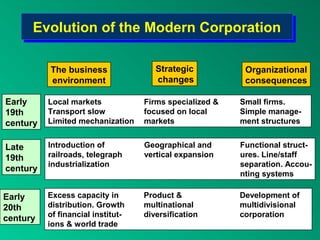
Evolution of the Modern CorporationEvolution of the Modern Corporation
The business
environment
Organizational
consequences
Strategic
changes
Late
19th
century
Early
19th
century
Early
20th
century
Local markets Firms specialized & Small firms.
Transport slow focused on local Simple manage-
Limited mechanization markets ment structures
Introduction of Geographical and Functional struct-
railroads, telegraph vertical expansion ures. Line/staff
industrialization separation. Accou-
nting systems
Excess capacity in Product & Development of
distribution. Growth multinational multidivisional
of financial institut- diversification corporation
ions & world trade
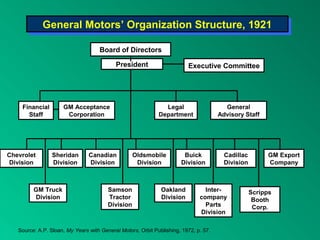
Board of Directors
President Executive Committee
Financial
Staff
Legal
Department
General
Advisory Staff
GM Acceptance
Corporation
Chevrolet
Division
Sheridan
Division
Canadian
Division
Oldsmobile
Division
GM Truck
Division
GM Export
Company
Cadillac
Division
Buick
Division
Inter-
company
Parts
Division
Oakland
Division
Samson
Tractor
Division
Scripps
Booth
Corp.
Source: A.P. Sloan, My Years with General Motors, Orbit Publishing, 1972, p. 57.
General Motors’ Organization Structure, 1921General Motors’ Organization Structure, 1921
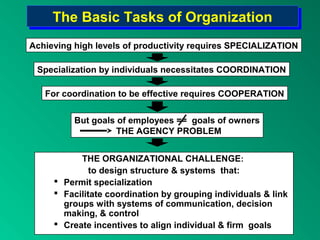
The Basic Tasks of OrganizationThe Basic Tasks of Organization
THE ORGANIZATIONAL CHALLENGE:
to design structure & systems that:
 Permit specialization
 Facilitate coordination by grouping individuals & link
groups with systems of communication, decision
making, & control
 Create incentives to align individual & firm goals
Achieving high levels of productivity requires SPECIALIZATION
Specialization by individuals necessitates COORDINATION
For coordination to be effective requires COOPERATION
But goals of employees == goals of owners
THE AGENCY PROBLEM
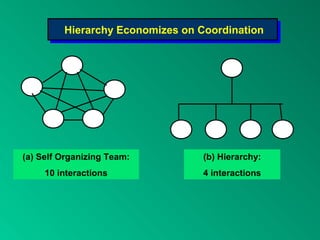
(a) Self Organizing Team:
10 interactions
(b) Hierarchy:
4 interactions
Hierarchy Economizes on CoordinationHierarchy Economizes on Coordination
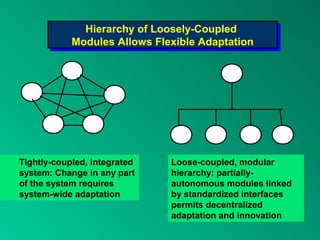
Tightly-coupled, integrated
system: Change in any part
of the system requires
system-wide adaptation
Loose-coupled, modular
hierarchy: partially-
autonomous modules linked
by standardized interfaces
permits decentralized
adaptation and innovation
Hierarchy of Loosely-Coupled
Modules Allows Flexible Adaptation
Hierarchy of Loosely-Coupled
Modules Allows Flexible Adaptation
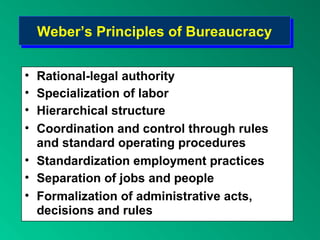
Weber’s Principles of BureaucracyWeber’s Principles of Bureaucracy
• Rational-legal authority
• Specialization of labor
• Hierarchical structure
• Coordination and control through rules
and standard operating procedures
• Standardization employment practices
• Separation of jobs and people
• Formalization of administrative acts,
decisions and rules
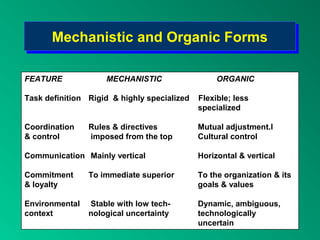
Mechanistic and Organic FormsMechanistic and Organic Forms
FEATURE MECHANISTIC ORGANIC
Task definition Rigid & highly specialized Flexible; less
specialized
Coordination Rules & directives Mutual adjustment.l
& control imposed from the top Cultural control
Communication Mainly vertical Horizontal & vertical
Commitment To immediate superior To the organization & its
& loyalty goals & values
Environmental Stable with low tech- Dynamic, ambiguous,
context nological uncertainty technologically
uncertain
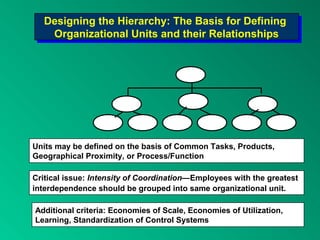
Designing the Hierarchy: The Basis for Defining
Organizational Units and their Relationships
Designing the Hierarchy: The Basis for Defining
Organizational Units and their Relationships
Units may be defined on the basis of Common Tasks, Products,
Geographical Proximity, or Process/Function
Critical issue: Intensity of Coordination—Employees with the greatest
interdependence should be grouped into same organizational unit.
Additional criteria: Economies of Scale, Economies of Utilization,
Learning, Standardization of Control Systems
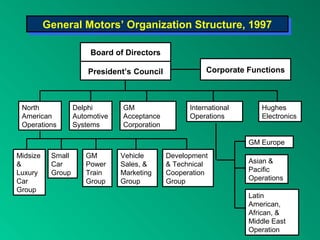
Board of Directors
President’s Council Corporate Functions
North
American
Operations
Delphi
Automotive
Systems
International
Operations
GM
Acceptance
Corporation
Hughes
Electronics
Midsize
&
Luxury
Car
Group
Small
Car
Group
GM
Power
Train
Group
Vehicle
Sales, &
Marketing
Group
Development
& Technical
Cooperation
Group
GM Europe
Asian &
Pacific
Operations
Latin
American,
African, &
Middle East
Operation
General Motors’ Organization Structure, 1997General Motors’ Organization Structure, 1997
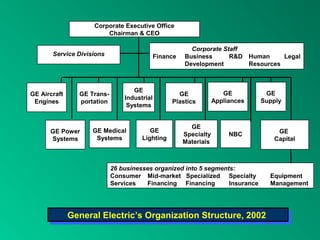
Corporate Executive Office
Chairman & CEO
Corporate Staff
Finance Business R&D Human Legal
Development Resources
GE Aircraft
Engines
GE Trans-
portation
GE
Industrial
Systems
GE
Plastics
GE
Appliances
GE
Supply
GE Power
Systems
GE Medical
Systems
GE
Lighting
GE
Specialty
Materials
NBC GE
Capital
26 businesses organized into 5 segments:
Consumer Mid-market Specialized Specialty Equipment
Services Financing Financing Insurance Management
Service Divisions
General Electric’s Organization Structure, 2002General Electric’s Organization Structure, 2002
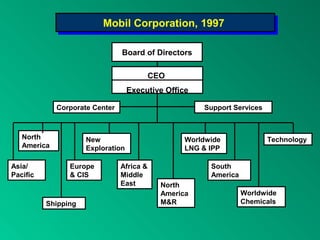
Mobil Corporation, 1997Mobil Corporation, 1997
Board of Directors
CEO
Executive Office
North
America
M&R
Technology
Worldwide
Chemicals
North
America
Europe
& CIS
Africa &
Middle
East
Asia/
Pacific
New
Exploration
South
America
Worldwide
LNG & IPP
Support ServicesCorporate Center
Shipping
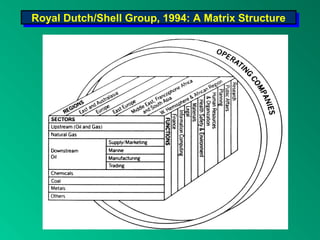
Royal Dutch/Shell Group, 1994: A Matrix StructureRoyal Dutch/Shell Group, 1994: A Matrix Structure
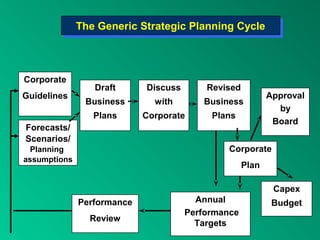
Corporate
Guidelines
Draft
Business
Plans
Discuss
with
Corporate
Revised
Business
Plans
Corporate
Plan
Forecasts/
Scenarios/
Planning
assumptions
Approval
by
Board
Annual
Performance
Targets
Performance
Review
Capex
Budget
The Generic Strategic Planning CycleThe Generic Strategic Planning Cycle

GM

  • 1.
    Organization Structure and ManagementSystems Organization Structure and Management Systems • Evolution of the corporation • Principles of organizational design • The role of hierarchy: bureaucratic control vs. modular integration • Alternative structural forms • Management systems OUTLINE
  • 2.
    Evolution of theModern CorporationEvolution of the Modern Corporation The business environment Organizational consequences Strategic changes Late 19th century Early 19th century Early 20th century Local markets Firms specialized & Small firms. Transport slow focused on local Simple manage- Limited mechanization markets ment structures Introduction of Geographical and Functional struct- railroads, telegraph vertical expansion ures. Line/staff industrialization separation. Accou- nting systems Excess capacity in Product & Development of distribution. Growth multinational multidivisional of financial institut- diversification corporation ions & world trade
  • 3.
    Board of Directors PresidentExecutive Committee Financial Staff Legal Department General Advisory Staff GM Acceptance Corporation Chevrolet Division Sheridan Division Canadian Division Oldsmobile Division GM Truck Division GM Export Company Cadillac Division Buick Division Inter- company Parts Division Oakland Division Samson Tractor Division Scripps Booth Corp. Source: A.P. Sloan, My Years with General Motors, Orbit Publishing, 1972, p. 57. General Motors’ Organization Structure, 1921General Motors’ Organization Structure, 1921
  • 4.
    The Basic Tasksof OrganizationThe Basic Tasks of Organization THE ORGANIZATIONAL CHALLENGE: to design structure & systems that:  Permit specialization  Facilitate coordination by grouping individuals & link groups with systems of communication, decision making, & control  Create incentives to align individual & firm goals Achieving high levels of productivity requires SPECIALIZATION Specialization by individuals necessitates COORDINATION For coordination to be effective requires COOPERATION But goals of employees == goals of owners THE AGENCY PROBLEM
  • 5.
    (a) Self OrganizingTeam: 10 interactions (b) Hierarchy: 4 interactions Hierarchy Economizes on CoordinationHierarchy Economizes on Coordination
  • 6.
    Tightly-coupled, integrated system: Changein any part of the system requires system-wide adaptation Loose-coupled, modular hierarchy: partially- autonomous modules linked by standardized interfaces permits decentralized adaptation and innovation Hierarchy of Loosely-Coupled Modules Allows Flexible Adaptation Hierarchy of Loosely-Coupled Modules Allows Flexible Adaptation
  • 7.
    Weber’s Principles ofBureaucracyWeber’s Principles of Bureaucracy • Rational-legal authority • Specialization of labor • Hierarchical structure • Coordination and control through rules and standard operating procedures • Standardization employment practices • Separation of jobs and people • Formalization of administrative acts, decisions and rules
  • 8.
    Mechanistic and OrganicFormsMechanistic and Organic Forms FEATURE MECHANISTIC ORGANIC Task definition Rigid & highly specialized Flexible; less specialized Coordination Rules & directives Mutual adjustment.l & control imposed from the top Cultural control Communication Mainly vertical Horizontal & vertical Commitment To immediate superior To the organization & its & loyalty goals & values Environmental Stable with low tech- Dynamic, ambiguous, context nological uncertainty technologically uncertain
  • 9.
    Designing the Hierarchy:The Basis for Defining Organizational Units and their Relationships Designing the Hierarchy: The Basis for Defining Organizational Units and their Relationships Units may be defined on the basis of Common Tasks, Products, Geographical Proximity, or Process/Function Critical issue: Intensity of Coordination—Employees with the greatest interdependence should be grouped into same organizational unit. Additional criteria: Economies of Scale, Economies of Utilization, Learning, Standardization of Control Systems
  • 10.
    Board of Directors President’sCouncil Corporate Functions North American Operations Delphi Automotive Systems International Operations GM Acceptance Corporation Hughes Electronics Midsize & Luxury Car Group Small Car Group GM Power Train Group Vehicle Sales, & Marketing Group Development & Technical Cooperation Group GM Europe Asian & Pacific Operations Latin American, African, & Middle East Operation General Motors’ Organization Structure, 1997General Motors’ Organization Structure, 1997
  • 11.
    Corporate Executive Office Chairman& CEO Corporate Staff Finance Business R&D Human Legal Development Resources GE Aircraft Engines GE Trans- portation GE Industrial Systems GE Plastics GE Appliances GE Supply GE Power Systems GE Medical Systems GE Lighting GE Specialty Materials NBC GE Capital 26 businesses organized into 5 segments: Consumer Mid-market Specialized Specialty Equipment Services Financing Financing Insurance Management Service Divisions General Electric’s Organization Structure, 2002General Electric’s Organization Structure, 2002
  • 12.
    Mobil Corporation, 1997MobilCorporation, 1997 Board of Directors CEO Executive Office North America M&R Technology Worldwide Chemicals North America Europe & CIS Africa & Middle East Asia/ Pacific New Exploration South America Worldwide LNG & IPP Support ServicesCorporate Center Shipping
  • 13.
    Royal Dutch/Shell Group,1994: A Matrix StructureRoyal Dutch/Shell Group, 1994: A Matrix Structure
  • 14.