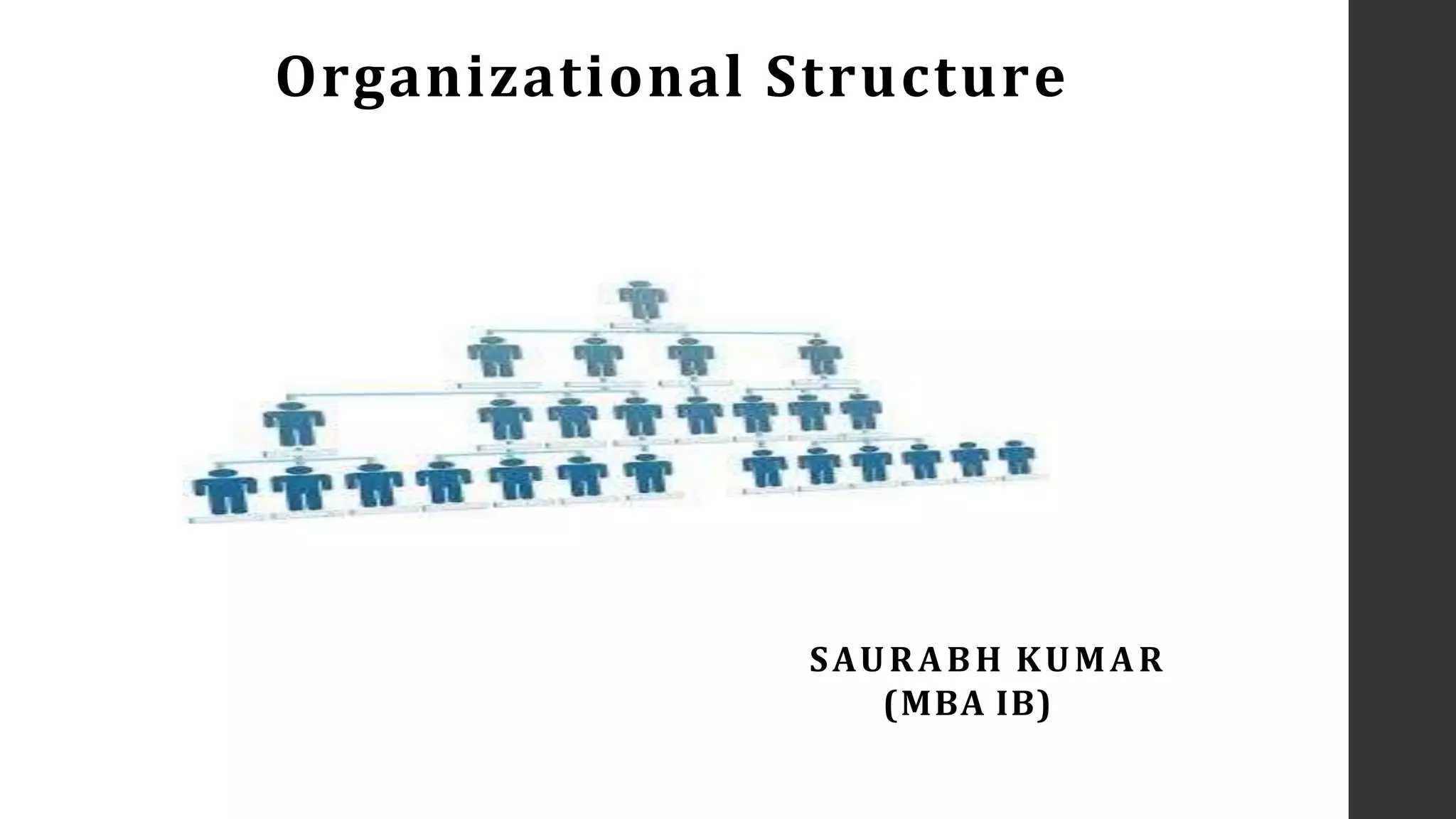
Organizational Structure
SAURABH KUMAR
(MBA IB)
Organizational structure
• What Is an Organizational Structure?
• An organizational structure is a system that
outlines how certain activities are directed in
order to achieve the goals of an organization.
These activities can include rules, roles, and
responsibilities.
• The organizational structure also determines how
information flows between levels within the
company.
Benefits of organizational structure:-
1.Streamline Business Operations
2.Improve Decision Making
3.Operate Multiple Locations
4.Improve Employee Performance
Limitations of organizational structure:-
1.Individual creativity and originality may be stifled by the rather rigid
determination of duties and responsibilities.
2.Workers may become less willing to assume duties that are not
formally a part of their original assignment.
3.Very often the fixed relationships and lines of authority seem
inflexible and difficult to adjust to meet changing needs.
Types of Organizational Structures:-
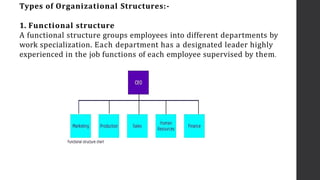
1. Functional structure
A functional structure groups employees into different departments by
work specialization. Each department has a designated leader highly
experienced in the job functions of each employee supervised by them.
Advantages of this structure may include:
• Employees grouped by skill
• Greater sense of teamwork
Disadvantages of this structure may include:
• Lack of communication with other departments
• Unhealthy competition
• Management issues
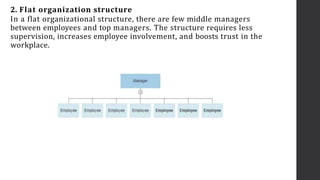
2. Flat organization structure
In a flat organizational structure, there are few middle managers
between employees and top managers. The structure requires less
supervision, increases employee involvement, and boosts trust in the
workplace.
Advantages of this structure may include:
• Cost-efficient
• Fosters good communication
• Higher employee morale
• Faster decision making
Disadvantages of this structure may include:
• Potential employee conflict
• Leadership confusion
. 3. Matrix structure
Within a matrix organizational structure, team members report to several
managers at once.
Having multiple supervisors allows for company-wide interaction and faster
project delivery. For instance, when answering to functional managers and
project managers, employees have a chance to collect experience outside their
team. While functional managers can help to solve job-specific issues, project
managers can bring in knowledge or talents from other departments
4. Hierarchical structure
It’s the most common organizational structure type that follows a direct
chain of command.
A chain of command, in this case, goes from senior management to
general employees through a range of executives on the departmental
and team level. The highest-level executive has the highest power over
the decision-making process.
Advantages of this matrix structure may include:
• Fosters open dialogue
• Flexible workplace environment
Disadvantages of this matrix structure may include:
• Leadership confusion
• Conflicting leadership loyalties
• Potentially more costly
• Roles may not be clearly defined
Advantages of hierarchical structure:-
• CLEAR CHAIN OF COMMAND
• CLEAR PATHS OF ADVANCEMENT
DISADVANTAGES:-
• POOR FLEXIBILITY
• COMMUNICATION BARRIERS
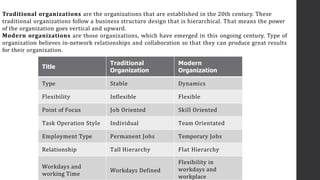
Title
Traditional
Organization
Modern
Organization
Type Stable Dynamics
Flexibility Inflexible Flexible
Point of Focus Job Oriented Skill Oriented
Task Operation Style Individual Team Orientated
Employment Type Permanent Jobs Temporary Jobs
Relationship Tall Hierarchy Flat Hierarchy
Workdays and
working Time
Workdays Defined
Flexibility in
workdays and
workplace
Traditional organizations are the organizations that are established in the 20th century. These
traditional organizations follow a business structure design that is hierarchical. That means the power
of the organization goes vertical and upward.
Modern organizations are those organizations, which have emerged in this ongoing century. Type of
organization believes in-network relationships and collaboration so that they can produce great results
for their organization.
THANK YOU

SAURABH KUMAR_Organisational structure.pptx.pptx

  • 1.
  • 2.
    Organizational structure • WhatIs an Organizational Structure? • An organizational structure is a system that outlines how certain activities are directed in order to achieve the goals of an organization. These activities can include rules, roles, and responsibilities. • The organizational structure also determines how information flows between levels within the company.
  • 3.
    Benefits of organizationalstructure:- 1.Streamline Business Operations 2.Improve Decision Making 3.Operate Multiple Locations 4.Improve Employee Performance Limitations of organizational structure:- 1.Individual creativity and originality may be stifled by the rather rigid determination of duties and responsibilities. 2.Workers may become less willing to assume duties that are not formally a part of their original assignment. 3.Very often the fixed relationships and lines of authority seem inflexible and difficult to adjust to meet changing needs.
  • 4.
    Types of OrganizationalStructures:- 1. Functional structure A functional structure groups employees into different departments by work specialization. Each department has a designated leader highly experienced in the job functions of each employee supervised by them.
  • 5.
    Advantages of thisstructure may include: • Employees grouped by skill • Greater sense of teamwork Disadvantages of this structure may include: • Lack of communication with other departments • Unhealthy competition • Management issues
  • 6.
    2. Flat organizationstructure In a flat organizational structure, there are few middle managers between employees and top managers. The structure requires less supervision, increases employee involvement, and boosts trust in the workplace.
  • 7.
    Advantages of thisstructure may include: • Cost-efficient • Fosters good communication • Higher employee morale • Faster decision making Disadvantages of this structure may include: • Potential employee conflict • Leadership confusion
  • 8.
    . 3. Matrixstructure Within a matrix organizational structure, team members report to several managers at once. Having multiple supervisors allows for company-wide interaction and faster project delivery. For instance, when answering to functional managers and project managers, employees have a chance to collect experience outside their team. While functional managers can help to solve job-specific issues, project managers can bring in knowledge or talents from other departments 4. Hierarchical structure It’s the most common organizational structure type that follows a direct chain of command. A chain of command, in this case, goes from senior management to general employees through a range of executives on the departmental and team level. The highest-level executive has the highest power over the decision-making process.
  • 9.
    Advantages of thismatrix structure may include: • Fosters open dialogue • Flexible workplace environment Disadvantages of this matrix structure may include: • Leadership confusion • Conflicting leadership loyalties • Potentially more costly • Roles may not be clearly defined Advantages of hierarchical structure:- • CLEAR CHAIN OF COMMAND • CLEAR PATHS OF ADVANCEMENT DISADVANTAGES:- • POOR FLEXIBILITY • COMMUNICATION BARRIERS
  • 10.
    Title Traditional Organization Modern Organization Type Stable Dynamics FlexibilityInflexible Flexible Point of Focus Job Oriented Skill Oriented Task Operation Style Individual Team Orientated Employment Type Permanent Jobs Temporary Jobs Relationship Tall Hierarchy Flat Hierarchy Workdays and working Time Workdays Defined Flexibility in workdays and workplace Traditional organizations are the organizations that are established in the 20th century. These traditional organizations follow a business structure design that is hierarchical. That means the power of the organization goes vertical and upward. Modern organizations are those organizations, which have emerged in this ongoing century. Type of organization believes in-network relationships and collaboration so that they can produce great results for their organization.
  • 11.