Insert or Drag& Drop your photo
OBJECTIVE
discuss the nature of
organizations;
4.
Insert or Drag& Drop your photo
INSTRUCTION:
26.DIVIDETHECLASSINTO4GROUPS.
27.THEDURA
TIONOFTHEACTIVITYWILLONL
YBE15MINUTES.
28.LOOKFORTHEMARKETINGMIXINTHECROSSWORDPUZZLE
AFTER PLANNING, organizingfollows. The goals and
objectives established during planning will all go to waste
without effective organizing, through the development of
a designed structure of roles for effective performance. It
requires an interlacing of decision and communication
work units to coordinate efforts toward the organizational
goals and objectives that were set earlier. To function well,
organization structures and their specific roles must be
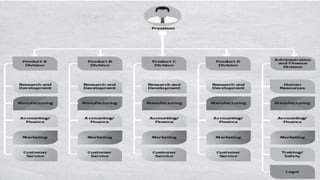
understood by all members of the organization. Rules and
regulation principles must also be put into practice.
However, that organizing depends on the specific situation
INTRODUCTION
7.
Differentiation in organizationsinvolves
division of labor and specialization according
to Bateman and Snell (2008). These
necessarily result from the organization’s
composition—many different work units
with different kinds of tasks, using different
skills and work activities coordinating with
one another for a common end.
Differentiation of the
Organization’s Internal
Environment
8.
Division of laborinvolves assigning different
tasks to different people in the
organization’s different work units. Related
to it is specialization, the process in which
different individuals and units perform
different tasks. An organization’s overall
work is complex and would be too much for
any individual, therefore, the bigger the
organization, the more work units or work
divisions and specializations are to be
expected.
9.
•Integration is anotherprocess in the
organization’s internal environment
which involves the collaboration and
coordination of its different work units
or work divisions. Coordination refers
to the procedures that connect the
work activities of the different work
divisions/units of the firm in order to
achieve its overall goal.
Integration of Work
Units
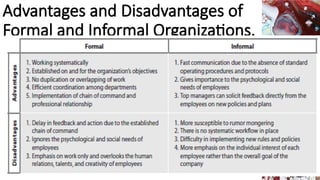
10.
•Structural mechanisms maybe
devised in order to increase
collaboration and coordination.
The more highly differentiated
one’s organization is, the greater
the need for integration among
the different units.
11.
1. Give theimportance of organizing in
business companies.
2. What is the negative effect of not having
division of labor in organizations?
3. Why should organizations be encouraged
to have an organization chart?
4. Is the term “specialization” synonymous
with the term “differentiation?” Explain.
Fast Learning Review
Insert or Drag& Drop your photo
OBJECTIVE
Distinguishing the various
types of organization
structures
14.
An organization structureis a system made up
of tasks to be accomplished, work movements
from one work level to other work levels in the
system, reporting relationships, and
communication passageways that unite the
work of different individual persons and
groups. The types of organizational structures
include:
a. vertical structure
b. horizontal structure
c. network structure
INTRODUCTION
15.
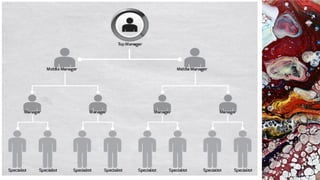
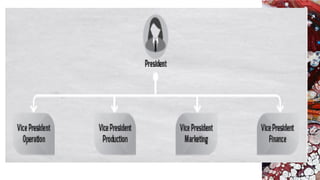
According to Batemanand Snell
(2008), a vertical structure clears out
issues related to authority rights,
responsibilities, and reporting
relationships. Authority rights refer to
the legitimate rights of individuals,
appointed in positions like president,
vice president, manager, and the like,
to give orders to their subordinates,
who in turn, report to them what they
have done.
18.
• Owners ofprivate business companies are said to have
absolute authority, even if other persons are appointed as
managers in their companies. In corporations, the owners
are the stockholders and they elect a board of directors to
manage the organization’s activities. The board has a
chairman who acts as the leader, while the members act as
the corporation’s authority figures, responsible for making
major decisions affecting their organizations, subject to the
corporation’s constitution and by-law provisions. Besides
the chairman of the board, a chief executive officer (CEO) is
appointed to occupy the top post in the organization
pyramid and is personally accountable to the members of
the board and other owners for the organizational
19.
Below the top-levelmanagers are the
middle-level managers in charge of
departments who, as earlier mentioned,
report to them. Under the middle-level
managers are the lower-level managers
which include office managers, sales
managers, and supervisors who directly
report to the former. Employees under the
lower-level managers also have reporting
relationships with their respective
department managers.
20.
A horizontal structurerefers
to the departmentalization of
an organization into smaller
work units as tasks become
increasingly varied and
numerous.
21.
•Line departments –deal directly with the
firm’s primary goods and services;
responsible for manufacturing, selling, and
providing services to clients.
•Staff departments – support the activities of
the line departments by doing research,
attending to legal matters, performing public
relations duties, etc. Meanwhile,
departmentalization may be done using
three approaches:
Types of Department:
22.
•Functional approach –where the subdivisions
are formed based on specialized activities such as
marketing, production, financial management,
and human resources management.
•Divisional approach – where departments are
formed based on management of their products,
customers, or geographic areas covered.
•Matrix approach – is a hybrid form of
departmentalization where managers and staff
personnel report to the superiors, the functional
manager, and the divisional manager.
23.
Finally, a networkstructure is a collection
of independent, usually single function
organizations/companies that work
together in order to produce a product or
service. Such network organizations are
each capable of doing their own
specialized work activities independently,
like producing, distributing, designing, etc.,
but are capable of working effectively at
the same time with other network
members.
25.
Often their communicationis by
electronic means where sharing of
information is speedy. This results
to their ability to respond at once
to their customers’ demands.
Organizational structure are needed
to keep employees needed, to build
a learning organization and to
manage global structural problems.
26.
1. What arethe types of organization structures?
Briefly define each.
2. Summarize how authority operates in the vertical
organization structure.
3. Give the difference between a line department
and staff department.
4. In your opinion, who have greater responsibilities,
the line department managers or the staff
department managers? Explain your choice.
Fast Learning Review
Insert or Drag& Drop your photo
OBJECTIVE
Distinguishing the various
types of organization
structures
29.
•Organizational design –the manner in which a
management achieves the right combination of
differentiation and integration of the
organization’s operations, in response to the
level of uncertainty in its external environment
•Traditional Theories – are the usual, old
fashioned ways
•Modern Theories – are contemporary or new
design theories
Definition of
Terms
30.
There are twomain classifications of
theories regarding organizational
design according to Robbins and
Coulter (2009): traditional and
modern. Traditional pertains to the
usual or old-fashioned ways, while
modern refers to contemporary or new
design theories.
INTRODUCTION
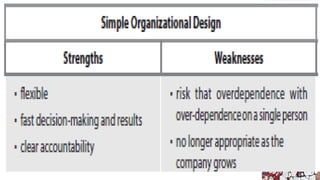
•This organizational designhas few
departments, wide spans of control, or a big
number of subordinates directly reporting
to a manager; has a centralized authority
figure and has very little formalization of
work; usually used by companies that start
out as entrepreneurial ventures.
•When applied, its strengths and weaknesses
are revealed. See Table 4.1 below.
Simple
34.
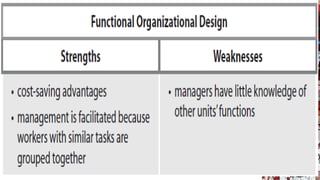
•This organizational designgroups together
similar or related specialties. Generally,
functional departmentalization is utilized
and put into practice in an entire
organization. For example: A marketing firm
that markets cars and related products like
tires, car batteries, and accessories.
•It also has strengths and weaknesses as
seen in Table 4.2.
Functional
36.
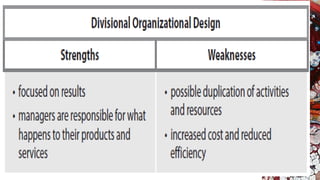
•This organizational designis made
up of separate business divisions or
units, where the parent
corporation acts as overseer to
coordinate and control the
different divisions and provide
financial and legal support services.
Divisional
•In team design,the entire organization
is made up of work groups or teams. Its
advantages include empowerment of
team members and reduced barriers
among functional areas. It also has
disadvantages, including a clear chain of
command and great pressure on teams
to perform.
Team Design
40.
•Matrix design refersto an organization design
where specialists from different departments
work on projects that are supervised by a
project manager. This design results in a
double chain of command wherein workers
have two managers—their functional area
manager and their project manager—who
share authority over them. Advantage:
specialists are involved in the project.
Disadvantage: task and personality conflicts.
Matrix-Project Design
41.
Project design refersto an
organizational design where employees
continuously work on a project.
Advantages: flexible designs and fast
decision-making. Disadvantages:
complexity of assigning people to
projects and tasks and personality
conflicts.
43.
•This is anothermodern organizational
design where the design is not defined or
limited by vertical, horizontal, and external
boundaries. In other words, there are no
hierarchical levels that separate
employees, no departmentalization, and
no boundaries that separate the
organization from customers, suppliers,
and other stakeholders.
Boundary-less
Design
44.
Virtual organization designsare often
used in this design; small groups of
full-time employees and outside
specialists are temporarily hired to
work on projects. Its advantages
include being highly flexible and
responsive, while its disadvantages are
lack of control and problems in
communication.
45.
1. What arethe three traditional organizational
design theories? Briefly define each.
2. What are the advantages and disadvantages of
the simple organizational design? Do you agree or
disagree with these advantages and
disadvantages? Explain your answer.
3. Name the different modern organizational
design theories. Briefly define each.
4. Task and personality conflicts are said to be the
disadvantages to the use of the matrix-project
design. Explain the rationale of this statement.
Fast Learning
Review
Insert or Drag& Drop your photo
OBJECTIVE
Identify the different
elements of delegation
48.
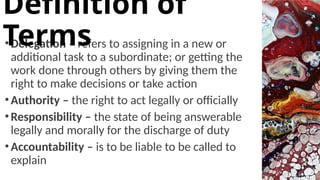
Delegation refers toassigning a new or
additional task to a subordinate; it may also
refer to getting work done through others by
giving them the right to make decisions and
take action. Elements of delegation include:
authority or the right to set officially or
legally, responsibility or the state of being
answerable legally/morally for the discharge
of a duty, and accountability is to be liable to
be called to explain.
INTRODUCTION
49.
1. Defining thegoal clearly. Managers
must clearly explain the task objective
and the work or duties someone else is
expected to do.
2. Selecting the person who will be
given the task. The selected subordinate
must be competent and must share the
manager’s task objectives.
Steps in delegation
include:
50.
3. Assigning ofresponsibility – Managers must
explain that the responsibility assigned to the
selected subordinate is an expectation for him
or her to perform the assigned tasks well.
4. Asking the person assigned about his or
her planned approaches to accomplish the
task objectives. It is expected that the person
chosen to do the task already has a tentative
plan of action that may be presented to the
manager, to assure him or her that the person
assigned could achieve the task objective.
51.
5. Granting theassigned person the authority
to act. If the manager is satisfied with the
tentative plan of action presented, granting of
the authority to act immediately follows.
Authority is a right to act in ways needed to
carry out the assigned task.
6. Giving the assigned person enough time and
resources to do the task, while at the same
time emphasizing his or her accountability.
Accountability is the assigned person’s
willingness to complete the job, as agreed
upon.
52.
7. Checking thetask
accomplishment progress. Following
up and discussing the task
accomplishment progress at regular
intervals is necessary.
8. Making sure that the task
objective has been achieved. The
above steps of delegation were given
by Weihrich and Krontz (2005).
53.
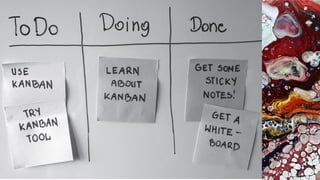
Kanban Board
•This boardis used to implement the
Kanban method for a specific project.
Kanban is a Japanese word which
means “signboard” or “billboard”. David
J. Anderson later on used this term to
name his own method for delegating a
team’s workload and deliverables
without overloading its members.
•Delegation – refersto assigning in a new or
additional task to a subordinate; or getting the
work done through others by giving them the
right to make decisions or take action
•Authority – the right to act legally or officially
•Responsibility – the state of being answerable
legally and morally for the discharge of duty
•Accountability – is to be liable to be called to
explain
Definition of
Terms
57.
1. Define theterm “delegation.”
2. What are the steps involved in
delegating tasks to others?
3. What are the positive effects of
delegating tasks?
4. What will be the possible result if
managers frequently delegate their
task to others? Justify your answer.
Fast Learning
Review
Insert or Drag& Drop your photo
OBJECTIVE
Differentiate formal from
informal organization
60.
•Whether an organizationis formal or informal is
determined by the kind of relationships that
prevail in each organization type.
•Formal organizations are characterized by
hierarchical and reporting relationships among
groups or members. On the other hand, informal
organizations consist of informal groups born out
of the need for social affiliation. Both formal and
informal organizations may exist in the same
organization structure.
INTRODUCTION
61.
•Formal organizations –refer to organizations
formed by the company owner or manager to
help the firm accomplish its goals; made up of
formal groups (work groups/project
team/committee) similarly formed by
company authorities to support their activities
and achieve their objectives
•Informal organizations – refer to organizations
that exist because of friendship or common
interest; made up of informal groups which
exist for the members’ need for social
affiliation
62.
Formal organizations andinformal organizations both have
functions and advantages that benefit the organization
and its members.
Formal organizations have the following function:
1. Accomplish goals that require cooperation or
collaboration among formal groups in the organization;
2. Produce or bring about new and creative ideas and
solutions to company problems;
3. Coordinate interdepartmental activities;
4. Implement company rules/regulations and policies; and
5. Orient/train new employees.
63.
Meanwhile, informal organizations’function
include the following:
1. Satisfy the members’ need for affiliation;
2. Give the individual members a chance to
develop their self-esteem;
3. Give individual members an opportunity to
share their ideas;
4. Lessen individual members’ insecurities;
and
5. Provide a mechanism to solve members’
personal and interpersonal problems.
1. Define formaland informal organizations.
2. Give specific examples of formal and
informal organizations.
3. Do informal organizations help in the
achievement of the company’s set goals?
Explain your answer.
4. How could informal organizations lessen
its members’ insecurities?
Fast Learning
Review