ORGANIZATIONAL
STRUCTURE
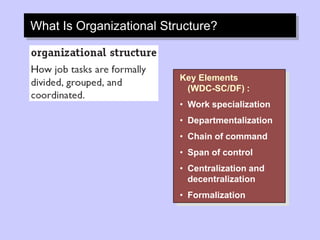
What Is Organizational Structure?
Key Elements
(WDC-SC/DF) :
• Work specialization
• Departmentalization
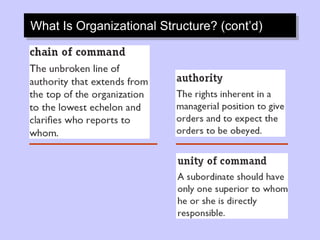
• Chain of command
• Span of control
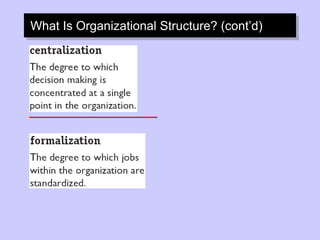
• Centralization and
decentralization
• Formalization
What Determines
Organizational Structure?
À To what degree are tasks subdivided into separate
jobs?
Á On what basis will jobs be grouped together?
 To whom do individuals and groups report?
à How many individuals can a manager efficiently and
effectively direct?
Ä Where does decision-making authority lie?
Å To what degree will there be rules and regulations to
direct employees and managers?
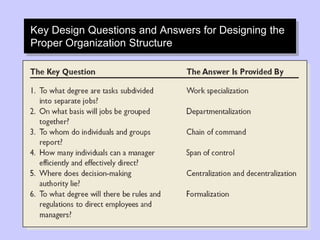
Key Design Questions and Answers for Designing the
Proper Organization Structure
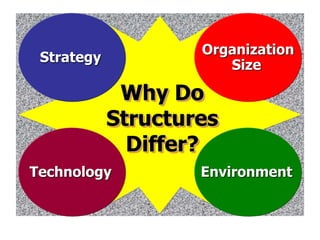
Strategy
Why Do
Structures
Differ?
Organization
Size
Technology Environment
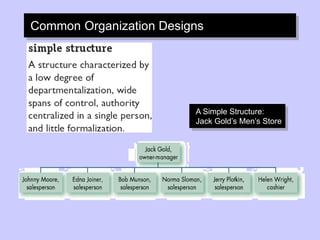
Common Organization Designs
A Simple Structure:
Jack Gold’s Men’s Store
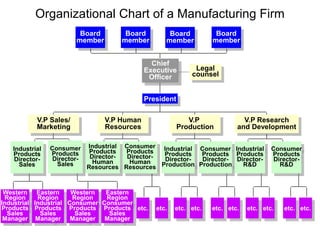
Organizational Chart of a Manufacturing Firm
Board
member
Board
member
Board
member
Board
member
Chief
Executive
Officer
Legal
counsel
President
Industrial
Products
Director-
Human
Resources
Consumer
Products
Director-
Human
Resources
Western
Region
Industrial
Products
Sales
Manager
Eastern
Region
Industrial
Products
Sales
Manager
Western
Region
Consumer
Products
Sales
Manager
Eastern
Region
Consumer
Products
Sales
Manager
etc. etc. etc. etc. etc. etc. etc. etc. etc. etc.
Industrial
Products
Director-
Production
Consumer
Products
Director-
Production
Industrial
Products
Director-
R&D
Consumer
Products
Director-
R&D
V.P Research
and Development
V.P Sales/
Marketing
V.P Human
Resources
V.P
Production
Industrial
Products
Director-
Sales
Consumer
Products
Director-
Sales
Tall versus Flat Organizations
Chief
Executive
Chief
Executive
TallhierarchyFlathierarchy
Relatively wide
span of control
Relatively narrow
span of control
Tall Organization
Flat Organization
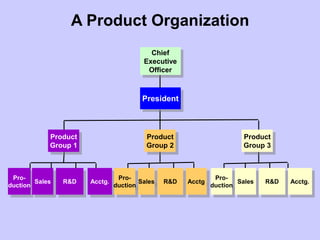
A Product Organization
Pro-
duction
Acctg.Sales R&D
Pro-
duction
Acctg.Sales R&D
Pro-
duction
AcctgSales R&D
Product
Group 2
Product
Group 1
Product
Group 3
President
Chief
Executive
Officer
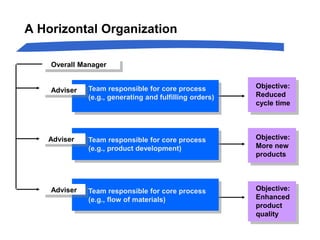
A Horizontal Organization
Team responsible for core process
(e.g., generating and fulfilling orders)
Team responsible for core process
(e.g., product development)
Team responsible for core process
(e.g., flow of materials)
Adviser
Adviser
Adviser
Overall Manager
Objective:
Reduced
cycle time
Objective:
More new
products
Objective:
Enhanced
product
quality
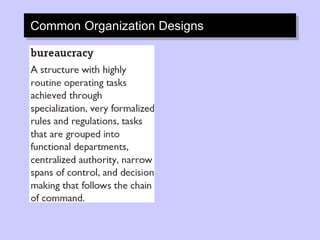
Common Organization Designs
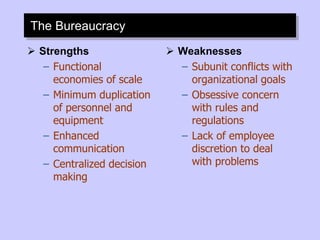
The Bureaucracy
 Strengths
– Functional
economies of scale
– Minimum duplication
of personnel and
equipment
– Enhanced
communication
– Centralized decision
making
 Weaknesses
– Subunit conflicts with
organizational goals
– Obsessive concern
with rules and
regulations
– Lack of employee
discretion to deal
with problems
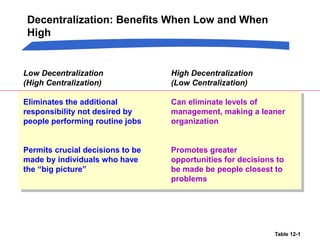
Decentralization: Benefits When Low and When
High
Low Decentralization
(High Centralization)
Eliminates the additional
responsibility not desired by
people performing routine jobs
Permits crucial decisions to be
made by individuals who have
the “big picture”
High Decentralization
(Low Centralization)
Can eliminate levels of
management, making a leaner
organization
Promotes greater
opportunities for decisions to
be made be people closest to
problems
Table 12-1
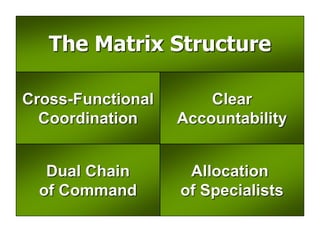
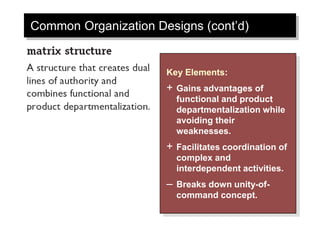
The Matrix Structure
Cross-Functional
Coordination
Clear
Accountability
Allocation
of Specialists
Dual Chain
of Command
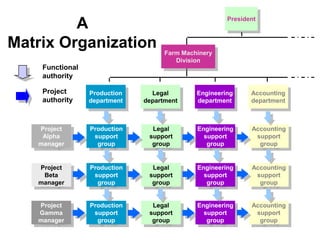
A
Matrix Organization
Project
Gamma
manager
Production
support
group
Legal
support
group
Accounting
support
group
Engineering
support
group
Project
Beta
manager
Production
support
group
Legal
support
group
Accounting
support
group
Engineering
support
group
Project
Alpha
manager
Production
support
group
Legal
support
group
Accounting
support
group
Engineering
support
group
Production
department
Legal
department
Accounting
department
Engineering
department
Farm Machinery
Division
President
Functional
authority
Project
authority
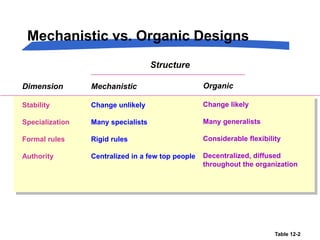
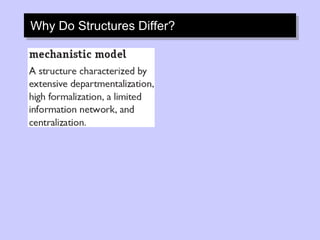
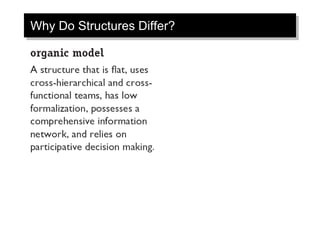
Mechanistic vs. Organic Designs
Dimension
Stability
Specialization
Formal rules
Authority
Mechanistic
Change unlikely
Many specialists
Rigid rules
Centralized in a few top people
Organic
Change likely
Many generalists
Considerable flexibility
Decentralized, diffused
throughout the organization
Structure
Table 12-2
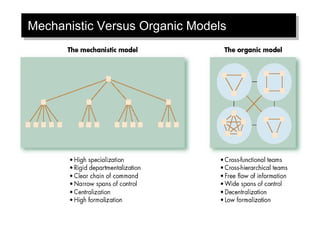
Mechanistic Versus Organic Models
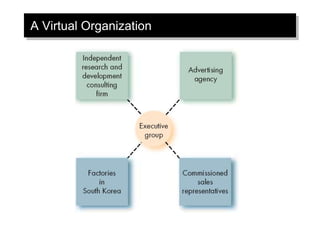
A Virtual Organization
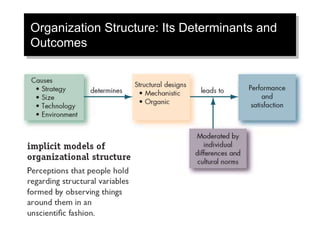
Organization Structure: Its Determinants and
Outcomes
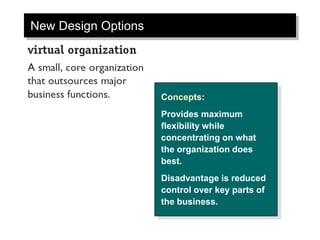
New Design Options
Concepts:
Provides maximum
flexibility while
concentrating on what
the organization does
best.
Disadvantage is reduced
control over key parts of
the business.
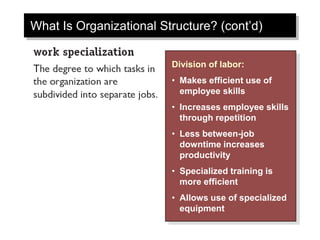
What Is Organizational Structure? (cont’d)
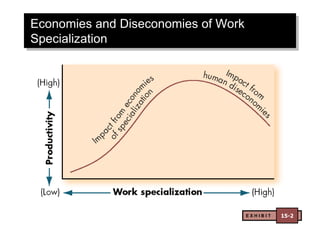
Division of labor:
• Makes efficient use of
employee skills
• Increases employee skills
through repetition
• Less between-job
downtime increases
productivity
• Specialized training is
more efficient
• Allows use of specialized
equipment
Economies and Diseconomies of Work
Specialization
E X H I B I T 15-2
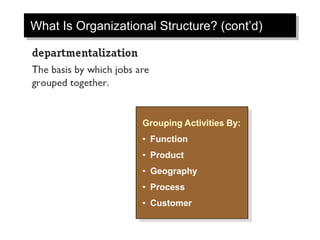
What Is Organizational Structure? (cont’d)
Grouping Activities By:
• Function
• Product
• Geography
• Process
• Customer
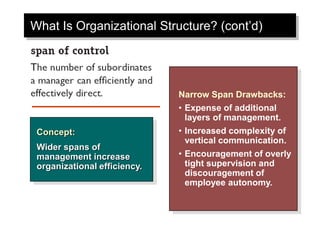
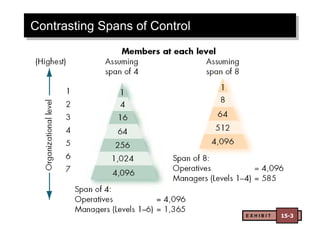
What Is Organizational Structure? (cont’d)
Narrow Span Drawbacks:
• Expense of additional
layers of management.
• Increased complexity of
vertical communication.
• Encouragement of overly
tight supervision and
discouragement of
employee autonomy.
Concept:
Wider spans of
management increase
organizational efficiency.
Contrasting Spans of Control
E X H I B I T 15-3
What Is Organizational Structure? (cont’d)
Common Organization Designs (cont’d)
Key Elements:
+ Gains advantages of
functional and product
departmentalization while
avoiding their
weaknesses.
+ Facilitates coordination of
complex and
interdependent activities.
– Breaks down unity-of-
command concept.
New Design Options
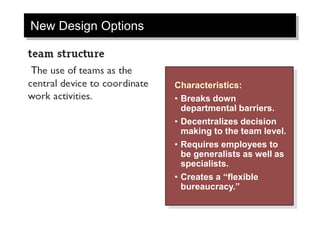
Characteristics:
• Breaks down
departmental barriers.
• Decentralizes decision
making to the team level.
• Requires employees to
be generalists as well as
specialists.
• Creates a “flexible
bureaucracy.”
New Design Options (cont’d)
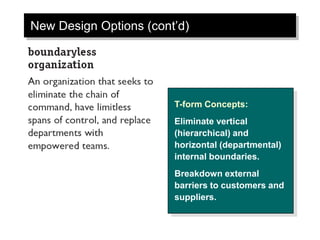
T-form Concepts:
Eliminate vertical
(hierarchical) and
horizontal (departmental)
internal boundaries.
Breakdown external
barriers to customers and
suppliers.
Why Do Structures Differ?
Why Do Structures Differ? – Strategy
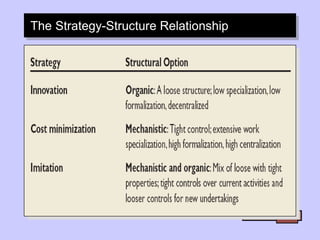
The Strategy-Structure Relationship
E X H I B I T 15-9
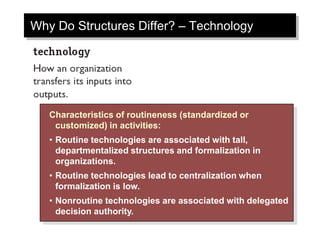
Why Do Structures Differ? – Technology
Characteristics of routineness (standardized or
customized) in activities:
• Routine technologies are associated with tall,
departmentalized structures and formalization in
organizations.
• Routine technologies lead to centralization when
formalization is low.
• Nonroutine technologies are associated with delegated
decision authority.
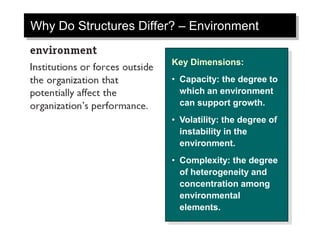
Why Do Structures Differ? – Environment
Key Dimensions:
• Capacity: the degree to
which an environment
can support growth.
• Volatility: the degree of
instability in the
environment.
• Complexity: the degree
of heterogeneity and
concentration among
environmental
elements.
What Is Organizational Structure? (cont’d)
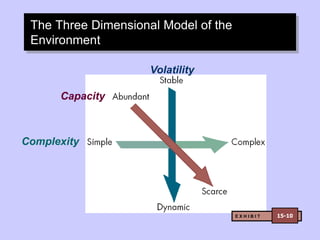
The Three Dimensional Model of the
Environment
E X H I B I T 15-10
Complexity
Volatility
Capacity
Organizational Designs and Employee
Behavior
Research Findings:
• Work specialization contributes to higher employee
productivity, but it reduces job satisfaction.
• The benefits of specialization have decreased rapidly as
employees seek more intrinsically rewarding jobs.
• The effect of span of control on employee performance is
contingent upon individual differences and abilities, task
structures, and other organizational factors.
• Participative decision making in decentralized
organizations is positively related to job satisfaction.

Lecture no. 2 org.structure