MPE 505: Organizational Structure
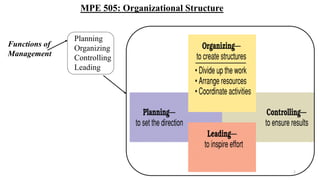
Functions of
Management
Planning
Organizing
Controlling
Leading
1
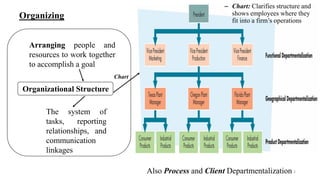
Organizing
Arranging people and
resources to work together
to accomplish a goal
The system of
tasks, reporting
relationships, and
communication
linkages
Organizational Structure
Also Process and Client Departmentalization
– Chart: Clarifies structure and
shows employees where they
fit into a firm’s operations
Chart
2
What are some elements that help determine the type of organizational structure an
organization will use? Key include:
(i). Mission: The organization’s mission can describe a specific manner in which the firm
should manage employees, work flow, etc.
(ii). Strategy: The organization’s strategy can determine the hierarchy or shape of the
organization chart.
(iii). Size: The larger an organization, the more complex will its organizational structure be.
(iv). Internal Environment: Depending on how the organization reacts within its internal
environment can determine the shape and style of its organizational structure.
(iv). External Environment: The same holds true for how an organization deals with the
external environmental variables that are outside of its control.
Determinants of Organizational Structure
3
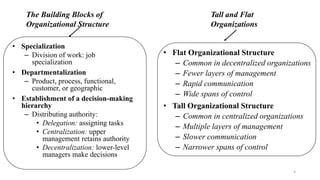
The Building Blocks of
Organizational Structure
• Specialization
– Division of work: job
specialization
• Departmentalization
– Product, process, functional,
customer, or geographic
• Establishment of a decision-making
hierarchy
– Distributing authority:
• Delegation: assigning tasks
• Centralization: upper
management retains authority
• Decentralization: lower-level
managers make decisions
Tall and Flat
Organizations
• Flat Organizational Structure
– Common in decentralized organizations
– Fewer layers of management
– Rapid communication
– Wide spans of control
• Tall Organizational Structure
– Common in centralized organizations
– Multiple layers of management
– Slower communication
– Narrower spans of control
4
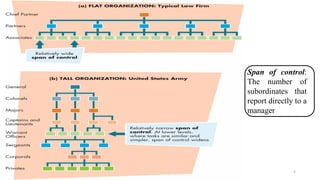
Span of control:
The number of
subordinates that
report directly to a
manager
5
Types of Organizational Structures
Informal structures – the set of unofficial relationships between
organization members
Formal structures – the set of official relationships between
organization members
6
Informal structures
Potential advantages of informal structures:
Helping people accomplish their work
Overcoming limits of formal structure
Gaining access to interpersonal networks
Informal learning
Potential disadvantages of informal structures:
May carry inaccurate information
May breed resistance to change
Diversion of work efforts from important objectives
Feeling of alienation by outsiders
May work against best interests of entire organization
7
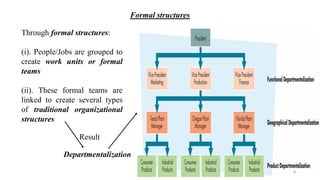
Formal structures
Through formal structures:
(i). People/Jobs are grouped to
create work units or formal
teams
(ii). These formal teams are
linked to create several types
of traditional organizational
structures
Departmentalization
Result
8
Formal structures
Several types of
formal structures
exist:
Functional Structure
Divisional structure
Matrix structure
Team structures
Network structures
Functional structures
• People with similar skills and performing similar tasks are
grouped together into formal work units
• Members work in their functional areas of expertise
• Are not limited to businesses
• Work well for small organizations producing few products
or services
Potential advantages of functional structures:
Economies of scale
Task assignments consistent with expertise and training
High-quality technical problem solving
In-depth training and skill development
Clear career paths within functions 9
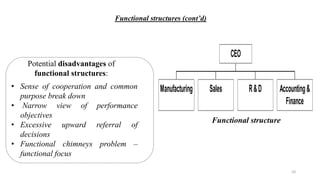
Functional structures (cont’d)
Manufacturing Sales R&D Accounting&
Finance
CEO
Functional structure
• Sense of cooperation and common
purpose break down
• Narrow view of performance
objectives
• Excessive upward referral of
decisions
• Functional chimneys problem –
functional focus
Potential disadvantages of
functional structures:
10
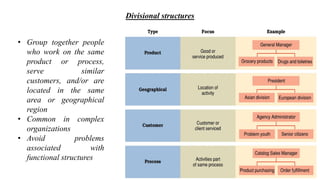
Divisional structures
• Group together people
who work on the same
product or process,
serve similar
customers, and/or are
located in the same
area or geographical
region
• Common in complex
organizations
• Avoid problems
associated with
functional structures
11
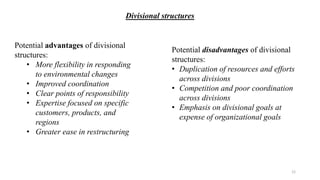
Potential advantages of divisional
structures:
• More flexibility in responding
to environmental changes
• Improved coordination
• Clear points of responsibility
• Expertise focused on specific
customers, products, and
regions
• Greater ease in restructuring
Potential disadvantages of divisional
structures:
• Duplication of resources and efforts
across divisions
• Competition and poor coordination
across divisions
• Emphasis on divisional goals at
expense of organizational goals
Divisional structures
12
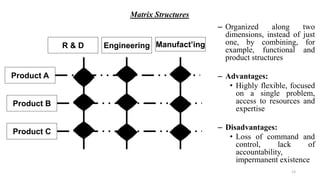
Product A
Product B
Product C
R & D Engineering Manufact’ing
Matrix Structures
– Organized along two
dimensions, instead of just
one, by combining, for
example, functional and
product structures
– Advantages:
• Highly flexible, focused
on a single problem,
access to resources and
expertise
– Disadvantages:
• Loss of command and
control, lack of
accountability,
impermanent existence
13
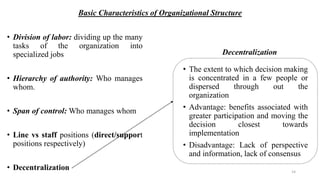
Basic Characteristics of Organizational Structure
• Division of labor: dividing up the many
tasks of the organization into
specialized jobs
• Hierarchy of authority: Who manages
whom.
• Span of control: Who manages whom
• Line vs staff positions (direct/support
positions respectively)
• Decentralization
• The extent to which decision making
is concentrated in a few people or
dispersed through out the
organization
• Advantage: benefits associated with
greater participation and moving the
decision closest towards
implementation
• Disadvantage: Lack of perspective
and information, lack of consensus
Decentralization
14
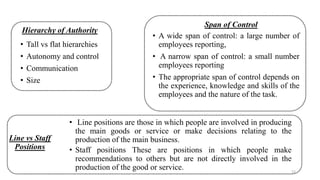
Hierarchy of Authority
• Tall vs flat hierarchies
• Autonomy and control
• Communication
• Size
Span of Control
• A wide span of control: a large number of
employees reporting,
• A narrow span of control: a small number
employees reporting
• The appropriate span of control depends on
the experience, knowledge and skills of the
employees and the nature of the task.
Line vs Staff
Positions
• Line positions are those in which people are involved in producing
the main goods or service or make decisions relating to the
production of the main business.
• Staff positions These are positions in which people make
recommendations to others but are not directly involved in the
production of the good or service. 15
• International Structures
– Developed in response to the need to manufacture,
purchase, and sell in global markets
– Department, division, or geographic
• Global Structure
– Acquiring resources (including capital), producing goods
and services, engaging in research and development, and
selling products in whatever local market is appropriate,
without any consideration of national boundaries
16
International Division Structure
17
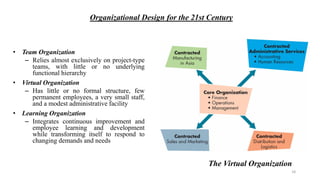
Organizational Design for the 21st Century
• Team Organization
– Relies almost exclusively on project-type
teams, with little or no underlying
functional hierarchy
• Virtual Organization
– Has little or no formal structure, few
permanent employees, a very small staff,
and a modest administrative facility
• Learning Organization
– Integrates continuous improvement and
employee learning and development
while transforming itself to respond to
changing demands and needs
The Virtual Organization
18
The Delegation Process
• Delegation
– The process through which a
manager allocates work to
subordinates
• Delegation Entails:
– Assignment of
responsibility—the duty to
perform an assigned task
– Granting of authority—the
power to make decisions
necessary to complete the task
– Creation of accountability—
the obligation of employees to
successfully complete the task
• The fear that subordinates don’t really
know how to do the job
• The desire to keep as much control as
possible over how things are done
• The fear that a subordinate might “show
the manager up” in front of others by
doing a superb job
• A simple lack of ability as to how to
effectively delegate to others
Why Managers Won’t Delegate
19
Summary
1. Discuss the factors that influence a firm’s organizational structure.
2. Explain specialization and departmentalization as two of the
building blocks of organizational structure.
3. Describe centralization and decentralization, delegation, and
authority as the key ingredients in establishing the decision-making
hierarchy.
4. Explain the differences among functional, divisional, matrix, and
international organizational structures and describe the most popular
new forms of organizational design.
5. Describe the informal organization structure
20

MPE 505 Organizatonal Structure.pdf document

  • 1.
    MPE 505: OrganizationalStructure Functions of Management Planning Organizing Controlling Leading 1
  • 2.
    Organizing Arranging people and resourcesto work together to accomplish a goal The system of tasks, reporting relationships, and communication linkages Organizational Structure Also Process and Client Departmentalization – Chart: Clarifies structure and shows employees where they fit into a firm’s operations Chart 2
  • 3.
    What are someelements that help determine the type of organizational structure an organization will use? Key include: (i). Mission: The organization’s mission can describe a specific manner in which the firm should manage employees, work flow, etc. (ii). Strategy: The organization’s strategy can determine the hierarchy or shape of the organization chart. (iii). Size: The larger an organization, the more complex will its organizational structure be. (iv). Internal Environment: Depending on how the organization reacts within its internal environment can determine the shape and style of its organizational structure. (iv). External Environment: The same holds true for how an organization deals with the external environmental variables that are outside of its control. Determinants of Organizational Structure 3
  • 4.
    The Building Blocksof Organizational Structure • Specialization – Division of work: job specialization • Departmentalization – Product, process, functional, customer, or geographic • Establishment of a decision-making hierarchy – Distributing authority: • Delegation: assigning tasks • Centralization: upper management retains authority • Decentralization: lower-level managers make decisions Tall and Flat Organizations • Flat Organizational Structure – Common in decentralized organizations – Fewer layers of management – Rapid communication – Wide spans of control • Tall Organizational Structure – Common in centralized organizations – Multiple layers of management – Slower communication – Narrower spans of control 4
  • 5.
    Span of control: Thenumber of subordinates that report directly to a manager 5
  • 6.
    Types of OrganizationalStructures Informal structures – the set of unofficial relationships between organization members Formal structures – the set of official relationships between organization members 6
  • 7.
    Informal structures Potential advantagesof informal structures: Helping people accomplish their work Overcoming limits of formal structure Gaining access to interpersonal networks Informal learning Potential disadvantages of informal structures: May carry inaccurate information May breed resistance to change Diversion of work efforts from important objectives Feeling of alienation by outsiders May work against best interests of entire organization 7
  • 8.
    Formal structures Through formalstructures: (i). People/Jobs are grouped to create work units or formal teams (ii). These formal teams are linked to create several types of traditional organizational structures Departmentalization Result 8
  • 9.
    Formal structures Several typesof formal structures exist: Functional Structure Divisional structure Matrix structure Team structures Network structures Functional structures • People with similar skills and performing similar tasks are grouped together into formal work units • Members work in their functional areas of expertise • Are not limited to businesses • Work well for small organizations producing few products or services Potential advantages of functional structures: Economies of scale Task assignments consistent with expertise and training High-quality technical problem solving In-depth training and skill development Clear career paths within functions 9
  • 10.
    Functional structures (cont’d) ManufacturingSales R&D Accounting& Finance CEO Functional structure • Sense of cooperation and common purpose break down • Narrow view of performance objectives • Excessive upward referral of decisions • Functional chimneys problem – functional focus Potential disadvantages of functional structures: 10
  • 11.
    Divisional structures • Grouptogether people who work on the same product or process, serve similar customers, and/or are located in the same area or geographical region • Common in complex organizations • Avoid problems associated with functional structures 11
  • 12.
    Potential advantages ofdivisional structures: • More flexibility in responding to environmental changes • Improved coordination • Clear points of responsibility • Expertise focused on specific customers, products, and regions • Greater ease in restructuring Potential disadvantages of divisional structures: • Duplication of resources and efforts across divisions • Competition and poor coordination across divisions • Emphasis on divisional goals at expense of organizational goals Divisional structures 12
  • 13.
    Product A Product B ProductC R & D Engineering Manufact’ing Matrix Structures – Organized along two dimensions, instead of just one, by combining, for example, functional and product structures – Advantages: • Highly flexible, focused on a single problem, access to resources and expertise – Disadvantages: • Loss of command and control, lack of accountability, impermanent existence 13
  • 14.
    Basic Characteristics ofOrganizational Structure • Division of labor: dividing up the many tasks of the organization into specialized jobs • Hierarchy of authority: Who manages whom. • Span of control: Who manages whom • Line vs staff positions (direct/support positions respectively) • Decentralization • The extent to which decision making is concentrated in a few people or dispersed through out the organization • Advantage: benefits associated with greater participation and moving the decision closest towards implementation • Disadvantage: Lack of perspective and information, lack of consensus Decentralization 14
  • 15.
    Hierarchy of Authority •Tall vs flat hierarchies • Autonomy and control • Communication • Size Span of Control • A wide span of control: a large number of employees reporting, • A narrow span of control: a small number employees reporting • The appropriate span of control depends on the experience, knowledge and skills of the employees and the nature of the task. Line vs Staff Positions • Line positions are those in which people are involved in producing the main goods or service or make decisions relating to the production of the main business. • Staff positions These are positions in which people make recommendations to others but are not directly involved in the production of the good or service. 15
  • 16.
    • International Structures –Developed in response to the need to manufacture, purchase, and sell in global markets – Department, division, or geographic • Global Structure – Acquiring resources (including capital), producing goods and services, engaging in research and development, and selling products in whatever local market is appropriate, without any consideration of national boundaries 16
  • 17.
  • 18.
    Organizational Design forthe 21st Century • Team Organization – Relies almost exclusively on project-type teams, with little or no underlying functional hierarchy • Virtual Organization – Has little or no formal structure, few permanent employees, a very small staff, and a modest administrative facility • Learning Organization – Integrates continuous improvement and employee learning and development while transforming itself to respond to changing demands and needs The Virtual Organization 18
  • 19.
    The Delegation Process •Delegation – The process through which a manager allocates work to subordinates • Delegation Entails: – Assignment of responsibility—the duty to perform an assigned task – Granting of authority—the power to make decisions necessary to complete the task – Creation of accountability— the obligation of employees to successfully complete the task • The fear that subordinates don’t really know how to do the job • The desire to keep as much control as possible over how things are done • The fear that a subordinate might “show the manager up” in front of others by doing a superb job • A simple lack of ability as to how to effectively delegate to others Why Managers Won’t Delegate 19
  • 20.
    Summary 1. Discuss thefactors that influence a firm’s organizational structure. 2. Explain specialization and departmentalization as two of the building blocks of organizational structure. 3. Describe centralization and decentralization, delegation, and authority as the key ingredients in establishing the decision-making hierarchy. 4. Explain the differences among functional, divisional, matrix, and international organizational structures and describe the most popular new forms of organizational design. 5. Describe the informal organization structure 20