Uses of a Centre Lathe
Liam Pourhana
The lathe is a useful machine tool. As a
maintenance machinist you will often use a
lathe to carry out repairs or machine new
components. To do these tasks you must be
able to operate the lathe safely and correctly.
This training unit covers the skills and
knowledge you will need to operate the center
lathe correctly.
A lathe is a machine tool that carries out many
machine shop tasks. It can cut and smooth the
face of a work piece. It can make holes to an
exact size and position. It can also make
external or internal threaded parts on a work
piece. This ability to do different tasks makes it
an important tool. In most tasks a lathe's use is
only limited by the size of the work piece. As a
maintenance machinist, it is important that
you know how a lathe functions and how to
operate it correctly.
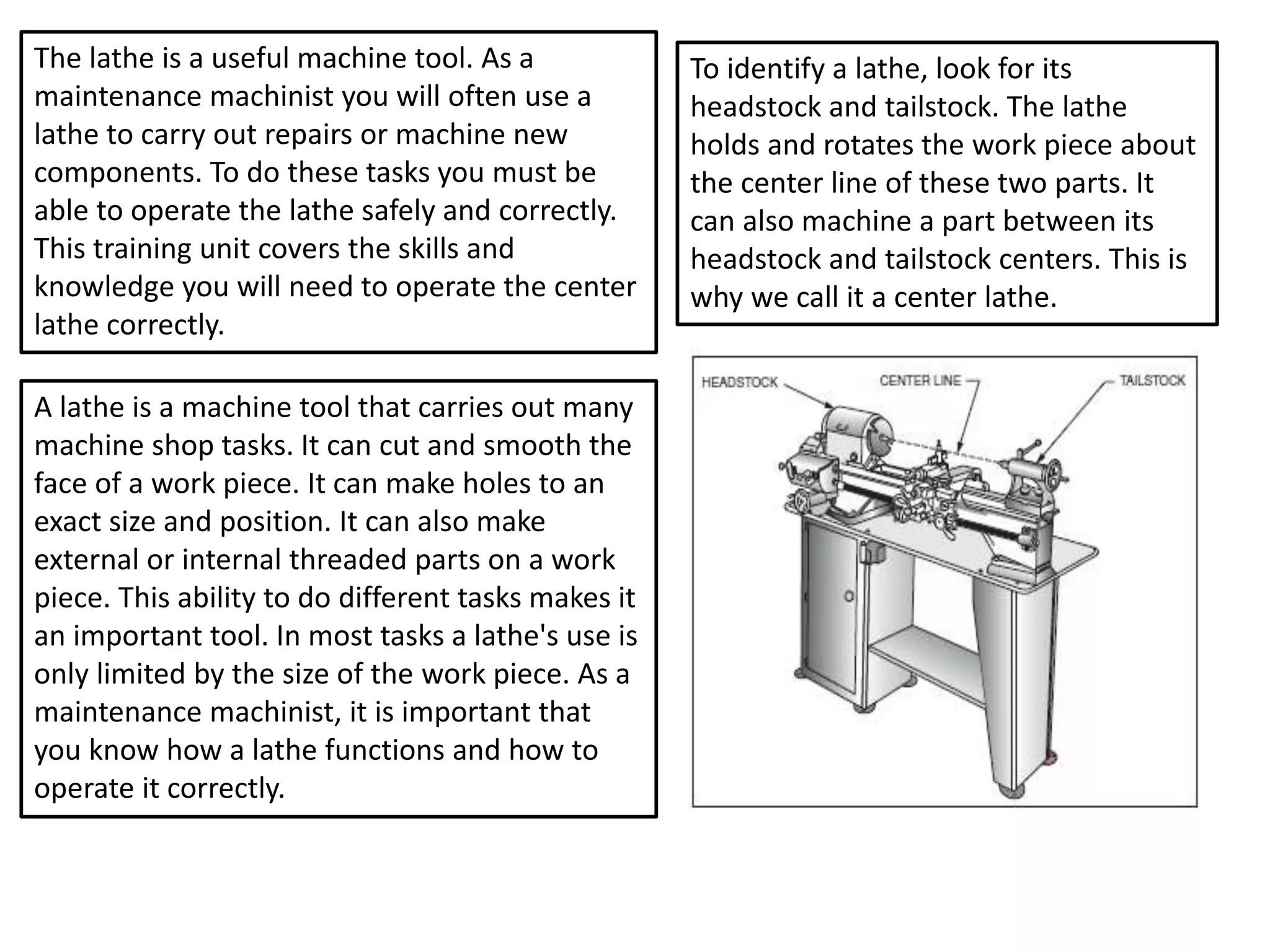
To identify a lathe, look for its
headstock and tailstock. The lathe
holds and rotates the work piece about
the center line of these two parts. It
can also machine a part between its
headstock and tailstock centers. This is
why we call it a center lathe.
A maintenance machinist is responsible for keeping
plant equipment and machinery in good working
order. Most mechanical equipment contains round or
cylindrical parts such as shafts, bearings, and
couplings. Lathes can work on both cylindrical and
non-cylindrical parts. But, it is important to
remember that a lathe is the only workshop machine
that you will use to work on cylindrical parts at this
stage of your professional development.
There will be times when a replacement part is not
available. At these times you will have to repair an
old part or machine a new one. At other times, you
will need to fit a part to the special requirements of
specific installations. Often new parts supplied by a
manufacturer will require machining. Therefore, you
must know how to use the lathe correctly to repair,
fabricate or fit cylindrical components.
The lathe shapes a metal work piece by rotating it
against a sharp cutting tool edge. The shape and the
finish of the part you produce is determined by how
you set up and cut the work piece.
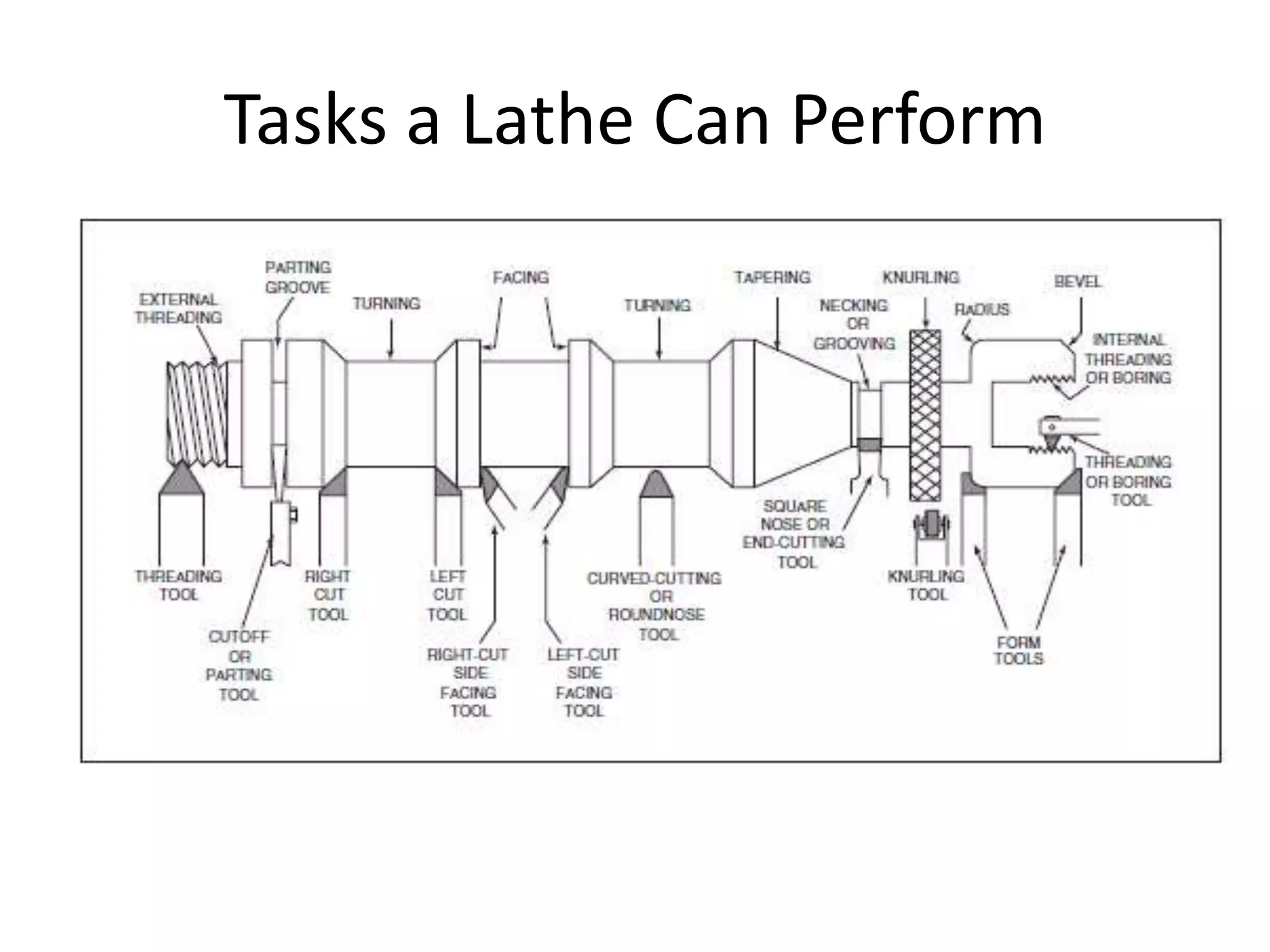
Tasks a Lathe Can Perform
The five most common tasks on a center lathe
that you will perform are:
o facing
o turning
o drilling
o boring
o thread cutting
Facing
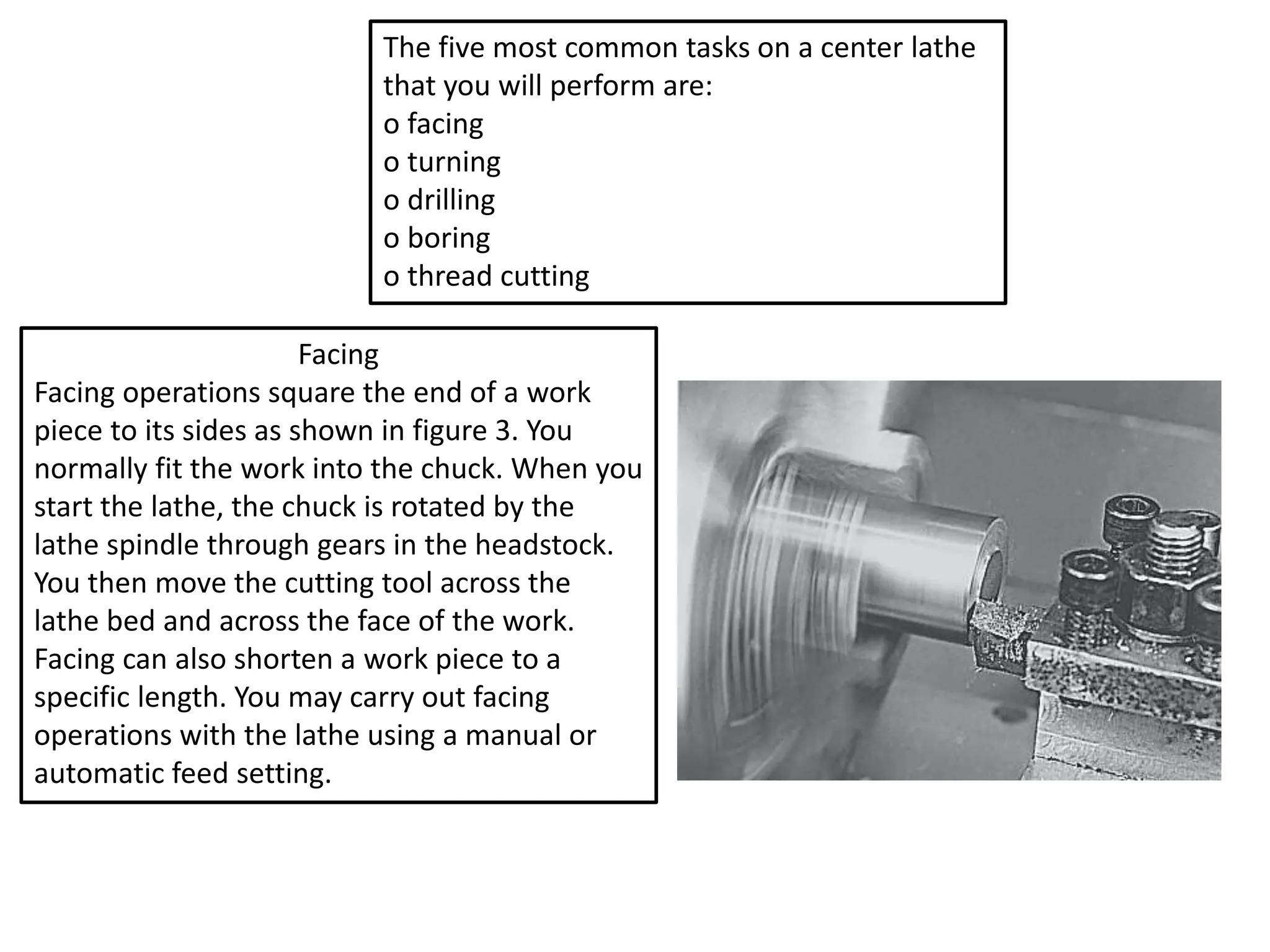
Facing operations square the end of a work
piece to its sides as shown in figure 3. You
normally fit the work into the chuck. When you
start the lathe, the chuck is rotated by the
lathe spindle through gears in the headstock.
You then move the cutting tool across the
lathe bed and across the face of the work.
Facing can also shorten a work piece to a
specific length. You may carry out facing
operations with the lathe using a manual or
automatic feed setting.
Turning
Turning, as shown in figure 4, reduces the
outside diameter of a work piece. As with
facing, you normally fit the work into the
chuck. To turn the work you move the cutting
tool parallel to the bed of the lathe and along
the side of the work piece. You may carry out
turning operations with the lathe using a
manual or automatic feed setting.
Drilling
When you drill a hole on the lathe, the work
piece rotates and the drill bit stays still. With
the tailstock clamped, you feed the drill bit
into the work piece by using the tailstock
hand-wheel as shown in the image to the right
Boring
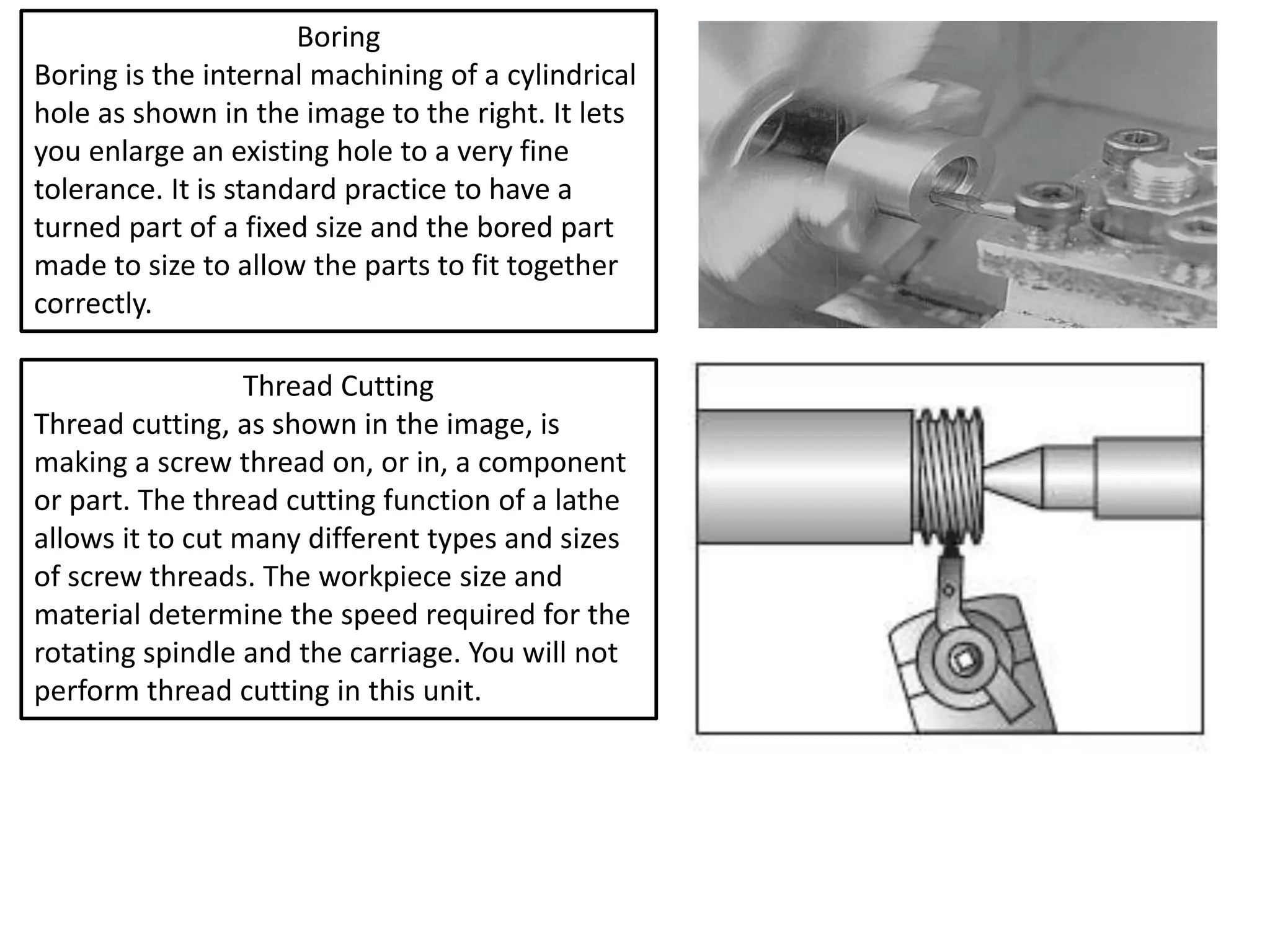
Boring is the internal machining of a cylindrical
hole as shown in the image to the right. It lets
you enlarge an existing hole to a very fine
tolerance. It is standard practice to have a
turned part of a fixed size and the bored part
made to size to allow the parts to fit together
correctly.
Thread Cutting
Thread cutting, as shown in the image, is
making a screw thread on, or in, a component
or part. The thread cutting function of a lathe
allows it to cut many different types and sizes
of screw threads. The workpiece size and
material determine the speed required for the
rotating spindle and the carriage. You will not
perform thread cutting in this unit.
1. What are the main tasks you perform on a center lathe?
a.
b.
c.
d.
2. What two parts let you identify a center lathe easily?
a.
b.
3. What lathe task reduces the outside diameter of a work piece?
4. What lathe task squares the end of a work piece to its sides?
5. What lathe parts rotate when drilling?
Like any machine, to operate a lathe you must
know its major parts and how to control them.
There are many different models of center
lathes.
Each manufacturer makes lathes with slight
differences. Some make lathes only to
complete tasks on very large or very small
work pieces. Even with differences in
manufacturer design, size, and names, most
lathes look very much alike and carry out
similar tasks.
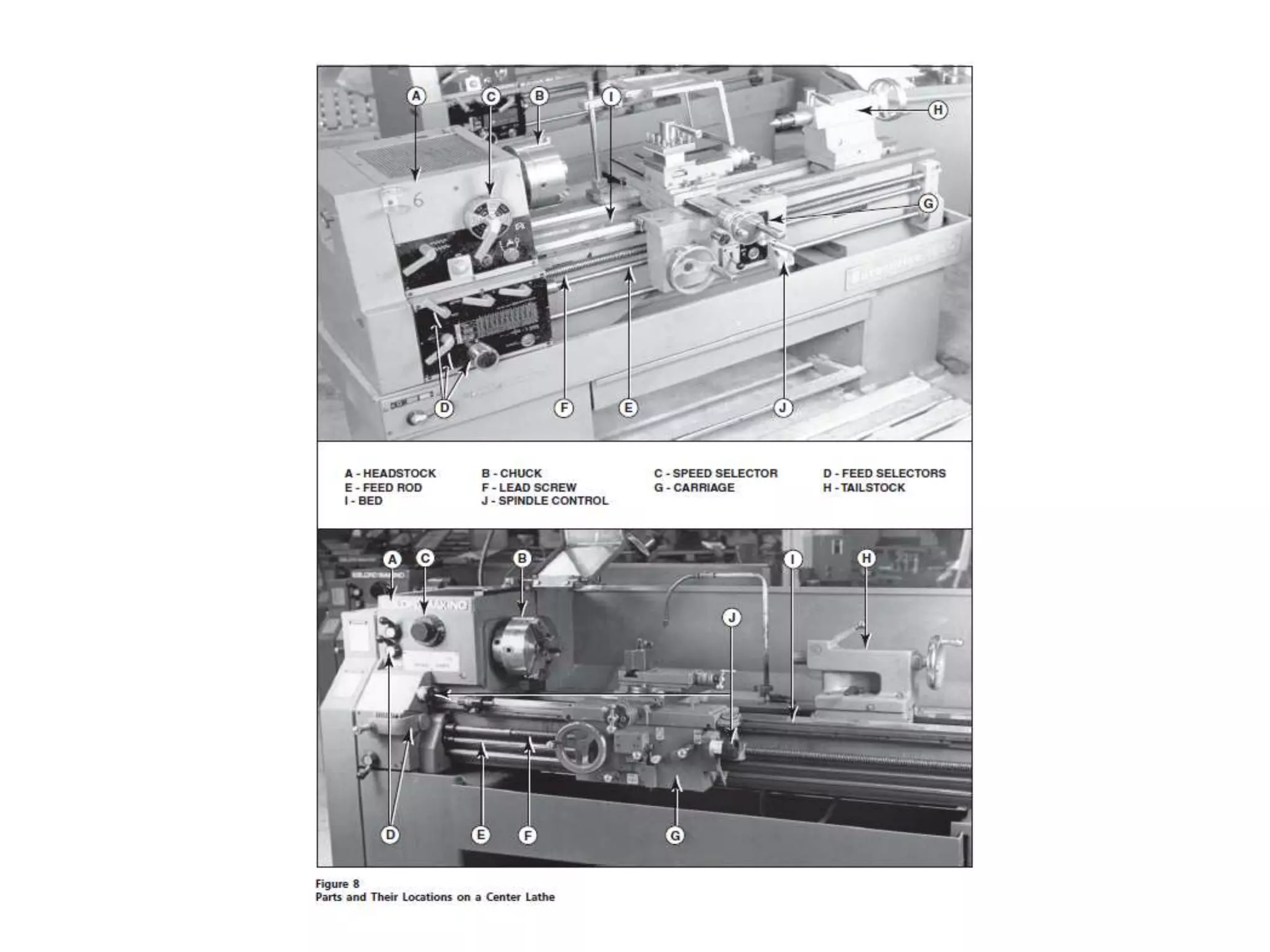
The major parts and controls of two
designs of a center lathe as shown in
figure 8 are as follows:
o headstock
o chuck
o speed selector
o spindle direction control
o feed selector
o feed rod
o lead screw
o safety guards
o carriage and saddle
o bed
o tailstock
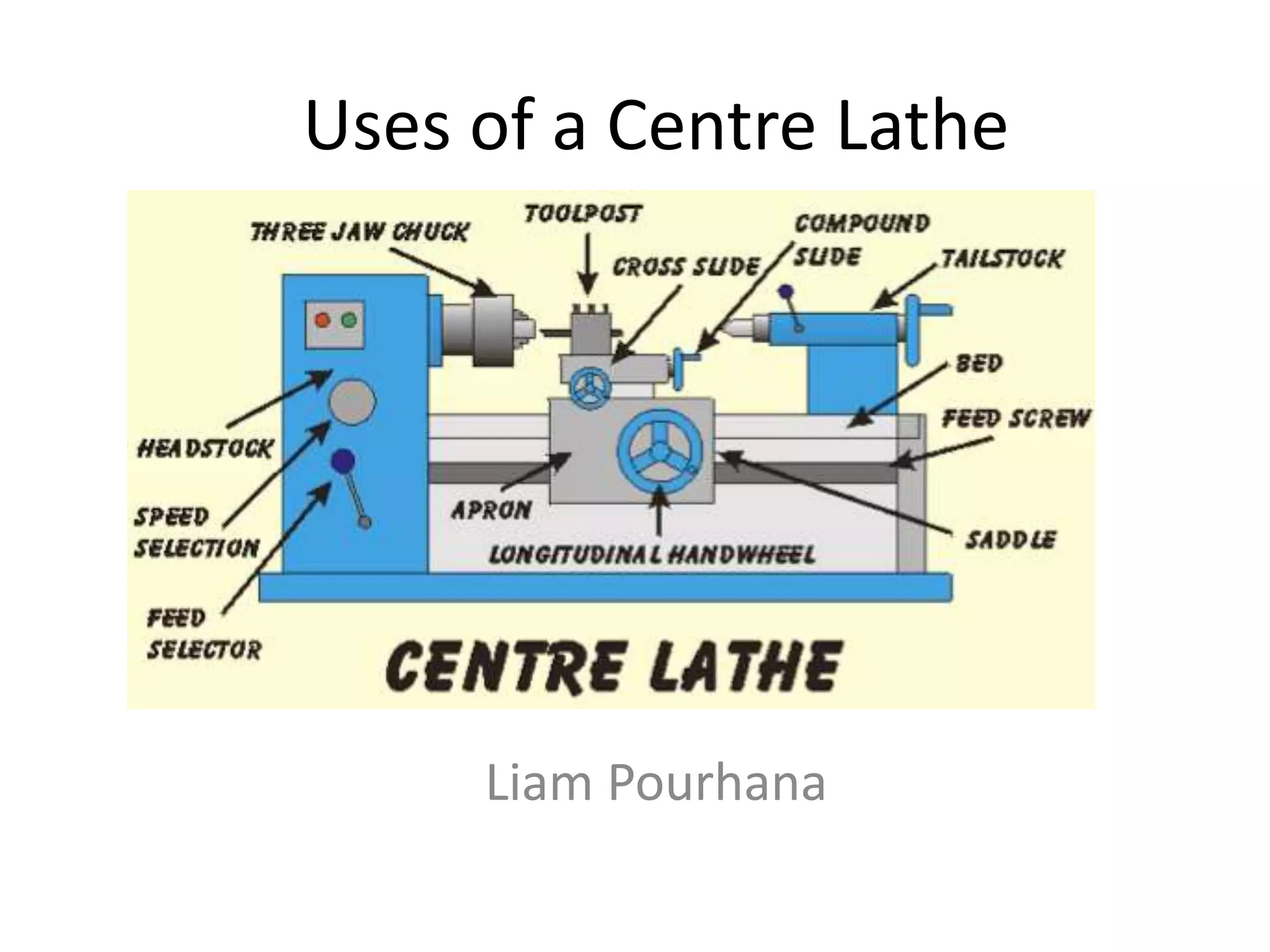
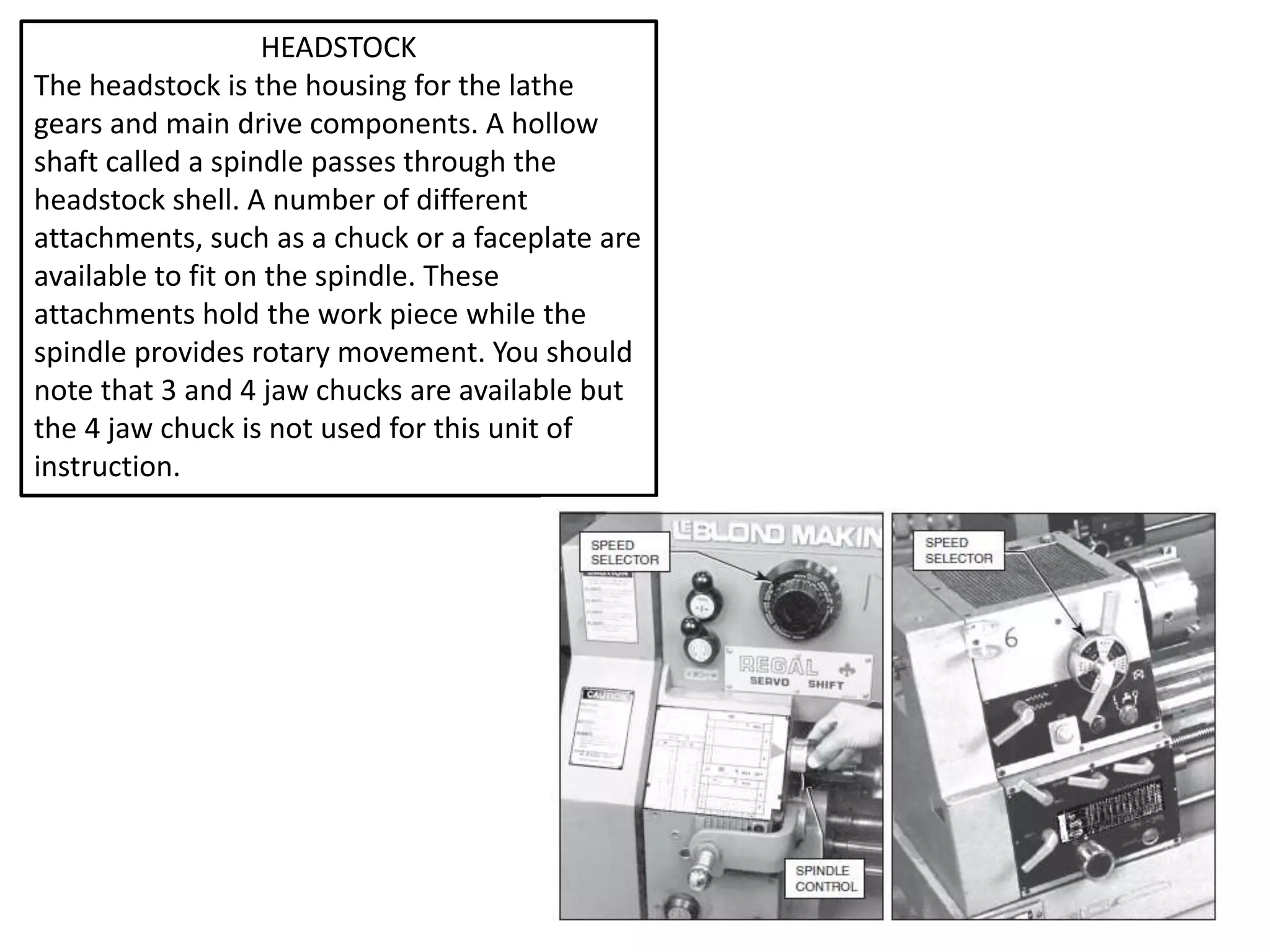
HEADSTOCK
The headstock is the housing for the lathe
gears and main drive components. A hollow
shaft called a spindle passes through the
headstock shell. A number of different
attachments, such as a chuck or a faceplate are
available to fit on the spindle. These
attachments hold the work piece while the
spindle provides rotary movement. You should
note that 3 and 4 jaw chucks are available but
the 4 jaw chuck is not used for this unit of
instruction.
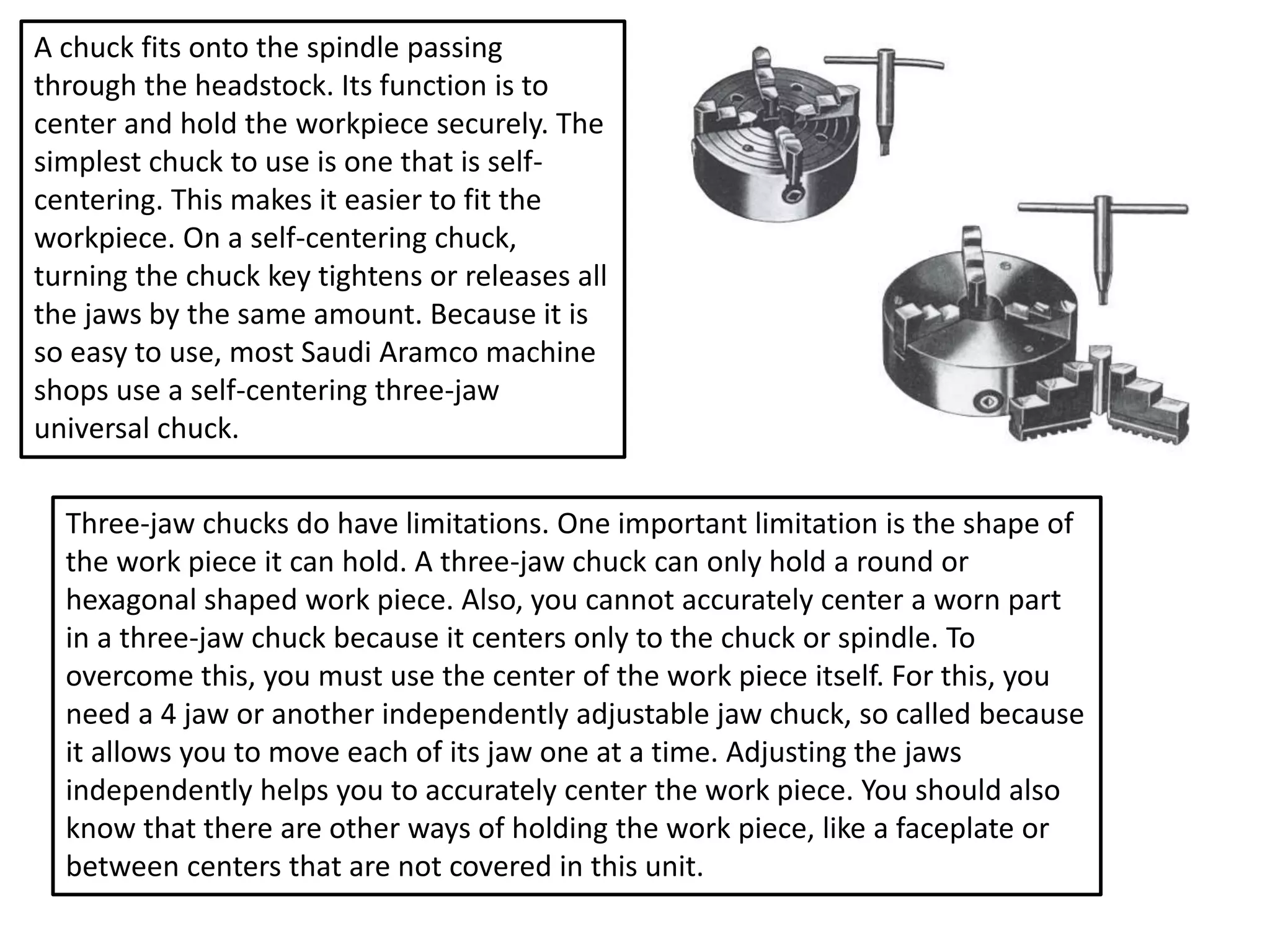
A chuck fits onto the spindle passing
through the headstock. Its function is to
center and hold the workpiece securely. The
simplest chuck to use is one that is self-
centering. This makes it easier to fit the
workpiece. On a self-centering chuck,
turning the chuck key tightens or releases all
the jaws by the same amount. Because it is
so easy to use, most Saudi Aramco machine
shops use a self-centering three-jaw
universal chuck.
Three-jaw chucks do have limitations. One important limitation is the shape of
the work piece it can hold. A three-jaw chuck can only hold a round or
hexagonal shaped work piece. Also, you cannot accurately center a worn part
in a three-jaw chuck because it centers only to the chuck or spindle. To
overcome this, you must use the center of the work piece itself. For this, you
need a 4 jaw or another independently adjustable jaw chuck, so called because
it allows you to move each of its jaw one at a time. Adjusting the jaws
independently helps you to accurately center the work piece. You should also
know that there are other ways of holding the work piece, like a faceplate or
between centers that are not covered in this unit.
SPEED SELECTOR
You use the speed selector to set the spindle
RPM. This sets the RPM of the chuck or
faceplate holding the work piece. Located on
the headstock, the speed selector takes power
from the lathe electric motor and transmits it
to the spindle. To do this, the speed selector
provides drive to the spindle through a gear
train or drive belts inside the headstock.
Through this drive and gearing the speed
selector controls or adjusts the output RPM.
The spindle control is either a lever or a dial,
depending upon which manufacturer made
the lathe. Different manufacturers put the
control on the headstock, on the carriage, or
on both.
SPINDLE DIRECTION CONTROL
The spindle direction control controls the way
the spindle turns. This allows you to set up and
use the lathe for different operations. The
control normally has forward and reverse
settings that allow you to drive the spindle in
the selected rotation. For example, you set a
counter clockwise (CCW) rotation, for normal
turning operations. You may also find a neutral
and stop setting. The neutral setting allows you
to move the spindle by hand in either
direction. The stop setting locks the spindle in
place and prevents it from turning. The spindle
direction control starts the rotation after the
isolation mechanism is canceled.
FEED SELECTOR
Normally; there are at least four (4)
levers used for feed selection. They let
you control how much movement and
in what direction. However, the
number of controls depends upon the
lathe manufacturers and lathe type.
The standard feed controls are:
o feed-on/off
o how much feed
o direction of feed movement ()
←↑→↓
o feed for carriage or cross slide () ↔
Between their different levers, feed
selectors set the rotational speed of
the lead screw and feed rod. They also
set the feed direction.
FEED ROD
The feed rod transmits drive from the
headstock gear train to the saddle or cross-
slide. The rod is either splined or keyed along
its length, depending upon which
manufacturer made the lathe.
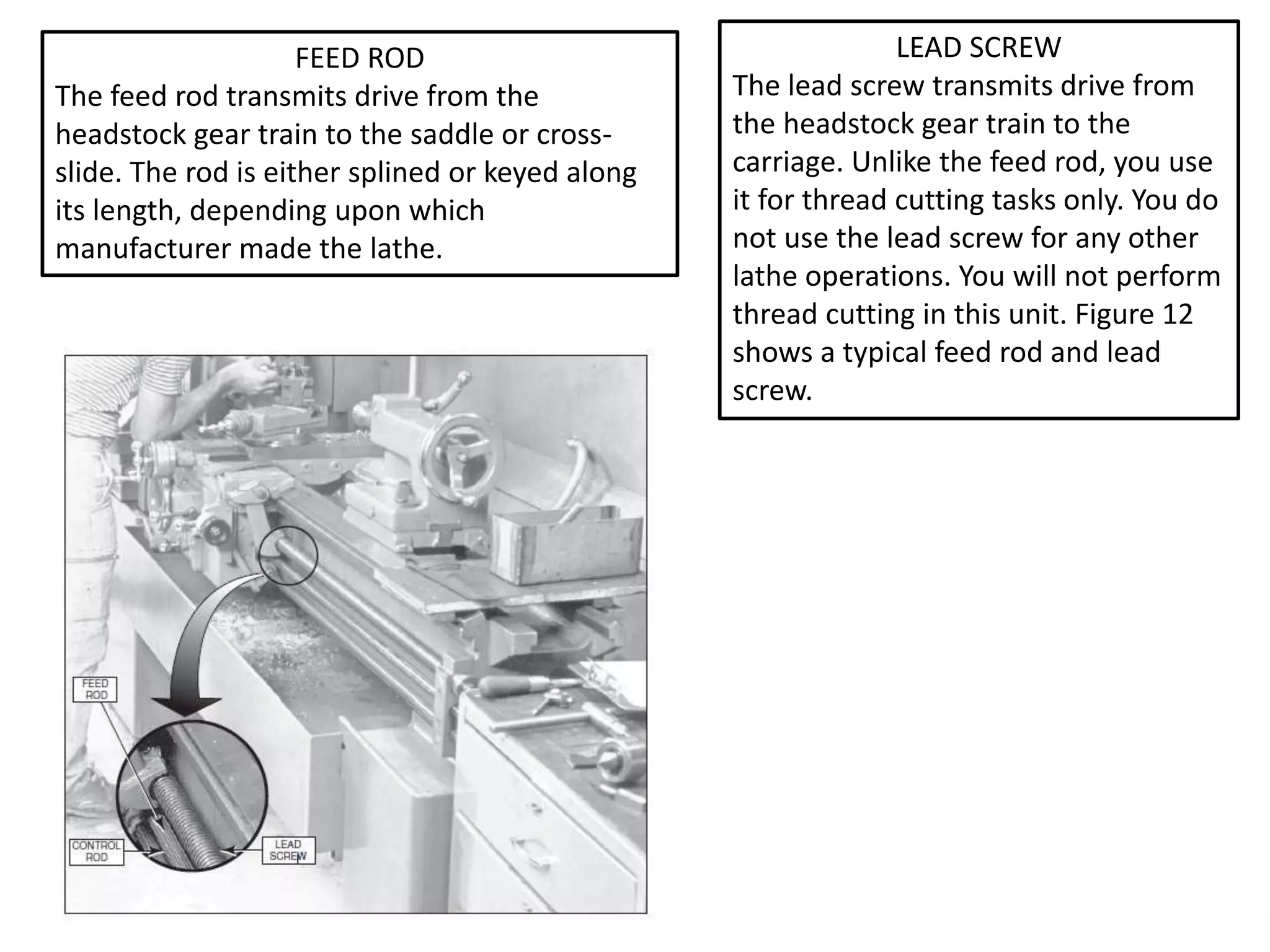
LEAD SCREW
The lead screw transmits drive from
the headstock gear train to the
carriage. Unlike the feed rod, you use
it for thread cutting tasks only. You do
not use the lead screw for any other
lathe operations. You will not perform
thread cutting in this unit. Figure 12
shows a typical feed rod and lead
screw.
SAFETYGUARDS
Safety guards are fitted at a variety of points
on the center lathe. The number and
positioning of guards depends upon the lathe
type and manufacturer. However, all lathes
have a cutting area guard. The cutting area
guard deflects flying metal cuttings or swarf
away from the operator.
CARRIAGEAND SADDLE
The carriage and saddle are an
arrangement of parts that support and
control the movement of the cutting tool
parallel to the centerline of the machine.
They fit on the lathe bed (as shown in
figure 13) and slide along the center lathe
guideways. Because lathe guideways are
part of the lathe bed, they are sometimes
called bedways
The main parts of the carriage and saddle are:
o apron
o carriage hand wheel
o cross slide and hand wheel
o compound slide and hand wheel
o tool post
Apron
The apron contains the controls and gears that allow
you to move the carriage and cross slide. Lathe
operations require you to cut with precision
tolerances. Therefore, to stop unwanted movement,
bolts secure the apron to the saddle. The apron also
contains the half nuts that engage the lead screw for
threading operations.
Carriage Hand wheel
The carriage hand wheel allows you to manually
control the movement of the carriage. Through this
movement the cutting tool moves parallel to the
lathe center line. On most lathes it is easy to
identify because it is the largest hand wheel on the
carriage.
Cross Slide and Hand wheel
The cross slide is mounted on the
carriage. It moves the cutting tool 90° to
the work piece. You can set the feed of
the cutting tool to either manual or
automatic depending on the task you are
doing. Using the hand wheel permits you
to move the cross-slide back and forth
across the bed.Compound Slide and Handwheel
The compound slide is mounted on top of the cross-
slide. You can make adjustments to position it
through 360°. The compound slide handwheel then
provides manual movement feed only for angular
cuts or tapers. If you position it parallel to the lathe
center line, the compound slide controls the depth
of cut. In this position you can use it for adding exact
cut depths during facing operations.
Tool Post
The tool post supports and secures the cutting
tool or tool holder. It is secured on top of the
compound slide. It is held firmly in position on
the compound slide T-slot. This prevents
unwanted movement from spoiling the cut.
Note: Lathe operations produce friction.
Friction causes heat. Therefore, many lathes
have a coolant or cutting fluid supply system.
The nozzle for these systems is near the tool
post. Most times this fluid nozzle is movable
and has a small valve that allows you to
regulate the flow as needed.
BED
The bed forms the base of the lathe
with the bedways running along it. Its
upper part supports the headstock,
carriage and tailstock. Through the bed
and bedways, the carriage is
maintained in precise alignment. This
permits you to machine to precision
tolerances along the length of the
workpiece.
TAILSTOCK
The tailstock is a heavy casting that moves
back and forth along the bed of the lathe. It
holds tools such as revolving centers, drill
chucks and taper shank drills which fit into the
tapered spindle.
SUMMARY
You can now name and identify the main parts of most
center lathes. You can also state their functions, find
their controls, and understand how they work. In lathe
operations, a work piece turns at high speed. You feed
cutting tools to, and around, the work piece. You know
that fast moving machinery, cutting tools, and flying
metal cuttings are dangerous. If not operated correctly;
a lathe will cause you painful injury Therefore, before
you learn detailed lathe procedures; you must learn the
lathe safety rules. Following these simple rules will stop
you from hurting yourself and may even save your life.
Uses of a centre lathe

Uses of a centre lathe

  • 1.
    Uses of aCentre Lathe Liam Pourhana
  • 2.
    The lathe isa useful machine tool. As a maintenance machinist you will often use a lathe to carry out repairs or machine new components. To do these tasks you must be able to operate the lathe safely and correctly. This training unit covers the skills and knowledge you will need to operate the center lathe correctly. A lathe is a machine tool that carries out many machine shop tasks. It can cut and smooth the face of a work piece. It can make holes to an exact size and position. It can also make external or internal threaded parts on a work piece. This ability to do different tasks makes it an important tool. In most tasks a lathe's use is only limited by the size of the work piece. As a maintenance machinist, it is important that you know how a lathe functions and how to operate it correctly. To identify a lathe, look for its headstock and tailstock. The lathe holds and rotates the work piece about the center line of these two parts. It can also machine a part between its headstock and tailstock centers. This is why we call it a center lathe.
  • 3.
    A maintenance machinistis responsible for keeping plant equipment and machinery in good working order. Most mechanical equipment contains round or cylindrical parts such as shafts, bearings, and couplings. Lathes can work on both cylindrical and non-cylindrical parts. But, it is important to remember that a lathe is the only workshop machine that you will use to work on cylindrical parts at this stage of your professional development. There will be times when a replacement part is not available. At these times you will have to repair an old part or machine a new one. At other times, you will need to fit a part to the special requirements of specific installations. Often new parts supplied by a manufacturer will require machining. Therefore, you must know how to use the lathe correctly to repair, fabricate or fit cylindrical components. The lathe shapes a metal work piece by rotating it against a sharp cutting tool edge. The shape and the finish of the part you produce is determined by how you set up and cut the work piece.
  • 4.
    Tasks a LatheCan Perform
  • 5.
    The five mostcommon tasks on a center lathe that you will perform are: o facing o turning o drilling o boring o thread cutting Facing Facing operations square the end of a work piece to its sides as shown in figure 3. You normally fit the work into the chuck. When you start the lathe, the chuck is rotated by the lathe spindle through gears in the headstock. You then move the cutting tool across the lathe bed and across the face of the work. Facing can also shorten a work piece to a specific length. You may carry out facing operations with the lathe using a manual or automatic feed setting.
  • 6.
    Turning Turning, as shownin figure 4, reduces the outside diameter of a work piece. As with facing, you normally fit the work into the chuck. To turn the work you move the cutting tool parallel to the bed of the lathe and along the side of the work piece. You may carry out turning operations with the lathe using a manual or automatic feed setting. Drilling When you drill a hole on the lathe, the work piece rotates and the drill bit stays still. With the tailstock clamped, you feed the drill bit into the work piece by using the tailstock hand-wheel as shown in the image to the right
  • 7.
    Boring Boring is theinternal machining of a cylindrical hole as shown in the image to the right. It lets you enlarge an existing hole to a very fine tolerance. It is standard practice to have a turned part of a fixed size and the bored part made to size to allow the parts to fit together correctly. Thread Cutting Thread cutting, as shown in the image, is making a screw thread on, or in, a component or part. The thread cutting function of a lathe allows it to cut many different types and sizes of screw threads. The workpiece size and material determine the speed required for the rotating spindle and the carriage. You will not perform thread cutting in this unit.
  • 8.
    1. What arethe main tasks you perform on a center lathe? a. b. c. d. 2. What two parts let you identify a center lathe easily? a. b. 3. What lathe task reduces the outside diameter of a work piece? 4. What lathe task squares the end of a work piece to its sides? 5. What lathe parts rotate when drilling?
  • 9.
    Like any machine,to operate a lathe you must know its major parts and how to control them. There are many different models of center lathes. Each manufacturer makes lathes with slight differences. Some make lathes only to complete tasks on very large or very small work pieces. Even with differences in manufacturer design, size, and names, most lathes look very much alike and carry out similar tasks. The major parts and controls of two designs of a center lathe as shown in figure 8 are as follows: o headstock o chuck o speed selector o spindle direction control o feed selector o feed rod o lead screw o safety guards o carriage and saddle o bed o tailstock
  • 11.
    HEADSTOCK The headstock isthe housing for the lathe gears and main drive components. A hollow shaft called a spindle passes through the headstock shell. A number of different attachments, such as a chuck or a faceplate are available to fit on the spindle. These attachments hold the work piece while the spindle provides rotary movement. You should note that 3 and 4 jaw chucks are available but the 4 jaw chuck is not used for this unit of instruction.
  • 12.
    A chuck fitsonto the spindle passing through the headstock. Its function is to center and hold the workpiece securely. The simplest chuck to use is one that is self- centering. This makes it easier to fit the workpiece. On a self-centering chuck, turning the chuck key tightens or releases all the jaws by the same amount. Because it is so easy to use, most Saudi Aramco machine shops use a self-centering three-jaw universal chuck. Three-jaw chucks do have limitations. One important limitation is the shape of the work piece it can hold. A three-jaw chuck can only hold a round or hexagonal shaped work piece. Also, you cannot accurately center a worn part in a three-jaw chuck because it centers only to the chuck or spindle. To overcome this, you must use the center of the work piece itself. For this, you need a 4 jaw or another independently adjustable jaw chuck, so called because it allows you to move each of its jaw one at a time. Adjusting the jaws independently helps you to accurately center the work piece. You should also know that there are other ways of holding the work piece, like a faceplate or between centers that are not covered in this unit.
  • 13.
    SPEED SELECTOR You usethe speed selector to set the spindle RPM. This sets the RPM of the chuck or faceplate holding the work piece. Located on the headstock, the speed selector takes power from the lathe electric motor and transmits it to the spindle. To do this, the speed selector provides drive to the spindle through a gear train or drive belts inside the headstock. Through this drive and gearing the speed selector controls or adjusts the output RPM. The spindle control is either a lever or a dial, depending upon which manufacturer made the lathe. Different manufacturers put the control on the headstock, on the carriage, or on both.
  • 14.
    SPINDLE DIRECTION CONTROL Thespindle direction control controls the way the spindle turns. This allows you to set up and use the lathe for different operations. The control normally has forward and reverse settings that allow you to drive the spindle in the selected rotation. For example, you set a counter clockwise (CCW) rotation, for normal turning operations. You may also find a neutral and stop setting. The neutral setting allows you to move the spindle by hand in either direction. The stop setting locks the spindle in place and prevents it from turning. The spindle direction control starts the rotation after the isolation mechanism is canceled. FEED SELECTOR Normally; there are at least four (4) levers used for feed selection. They let you control how much movement and in what direction. However, the number of controls depends upon the lathe manufacturers and lathe type. The standard feed controls are: o feed-on/off o how much feed o direction of feed movement () ←↑→↓ o feed for carriage or cross slide () ↔ Between their different levers, feed selectors set the rotational speed of the lead screw and feed rod. They also set the feed direction.
  • 15.
    FEED ROD The feedrod transmits drive from the headstock gear train to the saddle or cross- slide. The rod is either splined or keyed along its length, depending upon which manufacturer made the lathe. LEAD SCREW The lead screw transmits drive from the headstock gear train to the carriage. Unlike the feed rod, you use it for thread cutting tasks only. You do not use the lead screw for any other lathe operations. You will not perform thread cutting in this unit. Figure 12 shows a typical feed rod and lead screw.
  • 16.
    SAFETYGUARDS Safety guards arefitted at a variety of points on the center lathe. The number and positioning of guards depends upon the lathe type and manufacturer. However, all lathes have a cutting area guard. The cutting area guard deflects flying metal cuttings or swarf away from the operator. CARRIAGEAND SADDLE The carriage and saddle are an arrangement of parts that support and control the movement of the cutting tool parallel to the centerline of the machine. They fit on the lathe bed (as shown in figure 13) and slide along the center lathe guideways. Because lathe guideways are part of the lathe bed, they are sometimes called bedways
  • 17.
    The main partsof the carriage and saddle are: o apron o carriage hand wheel o cross slide and hand wheel o compound slide and hand wheel o tool post Apron The apron contains the controls and gears that allow you to move the carriage and cross slide. Lathe operations require you to cut with precision tolerances. Therefore, to stop unwanted movement, bolts secure the apron to the saddle. The apron also contains the half nuts that engage the lead screw for threading operations. Carriage Hand wheel The carriage hand wheel allows you to manually control the movement of the carriage. Through this movement the cutting tool moves parallel to the lathe center line. On most lathes it is easy to identify because it is the largest hand wheel on the carriage. Cross Slide and Hand wheel The cross slide is mounted on the carriage. It moves the cutting tool 90° to the work piece. You can set the feed of the cutting tool to either manual or automatic depending on the task you are doing. Using the hand wheel permits you to move the cross-slide back and forth across the bed.Compound Slide and Handwheel The compound slide is mounted on top of the cross- slide. You can make adjustments to position it through 360°. The compound slide handwheel then provides manual movement feed only for angular cuts or tapers. If you position it parallel to the lathe center line, the compound slide controls the depth of cut. In this position you can use it for adding exact cut depths during facing operations.
  • 18.
    Tool Post The toolpost supports and secures the cutting tool or tool holder. It is secured on top of the compound slide. It is held firmly in position on the compound slide T-slot. This prevents unwanted movement from spoiling the cut. Note: Lathe operations produce friction. Friction causes heat. Therefore, many lathes have a coolant or cutting fluid supply system. The nozzle for these systems is near the tool post. Most times this fluid nozzle is movable and has a small valve that allows you to regulate the flow as needed. BED The bed forms the base of the lathe with the bedways running along it. Its upper part supports the headstock, carriage and tailstock. Through the bed and bedways, the carriage is maintained in precise alignment. This permits you to machine to precision tolerances along the length of the workpiece. TAILSTOCK The tailstock is a heavy casting that moves back and forth along the bed of the lathe. It holds tools such as revolving centers, drill chucks and taper shank drills which fit into the tapered spindle. SUMMARY You can now name and identify the main parts of most center lathes. You can also state their functions, find their controls, and understand how they work. In lathe operations, a work piece turns at high speed. You feed cutting tools to, and around, the work piece. You know that fast moving machinery, cutting tools, and flying metal cuttings are dangerous. If not operated correctly; a lathe will cause you painful injury Therefore, before you learn detailed lathe procedures; you must learn the lathe safety rules. Following these simple rules will stop you from hurting yourself and may even save your life.