TURNING MACHINES
LATHE
Introduction
Lathe is a machine, which removes the metal from
a piece of work to the required shape & size
HENRY MAUDSLAY - 1797
Types of Lathe
Engine Lathe
The most common form of lathe, motor driven and
comes in large variety of sizes and shapes.
Bench Lathe
A bench top model usually of low power used to make
precision machine small work pieces.
Tracer Lathe
a lathe that has the ability to follow a template to copy
a shape or contour.
Automatic Lathe
A lathe in which the work piece is automatically fed and removed
without use of an operator. Cutting operations are automatically
controlled by a
sequencer of some form
Turret Lathe
lathe which have multiple tools mounted on turret either
attached to the tailstock or the cross-slide, which allows for quick
changes in tooling and cutting operations.
Computer Controlled Lathe
A highly automated lathe, where both cutting, loading, tool
changing, and part unloading are automatically controlled by
computer coding.
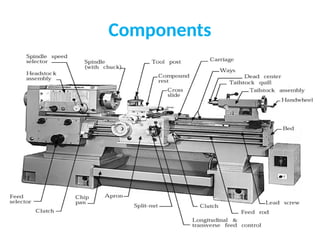
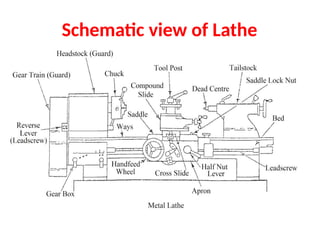
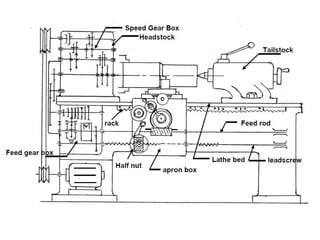
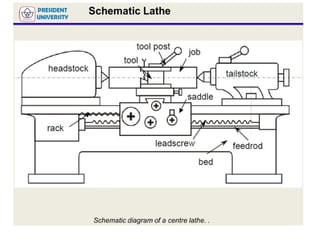
Components
Schematic view of Lathe
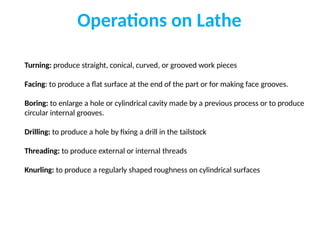
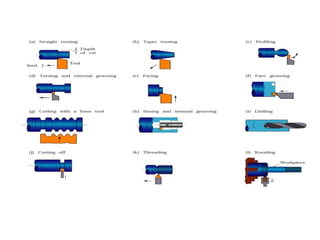
Operations on Lathe
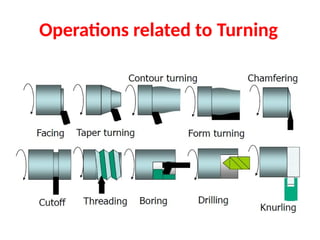
Turning: produce straight, conical, curved, or grooved work pieces
Facing: to produce a flat surface at the end of the part or for making face grooves.
Boring: to enlarge a hole or cylindrical cavity made by a previous process or to produce
circular internal grooves.
Drilling: to produce a hole by fixing a drill in the tailstock
Threading: to produce external or internal threads
Knurling: to produce a regularly shaped roughness on cylindrical surfaces
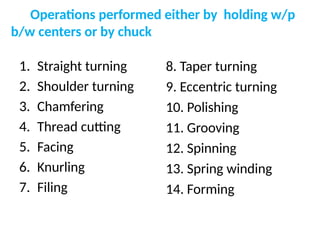
Operations performed either by holding w/p
b/w centers or by chuck
1. Straight turning
2. Shoulder turning
3. Chamfering
4. Thread cutting
5. Facing
6. Knurling
7. Filing
8. Taper turning
9. Eccentric turning
10. Polishing
11. Grooving
12. Spinning
13. Spring winding
14. Forming
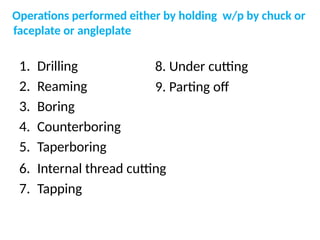
Operations performed either by holding w/p by chuck or
faceplate or angleplate
1. Drilling
2. Reaming
3. Boring
4. Counterboring
5. Taperboring
6. Internal thread cutting
7. Tapping
8. Under cutting
9. Parting off
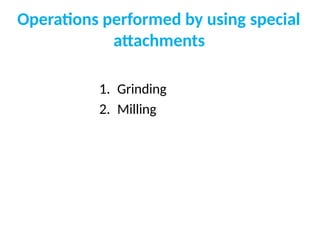
Operations performed by using special
attachments
1. Grinding
2. Milling
Operations related to Turning
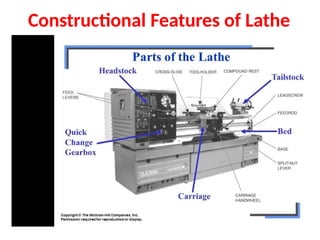
Constructional Features of Lathe
Constructional features &
functions
Lathe Machine consists of
• bed
• headstock
• tailstock
• carriage assembly
• quick change gearbox
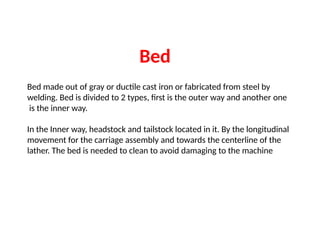
Bed made out of gray or ductile cast iron or fabricated from steel by
welding. Bed is divided to 2 types, first is the outer way and another one
is the inner way.
In the Inner way, headstock and tailstock located in it. By the longitudinal
movement for the carriage assembly and towards the centerline of the
lather. The bed is needed to clean to avoid damaging to the machine
Bed
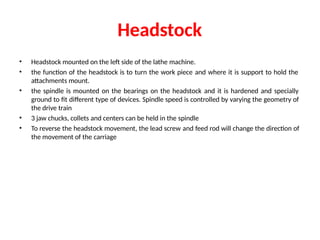
Headstock
• Headstock mounted on the left side of the lathe machine.
• the function of the headstock is to turn the work piece and where it is support to hold the
attachments mount.
• the spindle is mounted on the bearings on the headstock and it is hardened and specially
ground to fit different type of devices. Spindle speed is controlled by varying the geometry of
the drive train
• 3 jaw chucks, collets and centers can be held in the spindle
• To reverse the headstock movement, the lead screw and feed rod will change the direction of
the movement of the carriage
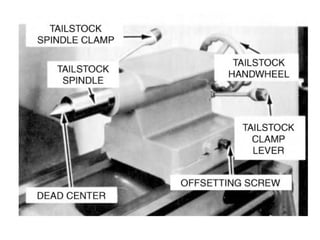
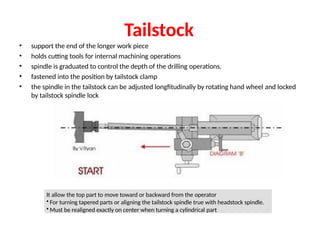
Tailstock
• support the end of the longer work piece
• holds cutting tools for internal machining operations
• spindle is graduated to control the depth of the drilling operations.
• fastened into the position by tailstock clamp
• the spindle in the tailstock can be adjusted longfitudinally by rotating hand wheel and locked
by tailstock spindle lock
It allow the top part to move toward or backward from the operator
• For turning tapered parts or aligning the tailstock spindle true with headstock spindle.
• Must be realigned exactly on center when turning a cylindrical part
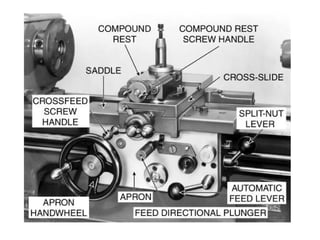
Carriage Assembly
• move along longitudinally
• H- shaped casting fitted on the outer set of ways
• cross slide mounted on the top of the saddle and moves the cutting tool laterally across the
bed by cross feed hand wheel that has a micrometer collar that allows the cutting tools to
remove metal.
• Compound Resta mounted on the cross slide and support the tool post and able to swiveled
to any angle for taper turning or cross - feed hand wheel.
• Aprona mounted beneath the front of saddle and houses the carriage and cross - slide
control mechanisms. The apron hand wheel is used to move the carriage assembly by rack
and gears.
Gearbox
• Gearbox - Mounted on the left side of bed and below the headstock
• Houses gears and other mechanisms that transmit various feed rates from
the headstock spindle to either of lead screw or feed rod
• Lead screw advances the carriage during threading operations, feed rod
moves the carriage during turning, boring and facing operations.
Lathe Accessories
Lathe Accessories
• Divided into two categories
– Work-holding, -supporting, and –driving devices
• Lathe centers, chucks, faceplates
• Mandrels, steady and follower rests
• Lathe dogs, drive plates
– Cutting-tool-holding devices
• Straight and offset tool holders
• Threading tool holders, boring bars
• Turret-type tool posts
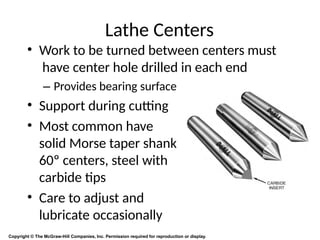
Lathe Centers
• Work to be turned between centers must
have center hole drilled in each end
– Provides bearing surface
• Support during cutting
• Most common have
solid Morse taper shank
60º centers, steel with
carbide tips
• Care to adjust and
lubricate occasionally
Copyright © The McGraw-Hill Companies, Inc. Permission required for reproduction or display.
Chucks
• Used extensively for holding work for
machining operations
– Work large or unusual shape
• Most commonly used lathe chucks
– Three-jaw universal
– Four-jaw independent
– Collet chuck
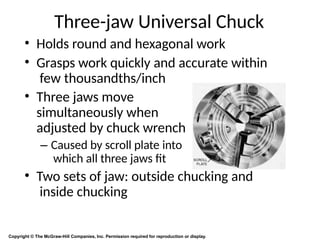
Three-jaw Universal Chuck
• Holds round and hexagonal work
• Grasps work quickly and accurate within
few thousandths/inch
• Three jaws move
simultaneously when
adjusted by chuck wrench
– Caused by scroll plate into
which all three jaws fit
• Two sets of jaw: outside chucking and
inside chucking
Copyright © The McGraw-Hill Companies, Inc. Permission required for reproduction or display.
Four-Jaw Independent Chuck
• Used to hold round, square, hexagonal, and
irregularly shaped workpieces
• Has four jaws
– Each can be adjusted independently by chuck
wrench
• Jaws can be reversed to hold work by inside
diameter
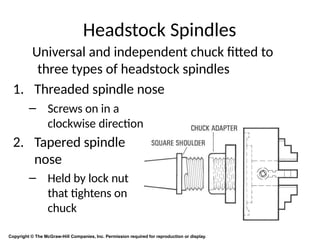
Headstock Spindles
Copyright © The McGraw-Hill Companies, Inc. Permission required for reproduction or display.
Universal and independent chuck fitted to
three types of headstock spindles
1. Threaded spindle nose
– Screws on in a
clockwise direction
2. Tapered spindle
nose
– Held by lock nut
that tightens on
chuck
Headstock Spindles
per
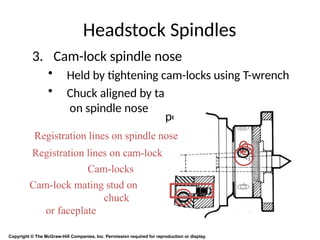
3. Cam-lock spindle nose
• Held by tightening cam-locks using T-wrench
• Chuck aligned by ta
on spindle nose
Registration lines on spindle nose
Registration lines on cam-lock
Cam-locks
Cam-lock mating stud on
chuck
or faceplate
Copyright © The McGraw-Hill Companies, Inc. Permission required for reproduction or display.
Collet Chuck
• Most accurate chuck
• Used for high-precision work
• Spring collets available to hold round,
square, or hexagon-shaped workpieces
• Each collet has range of only few
thousandths of an inch over or under size
stamped on collet
Copyright © The McGraw-Hill Companies, Inc. Permission required for reproduction or display.
|
Collet Chuck
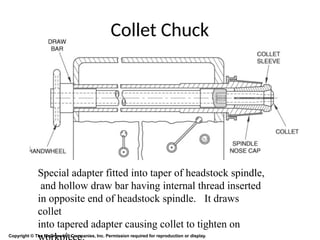
Special adapter fitted into taper of headstock spindle,
and hollow draw bar having internal thread inserted
in opposite end of headstock spindle. It draws
collet
into tapered adapter causing collet to tighten on
Types of Lathe Dogs
Copyright © The McGraw-Hill Companies, Inc. Permission required for reproduction or display.
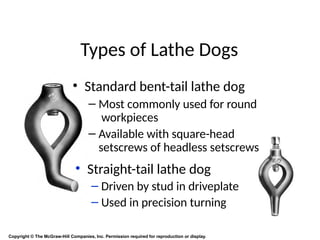
• Standard bent-tail lathe dog
– Most commonly used for round
workpieces
– Available with square-head
setscrews of headless setscrews
• Straight-tail lathe dog
– Driven by stud in driveplate
– Used in precision turning
Types of Lathe Dogs
Copyright © The McGraw-Hill Companies, Inc. Permission required for reproduction or display.
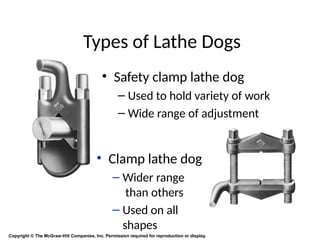
• Safety clamp lathe dog
– Used to hold variety of work
– Wide range of adjustment
• Clamp lathe dog
– Wider range
than others
– Used on all
shapes
Left-Hand Offset Toolholder
Copyright © The McGraw-Hill Companies, Inc. Permission required for reproduction or display.
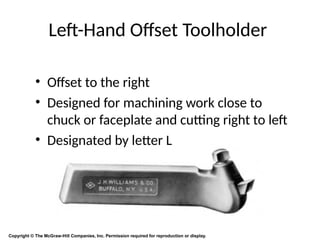
• Offset to the right
• Designed for machining work close to
chuck or faceplate and cutting right to left
• Designated by letter L
Right-Hand Offset Toolholder
Copyright © The McGraw-Hill Companies, Inc. Permission required for reproduction or display.
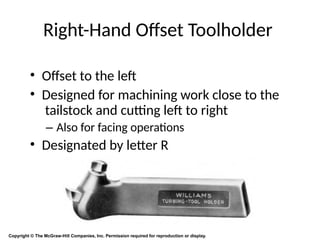
• Offset to the left
• Designed for machining work close to the
tailstock and cutting left to right
– Also for facing operations
• Designated by letter R
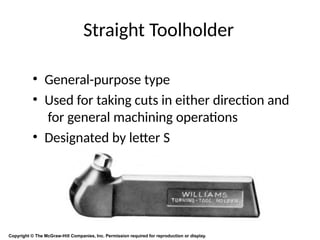
Straight Toolholder
• General-purpose type
• Used for taking cuts in either direction and
for general machining operations
• Designated by letter S
Copyright © The McGraw-Hill Companies, Inc. Permission required for reproduction or display.
Toolholders for Indexable
Carbide Inserts
• Held in holder by cam action or clamps
• Types available
– Conventional
– Turret-type
– Heavy-duty toolposts
Cutting-Off (Parting) Tools
• Used when work must be grooved or
parted off
• Long, thin cutting-off blade locked
securely in toolholder by either cam lock
or locking nut
• Three types of parting toolholders
– Left-hand
– Right-hand
– Straight
Threading Toolholder
• Designed to hold special form-relieved
thread-cutting tool
• Has accurately ground 60º angle
– Maintained throughout life of tool
• Only top of cutting surface sharpened when
becomes dull
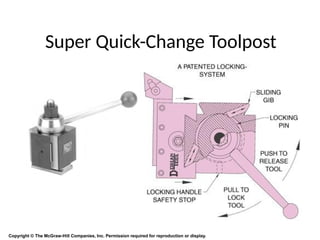
Super Quick-Change Toolpost
Copyright © The McGraw-Hill Companies, Inc. Permission required for reproduction or display.
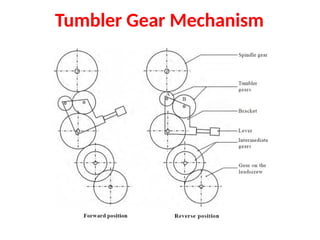
Tumbler Gear Mechanism
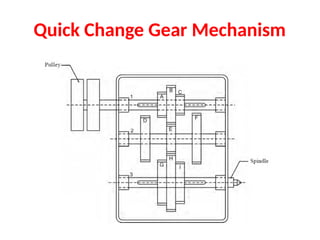
Quick Change Gear Mechanism
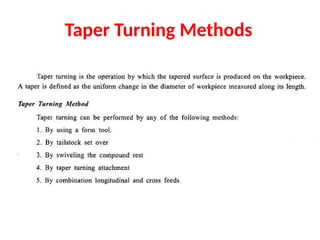
Taper Turning Methods
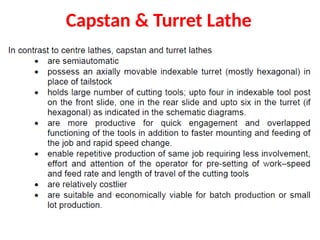
Semi automatic and Automatic
Lathe
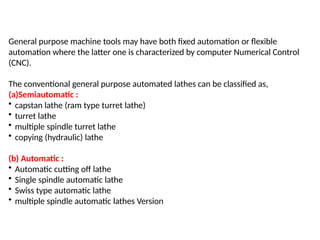
General purpose machine tools may have both fixed automation or flexible
automation where the latter one is characterized by computer Numerical Control
(CNC).
The conventional general purpose automated lathes can be classified as,
(a)Semiautomatic :
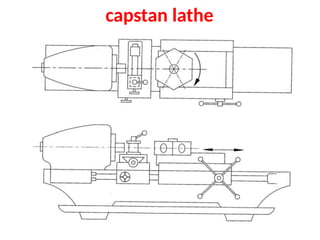
• capstan lathe (ram type turret lathe)
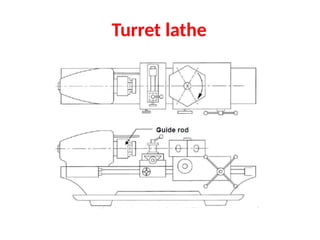
• turret lathe
• multiple spindle turret lathe
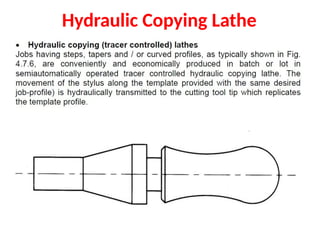
• copying (hydraulic) lathe
(b) Automatic :
• Automatic cutting off lathe
• Single spindle automatic lathe
• Swiss type automatic lathe
• multiple spindle automatic lathes Version
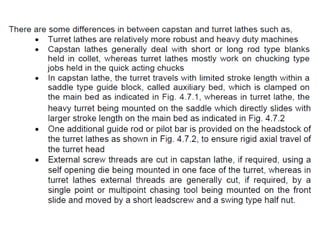
Capstan & Turret Lathe
capstan lathe
Turret lathe
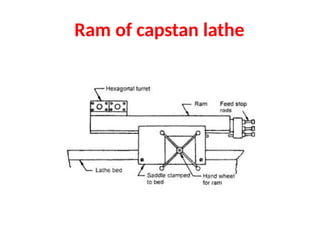
Ram of capstan lathe
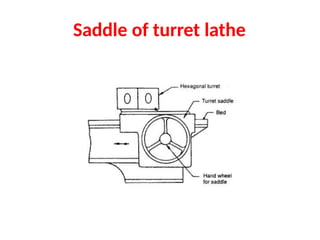
Saddle of turret lathe
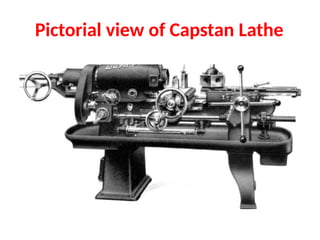
Pictorial view of Capstan Lathe
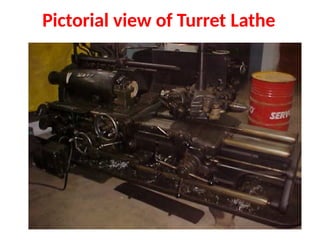
Pictorial view of Turret Lathe
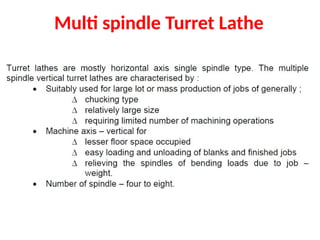
Multi spindle Turret Lathe
Hydraulic Copying Lathe
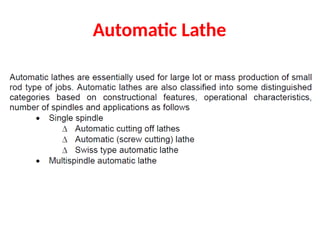
Automatic Lathe
Automatic Lathe
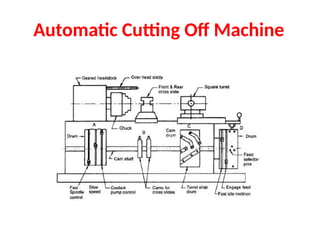
Automatic cutting off lathe
Automatic Cutting Off Machine
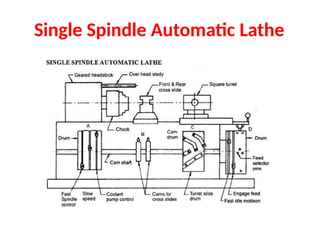
Single Spindle Automatic Lathe
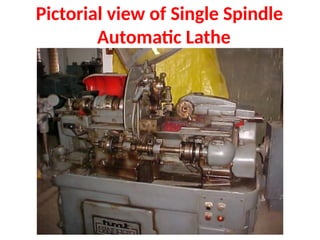
Pictorial view of Single Spindle
Automatic Lathe
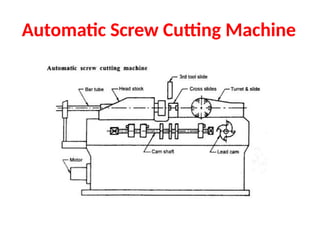
Automatic Screw Cutting Machine
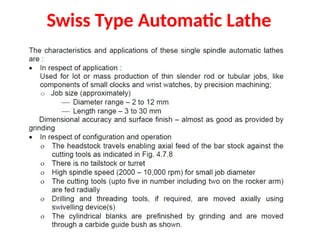
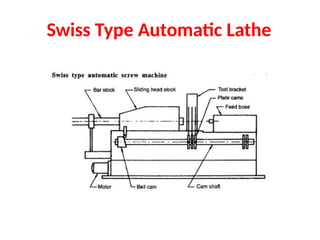
Swiss Type Automatic Lathe
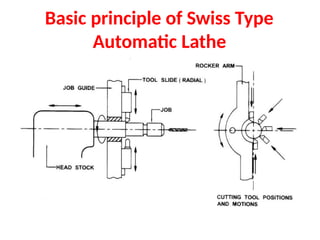
Basic principle of Swiss Type
Automatic Lathe
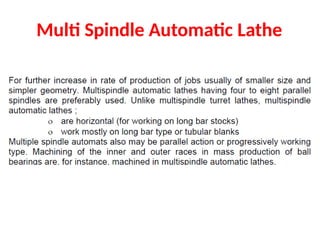
Multi Spindle Automatic Lathe
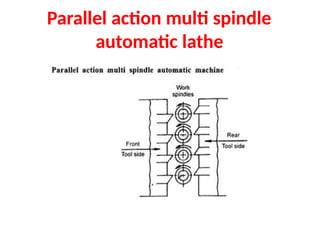
Parallel action multi spindle
automatic lathe
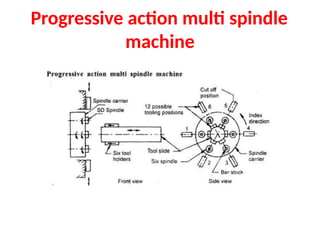
Progressive action multi spindle
machine
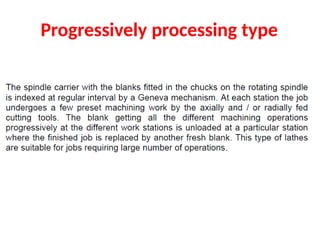
Progressively processing type
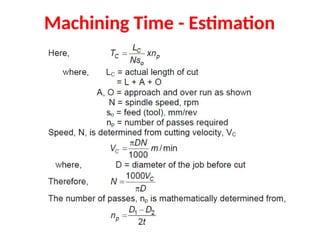
Machining Time - Estimation
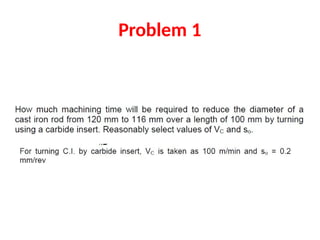
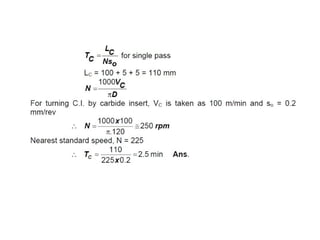
Problem 1
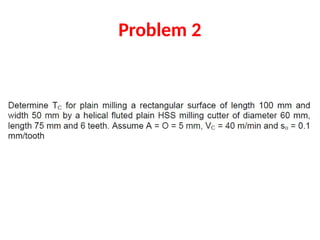
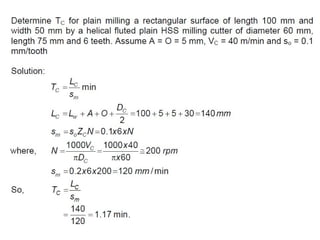
Problem 2
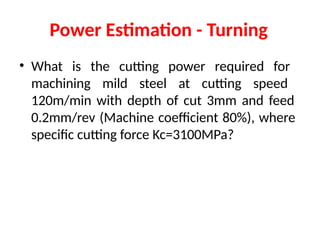
Power Estimation - Turning
• What is the cutting power required for
machining mild steel at cutting speed
120m/min with depth of cut 3mm and feed
0.2mm/rev (Machine coefficient 80%), where
specific cutting force Kc=3100MPa?
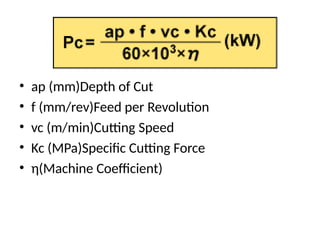
• ap (mm)Depth of Cut
• f (mm/rev)Feed per Revolution
• vc (m/min)Cutting Speed
• Kc (MPa)Specific Cutting Force
• η(Machine Coefficient)
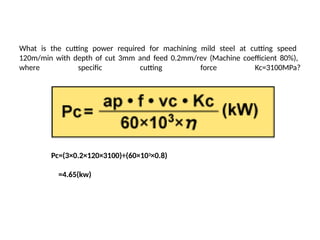
What is the cutting power required for machining mild steel at cutting speed
120m/min with depth of cut 3mm and feed 0.2mm/rev (Machine coefficient 80%),
where specific cutting force Kc=3100MPa?
Pc=(3×0.2×120×3100)÷(60×103×0.8)
=4.65(kw)
Power Estimation - Milling
• What is the cutting power required for milling
tool steel at cutting speed 80m/min. With
depth of cut 2mm, cutting width 80mm, and
table feed 280mm/min by ø250 cutter with 12
insert. Machine coefficient 80%.
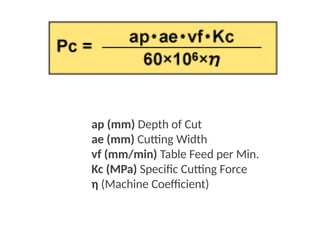
ap (mm) Depth of Cut
ae (mm) Cutting Width
vf (mm/min) Table Feed per Min.
Kc (MPa) Specific Cutting Force
η (Machine Coefficient)
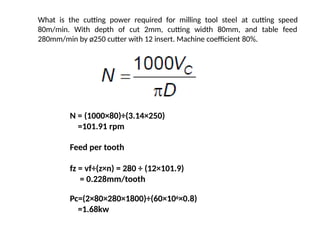
What is the cutting power required for milling tool steel at cutting speed
80m/min. With depth of cut 2mm, cutting width 80mm, and table feed
280mm/min by ø250 cutter with 12 insert. Machine coefficient 80%.
N = (1000×80)÷(3.14×250)
=101.91 rpm
Feed per tooth
fz = vf÷(z×n) = 280 ÷ (12×101.9)
= 0.228mm/tooth
Pc=(2×80×280×1800)÷(60×106×0.8)
=1.68kw


Lathe Manufacturing Technology unit 2 mt1

  • 1.
  • 2.
  • 3.
    Introduction Lathe is amachine, which removes the metal from a piece of work to the required shape & size HENRY MAUDSLAY - 1797
  • 4.
    Types of Lathe EngineLathe The most common form of lathe, motor driven and comes in large variety of sizes and shapes. Bench Lathe A bench top model usually of low power used to make precision machine small work pieces. Tracer Lathe a lathe that has the ability to follow a template to copy a shape or contour.
  • 5.
    Automatic Lathe A lathein which the work piece is automatically fed and removed without use of an operator. Cutting operations are automatically controlled by a sequencer of some form Turret Lathe lathe which have multiple tools mounted on turret either attached to the tailstock or the cross-slide, which allows for quick changes in tooling and cutting operations. Computer Controlled Lathe A highly automated lathe, where both cutting, loading, tool changing, and part unloading are automatically controlled by computer coding.
  • 6.
  • 7.
  • 10.
    Operations on Lathe Turning:produce straight, conical, curved, or grooved work pieces Facing: to produce a flat surface at the end of the part or for making face grooves. Boring: to enlarge a hole or cylindrical cavity made by a previous process or to produce circular internal grooves. Drilling: to produce a hole by fixing a drill in the tailstock Threading: to produce external or internal threads Knurling: to produce a regularly shaped roughness on cylindrical surfaces
  • 12.
    Operations performed eitherby holding w/p b/w centers or by chuck 1. Straight turning 2. Shoulder turning 3. Chamfering 4. Thread cutting 5. Facing 6. Knurling 7. Filing 8. Taper turning 9. Eccentric turning 10. Polishing 11. Grooving 12. Spinning 13. Spring winding 14. Forming
  • 13.
    Operations performed eitherby holding w/p by chuck or faceplate or angleplate 1. Drilling 2. Reaming 3. Boring 4. Counterboring 5. Taperboring 6. Internal thread cutting 7. Tapping 8. Under cutting 9. Parting off
  • 14.
    Operations performed byusing special attachments 1. Grinding 2. Milling
  • 15.
  • 16.
  • 19.
    Constructional features & functions LatheMachine consists of • bed • headstock • tailstock • carriage assembly • quick change gearbox
  • 20.
    Bed made outof gray or ductile cast iron or fabricated from steel by welding. Bed is divided to 2 types, first is the outer way and another one is the inner way. In the Inner way, headstock and tailstock located in it. By the longitudinal movement for the carriage assembly and towards the centerline of the lather. The bed is needed to clean to avoid damaging to the machine Bed
  • 21.
    Headstock • Headstock mountedon the left side of the lathe machine. • the function of the headstock is to turn the work piece and where it is support to hold the attachments mount. • the spindle is mounted on the bearings on the headstock and it is hardened and specially ground to fit different type of devices. Spindle speed is controlled by varying the geometry of the drive train • 3 jaw chucks, collets and centers can be held in the spindle • To reverse the headstock movement, the lead screw and feed rod will change the direction of the movement of the carriage
  • 22.
    Tailstock • support theend of the longer work piece • holds cutting tools for internal machining operations • spindle is graduated to control the depth of the drilling operations. • fastened into the position by tailstock clamp • the spindle in the tailstock can be adjusted longfitudinally by rotating hand wheel and locked by tailstock spindle lock It allow the top part to move toward or backward from the operator • For turning tapered parts or aligning the tailstock spindle true with headstock spindle. • Must be realigned exactly on center when turning a cylindrical part
  • 23.
    Carriage Assembly • movealong longitudinally • H- shaped casting fitted on the outer set of ways • cross slide mounted on the top of the saddle and moves the cutting tool laterally across the bed by cross feed hand wheel that has a micrometer collar that allows the cutting tools to remove metal. • Compound Resta mounted on the cross slide and support the tool post and able to swiveled to any angle for taper turning or cross - feed hand wheel. • Aprona mounted beneath the front of saddle and houses the carriage and cross - slide control mechanisms. The apron hand wheel is used to move the carriage assembly by rack and gears.
  • 24.
    Gearbox • Gearbox -Mounted on the left side of bed and below the headstock • Houses gears and other mechanisms that transmit various feed rates from the headstock spindle to either of lead screw or feed rod • Lead screw advances the carriage during threading operations, feed rod moves the carriage during turning, boring and facing operations.
  • 25.
  • 26.
    Lathe Accessories • Dividedinto two categories – Work-holding, -supporting, and –driving devices • Lathe centers, chucks, faceplates • Mandrels, steady and follower rests • Lathe dogs, drive plates – Cutting-tool-holding devices • Straight and offset tool holders • Threading tool holders, boring bars • Turret-type tool posts
  • 27.
    Lathe Centers • Workto be turned between centers must have center hole drilled in each end – Provides bearing surface • Support during cutting • Most common have solid Morse taper shank 60º centers, steel with carbide tips • Care to adjust and lubricate occasionally Copyright © The McGraw-Hill Companies, Inc. Permission required for reproduction or display.
  • 28.
    Chucks • Used extensivelyfor holding work for machining operations – Work large or unusual shape • Most commonly used lathe chucks – Three-jaw universal – Four-jaw independent – Collet chuck
  • 29.
    Three-jaw Universal Chuck •Holds round and hexagonal work • Grasps work quickly and accurate within few thousandths/inch • Three jaws move simultaneously when adjusted by chuck wrench – Caused by scroll plate into which all three jaws fit • Two sets of jaw: outside chucking and inside chucking Copyright © The McGraw-Hill Companies, Inc. Permission required for reproduction or display.
  • 30.
    Four-Jaw Independent Chuck •Used to hold round, square, hexagonal, and irregularly shaped workpieces • Has four jaws – Each can be adjusted independently by chuck wrench • Jaws can be reversed to hold work by inside diameter
  • 31.
    Headstock Spindles Copyright ©The McGraw-Hill Companies, Inc. Permission required for reproduction or display. Universal and independent chuck fitted to three types of headstock spindles 1. Threaded spindle nose – Screws on in a clockwise direction 2. Tapered spindle nose – Held by lock nut that tightens on chuck
  • 32.
    Headstock Spindles per 3. Cam-lockspindle nose • Held by tightening cam-locks using T-wrench • Chuck aligned by ta on spindle nose Registration lines on spindle nose Registration lines on cam-lock Cam-locks Cam-lock mating stud on chuck or faceplate Copyright © The McGraw-Hill Companies, Inc. Permission required for reproduction or display.
  • 33.
    Collet Chuck • Mostaccurate chuck • Used for high-precision work • Spring collets available to hold round, square, or hexagon-shaped workpieces • Each collet has range of only few thousandths of an inch over or under size stamped on collet
  • 34.
    Copyright © TheMcGraw-Hill Companies, Inc. Permission required for reproduction or display. | Collet Chuck Special adapter fitted into taper of headstock spindle, and hollow draw bar having internal thread inserted in opposite end of headstock spindle. It draws collet into tapered adapter causing collet to tighten on
  • 35.
    Types of LatheDogs Copyright © The McGraw-Hill Companies, Inc. Permission required for reproduction or display. • Standard bent-tail lathe dog – Most commonly used for round workpieces – Available with square-head setscrews of headless setscrews • Straight-tail lathe dog – Driven by stud in driveplate – Used in precision turning
  • 36.
    Types of LatheDogs Copyright © The McGraw-Hill Companies, Inc. Permission required for reproduction or display. • Safety clamp lathe dog – Used to hold variety of work – Wide range of adjustment • Clamp lathe dog – Wider range than others – Used on all shapes
  • 37.
    Left-Hand Offset Toolholder Copyright© The McGraw-Hill Companies, Inc. Permission required for reproduction or display. • Offset to the right • Designed for machining work close to chuck or faceplate and cutting right to left • Designated by letter L
  • 38.
    Right-Hand Offset Toolholder Copyright© The McGraw-Hill Companies, Inc. Permission required for reproduction or display. • Offset to the left • Designed for machining work close to the tailstock and cutting left to right – Also for facing operations • Designated by letter R
  • 39.
    Straight Toolholder • General-purposetype • Used for taking cuts in either direction and for general machining operations • Designated by letter S Copyright © The McGraw-Hill Companies, Inc. Permission required for reproduction or display.
  • 40.
    Toolholders for Indexable CarbideInserts • Held in holder by cam action or clamps • Types available – Conventional – Turret-type – Heavy-duty toolposts
  • 42.
    Cutting-Off (Parting) Tools •Used when work must be grooved or parted off • Long, thin cutting-off blade locked securely in toolholder by either cam lock or locking nut • Three types of parting toolholders – Left-hand – Right-hand – Straight
  • 43.
    Threading Toolholder • Designedto hold special form-relieved thread-cutting tool • Has accurately ground 60º angle – Maintained throughout life of tool • Only top of cutting surface sharpened when becomes dull
  • 44.
    Super Quick-Change Toolpost Copyright© The McGraw-Hill Companies, Inc. Permission required for reproduction or display.
  • 45.
  • 46.
  • 47.
  • 48.
    Semi automatic andAutomatic Lathe
  • 49.
    General purpose machinetools may have both fixed automation or flexible automation where the latter one is characterized by computer Numerical Control (CNC). The conventional general purpose automated lathes can be classified as, (a)Semiautomatic : • capstan lathe (ram type turret lathe) • turret lathe • multiple spindle turret lathe • copying (hydraulic) lathe (b) Automatic : • Automatic cutting off lathe • Single spindle automatic lathe • Swiss type automatic lathe • multiple spindle automatic lathes Version
  • 50.
  • 51.
  • 52.
  • 54.
  • 55.
  • 56.
    Pictorial view ofCapstan Lathe
  • 57.
    Pictorial view ofTurret Lathe
  • 58.
  • 59.
  • 60.
  • 61.
  • 62.
  • 63.
  • 64.
  • 65.
  • 66.
    Pictorial view ofSingle Spindle Automatic Lathe
  • 67.
  • 68.
  • 69.
  • 70.
    Basic principle ofSwiss Type Automatic Lathe
  • 71.
  • 72.
    Parallel action multispindle automatic lathe
  • 73.
    Progressive action multispindle machine
  • 74.
  • 75.
    Machining Time -Estimation
  • 76.
  • 78.
  • 80.
    Power Estimation -Turning • What is the cutting power required for machining mild steel at cutting speed 120m/min with depth of cut 3mm and feed 0.2mm/rev (Machine coefficient 80%), where specific cutting force Kc=3100MPa?
  • 81.
    • ap (mm)Depthof Cut • f (mm/rev)Feed per Revolution • vc (m/min)Cutting Speed • Kc (MPa)Specific Cutting Force • η(Machine Coefficient)
  • 82.
    What is thecutting power required for machining mild steel at cutting speed 120m/min with depth of cut 3mm and feed 0.2mm/rev (Machine coefficient 80%), where specific cutting force Kc=3100MPa? Pc=(3×0.2×120×3100)÷(60×103×0.8) =4.65(kw)
  • 83.
    Power Estimation -Milling • What is the cutting power required for milling tool steel at cutting speed 80m/min. With depth of cut 2mm, cutting width 80mm, and table feed 280mm/min by ø250 cutter with 12 insert. Machine coefficient 80%.
  • 84.
    ap (mm) Depthof Cut ae (mm) Cutting Width vf (mm/min) Table Feed per Min. Kc (MPa) Specific Cutting Force η (Machine Coefficient)
  • 85.
    What is thecutting power required for milling tool steel at cutting speed 80m/min. With depth of cut 2mm, cutting width 80mm, and table feed 280mm/min by ø250 cutter with 12 insert. Machine coefficient 80%. N = (1000×80)÷(3.14×250) =101.91 rpm Feed per tooth fz = vf÷(z×n) = 280 ÷ (12×101.9) = 0.228mm/tooth Pc=(2×80×280×1800)÷(60×106×0.8) =1.68kw