Lymphatic System: 2
Dr. Komal Parmar
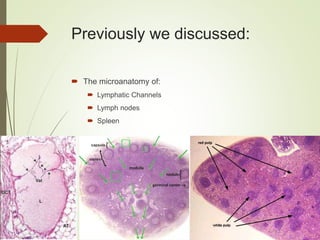
Previously we discussed:
 The microanatomy of:
 Lymphatic Channels
 Lymph nodes
 Spleen
Today’s Objectives:
 Microanatomy of
 Thymus
 Tonsils
 Lymphoid tissue associated with epithelial surface
 Tertiary lymphoid organs
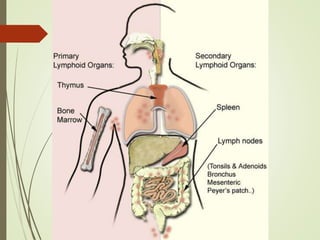
Thymus
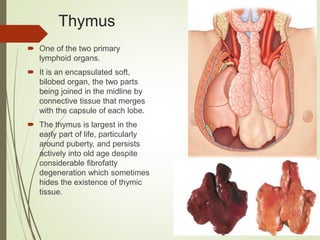
 One of the two primary
lymphoid organs.
 It is an encapsulated soft,
bilobed organ, the two parts
being joined in the midline by
connective tissue that merges
with the capsule of each lobe.
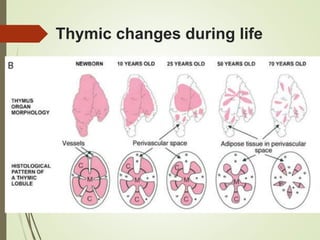
 The thymus is largest in the
early part of life, particularly
around puberty, and persists
actively into old age despite
considerable fibrofatty
degeneration which sometimes
hides the existence of thymic
tissue.
 Site of mature T
lymphocyte
production.
 Acquiring immune
tolerance to the
body’s own
components.
 Also part of the
neuroimmunologic
al and
neuroendocrine
axes of the body
General Architecture
 Embryological
Consideration:
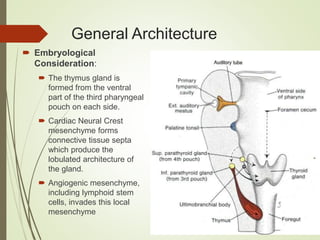
 The thymus gland is
formed from the ventral
part of the third pharyngeal
pouch on each side.
 Cardiac Neural Crest
mesenchyme forms
connective tissue septa
which produce the
lobulated architecture of
the gland.
 Angiogenic mesenchyme,
including lymphoid stem
cells, invades this local
mesenchyme
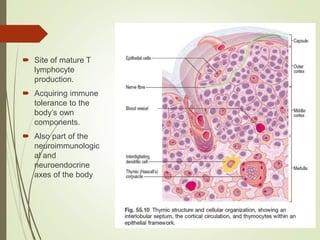
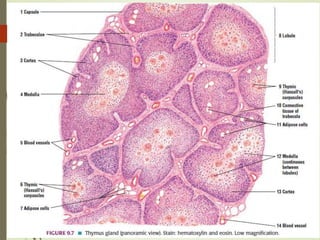
Capsule
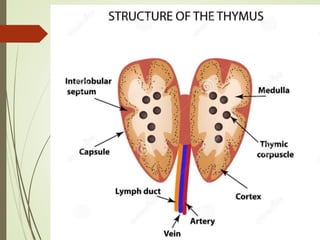
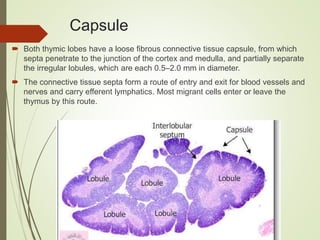
 Both thymic lobes have a loose fibrous connective tissue capsule, from which
septa penetrate to the junction of the cortex and medulla, and partially separate
the irregular lobules, which are each 0.5–2.0 mm in diameter.
 The connective tissue septa form a route of entry and exit for blood vessels and
nerves and carry efferent lymphatics. Most migrant cells enter or leave the
thymus by this route.
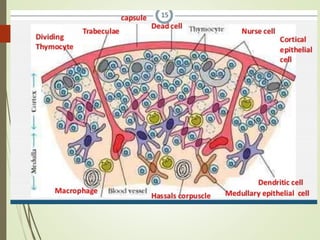
Cortex
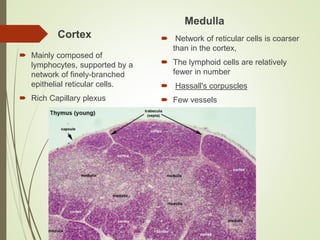
 Mainly composed of
lymphocytes, supported by a
network of finely-branched
epithelial reticular cells.
 Rich Capillary plexus
Medulla
 Network of reticular cells is coarser
than in the cortex,
 The lymphoid cells are relatively
fewer in number
 Hassall's corpuscles
 Few vessels
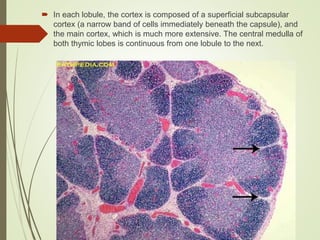
 In each lobule, the cortex is composed of a superficial subcapsular
cortex (a narrow band of cells immediately beneath the capsule), and
the main cortex, which is much more extensive. The central medulla of
both thymic lobes is continuous from one lobule to the next.
Epithelial framework
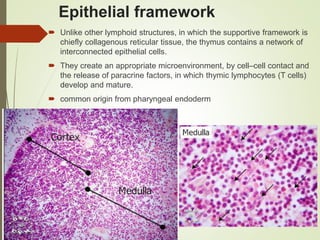
 Unlike other lymphoid structures, in which the supportive framework is
chiefly collagenous reticular tissue, the thymus contains a network of
interconnected epithelial cells.
 They create an appropriate microenvironment, by cell–cell contact and
the release of paracrine factors, in which thymic lymphocytes (T cells)
develop and mature.
 common origin from pharyngeal endoderm
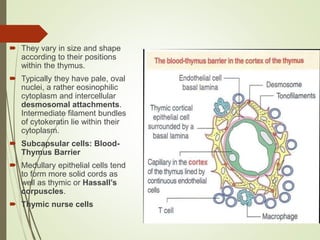
 They vary in size and shape
according to their positions
within the thymus.
 Typically they have pale, oval
nuclei, a rather eosinophilic
cytoplasm and intercellular
desmosomal attachments.
Intermediate filament bundles
of cytokeratin lie within their
cytoplasm.
 Subcapsular cells: Blood-
Thymus Barrier
 Medullary epithelial cells tend
to form more solid cords as
well as thymic or Hassall’s
corpuscles.
 Thymic nurse cells
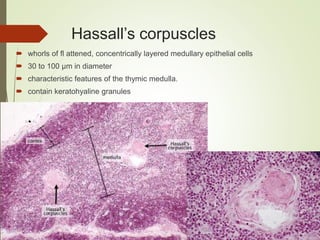
Hassall’s corpuscles
 whorls of fl attened, concentrically layered medullary epithelial cells
 30 to 100 μm in diameter
 characteristic features of the thymic medulla.
 contain keratohyaline granules
Thymic Nurse Cells
 Large epithelial cells may be associated with around 50 or more
thymocytes.
 Found in the cortex of thymus and also in cortico-medullary junction,
Myoid Cells
 Thymic myoid cells correspond to a muscle-like cell population present in the
thymic medulla.
 They are large, rounded cells, and possess a central nucleus surrounded by
irregularly arranged bundles of myofilaments.
 Their functions are unknown, although it has been suggested that their
contractions might aid the movement of lymphoid cells across or out of the
thymus.
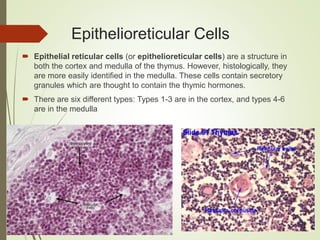
Epithelioreticular Cells
 Epithelial reticular cells (or epithelioreticular cells) are a structure in
both the cortex and medulla of the thymus. However, histologically, they
are more easily identified in the medulla. These cells contain secretory
granules which are thought to contain the thymic hormones.
 There are six different types: Types 1-3 are in the cortex, and types 4-6
are in the medulla
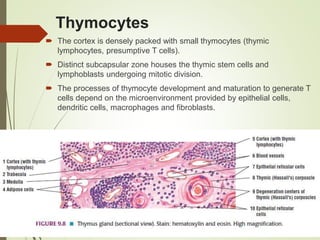
Thymocytes
 The cortex is densely packed with small thymocytes (thymic
lymphocytes, presumptive T cells).
 Distinct subcapsular zone houses the thymic stem cells and
lymphoblasts undergoing mitotic division.
 The processes of thymocyte development and maturation to generate T
cells depend on the microenvironment provided by epithelial cells,
dendritic cells, macrophages and fibroblasts.
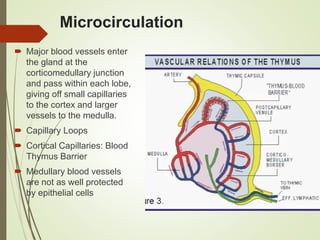
Microcirculation
 Major blood vessels enter
the gland at the
corticomedullary junction
and pass within each lobe,
giving off small capillaries
to the cortex and larger
vessels to the medulla.
 Capillary Loops
 Cortical Capillaries: Blood
Thymus Barrier
 Medullary blood vessels
are not as well protected
by epithelial cells
Thymic changes during life
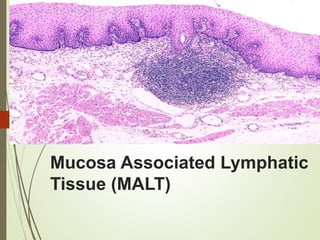
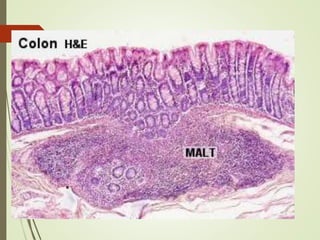
Mucosa Associated Lymphatic
Tissue (MALT)
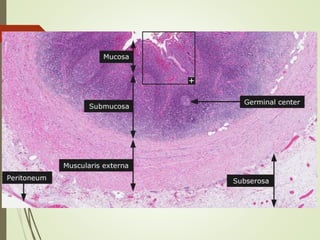
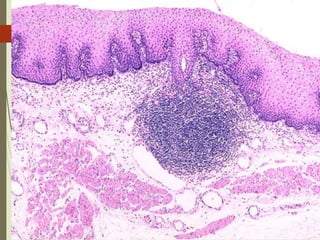
 unencapsulated lymphoid tissue
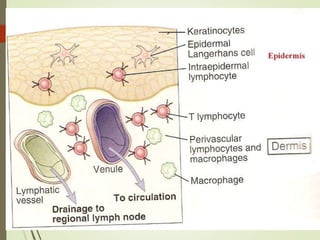
 exist in the walls of the alimentary, respiratory, reproductive
and urinary tracts, and in the skin.
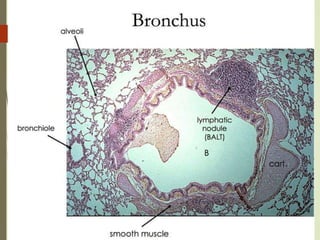
 the main subclasses are gut-associated lymphoid tissue
(GALT) and bronchus-associated lymphoid tissue (BALT).
 located in the lamina propria and in the submucosa as
discrete follicles or nodules
 More scattered cells, derived from these follicles, are found
throughout the lamina propria and in the base of the
epithelium.
 Macroscopically visible lymphoid masses, notably the
peripharyngeal lymphoid (Waldeyer’s) ring of tonsillar tissue
(palatine, nasopharyngeal, tubal and lingual), and the
Peyer’s patches of the small intestine.
 Lymphocyte populations are supported mechanically by a fi
ne network of fine type III collagen (reticulin) fibres and
associated fi broblasts, as they are in lymph nodes.
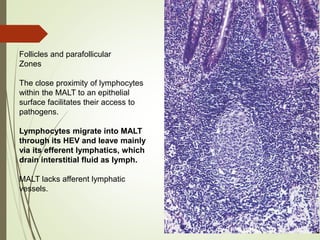
Follicles and parafollicular
Zones
The close proximity of lymphocytes
within the MALT to an epithelial
surface facilitates their access to
pathogens.
Lymphocytes migrate into MALT
through its HEV and leave mainly
via its efferent lymphatics, which
drain interstitial fluid as lymph.
MALT lacks afferent lymphatic
vessels.
Changes in the overlying
epithelium
 The main function of B lymphocytes in MALT is to produce
IgA for secretion into the lumen of the tracts which they line.
 Epithelium samples and transfers these antigens to
antigen-presenting cells.
 In the small and large intestine these specialized epithelial
cells have characteristic short microvilli on their luminal
surface and are known as microfold (M) cells.
 In the palatine tonsils they include modified stratifi ed
squamous reticulated epithelial cells.
Gut Associated Lymphoid
Tissue (GALT)
 The following comprise lymphoid tissue in the gut:
 Waldeyer's tonsillar ring
 Peyer's patches
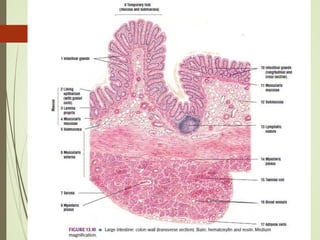
 Lymphoid aggregates in the appendix and large
intestine
 Lymphoid tissue accumulating with age in
the stomach
 Small lymphoid aggregates in the esophagus
 Diffusely distributed lymphoid cells and plasma cells
in the lamina propria of the gut
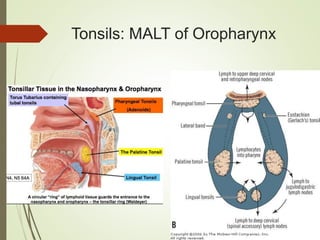
Tonsils: MALT of Oropharynx
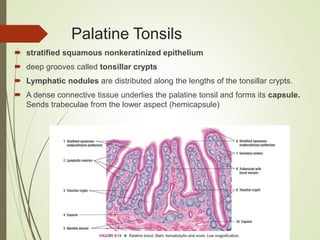
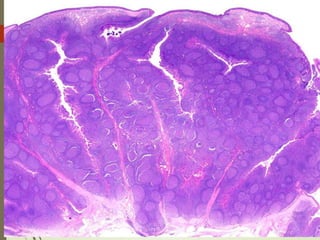
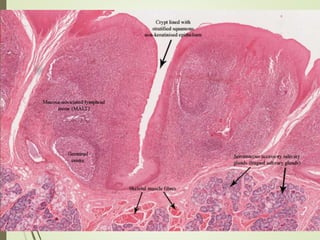
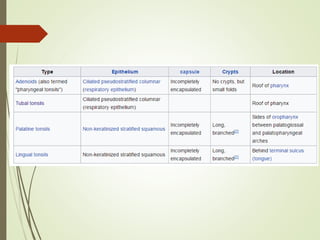
Palatine Tonsils
 stratified squamous nonkeratinized epithelium
 deep grooves called tonsillar crypts
 Lymphatic nodules are distributed along the lengths of the tonsillar crypts.
 A dense connective tissue underlies the palatine tonsil and forms its capsule.
Sends trabeculae from the lower aspect (hemicapsule)
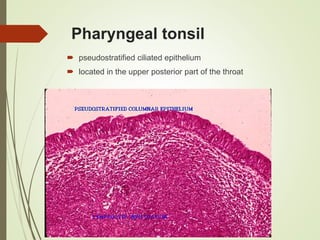
Pharyngeal tonsil
 pseudostratified ciliated epithelium
 located in the upper posterior part of the throat
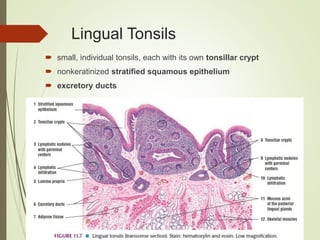
Lingual Tonsils
 small, individual tonsils, each with its own tonsillar crypt
 nonkeratinized stratified squamous epithelium
 excretory ducts
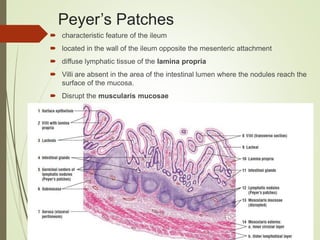
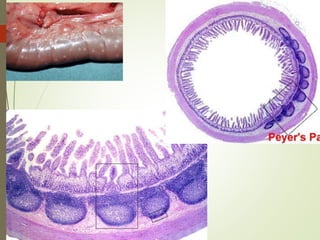
Peyer’s Patches
 characteristic feature of the ileum
 located in the wall of the ileum opposite the mesenteric attachment
 diffuse lymphatic tissue of the lamina propria
 Villi are absent in the area of the intestinal lumen where the nodules reach the
surface of the mucosa.
 Disrupt the muscularis mucosae
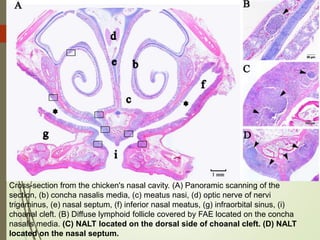
Cross-section from the chicken's nasal cavity. (A) Panoramic scanning of the
section, (b) concha nasalis media, (c) meatus nasi, (d) optic nerve of nervi
trigeminus, (e) nasal septum, (f) inferior nasal meatus, (g) infraorbital sinus, (i)
choanal cleft. (B) Diffuse lymphoid follicle covered by FAE located on the concha
nasalis media. (C) NALT located on the dorsal side of choanal cleft. (D) NALT
located on the nasal septum.
Tertiary Lymphoid Organs
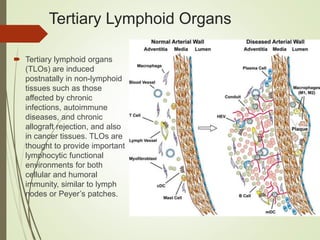
 Tertiary lymphoid organs
(TLOs) are induced
postnatally in non-lymphoid
tissues such as those
affected by chronic
infections, autoimmune
diseases, and chronic
allograft rejection, and also
in cancer tissues. TLOs are
thought to provide important
lymphocytic functional
environments for both
cellular and humoral
immunity, similar to lymph
nodes or Peyer’s patches.
Lymphatic system- Thymus and MALT

Lymphatic system- Thymus and MALT

  • 1.
  • 2.
    Previously we discussed: The microanatomy of:  Lymphatic Channels  Lymph nodes  Spleen
  • 3.
    Today’s Objectives:  Microanatomyof  Thymus  Tonsils  Lymphoid tissue associated with epithelial surface  Tertiary lymphoid organs
  • 5.
    Thymus  One ofthe two primary lymphoid organs.  It is an encapsulated soft, bilobed organ, the two parts being joined in the midline by connective tissue that merges with the capsule of each lobe.  The thymus is largest in the early part of life, particularly around puberty, and persists actively into old age despite considerable fibrofatty degeneration which sometimes hides the existence of thymic tissue.
  • 6.
     Site ofmature T lymphocyte production.  Acquiring immune tolerance to the body’s own components.  Also part of the neuroimmunologic al and neuroendocrine axes of the body
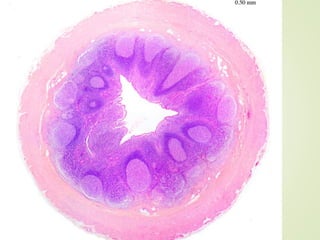
  • 7.
    General Architecture  Embryological Consideration: The thymus gland is formed from the ventral part of the third pharyngeal pouch on each side.  Cardiac Neural Crest mesenchyme forms connective tissue septa which produce the lobulated architecture of the gland.  Angiogenic mesenchyme, including lymphoid stem cells, invades this local mesenchyme
  • 9.
    Capsule  Both thymiclobes have a loose fibrous connective tissue capsule, from which septa penetrate to the junction of the cortex and medulla, and partially separate the irregular lobules, which are each 0.5–2.0 mm in diameter.  The connective tissue septa form a route of entry and exit for blood vessels and nerves and carry efferent lymphatics. Most migrant cells enter or leave the thymus by this route.
  • 10.
    Cortex  Mainly composedof lymphocytes, supported by a network of finely-branched epithelial reticular cells.  Rich Capillary plexus Medulla  Network of reticular cells is coarser than in the cortex,  The lymphoid cells are relatively fewer in number  Hassall's corpuscles  Few vessels
  • 11.
     In eachlobule, the cortex is composed of a superficial subcapsular cortex (a narrow band of cells immediately beneath the capsule), and the main cortex, which is much more extensive. The central medulla of both thymic lobes is continuous from one lobule to the next.
  • 12.
    Epithelial framework  Unlikeother lymphoid structures, in which the supportive framework is chiefly collagenous reticular tissue, the thymus contains a network of interconnected epithelial cells.  They create an appropriate microenvironment, by cell–cell contact and the release of paracrine factors, in which thymic lymphocytes (T cells) develop and mature.  common origin from pharyngeal endoderm
  • 13.
     They varyin size and shape according to their positions within the thymus.  Typically they have pale, oval nuclei, a rather eosinophilic cytoplasm and intercellular desmosomal attachments. Intermediate filament bundles of cytokeratin lie within their cytoplasm.  Subcapsular cells: Blood- Thymus Barrier  Medullary epithelial cells tend to form more solid cords as well as thymic or Hassall’s corpuscles.  Thymic nurse cells
  • 14.
    Hassall’s corpuscles  whorlsof fl attened, concentrically layered medullary epithelial cells  30 to 100 μm in diameter  characteristic features of the thymic medulla.  contain keratohyaline granules
  • 15.
    Thymic Nurse Cells Large epithelial cells may be associated with around 50 or more thymocytes.  Found in the cortex of thymus and also in cortico-medullary junction, Myoid Cells  Thymic myoid cells correspond to a muscle-like cell population present in the thymic medulla.  They are large, rounded cells, and possess a central nucleus surrounded by irregularly arranged bundles of myofilaments.  Their functions are unknown, although it has been suggested that their contractions might aid the movement of lymphoid cells across or out of the thymus.
  • 17.
    Epithelioreticular Cells  Epithelialreticular cells (or epithelioreticular cells) are a structure in both the cortex and medulla of the thymus. However, histologically, they are more easily identified in the medulla. These cells contain secretory granules which are thought to contain the thymic hormones.  There are six different types: Types 1-3 are in the cortex, and types 4-6 are in the medulla
  • 18.
    Thymocytes  The cortexis densely packed with small thymocytes (thymic lymphocytes, presumptive T cells).  Distinct subcapsular zone houses the thymic stem cells and lymphoblasts undergoing mitotic division.  The processes of thymocyte development and maturation to generate T cells depend on the microenvironment provided by epithelial cells, dendritic cells, macrophages and fibroblasts.
  • 19.
    Microcirculation  Major bloodvessels enter the gland at the corticomedullary junction and pass within each lobe, giving off small capillaries to the cortex and larger vessels to the medulla.  Capillary Loops  Cortical Capillaries: Blood Thymus Barrier  Medullary blood vessels are not as well protected by epithelial cells
  • 20.
  • 22.
  • 23.
     unencapsulated lymphoidtissue  exist in the walls of the alimentary, respiratory, reproductive and urinary tracts, and in the skin.  the main subclasses are gut-associated lymphoid tissue (GALT) and bronchus-associated lymphoid tissue (BALT).  located in the lamina propria and in the submucosa as discrete follicles or nodules  More scattered cells, derived from these follicles, are found throughout the lamina propria and in the base of the epithelium.  Macroscopically visible lymphoid masses, notably the peripharyngeal lymphoid (Waldeyer’s) ring of tonsillar tissue (palatine, nasopharyngeal, tubal and lingual), and the Peyer’s patches of the small intestine.  Lymphocyte populations are supported mechanically by a fi ne network of fine type III collagen (reticulin) fibres and associated fi broblasts, as they are in lymph nodes.
  • 25.
    Follicles and parafollicular Zones Theclose proximity of lymphocytes within the MALT to an epithelial surface facilitates their access to pathogens. Lymphocytes migrate into MALT through its HEV and leave mainly via its efferent lymphatics, which drain interstitial fluid as lymph. MALT lacks afferent lymphatic vessels.
  • 26.
    Changes in theoverlying epithelium  The main function of B lymphocytes in MALT is to produce IgA for secretion into the lumen of the tracts which they line.  Epithelium samples and transfers these antigens to antigen-presenting cells.  In the small and large intestine these specialized epithelial cells have characteristic short microvilli on their luminal surface and are known as microfold (M) cells.  In the palatine tonsils they include modified stratifi ed squamous reticulated epithelial cells.
  • 27.
    Gut Associated Lymphoid Tissue(GALT)  The following comprise lymphoid tissue in the gut:  Waldeyer's tonsillar ring  Peyer's patches  Lymphoid aggregates in the appendix and large intestine  Lymphoid tissue accumulating with age in the stomach  Small lymphoid aggregates in the esophagus  Diffusely distributed lymphoid cells and plasma cells in the lamina propria of the gut
  • 28.
    Tonsils: MALT ofOropharynx
  • 29.
    Palatine Tonsils  stratifiedsquamous nonkeratinized epithelium  deep grooves called tonsillar crypts  Lymphatic nodules are distributed along the lengths of the tonsillar crypts.  A dense connective tissue underlies the palatine tonsil and forms its capsule. Sends trabeculae from the lower aspect (hemicapsule)
  • 31.
    Pharyngeal tonsil  pseudostratifiedciliated epithelium  located in the upper posterior part of the throat
  • 32.
    Lingual Tonsils  small,individual tonsils, each with its own tonsillar crypt  nonkeratinized stratified squamous epithelium  excretory ducts
  • 35.
    Peyer’s Patches  characteristicfeature of the ileum  located in the wall of the ileum opposite the mesenteric attachment  diffuse lymphatic tissue of the lamina propria  Villi are absent in the area of the intestinal lumen where the nodules reach the surface of the mucosa.  Disrupt the muscularis mucosae
  • 43.
    Cross-section from thechicken's nasal cavity. (A) Panoramic scanning of the section, (b) concha nasalis media, (c) meatus nasi, (d) optic nerve of nervi trigeminus, (e) nasal septum, (f) inferior nasal meatus, (g) infraorbital sinus, (i) choanal cleft. (B) Diffuse lymphoid follicle covered by FAE located on the concha nasalis media. (C) NALT located on the dorsal side of choanal cleft. (D) NALT located on the nasal septum.
  • 45.
    Tertiary Lymphoid Organs Tertiary lymphoid organs (TLOs) are induced postnatally in non-lymphoid tissues such as those affected by chronic infections, autoimmune diseases, and chronic allograft rejection, and also in cancer tissues. TLOs are thought to provide important lymphocytic functional environments for both cellular and humoral immunity, similar to lymph nodes or Peyer’s patches.