Elements of Electrical Engineering
(2110005)
Mesh Analysis and Nodal
analysis with derivations and
Examples
Made By : Komal Kotak
Mesh Analysis
Mesh is a loop that doesn’t consists of any other loop
inside it. Mesh analysis technique, uses mesh
currents as variables , instead of currents in the eleme
nts to analyze the circuit. Therefore, this method
absolutely reduces the number of equations to be
solved . Mesh analysis applies the Kirchhoff’s Voltage
Law (KVL) to determine the unknown currents in a
given circuit. Mesh analysis is also called as
mesh-current method or loop analysis. After finding
the mesh currents using KVL, voltages anywhere in a
given circuit can be determined by using Ohms law.
Mesh Analysis
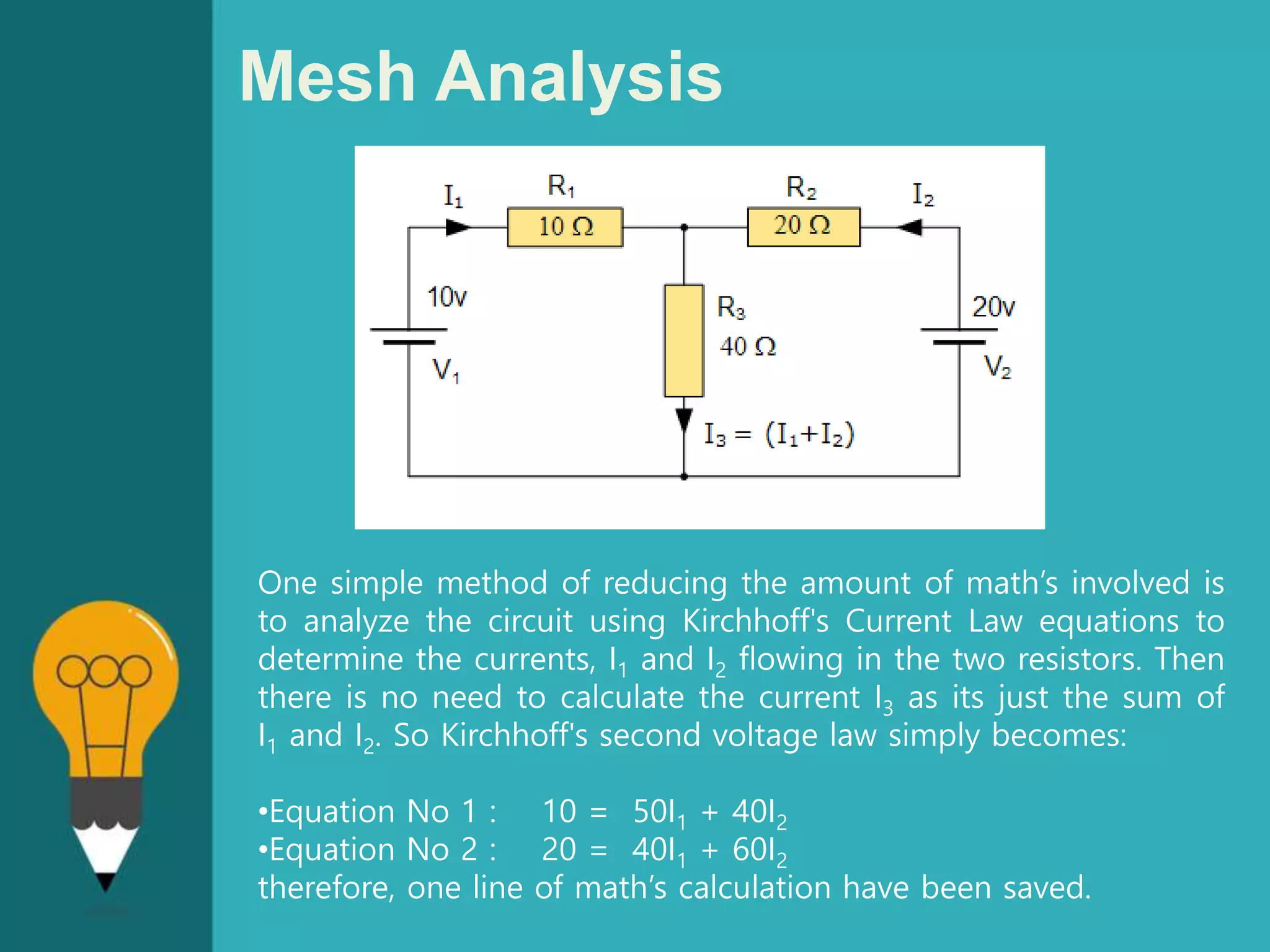
One simple method of reducing the amount of math’s involved is
to analyze the circuit using Kirchhoff's Current Law equations to
determine the currents, I1 and I2 flowing in the two resistors. Then
there is no need to calculate the current I3 as its just the sum of
I1 and I2. So Kirchhoff's second voltage law simply becomes:
•Equation No 1 : 10 = 50I1 + 40I2
•Equation No 2 : 20 = 40I1 + 60I2
therefore, one line of math’s calculation have been saved.
Mesh Analysis
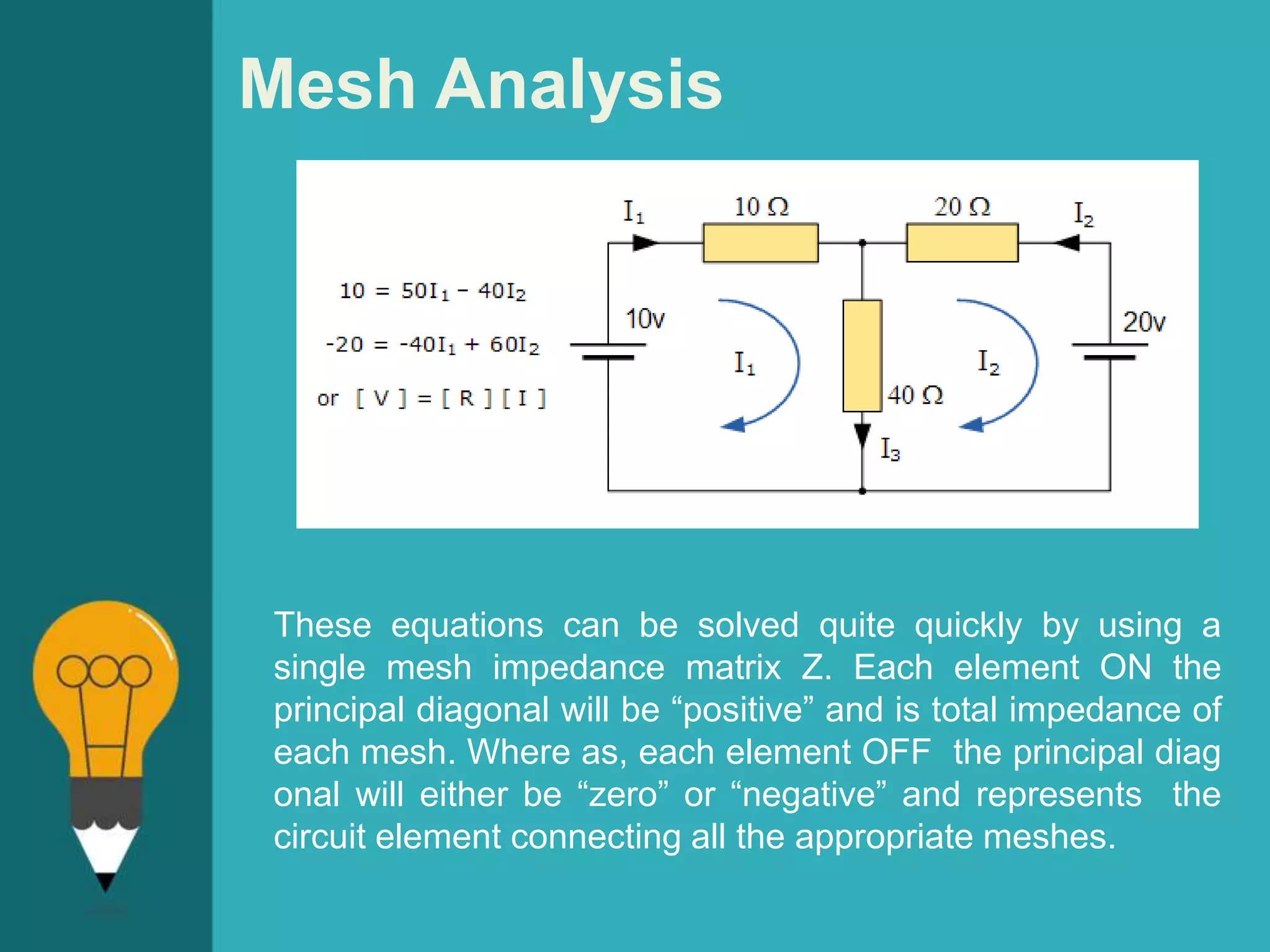
An easier method of solving the above circuit is by
using Mesh Current Analysis or Loop Analysis
which is also sometimes called Maxwell´s Circulating
Currents method. Instead of labelling the branch
currents we need to label each “closed loop” with a
circulating current.
As a general rule of thumb, only label inside loops in a
clockwise direction with circulating currents as the aim
is to cover all the elements of the circuit at least once.
Any required branch current may be found from the
appropriate loop or mesh currents as before using
Kirchoff´s method.
For example: : i1 = I1 , i2 = -I2 and I3 = I1 – I2
Mesh Analysis
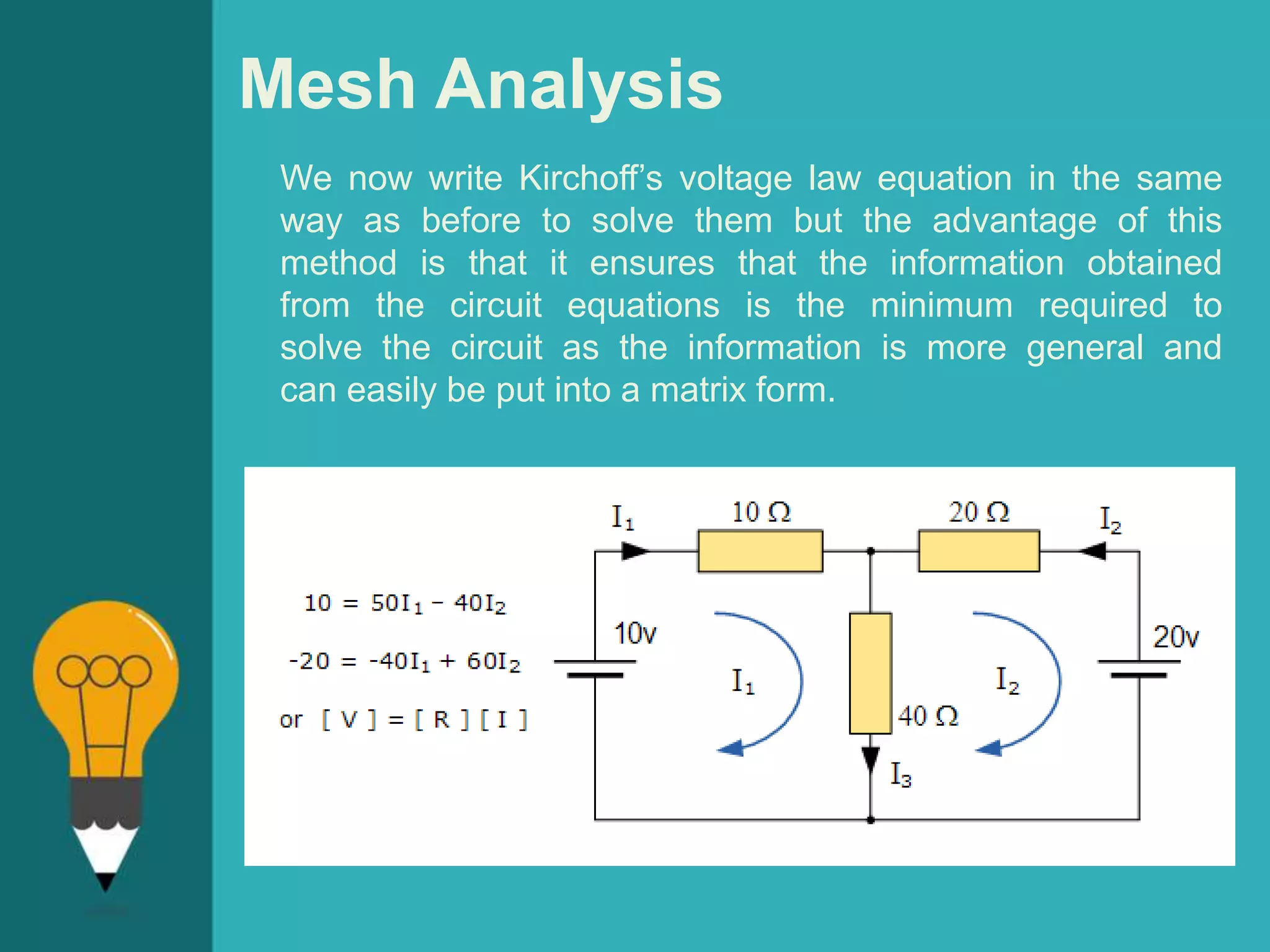
We now write Kirchoff’s voltage law equation in the same
way as before to solve them but the advantage of this
method is that it ensures that the information obtained
from the circuit equations is the minimum required to
solve the circuit as the information is more general and
can easily be put into a matrix form.
Mesh Analysis
These equations can be solved quite quickly by using a
single mesh impedance matrix Z. Each element ON the
principal diagonal will be “positive” and is total impedance of
each mesh. Where as, each element OFF the principal diag
onal will either be “zero” or “negative” and represents the
circuit element connecting all the appropriate meshes.
Mesh Analysis
First we need to understand that when dealing with
matrices, for the division of two matrices it is the same as
multiplying one matrix by the inverse of the other as
shown.
Mesh Analysis
having found the inverse of R, as V/R is the same as V x R-1,
we can now use it to find the two circulating currents.
Mesh Analysis
Where:
• [ V ] gives the total battery voltage for loop 1 and then
loop 2
• [ I ] states the names of the loop currents which we are
trying to find
• [ R ] is the resistance matrix
• [ R-1 ] is the inverse of the [ R ] matrix
and this gives I1 as -0.143 Amps and I2 as -0.429 Amps
As : I3 = I1 – I2
The combined current of I3 is therefore givens :
-0.143 – (-0.429) = 0.286 Amps
which is the same value of 0.286 amps, we found using
Kirchhoff's circuit law in the previous tutorial.
Mesh Analysis
This “look-see” method of circuit analysis is probably the
best of all the circuit analysis methods with the basic
procedure for solving Mesh Current Analysis equations is
as follows:
1. Label all the internal loops with circulating currents.
(I1, I2, …IL etc)
2. Write the [ L x 1 ] column matrix [ V ] giving the sum of
all voltage sources in each loop.
3. Write the [ L x L ] matrix, [ R ] for all the resistances in
the circuit as follows;
• R11 = the total resistance in the first loop.
• Rnn = the total resistance in the Nth loop.
• RJK = the resistance which directly joins loop J to
Loop K.
4. Write the matrix or vector equation [V] = [R] x [I]
where [I] is the list of currents to be found.
Mesh Analysis
As well as using Mesh Current Analysis, we can
also use node analysis to calculate the voltages
around the loops, again reducing the amount of
mathematics required using just Kirchhoff's laws. In
the next tutorial relating to DC circuit theory, we will
look at Nodal Voltage Analysis to do just that.
Nodal Analysis
•Nodal analysis is a method that provides a general
procedure for analyzing circuits using node voltages as
the circuit variables. Nodal Analysis is also called
the Node –Voltage Method. Some Features of
Nodal Analysis are asNodal Analysis is based on
the application of the Kirchhoff’s Current Law (KCL).
•Having ‘n’ nodes there will be ‘n-1’ simultaneous
equations to solve.
•Solving ‘n-1’ equations all the nodes voltages can be
obtained.
•The number of non reference nodes is equal to the
number of Nodal equations that can be obtained.
Nodal Analysis
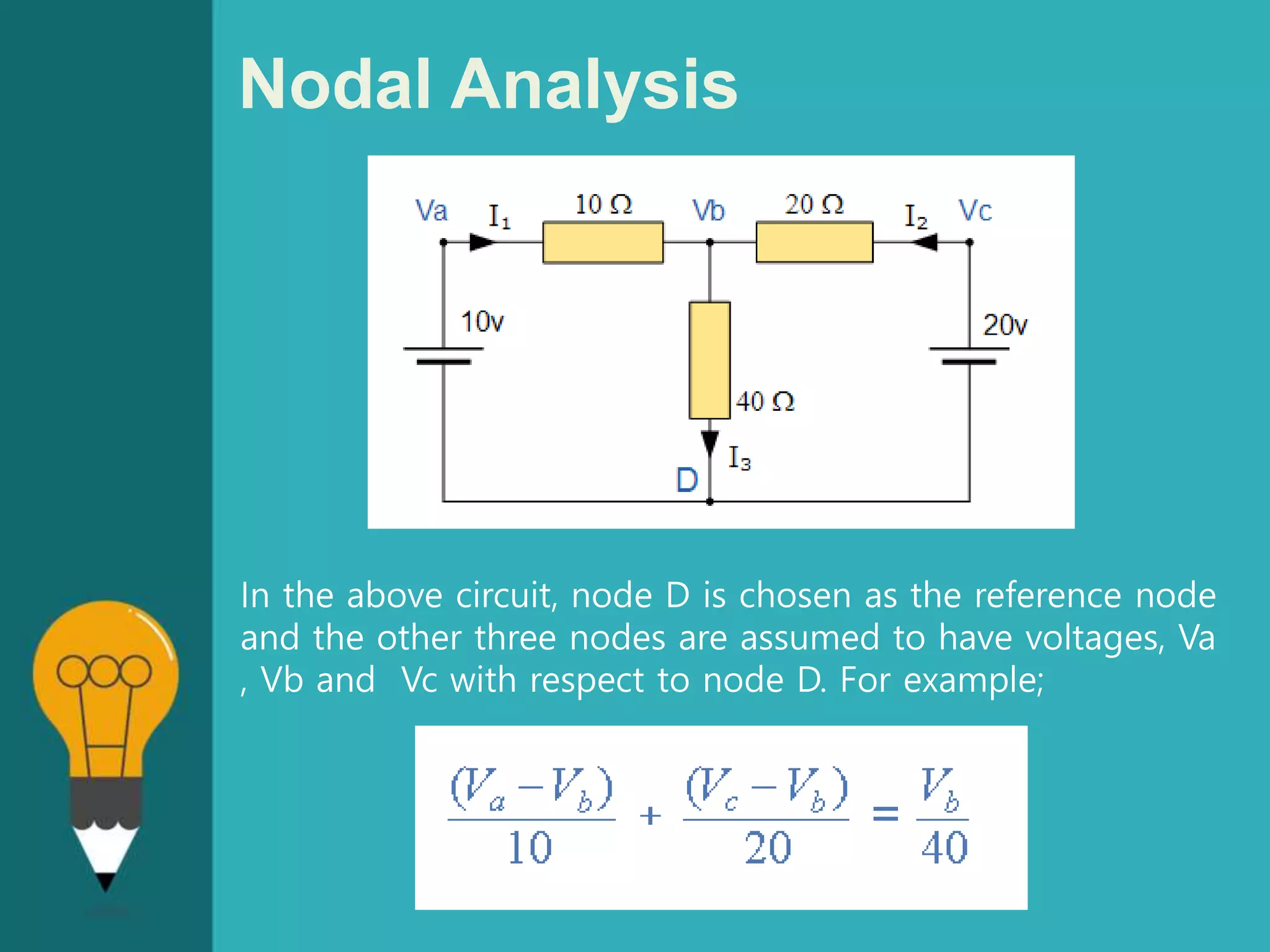
In the above circuit, node D is chosen as the reference node
and the other three nodes are assumed to have voltages, Va
, Vb and Vc with respect to node D. For example;
Nodal Analysis
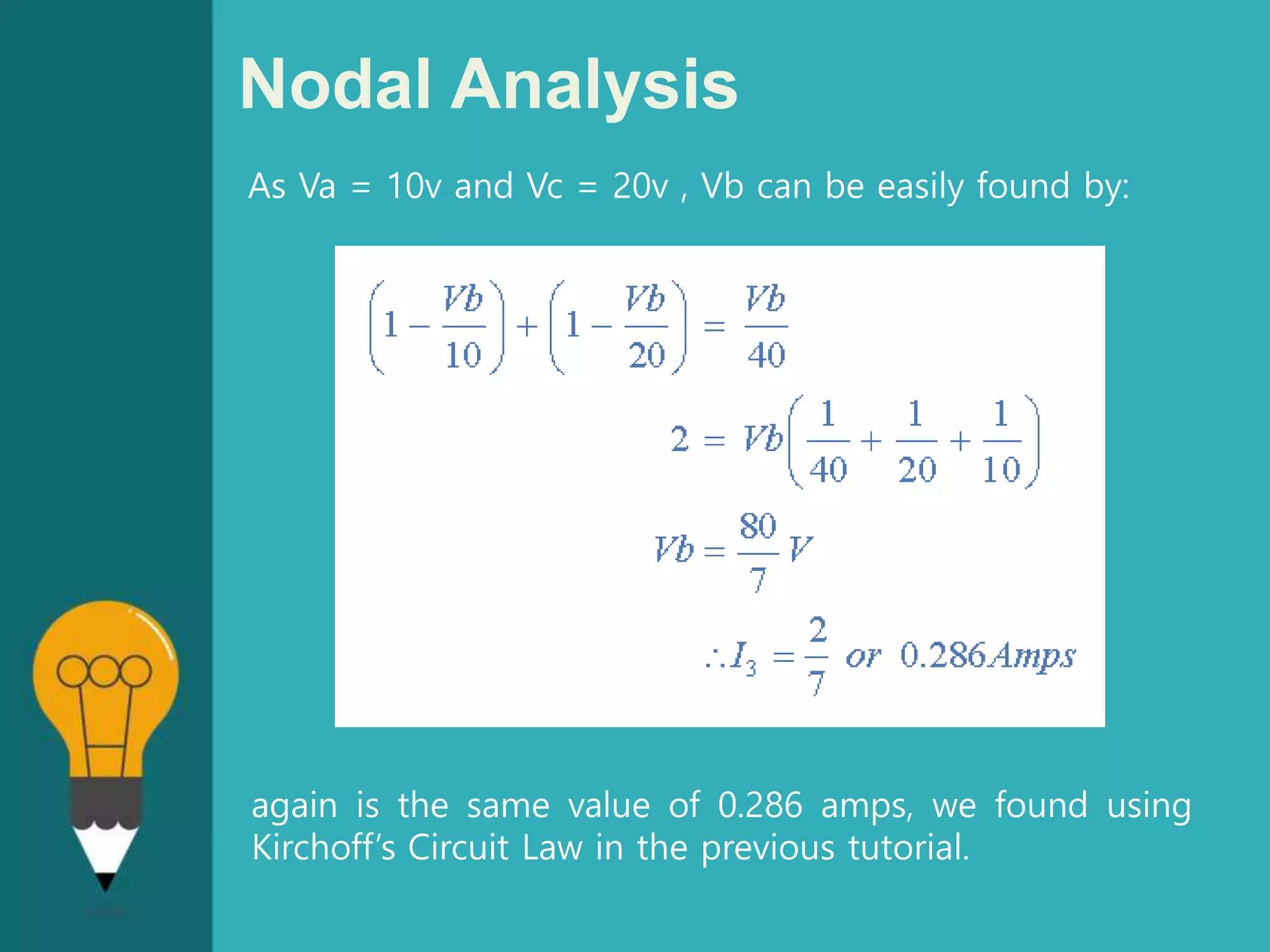
As Va = 10v and Vc = 20v , Vb can be easily found by:
again is the same value of 0.286 amps, we found using
Kirchoff’s Circuit Law in the previous tutorial.
Nodal Analysis
From both Mesh and Nodal Analysis methods we
have looked at so far, this is the simplest method
of solving this particular circuit. Generally, nodal
voltage analysis is more appropriate when there
are a larger number of current sources around. The
network is then defined as: [ I ] = [ Y ] [ V ] where
[ I ] are the driving current sources, [ V ] are the
nodal voltages to be found and [ Y ] is the
admittance matrix of the network which operates on
[ V ] to give [ I ].
Nodal Analysis
The basic procedure for solving Nodal Analysis equations is
as follows:
1. Write down the current vectors, assuming currents into a
node are positive. i.e, a (N x 1)
matrices for “N” independent nodes.
2. Write the admittance matrix [Y] of the network where:
• Y11 = the total admittance of the first node.
• Y22 = the total admittance of the second node.
• RJK = the total admittance joining node J to node K.
3. For a network with “N” independent nodes, [Y] will be an
(N x N) matrix and that Ynn will be positive and Yjk will be
negative or zero value.
4. The voltage vector will be (N x L) and will list the “N”
voltages to be found.
Mesh analysis and Nodal Analysis

Mesh analysis and Nodal Analysis

  • 1.
    Elements of ElectricalEngineering (2110005) Mesh Analysis and Nodal analysis with derivations and Examples Made By : Komal Kotak
  • 2.
    Mesh Analysis Mesh isa loop that doesn’t consists of any other loop inside it. Mesh analysis technique, uses mesh currents as variables , instead of currents in the eleme nts to analyze the circuit. Therefore, this method absolutely reduces the number of equations to be solved . Mesh analysis applies the Kirchhoff’s Voltage Law (KVL) to determine the unknown currents in a given circuit. Mesh analysis is also called as mesh-current method or loop analysis. After finding the mesh currents using KVL, voltages anywhere in a given circuit can be determined by using Ohms law.
  • 3.
    Mesh Analysis One simplemethod of reducing the amount of math’s involved is to analyze the circuit using Kirchhoff's Current Law equations to determine the currents, I1 and I2 flowing in the two resistors. Then there is no need to calculate the current I3 as its just the sum of I1 and I2. So Kirchhoff's second voltage law simply becomes: •Equation No 1 : 10 = 50I1 + 40I2 •Equation No 2 : 20 = 40I1 + 60I2 therefore, one line of math’s calculation have been saved.
  • 4.
    Mesh Analysis An easiermethod of solving the above circuit is by using Mesh Current Analysis or Loop Analysis which is also sometimes called Maxwell´s Circulating Currents method. Instead of labelling the branch currents we need to label each “closed loop” with a circulating current. As a general rule of thumb, only label inside loops in a clockwise direction with circulating currents as the aim is to cover all the elements of the circuit at least once. Any required branch current may be found from the appropriate loop or mesh currents as before using Kirchoff´s method. For example: : i1 = I1 , i2 = -I2 and I3 = I1 – I2
  • 5.
    Mesh Analysis We nowwrite Kirchoff’s voltage law equation in the same way as before to solve them but the advantage of this method is that it ensures that the information obtained from the circuit equations is the minimum required to solve the circuit as the information is more general and can easily be put into a matrix form.
  • 6.
    Mesh Analysis These equationscan be solved quite quickly by using a single mesh impedance matrix Z. Each element ON the principal diagonal will be “positive” and is total impedance of each mesh. Where as, each element OFF the principal diag onal will either be “zero” or “negative” and represents the circuit element connecting all the appropriate meshes.
  • 7.
    Mesh Analysis First weneed to understand that when dealing with matrices, for the division of two matrices it is the same as multiplying one matrix by the inverse of the other as shown.
  • 8.
    Mesh Analysis having foundthe inverse of R, as V/R is the same as V x R-1, we can now use it to find the two circulating currents.
  • 9.
    Mesh Analysis Where: • [V ] gives the total battery voltage for loop 1 and then loop 2 • [ I ] states the names of the loop currents which we are trying to find • [ R ] is the resistance matrix • [ R-1 ] is the inverse of the [ R ] matrix and this gives I1 as -0.143 Amps and I2 as -0.429 Amps As : I3 = I1 – I2 The combined current of I3 is therefore givens : -0.143 – (-0.429) = 0.286 Amps which is the same value of 0.286 amps, we found using Kirchhoff's circuit law in the previous tutorial.
  • 10.
    Mesh Analysis This “look-see”method of circuit analysis is probably the best of all the circuit analysis methods with the basic procedure for solving Mesh Current Analysis equations is as follows: 1. Label all the internal loops with circulating currents. (I1, I2, …IL etc) 2. Write the [ L x 1 ] column matrix [ V ] giving the sum of all voltage sources in each loop. 3. Write the [ L x L ] matrix, [ R ] for all the resistances in the circuit as follows; • R11 = the total resistance in the first loop. • Rnn = the total resistance in the Nth loop. • RJK = the resistance which directly joins loop J to Loop K. 4. Write the matrix or vector equation [V] = [R] x [I] where [I] is the list of currents to be found.
  • 11.
    Mesh Analysis As wellas using Mesh Current Analysis, we can also use node analysis to calculate the voltages around the loops, again reducing the amount of mathematics required using just Kirchhoff's laws. In the next tutorial relating to DC circuit theory, we will look at Nodal Voltage Analysis to do just that.
  • 12.
    Nodal Analysis •Nodal analysisis a method that provides a general procedure for analyzing circuits using node voltages as the circuit variables. Nodal Analysis is also called the Node –Voltage Method. Some Features of Nodal Analysis are asNodal Analysis is based on the application of the Kirchhoff’s Current Law (KCL). •Having ‘n’ nodes there will be ‘n-1’ simultaneous equations to solve. •Solving ‘n-1’ equations all the nodes voltages can be obtained. •The number of non reference nodes is equal to the number of Nodal equations that can be obtained.
  • 13.
    Nodal Analysis In theabove circuit, node D is chosen as the reference node and the other three nodes are assumed to have voltages, Va , Vb and Vc with respect to node D. For example;
  • 14.
    Nodal Analysis As Va= 10v and Vc = 20v , Vb can be easily found by: again is the same value of 0.286 amps, we found using Kirchoff’s Circuit Law in the previous tutorial.
  • 15.
    Nodal Analysis From bothMesh and Nodal Analysis methods we have looked at so far, this is the simplest method of solving this particular circuit. Generally, nodal voltage analysis is more appropriate when there are a larger number of current sources around. The network is then defined as: [ I ] = [ Y ] [ V ] where [ I ] are the driving current sources, [ V ] are the nodal voltages to be found and [ Y ] is the admittance matrix of the network which operates on [ V ] to give [ I ].
  • 16.
    Nodal Analysis The basicprocedure for solving Nodal Analysis equations is as follows: 1. Write down the current vectors, assuming currents into a node are positive. i.e, a (N x 1) matrices for “N” independent nodes. 2. Write the admittance matrix [Y] of the network where: • Y11 = the total admittance of the first node. • Y22 = the total admittance of the second node. • RJK = the total admittance joining node J to node K. 3. For a network with “N” independent nodes, [Y] will be an (N x N) matrix and that Ynn will be positive and Yjk will be negative or zero value. 4. The voltage vector will be (N x L) and will list the “N” voltages to be found.