OSSIFICATION
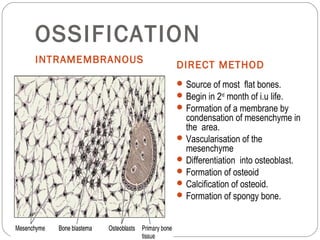
INTRAMEMBRANOUS
DIRECT METHOD
Source of most flat bones.
Begin in 2nd
month of i.u life.
Formation of a membrane by
condensation of mesenchyme in
the area.
Vascularisation of the
mesenchyme
Differentiation into osteoblast.
Formation of osteoid
Calcification of osteoid.
Formation of spongy bone.
continued
Fusion of ossification centres and replacement of orignal
c.tissue.
Fontanelles of newborn are unossified c.tissue.
Spaces between trabeculae filled with lamellar bone so
inner and outer tables of skull bone form. Entire primordium
is surrounded by dense mesenchyme which gives fibrous
layer of periosteum.
INTRACARTILAGINOUS OR
ENDOCHONDRAL OSSIFICATION
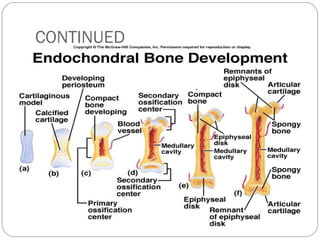
Source of long and short bones.
Formation of primary centre of ossification within a piece of
hayline cartilage which resemble a small version of bone in
diaphysis.
Degeneration of local cartilage by programmed cell death.
Penetration of blood vessels and mesenchymal cells.
Osteoprogenitor cells penetrate that area derived from
perichondrium around that area.
 Formation of primary bone by osteoblast that surround
cartilaginous matrix remanants.
Appearance of secondary centres of ossification in the extremities
of cartilage model.
Formation of cavities that are filled with bone marrow.
CONTINUE
Cartilage remains in two region in secondary ossification
centres.
Articular cartilage, which persist throught adult life and do
not contribute to bone growth.
Epiphyseal cartilage which connect two epiphysis to the
diaphysis. It is responsible for the growth in length of the
bone, it disappear in adults that’s why growth ceases in
adulthood.
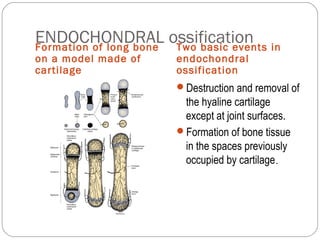
ENDOCHONDRAL ossificationFormation of long bone
on a model made of
cartilage
Two basic events in
endochondral
ossification
Destruction and removal of
the hyaline cartilage
except at joint surfaces.
Formation of bone tissue
in the spaces previously
occupied by cartilage.
CONTINUED
.
EPIPHYSEAL CARTILAGE
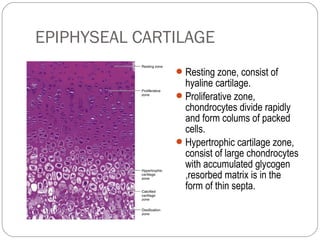
Resting zone, consist of
hyaline cartilage.
Proliferative zone,
chondrocytes divide rapidly
and form colums of packed
cells.
Hypertrophic cartilage zone,
consist of large chondrocytes
with accumulated glycogen
,resorbed matrix is in the
form of thin septa.
CONTINUE
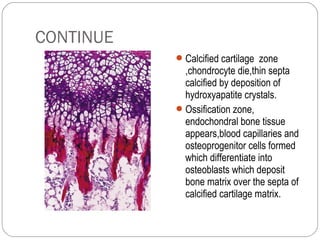
Calcified cartilage zone
,chondrocyte die,thin septa
calcified by deposition of
hydroxyapatite crystals.
Ossification zone,
endochondral bone tissue
appears,blood capillaries and
osteoprogenitor cells formed
which differentiate into
osteoblasts which deposit
bone matrix over the septa of
calcified cartilage matrix.
THREE DIMENSIONAL SHAPE OF
BONE IN THE EPIPHYSEAL PLATE
AREA
Rates of two opposing
events i.e proliferation and
destruction are equal
epipheal plate donot
change in thickness
It is displaced away from
the middle of the diaphysis
resulting in growth in
length of the bone.
CLINICAL
APPLICATION
Ricket, ca deficency in
children.Bone matrix does
not calcify normaly and
epiphyseal plate distorted
,ossification process Is
hindred, bone growth is slow.
Osteomalacia ,ca deficency
in adults characterised by
deficent calcification of
recently formed bone .
Osteoprosis ,found in
immobilised patients and in
postmenopausal women.It is
an imbalance in skeletal
turnover ,bone resorption
exceeds bone formation.
Osteopetrosis or
marblebone.a genetic
disorder charterised by dense
heavy bone ,osteoclast lack
ruffled border defective bone
resorption.
Ossification
Ossification
Ossification

Ossification

  • 1.
    OSSIFICATION INTRAMEMBRANOUS DIRECT METHOD Source ofmost flat bones. Begin in 2nd month of i.u life. Formation of a membrane by condensation of mesenchyme in the area. Vascularisation of the mesenchyme Differentiation into osteoblast. Formation of osteoid Calcification of osteoid. Formation of spongy bone.
  • 2.
    continued Fusion of ossificationcentres and replacement of orignal c.tissue. Fontanelles of newborn are unossified c.tissue. Spaces between trabeculae filled with lamellar bone so inner and outer tables of skull bone form. Entire primordium is surrounded by dense mesenchyme which gives fibrous layer of periosteum.
  • 3.
    INTRACARTILAGINOUS OR ENDOCHONDRAL OSSIFICATION Sourceof long and short bones. Formation of primary centre of ossification within a piece of hayline cartilage which resemble a small version of bone in diaphysis. Degeneration of local cartilage by programmed cell death. Penetration of blood vessels and mesenchymal cells. Osteoprogenitor cells penetrate that area derived from perichondrium around that area.  Formation of primary bone by osteoblast that surround cartilaginous matrix remanants. Appearance of secondary centres of ossification in the extremities of cartilage model. Formation of cavities that are filled with bone marrow.
  • 4.
    CONTINUE Cartilage remains intwo region in secondary ossification centres. Articular cartilage, which persist throught adult life and do not contribute to bone growth. Epiphyseal cartilage which connect two epiphysis to the diaphysis. It is responsible for the growth in length of the bone, it disappear in adults that’s why growth ceases in adulthood.
  • 5.
    ENDOCHONDRAL ossificationFormation oflong bone on a model made of cartilage Two basic events in endochondral ossification Destruction and removal of the hyaline cartilage except at joint surfaces. Formation of bone tissue in the spaces previously occupied by cartilage.
  • 6.
  • 7.
    EPIPHYSEAL CARTILAGE Resting zone,consist of hyaline cartilage. Proliferative zone, chondrocytes divide rapidly and form colums of packed cells. Hypertrophic cartilage zone, consist of large chondrocytes with accumulated glycogen ,resorbed matrix is in the form of thin septa.
  • 8.
    CONTINUE Calcified cartilage zone ,chondrocytedie,thin septa calcified by deposition of hydroxyapatite crystals. Ossification zone, endochondral bone tissue appears,blood capillaries and osteoprogenitor cells formed which differentiate into osteoblasts which deposit bone matrix over the septa of calcified cartilage matrix.
  • 9.
    THREE DIMENSIONAL SHAPEOF BONE IN THE EPIPHYSEAL PLATE AREA Rates of two opposing events i.e proliferation and destruction are equal epipheal plate donot change in thickness It is displaced away from the middle of the diaphysis resulting in growth in length of the bone.
  • 10.
    CLINICAL APPLICATION Ricket, ca deficencyin children.Bone matrix does not calcify normaly and epiphyseal plate distorted ,ossification process Is hindred, bone growth is slow. Osteomalacia ,ca deficency in adults characterised by deficent calcification of recently formed bone . Osteoprosis ,found in immobilised patients and in postmenopausal women.It is an imbalance in skeletal turnover ,bone resorption exceeds bone formation. Osteopetrosis or marblebone.a genetic disorder charterised by dense heavy bone ,osteoclast lack ruffled border defective bone resorption.