Defects in solids
http://www.bath.ac.uk/podcast/powerpoint/Inaugural_lecture_250407.pdf
http://www.materials.ac.uk/elearning/matter/crystallography/indexingdirectionsandplanes/indexing-of-hexagonal-systems.html
http://web.utk.edu/~prack/mse201/Chapter%204%20Defects.pdf
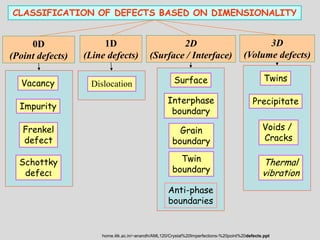
0D
(Point defects)
CLASSIFICATION OF DEFECTS BASED ON DIMENSIONALITY
1D
(Line defects)
2D
(Surface / Interface)
3D
(Volume defects)
Vacancy
Impurity
Frenkel
defect
Schottky
defect
Dislocation Surface
Interphase
boundary
Grain
boundary
Twin
boundary
Twins
Precipitate
Voids /
Cracks
Thermal
vibration
Anti-phase
boundaries
home.iitk.ac.in/~anandh/AML120/Crystal%20Imperfections-%20point%20defects.ppt
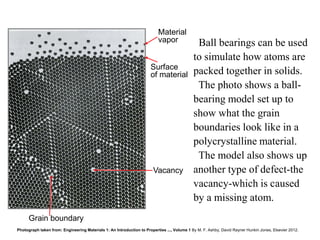
Ball bearings can be used
to simulate how atoms are
packed together in solids.
The photo shows a ball-
bearing model set up to
show what the grain
boundaries look like in a
polycrystalline material.
The model also shows up
another type of defect-the
vacancy-which is caused
by a missing atom.
Material
vapor
Surface
of material
Vacancy
Grain boundary
Photograph taken from: Engineering Materials 1: An Introduction to Properties ..., Volume 1 By M. F. Ashby, David Rayner Hunkin Jones, Elsevier 2012.
All solids, even the most ‘perfect’ crystals contain defects. Defects are of great
importance as they can affect properties such as mechanical strength, electrical
conductivity, chemical reactivity and corrosion. There are several terms used to
describe defects which we must consider:
Intrinsic defects – present for thermodynamic reasons.
Extrinsic defects – not required by thermodynamics and can be controlled by
purification or synthetic conditions.
Point defects – Occur at single sites. Random errors in a periodic lattice eg
absence of atom from usual place (vacancy) or atom in a site not normally
occupied (interstitial).
Extended defects – ordered in one, two and three dimensions. Eg errors in the
stacking of planes.
Every solid has a thermodynamic tendency to acquire point defects, as they
introduce disorder and therefore increase entropy.
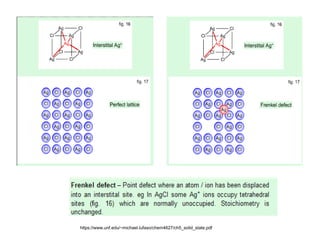
https://www.unf.edu/~michael.lufaso/chem4627/ch5_solid_state.pdf
Intrinsic point defects:
Point defects are not easy to directly detect. Several techniques have been
used to study them. Two physicists, Frenkel and Schottky used conductivity
and density data to identify specific types of point defects.
Schottky defect – Vacancy in an otherwise perfect lattice. Point defect where
atom / ion is missing from its usual point in the lattice. Overall stoichiometry
usually unaffected as there is normally equal numbers of vacancies at both M
and X sites preserving charge balance.
These defects are encountered more commonly when metal ions are able to
easily assume multiple oxidation states.
(MX)
https://www.unf.edu/~michael.lufaso/chem4627/ch5_solid_state.pdf
home.iitk.ac.in/~anandh/AML120/Crystal%20Imperfections-%20point%20defects.ppt
Frenkel
defect
Schottky
defect
Cation vacancy
+
cation interstitial
Cation vacancy
+
anion vacancy
 Schottky defect
- A pair of oppositely charged
ion vacancies
 Frenkel defect
- A vacancy-interstitialcy
combination
 Vacancy
- Unoccupied atom site
 Interstitial
- An atomic occupying an
interstitial site
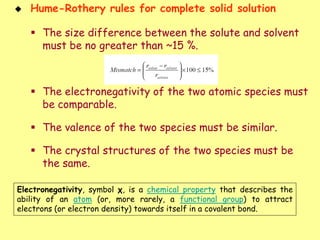
 Hume-Rothery rules for complete solid solution
 The size difference between the solute and solvent
must be no greater than ~15 %.
 The electronegativity of the two atomic species must
be comparable.
 The valence of the two species must be similar.
 The crystal structures of the two species must be
the same.
Electronegativity, symbol χ, is a chemical property that describes the
ability of an atom (or, more rarely, a functional group) to attract
electrons (or electron density) towards itself in a covalent bond.
• A metal with a lower valency is more likely to dissolve in one
which has a higher valency, than vice versa.
• A quasicrystal has long-range order but lacks translational
periodicity in three dimensions.
Impurities Impurities - atoms which are different from the host.
•All real solids are impure. Very pure metals 99.9999% - one impurity per 106
atoms .
•May be intentional or unintentional :
Examples: carbon added in small amounts to iron makes steel, which is
stronger than pure iron. Boron added to silicon change its electrical properties.
•Alloys - deliberate mixtures of metals Example: sterling silver is 92.5% silver –
7.5% copper alloy. Stronger than pure silver.
http://web.utk.edu/~prack/mse201/Chapter%204%20Defects.pdf
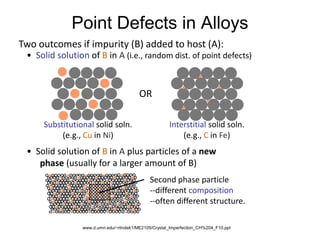
Substitutional defects
Two outcomes if impurity (B) added to host (A):
• Solid solution of B in A (i.e., random dist. of point defects)
• Solid solution of B in A plus particles of a new
phase (usually for a larger amount of B)
OR
Substitutional solid soln.
(e.g., Cu in Ni)
Interstitial solid soln.
(e.g., C in Fe)
Second phase particle
--different composition
--often different structure.
Point Defects in Alloys
www.d.umn.edu/~rlindek1/ME2105/Crystal_Imperfection_CH%204_F10.ppt
Linear Defects or
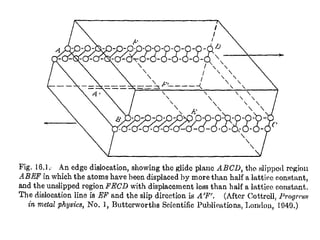
 Linear defects or dislocations : Associated with
mechanical deformation
⊥
Represents the edge of an
extra half plane of atoms
http://academic.uprm.edu/pcaceres/Courses/MatEng/MSE4-1.pdf
http://bibing.us.es/proyectos/abreproy/80016/fichero/chapter+2.pdf
b
t
b || t
1
2
3
http://people.exeter.ac.uk/jngrima/SOE1032/rmh_q3/dislocations.html
Screw Dislocation
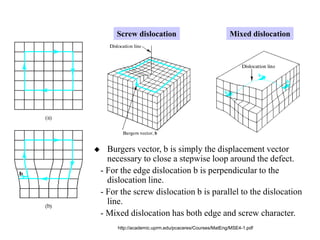
 Burgers vector, b is simply the displacement vector
necessary to close a stepwise loop around the defect.
- For the edge dislocation b is perpendicular to the
dislocation line.
- For the screw dislocation b is parallel to the dislocation
line.
- Mixed dislocation has both edge and screw character.
Mixed dislocationScrew dislocation
http://academic.uprm.edu/pcaceres/Courses/MatEng/MSE4-1.pdf
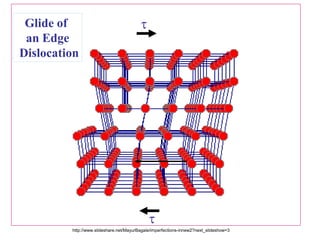
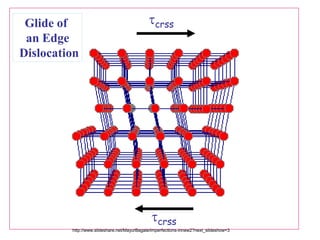
Glide of
an Edge
Dislocation
τ
τ
http://www.slideshare.net/MayurBagale/imperfections-innew2?next_slideshow=3
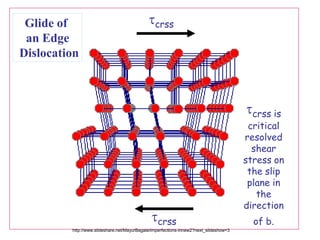
Glide of
an Edge
Dislocation
τcrss
τcrss
τcrss is
critical
resolved
shear
stress on
the slip
plane in
the
direction
of b.
http://www.slideshare.net/MayurBagale/imperfections-innew2?next_slideshow=3
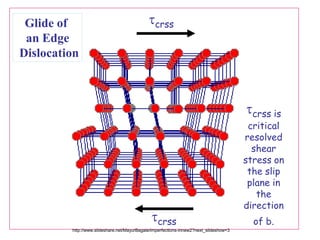
Glide of
an Edge
Dislocation
τcrss
τcrss
τcrss is
critical
resolved
shear
stress on
the slip
plane in
the
direction
of b.
http://www.slideshare.net/MayurBagale/imperfections-innew2?next_slideshow=3
Glide of
an Edge
Dislocation
τcrss
τcrss
τcrss is
critical
resolved
shear
stress on
the slip
plane in
the
direction
of b.
http://www.slideshare.net/MayurBagale/imperfections-innew2?next_slideshow=3
Glide of
an Edge
Dislocation
τcrss
τcrss
τcrss is
critical
resolved
shear
stress on
the slip
plane in
the
direction
of b.
http://www.slideshare.net/MayurBagale/imperfections-innew2?next_slideshow=3
Glide of
an Edge
Dislocation
τcrss
τcrss
τcrss is
critical
resolved
shear
stress on
the slip
plane in
the
direction
of b.
http://www.slideshare.net/MayurBagale/imperfections-innew2?next_slideshow=3
Glide of
an Edge
Dislocation
τcrss
τcrss
τcrss is
critical
resolved
shear
stress on
the slip
plane in
the
direction
of b.
http://www.slideshare.net/MayurBagale/imperfections-innew2?next_slideshow=3
Glide of
an Edge
Dislocation
τcrss
τcrss
http://www.slideshare.net/MayurBagale/imperfections-innew2?next_slideshow=3
Glide of
an Edge
Dislocation
τcrss
τcrss
Surface
step, not a
dislocation
A surface
step of b
is created
if a
dislocation
sweeps
over the
entire slip
plane
http://www.slideshare.net/MayurBagale/imperfections-innew2?next_slideshow=3
A dislocation line cannot end
abruptly inside a crystal
It can end on
Free surfaces
Grain boundaries
On other dislocations at a point called a node
On itself forming a loop
Grain 1 Grain 2
Grain
Boundary
Dislocation can end on a grain boundary
Transmission electron micrograph of dislocations
https://en.wikipedia.org/wiki/Dislocation#/media/File:TEM_micrograph_dislocations_precipitate_stainless_steel_1.jpg
http://web.utk.edu/~prack/mse201/Chapter%207%20Dislocations%20.pdf
Surface
Defects
External surface: Free surface
If bond are broken over
an area A then two free
surfaces of a total area
2A is created
Area A
Area A
Broken
bonds
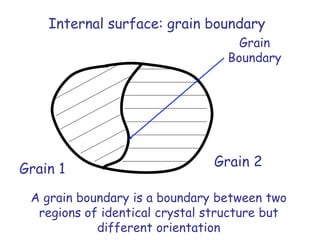
•A grain boundary is the interface between two grains in a polycrystalline material
•they tend to decrease the electrical and thermal conductivity of the material
http://www.eng.utah.edu/~lzang/images/lecture-6-grain-boundary-displocation-defects-vancancy.pdf
Grain 1
Grain 2
Grain
Boundary
Internal surface: grain boundary
A grain boundary is a boundary between two
regions of identical crystal structure but
different orientation
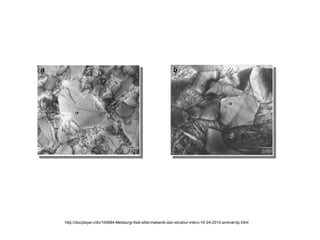
http://docplayer.info/104684-Metalurgi-fisik-sifat-mekanik-dan-struktur-mikro-10-24-2010-anrinal-itp.html
Photomicrograph of an iron chromium alloy. 100X.
http://docplayer.info/104684-Metalurgi-fisik-sifat-mekanik-dan-struktur-mikro-10-24-2010-anrinal-itp.html
galvanized surface with cristallites of zinc
http://web.utk.edu/~prack/mse201/Chapter%207%20Dislocations%20.pdf
High and low angle boundaries
It is convenient to separate grain boundaries by the extent of the
mis-orientation between the two grains.
•low angle grain boundaries (LAGBs) are those with a misorientation less than
about 11 degrees.
• high angle grain boundaries (HAGBs) whose misorientation is greater than
about 11 degrees
Low angle boundary
High angle boundary
Grain Boundary: tilt and twist
One grain orientation can be obtained by
rotation of another grain across the grain
boundary about an axis through an angle
If the axis of rotation lies in the
boundary plane it is called tilt boundary
If the angle of rotation is perpendicular
to the boundary plane it is called a
twist boundary
The most simple boundary is that of a tilt boundary where the rotation axis is
parallel to the boundary plane. This boundary can be conceived as forming from
a single, contiguous crystallite or grain which is gradually bent by some external
force. The energy associated with the elastic bending of the lattice can be
reduced by inserting a dislocation, which is essentially a half-plane of atoms that
act like a wedge, that creates a permanent misorientation between the two sides.
As the grain is bent further, more and more dislocations must be introduced to
accommodate the deformation resulting in a growing wall of dislocations - a low-
angle boundary. The grain can now be considered to have split into two sub-
grains of related crystallography but notably different orientations.
An alternative is a twist boundary where the misorientation occurs around
an axis that is perpendicular to the boundary plane
This type of boundary incorporates two sets of screw dislocations.
tilt boundary
twist boundary
https://en.wikipedia.org/wiki/Grain_boundary
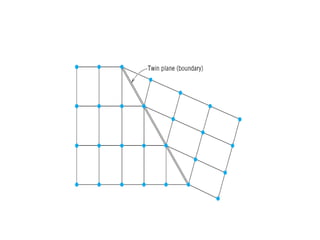
Twin Plane
C
B
A
C
B
A
C
B
A
C
B
A
C
A
B
C
A
B
C
B
A
C
B
A
Twin
plane
http://web.utk.edu/~prack/mse201/Chapter%207%20Dislocations%20.pdf
http://poozacreations.blogspot.ro/2012/03/structure-of-solids.html
see http://academic.uprm.edu/pcaceres/Courses/MatEng/MSE4-1.pdf
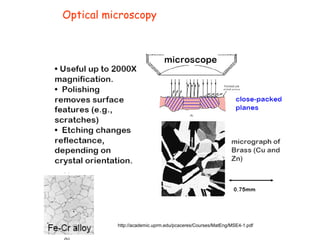
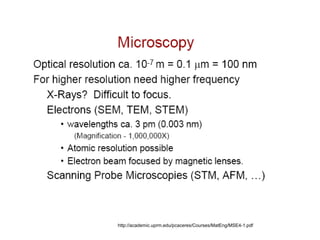
Optical microscopy
http://academic.uprm.edu/pcaceres/Courses/MatEng/MSE4-1.pdf
http://web.utk.edu/~prack/mse201/Chapter%204%20Defects.pdf
Conclusions
Point, line and area defects arise in solids.
The number and type of defects depend on
several factors (e.g. the concentration of
vacancied can be controled by temperature).
 The properties of the materials are affected
by defects (e.g. defects control mechanical ,
electrical, optical properties…)
Defects can be wanted or unwanted depending
of the specific application.

6 defects