MECHANICAL VENTILATION
Dean Tanner (MD)- EM PGY3 Carolina Med Center
Erasto Sylvanus (MD)- EM PGY2 MUHAS
Why are you intubating?
• Difficulty Oxygenating
• Difficulty Ventilating
• Airway Protection
• Tired
– Metabolic demand
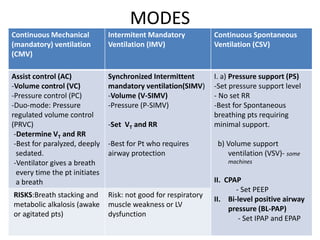
MODES
Continuous Mechanical
(mandatory) ventilation
(CMV)
Intermitent Mandatory
Ventilation (IMV)
Continuous Spontaneous
Ventilation (CSV)
Assist control (AC)
-Volume control (VC)
-Pressure control (PC)
-Duo-mode: Pressure
regulated volume control
(PRVC)
-Determine VT and RR
-Best for paralyzed, deeply
sedated.
-Ventilator gives a breath
every time the pt initiates
a breath
Synchronized Intermittent
mandatory ventilation(SIMV)
-Volume (V-SIMV)
-Pressure (P-SIMV)
-Set VT and RR
-Best for Pt who requires
airway protection
I. a) Pressure support (PS)
-Set pressure support level
- No set RR
-Best for Spontaneous
breathing pts requiring
minimal support.
b) Volume support
ventilation (VSV)- some
machines
II. CPAP
- Set PEEP
II. Bi-level positive airway
pressure (BL-PAP)
- Set IPAP and EPAP
RISKS:Breath stacking and
metabolic alkalosis (awake
or agitated pts)
Risk: not good for respiratory
muscle weakness or LV
dysfunction
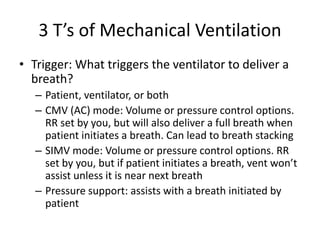
3 T’s of Mechanical Ventilation
• Trigger: What triggers the ventilator to deliver a
breath?
– Patient, ventilator, or both
– CMV (AC) mode: Volume or pressure control options.
RR set by you, but will also deliver a full breath when
patient initiates a breath. Can lead to breath stacking
– SIMV mode: Volume or pressure control options. RR
set by you, but if patient initiates a breath, vent won’t
assist unless it is near next breath
– Pressure support: assists with a breath initiated by
patient
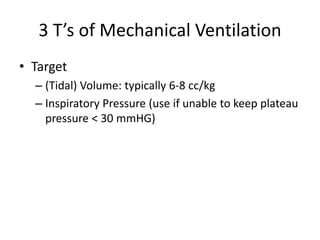
3 T’s of Mechanical Ventilation
• Target
– (Tidal) Volume: typically 6-8 cc/kg
– Inspiratory Pressure (use if unable to keep plateau
pressure < 30 mmHG)
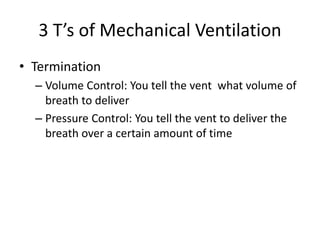
3 T’s of Mechanical Ventilation
• Termination
– Volume Control: You tell the vent what volume of
breath to deliver
– Pressure Control: You tell the vent to deliver the
breath over a certain amount of time
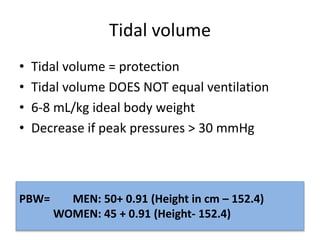
Tidal volume
• Tidal volume = protection
• Tidal volume DOES NOT equal ventilation
• 6-8 mL/kg ideal body weight
• Decrease if peak pressures > 30 mmHg
PBW= MEN: 50+ 0.91 (Height in cm – 152.4)
WOMEN: 45 + 0.91 (Height- 152.4)
Respiratory Rate
• RR = Ventilation
• Start at 16-18
• Adjust based on CO2 (ABG at 30 minutes)
FIO2/PEEP
• Start at 100% FIO2
• ABG/VBG
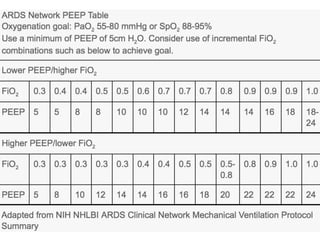
• Decrease FIO2 to 40%, then titrate FIO2 and
PEEP together using PEEP table
Obstruction patients (asthma, COPD)
• Goal is to give the patient time to expire
• Tidal volume = 8 ml/kg ideal body weight
• FIO2 = 100%  40%, titrate to Spo2 >90%
• PEEP = 5 or 0
• Resp rate = lung protection
– Start at 10 and adjust if necessary based on flow
waveform and plateau pressure
– Goal = I:E 1:4 or 1:5 to avoid barotrauma
– Permissive hypercapnea. pCO2 60-90 OK if pH >7.1
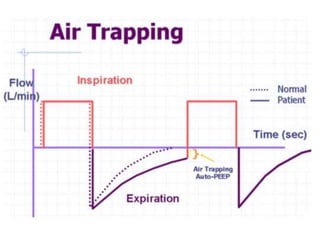
– Air trapping
• Rate will affect CO2
• FiO2 and PEEP will affect Oxygenation (O2)
• PEEP opens up more alveoli. But can increase
intrathoracic pressure as well that increases
the pressure in the right atrium and cause
low BP
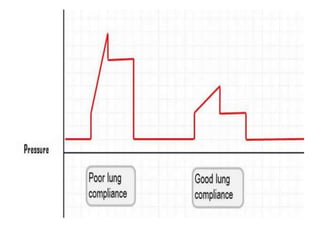
Compliance
• When air is going in…airways determine the pressure
seen in the pressure gauge.
• Once the lungs are inflated and once there is no more
movement in the airways, the thing that determines
the pressure in the air circuit is no longer the resistance
in the airways but the actual compliance of the lungs.
• In PTX or P. edema (prevent lung from expanding), the
machine will still give the same volume but you will see
a higher pressure, as a result of decreased compliance
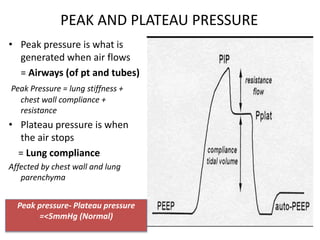
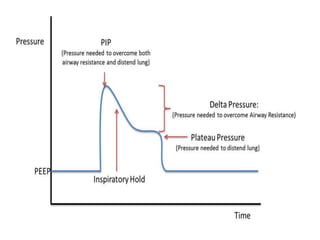
• Peak pressure is what is
generated when air flows
= Airways (of pt and tubes)
Peak Pressure = lung stiffness +
chest wall compliance +
resistance
• Plateau pressure is when
the air stops
= Lung compliance
Affected by chest wall and lung
parenchyma
Peak pressure- Plateau pressure
=<5mmHg (Normal)
PEAK AND PLATEAU PRESSURE
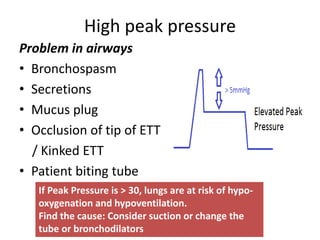
High peak pressure
Problem in airways
• Bronchospasm
• Secretions
• Mucus plug
• Occlusion of tip of ETT
/ Kinked ETT
• Patient biting tube
If Peak Pressure is > 30, lungs are at risk of hypo-
oxygenation and hypoventilation.
Find the cause: Consider suction or change the
tube or bronchodilators
Low peak pressure
Think of Air leak
• Bronchopleural fistula
• ETT cuff leak
• ETT dislodged/ migrated
• Disconnection of vent tubing
• Vent dysfunction
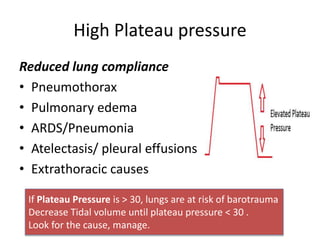
High Plateau pressure
Reduced lung compliance
• Pneumothorax
• Pulmonary edema
• ARDS/Pneumonia
• Atelectasis/ pleural effusions
• Extrathoracic causes
If Plateau Pressure is > 30, lungs are at risk of barotrauma
Decrease Tidal volume until plateau pressure < 30 .
Look for the cause, manage.
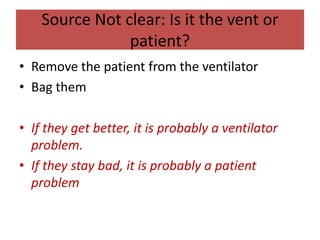
Source Not clear: Is it the vent or
patient?
• Remove the patient from the ventilator
• Bag them
• If they get better, it is probably a ventilator
problem.
• If they stay bad, it is probably a patient
problem
General Troubleshooting
D.O.P.E.S (Diagnose)
• Displaced ET tube / ET tube cuff not inflated
or has a leak
• Obstruction of ET tube
• Pneumothorax
• Equipment malfunction (disconnection of
the ventilator, incorrect vent settings, etc.)
• Stacking (breath stacking / Auto- PEEP
General Troubleshooting
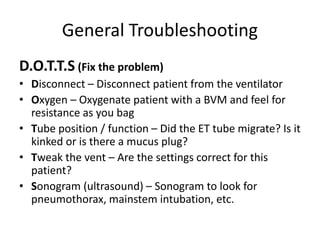
D.O.T.T.S (Fix the problem)
• Disconnect – Disconnect patient from the ventilator
• Oxygen – Oxygenate patient with a BVM and feel for
resistance as you bag
• Tube position / function – Did the ET tube migrate? Is it
kinked or is there a mucus plug?
• Tweak the vent – Are the settings correct for this
patient?
• Sonogram (ultrasound) – Sonogram to look for
pneumothorax, mainstem intubation, etc.
CASES
CASE 1
• A patient has a polypharmacy overdose and is
hypoventilating. How should you set the
ventilator?
CASE 2
• The patient has angioedema. The intubation is
for airway protection. They will be breathing
on their own but need something in between
their airway and their lungs to prevent closing
of the airway.
• How will you choose settings?
CASE 3
• A common reason for intubation is septic
pneumonia. The patient has metabolic and
airway protection problems. What is your
setting?
CASE 4
55 yrs Male with COPD exacerbation and was intubated yesterday after he
failed a trial of non-invasive ventilation. Earlier in the evening, the peak
pressure was 45 cm H2O while the plateau pressure was 25 cm H2O. Alarm
goes off and you find the peak pressure has risen to 60 cm H20 and the
plateau pressure is now 40 cmH20. His heart rate has increased from 90
beats/minute to 110 beats/minute while his blood pressure has fallen
from 110/85 to 90/70. The physical exam is noteworthy for diminished
breath sounds on the left side of the chest.
• What do plateau pressures represent on the ventilator?
•
• What do peak pressures represent on the ventilator?
•
• Where do you think the problem lies with this particular patient?
•
• What management steps should you institute at this point?
REFERENCE
• Rosen’s 8th edition
• Emcrit.com
• Foamem.com
• Lifeinthefastlane.com
• Emrap.com

Mechanical ventilation basics

  • 1.
    MECHANICAL VENTILATION Dean Tanner(MD)- EM PGY3 Carolina Med Center Erasto Sylvanus (MD)- EM PGY2 MUHAS
  • 2.
    Why are youintubating? • Difficulty Oxygenating • Difficulty Ventilating • Airway Protection • Tired – Metabolic demand
  • 3.
    MODES Continuous Mechanical (mandatory) ventilation (CMV) IntermitentMandatory Ventilation (IMV) Continuous Spontaneous Ventilation (CSV) Assist control (AC) -Volume control (VC) -Pressure control (PC) -Duo-mode: Pressure regulated volume control (PRVC) -Determine VT and RR -Best for paralyzed, deeply sedated. -Ventilator gives a breath every time the pt initiates a breath Synchronized Intermittent mandatory ventilation(SIMV) -Volume (V-SIMV) -Pressure (P-SIMV) -Set VT and RR -Best for Pt who requires airway protection I. a) Pressure support (PS) -Set pressure support level - No set RR -Best for Spontaneous breathing pts requiring minimal support. b) Volume support ventilation (VSV)- some machines II. CPAP - Set PEEP II. Bi-level positive airway pressure (BL-PAP) - Set IPAP and EPAP RISKS:Breath stacking and metabolic alkalosis (awake or agitated pts) Risk: not good for respiratory muscle weakness or LV dysfunction
  • 4.
    3 T’s ofMechanical Ventilation • Trigger: What triggers the ventilator to deliver a breath? – Patient, ventilator, or both – CMV (AC) mode: Volume or pressure control options. RR set by you, but will also deliver a full breath when patient initiates a breath. Can lead to breath stacking – SIMV mode: Volume or pressure control options. RR set by you, but if patient initiates a breath, vent won’t assist unless it is near next breath – Pressure support: assists with a breath initiated by patient
  • 5.
    3 T’s ofMechanical Ventilation • Target – (Tidal) Volume: typically 6-8 cc/kg – Inspiratory Pressure (use if unable to keep plateau pressure < 30 mmHG)
  • 6.
    3 T’s ofMechanical Ventilation • Termination – Volume Control: You tell the vent what volume of breath to deliver – Pressure Control: You tell the vent to deliver the breath over a certain amount of time
  • 7.
    Tidal volume • Tidalvolume = protection • Tidal volume DOES NOT equal ventilation • 6-8 mL/kg ideal body weight • Decrease if peak pressures > 30 mmHg PBW= MEN: 50+ 0.91 (Height in cm – 152.4) WOMEN: 45 + 0.91 (Height- 152.4)
  • 9.
    Respiratory Rate • RR= Ventilation • Start at 16-18 • Adjust based on CO2 (ABG at 30 minutes)
  • 10.
    FIO2/PEEP • Start at100% FIO2 • ABG/VBG • Decrease FIO2 to 40%, then titrate FIO2 and PEEP together using PEEP table
  • 12.
    Obstruction patients (asthma,COPD) • Goal is to give the patient time to expire • Tidal volume = 8 ml/kg ideal body weight • FIO2 = 100%  40%, titrate to Spo2 >90% • PEEP = 5 or 0 • Resp rate = lung protection – Start at 10 and adjust if necessary based on flow waveform and plateau pressure – Goal = I:E 1:4 or 1:5 to avoid barotrauma – Permissive hypercapnea. pCO2 60-90 OK if pH >7.1 – Air trapping
  • 13.
    • Rate willaffect CO2 • FiO2 and PEEP will affect Oxygenation (O2) • PEEP opens up more alveoli. But can increase intrathoracic pressure as well that increases the pressure in the right atrium and cause low BP
  • 15.
    Compliance • When airis going in…airways determine the pressure seen in the pressure gauge. • Once the lungs are inflated and once there is no more movement in the airways, the thing that determines the pressure in the air circuit is no longer the resistance in the airways but the actual compliance of the lungs. • In PTX or P. edema (prevent lung from expanding), the machine will still give the same volume but you will see a higher pressure, as a result of decreased compliance
  • 16.
    • Peak pressureis what is generated when air flows = Airways (of pt and tubes) Peak Pressure = lung stiffness + chest wall compliance + resistance • Plateau pressure is when the air stops = Lung compliance Affected by chest wall and lung parenchyma Peak pressure- Plateau pressure =<5mmHg (Normal) PEAK AND PLATEAU PRESSURE
  • 18.
    High peak pressure Problemin airways • Bronchospasm • Secretions • Mucus plug • Occlusion of tip of ETT / Kinked ETT • Patient biting tube If Peak Pressure is > 30, lungs are at risk of hypo- oxygenation and hypoventilation. Find the cause: Consider suction or change the tube or bronchodilators
  • 19.
    Low peak pressure Thinkof Air leak • Bronchopleural fistula • ETT cuff leak • ETT dislodged/ migrated • Disconnection of vent tubing • Vent dysfunction
  • 20.
    High Plateau pressure Reducedlung compliance • Pneumothorax • Pulmonary edema • ARDS/Pneumonia • Atelectasis/ pleural effusions • Extrathoracic causes If Plateau Pressure is > 30, lungs are at risk of barotrauma Decrease Tidal volume until plateau pressure < 30 . Look for the cause, manage.
  • 22.
    Source Not clear:Is it the vent or patient? • Remove the patient from the ventilator • Bag them • If they get better, it is probably a ventilator problem. • If they stay bad, it is probably a patient problem
  • 23.
    General Troubleshooting D.O.P.E.S (Diagnose) •Displaced ET tube / ET tube cuff not inflated or has a leak • Obstruction of ET tube • Pneumothorax • Equipment malfunction (disconnection of the ventilator, incorrect vent settings, etc.) • Stacking (breath stacking / Auto- PEEP
  • 24.
    General Troubleshooting D.O.T.T.S (Fixthe problem) • Disconnect – Disconnect patient from the ventilator • Oxygen – Oxygenate patient with a BVM and feel for resistance as you bag • Tube position / function – Did the ET tube migrate? Is it kinked or is there a mucus plug? • Tweak the vent – Are the settings correct for this patient? • Sonogram (ultrasound) – Sonogram to look for pneumothorax, mainstem intubation, etc.
  • 26.
    CASES CASE 1 • Apatient has a polypharmacy overdose and is hypoventilating. How should you set the ventilator?
  • 27.
    CASE 2 • Thepatient has angioedema. The intubation is for airway protection. They will be breathing on their own but need something in between their airway and their lungs to prevent closing of the airway. • How will you choose settings?
  • 28.
    CASE 3 • Acommon reason for intubation is septic pneumonia. The patient has metabolic and airway protection problems. What is your setting?
  • 29.
    CASE 4 55 yrsMale with COPD exacerbation and was intubated yesterday after he failed a trial of non-invasive ventilation. Earlier in the evening, the peak pressure was 45 cm H2O while the plateau pressure was 25 cm H2O. Alarm goes off and you find the peak pressure has risen to 60 cm H20 and the plateau pressure is now 40 cmH20. His heart rate has increased from 90 beats/minute to 110 beats/minute while his blood pressure has fallen from 110/85 to 90/70. The physical exam is noteworthy for diminished breath sounds on the left side of the chest. • What do plateau pressures represent on the ventilator? • • What do peak pressures represent on the ventilator? • • Where do you think the problem lies with this particular patient? • • What management steps should you institute at this point?
  • 30.
    REFERENCE • Rosen’s 8thedition • Emcrit.com • Foamem.com • Lifeinthefastlane.com • Emrap.com

Editor's Notes

  • #3 Altered, at risk of aspiration or osbtruction, upper airway obstruction; pulm edema, ARDS, pneumonia. Metabolic demand, pt getting tired Asthma/COPD
  • #5 If P plateau > 30, decrease Tv and if that doesn’t work can switch to pressure control. Metabolic problem e.g. DKA, easy to titrate and follow with volume control.
  • #8 PBW= MEN: 50+ 0.91 (Height in cm – 152.4) WOMEN: 45 + 0.91 (Height- 152.4)
  • #9 Smaller amount of lung available for gas exchange. If you give normal amount as normal lung, the alveoli that are free will be expanded too much. Why we need low Tv
  • #12 Goal is alveolar recruitment
  • #16 In AC mode (VCV)for example, you set the volume and the pressure is variable depending on compliance Plateau pressure is Pressure required to hold the lungs and chest wall open when there is no air flow during inspiratory cycle.
  • #17 Peak pressure is the summation of pressure generated from: 1) tidal volume and compliance; 2) resistance and peak inspiratory flow; and 3) PEEP Plateau pressure is Pressure required to hold the lungs and chest wall open when there is no air flow during inspiratory cycle
  • #18 Peak pressure is the summation of pressure generated from: 1) tidal volume and compliance; 2) resistance and peak inspiratory flow; and 3) PEEP Plateau pressure is Pressure required to hold the lungs and chest wall open when there is no air flow during inspiratory cycle
  • #21 Extrathoracic causes (body habitus, ascites, abdominal compartment syndrome, chest wall eschar, positioning (trendelenberg)
  • #27 The patient needs intubation for airway protection. Consider AC volume control or SIMV as the patient is expected to wake up and has no apparent lung injury. Vt 6-8 cc/kg, RR 16-18, 100% -> 40%, PEEP 5
  • #28 AC/PRVC -> Pressure support Vt 6-8 cc/kg, RR 16-18, 100% -> 40%, PEEP 5
  • #30 AC, well sedated to give rest 6-8 cc/kg PEEP 7-10