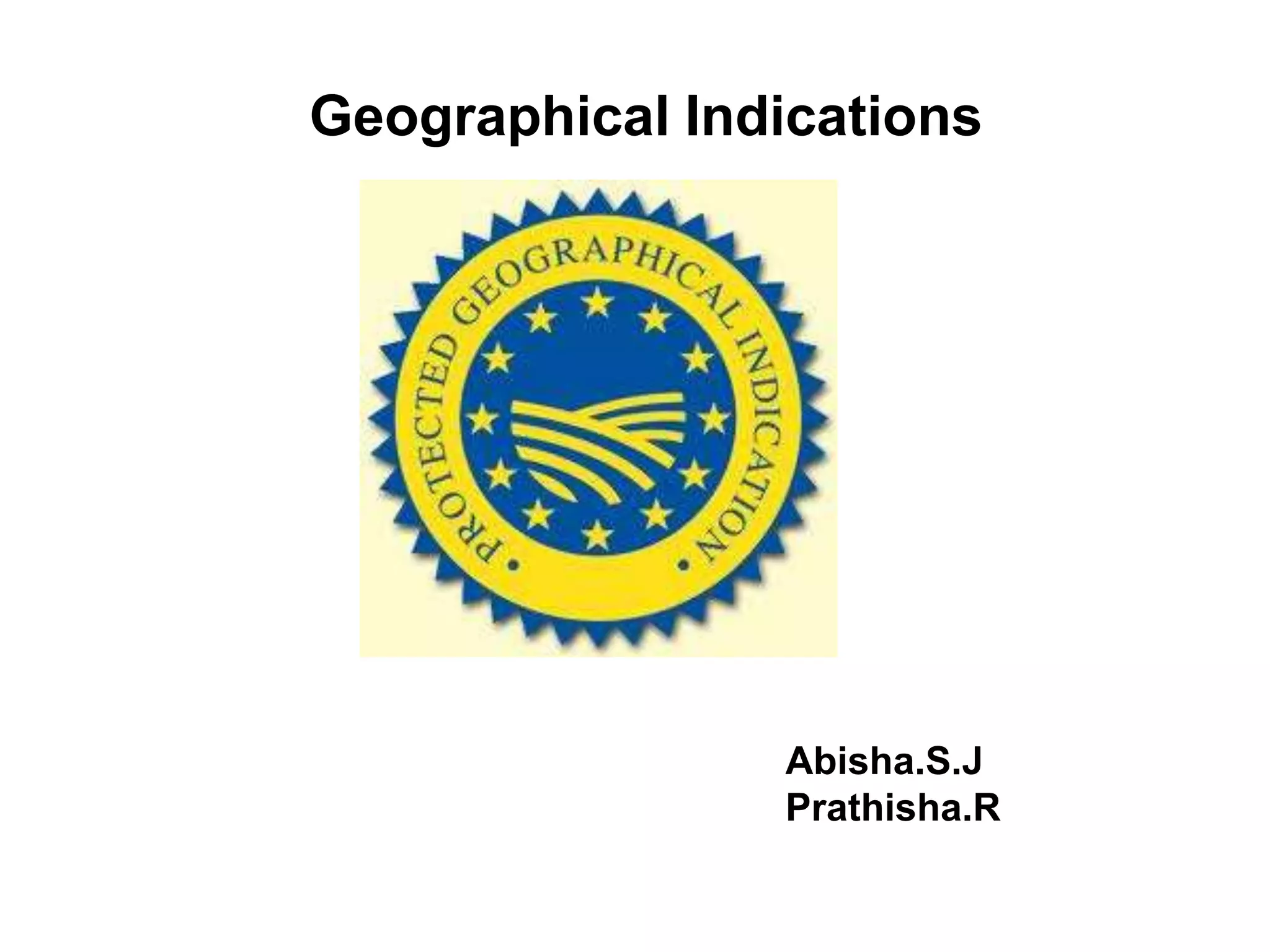
Geographical Indications
Abisha.S.J
Prathisha.R
Outline
Geographical Indications (GI)
Types of GI
Why GI needs to be protected?
Advantages of GI
How are GIs Protected?
WIPO and GI
GI in India
Registration process
GI in Tamil Nadu
What is Geographical Indication?
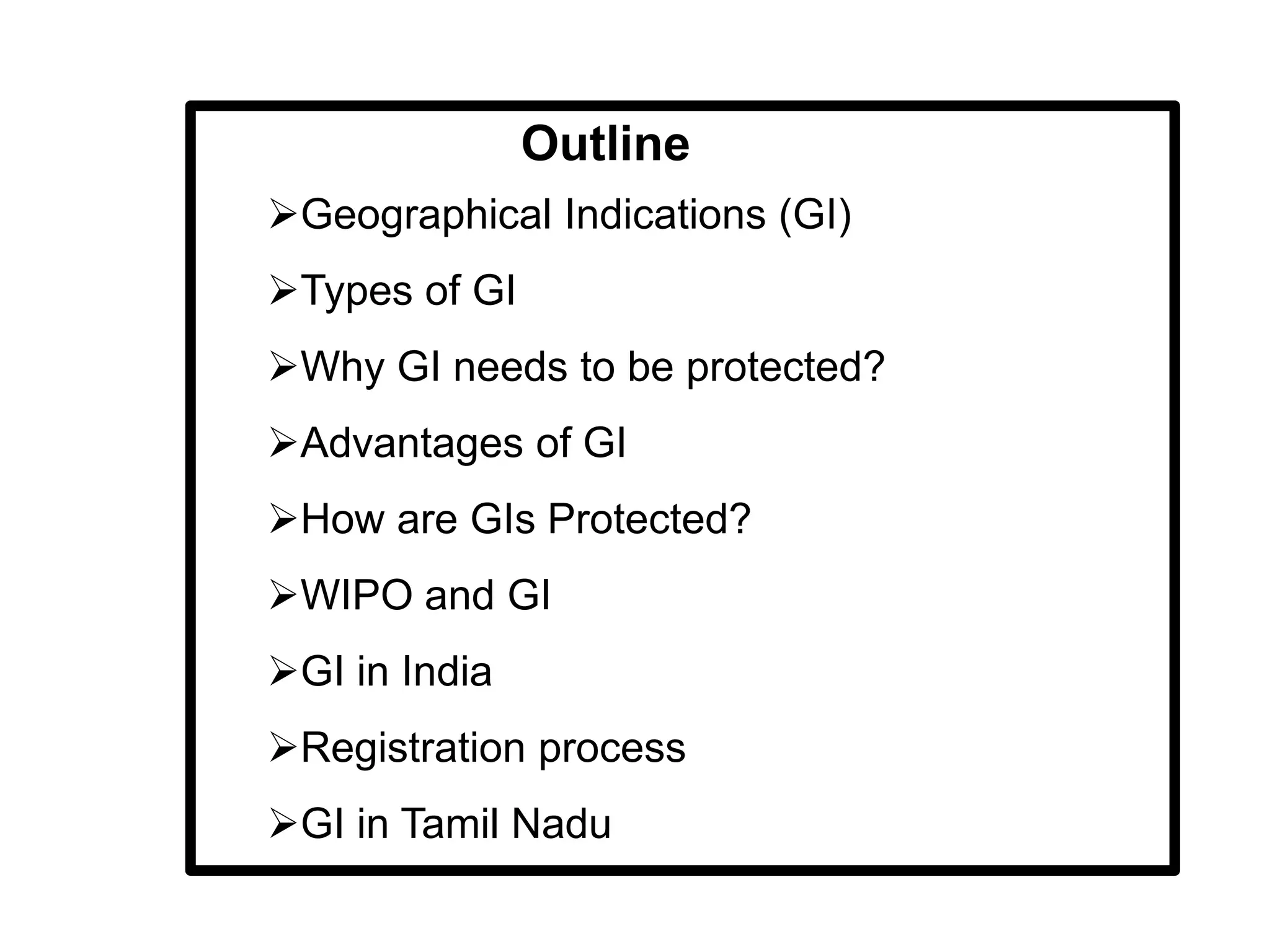
Geographical indication (GI) is a name or sign used on
certain products which corresponds to a specific
geographical location or origin (e.g. a town, region, or
country)
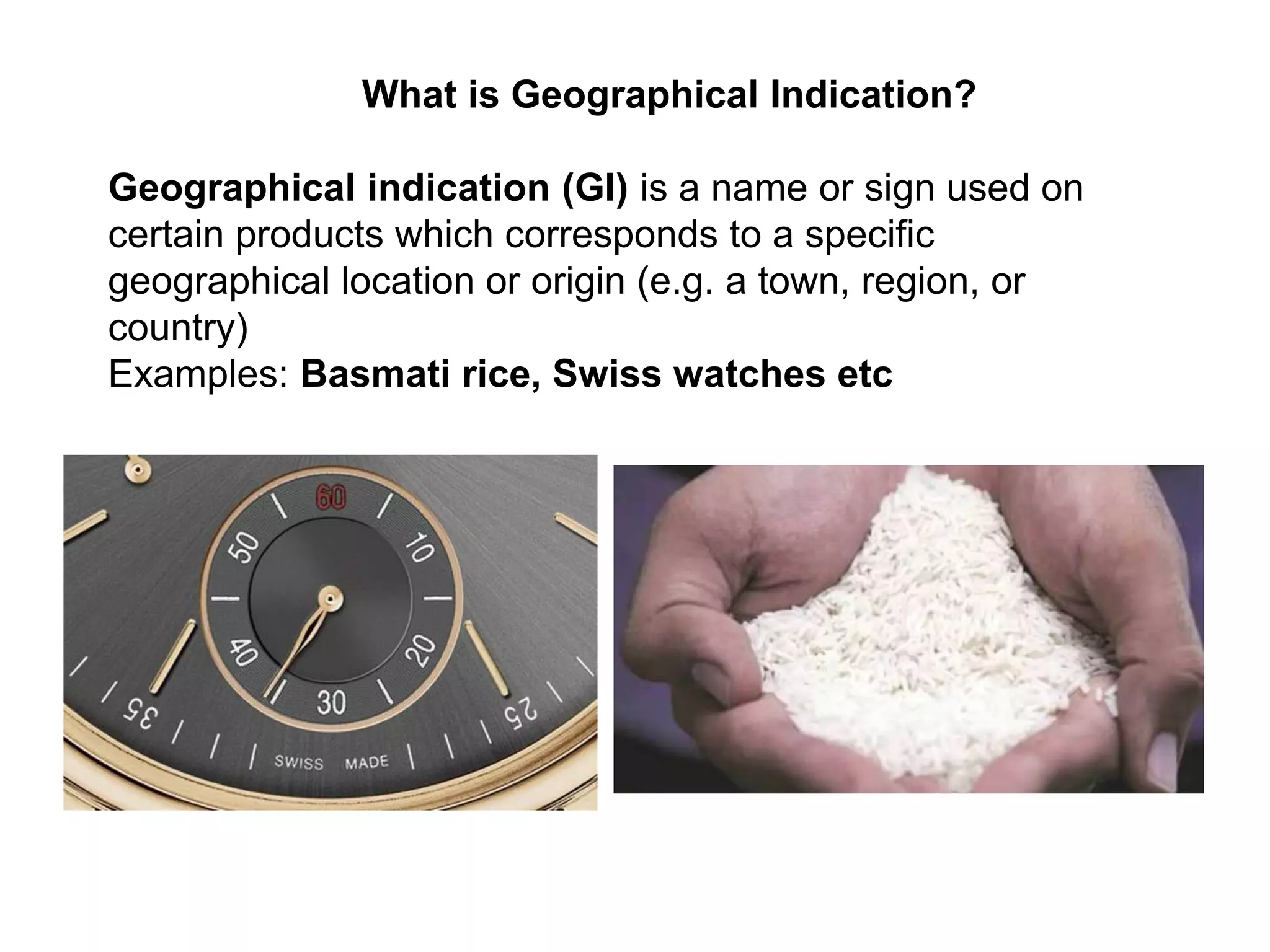
Examples: Basmati rice, Swiss watches etc
“Porto”, “Havana”, “Tequila” and “Darjeeling are some well-
known examples of names associated throughout the world with
products of a certain nature and quality, known for their
geographical origin and for having characteristics linked to that
origin.
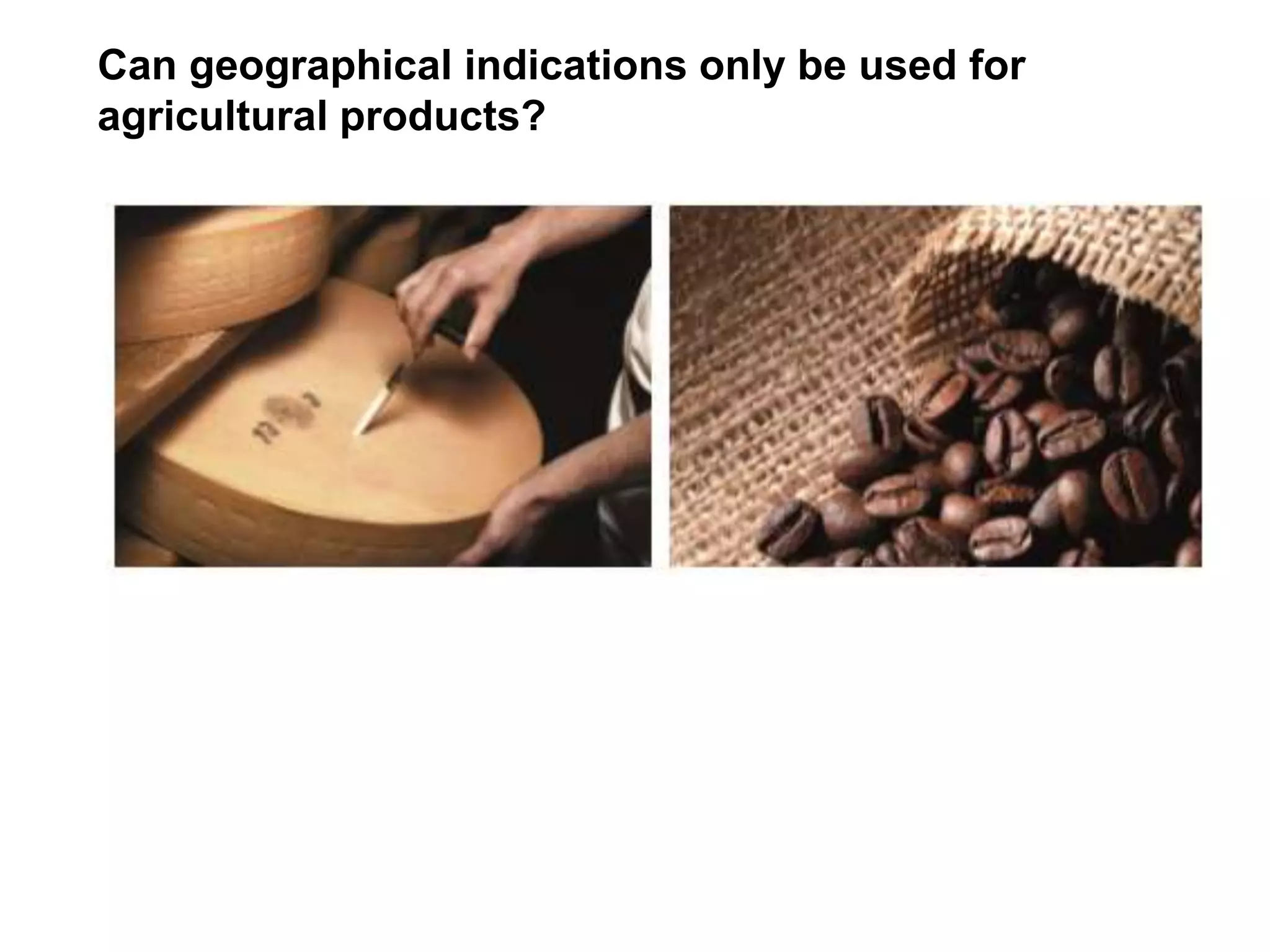
Can geographical indications only be used for
agricultural products?
HISTORY OF GI
• First GI system used in France –
20th century--appellation d'origine
contrôlée (AOC).
– Items that meet geographical
origin and quality standards
may be endorsed with a
government-issued stamp which
acts as official certification of the
origins and standards of the
product to the consumer.
– E.g: Gruyere cheese (from
Switzerland) and many French
wine
7
Geographical indications have long been
associated with the concept of terroir and
with Europe as an entity, where there is a tradition of
associating certain food products with particular regions
Under European Union Law, the protected designation of
origin framework which came into effect in 1992 regulates the
following systems of geographical indications:
 Protected designation of origin (PDO),
Protected geographical indication (PGI) and
Traditional Specialities Guaranteed (TSG)
EU quality logos
Protected designations of origin
(PDO):
covers agricultural products and
foodstuffs which are produced,
processed and prepared in a
given geographical area using
recognised know-how.
(require all stages of the food
production process to be carried
out in the area concerned)
“Huile d’olive de Nyons” and
“Shetland lamb”
Types of GI
Protected Geographical Indication
(PGI):
covers agricultural products and
foodstuffs closely linked to the
geographical area. At least one of the
stages of production, processing or
preparation takes place in the area,
while the raw materials used in
production may come from another
region
Eg- Arancia Rossa di Sicilia”
Traditional Specialties Guaranteed
(TSG):
highlights traditional character,
either in the composition or means of
production.
So, what is the difference?
A certain product could potentially obtain a PDO if all the stages
of production, processing and preparation are carried out in a
defined geographical area.
If one of this stages is done outside this geographical area (for
example, packaging) the product could obtain a PGI.
 If the product and its ingredients are not directly linked to a
specific geographical area, but traditionally the know-how or
composition is recognised, the product could obtain a TSG.
Why GI is to be protected
Denote quality and origin of products
Good reputation for the product
Preventing the product from generic products
Protecting the domestic market from competitors
Advantages of GI
Legal protection and preventing from unauthorized use
Benefits for farmers and local producers
Boost the rural development
Reduces unfair practices of trade
Preserving local culture and resources
Provides complete information to consumers
How are GIs protected
In accordance with international treaties and national laws
under a wide range of concepts:
special laws for the protection of geographical indications or
appellations of origin
trademark laws in the form of collective marks or certification
marks
laws against unfair competition
consumer protection laws, or
specific laws or decrees that recognize individual
geographical indications.
CONDITIONS TO GET GI
 It relates to a good although, in some countries, services
are also included;
 These goods/services must originate from a defined area;
 The goods/services must have qualities, reputations or
other characteristics which are clearly linked to the
geographical origin of goods.
16
The following are the prohibitions to
registration of certain GI:-
the use of which would be likely to
deceive or cause confusion; or
the use of which would be contrary to
any law for the time being in force;or
which comprises or contains
scandalous or obscene matter; or
What cannot be registered under GI
which comprises or contains any matter likely to hurt the
religious susceptibilities of any class or section of the
citizens of India; or
which are determined to generic names or indications of
goods and are, therefore, not or ceases to be protected in
their country of origin, or which have fallen in to disuse in
that country; or
which, although literally true as to the territory, region or
locality in which the goods originate, but falsely represent to
the persons that the goods originate in another territory,
region or locality, as the case may be.
The unique blue cheese
from France is aged in
natural caves around the
Roquefort-sur-Soulzon
region and protected
using geographical
indications.
The Pinggu district
north of Beijing,
China, bills itself as the
biggest peach farm in
the world, providing
employment for over
150,000 people
Roquefort cheese
Pinggu peaches
International Agreements and
Organizations on Geographical
Indications
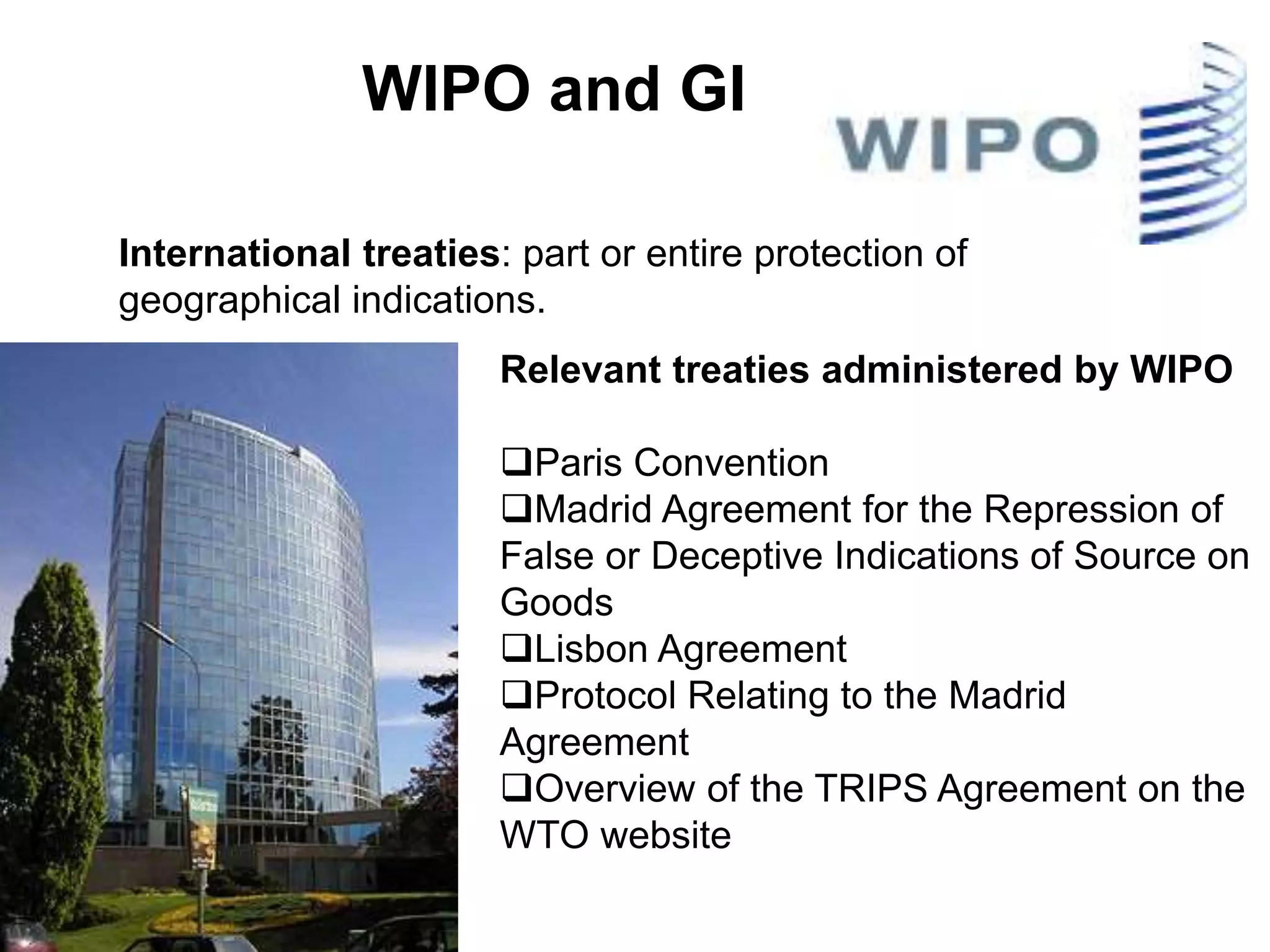
The World Intellectual Property Organization (WIPO) is
the global forum for intellectual property services, policy,
information and cooperation.
Role of WIPO
It is an international organization
dedicated to ensuring the rights of
creators and owners of the
intellectual property are protected
worldwide, and the inventors and
authors are thus recognized and
rewarded for their ingenuity
International treaties: part or entire protection of
geographical indications.
WIPO and GI
Relevant treaties administered by WIPO
Paris Convention
Madrid Agreement for the Repression of
False or Deceptive Indications of Source on
Goods
Lisbon Agreement
Protocol Relating to the Madrid
Agreement
Overview of the TRIPS Agreement on the
WTO website
Paris Convention for the Protection
of Industrial Property
The Paris Convention, adopted
in 1883, applies to industrial
property in the widest sense, the
repression of unfair competition.
This international agreement was
the first major step taken to help
creators ensure that their
intellectual works were protected
in other countries.
Madrid Agreement for the
Repression of False or Deceptive
Indications of Source on Goods
According to the Madrid Agreement,
all goods bearing a false or deceptive
indication of source, must be seized
on importation, or such importation
must be prohibited, or other actions
and sanctions must be applied in
connection with such importation
Protocol Relating to the Madrid Agreement Concerning the
International Registration of Marks (which also provides for the
international registration of certification marks)
Lisbon Agreement for the
Protection of Appellations of
Origin and their International
Registration
The TRIPS Agreement - (came into effect on 1
January 1995):
addresses the international protection of GIs
within the framework of the World Trade Organization
(WTO)
The three main features of the Agreement are
Standards
Enforcement
Dispute Settlement
.
Through the work of the Standing Committee on the Law of
Trademarks, Industrial Designs and Geographical Indications
(SCT) is the forum where WIPO's member states discuss
policy and legal issues relating to the international
development of law and standards for geographical
indications and appellations of origin.
The WIPO international/worldwide Symposia, (held every
two years).
WIPO GOLD is a free public resource which provides a one-
stop gateway to WIPO’s global collections of searchable IP
data.
Delegates at a meeting of the
SCT (Photo: WIPO).
WIPO GOLD
GI in India
In India the Geographical
Indications of Goods
(Registration and
Protection) Act, 1999 came
in force with effect from
September 2003.
Producers dealing with the
following three categories of goods
can apply:
Agricultural Goods includes
the production, processing,
trading or dealing
 Natural Goods includes
exploiting, trading or dealing
 Handicrafts or Industrial
goods include making,
manufacturing, trading or
dealing
Process of registration in India:
Productwise distribution of GIs
registered in India till 15 August
2009
Product category No. of registered GIs
1. Handicrafts 73
2. Agricultural Products 24
3. Manufactured Products 6
4. Horticulture 2
5. Foodstuff 1
Total GIs registered 106
How to apply
The application must be filed at the Office of the GI Registry located
in Chennai
Geographical Signification of the Indication
Class of goods
Geographical Area
Details of the appearance
Particulars of the producers
Affidavit deposing the Applicant’s right to become the
Registrant
Geographical Indications Registry
Intellectual Property Office Building
Industrial Estate, G.S.T Road
Guindy, Chennai – 600 032
Ph: 044 – 22502091-93 & 98
Fx : 044 – 22502090
E-mail: gir-ipo@nic.in
Website : ipindia.gov.in
 The Registrar will have the Application examined.
 Published in the GI journal.
 Notice of Opposition within a maximum period of four months
of publication in the Journal.
 If the Registrar accepts the Application then a certificate of
registration issued.
The registration of a
geographical indication is valid
for a period of 10 years.
It can be renewed from time to
time for further period of 10
years each.
If a registered geographical
indication is not renewed it is
liable to be removed from the
register.
Challenges
• Low brand value
• Lack of awareness of rules &
regulations.
• rampant misuse of Indian Gis.
• Immigration of labors.
Why are geographical indications valuable?
• GIs are a marketing tool
• Reputation for quality associated with place name used on
labels, advertising
• GI-identified products are believed to command higher
prices
• Of particular interest to developing countries
Geographical indications and trademarks
• GIs are closely related to trademarks; both
indicate product origin
• GIs and trademarks differ in two ways:
1. A trademark belongs to a particular company; it
distinguishes that company’s products. GIs are
shared by all producers in the region identified
by the GI.
2. GIs attach to a location; trademarks don’t.
Basmati Rice
Darjeeling Tea
Kanchipuram Silk Saree
Alphanso Mango
Nagpur Orange
Kolhapuri Chappal
Bikaneri Bhujia
Agra Petha
Examples of Indian GIs
143 INDIAN TAGS FROM TAMIL NADU
Oddanchatram vegetables
Kancheepuram Silk
Bhavani Jamakkalam
Madurai Sungudi
Bidriware
Coimbatore Wet Grinder
Thanjavur painting
Thanjavur Art Plate
Kovai Cora Cotton
Swamimalai Bronze Icons
Nagercoil temple jewellery
Tanjavur dancing doll
Nilgiri tea
Dindugul lock
Reference
Sahai, S., I. Barpujari. 2007. Are geographical indications
better suited to protect indigenous knowledge? A
developing country perspective, New Delhi: Gene
Campaign.
http://www.genecampaign.org/
home_files/Gene_Briefing/Policy%20Brief-2.pdf, accessed
on December 22, 2012. WTO. 2004.
Exploring the Linkage between the Domestic Policy
Environment and International Trade,
http://www.wto.org/english/res_e/booksp_e/anrep_e/
world_trade_report04_e.pdf, accessed on January 16,
2013.
Rangnekar, D. 2004. The socio-economics of
geographical indications, BRIDGES between Trade and
Sustainable Development, Vol. 8 No. 8, pp 20-21.
 Rangnekar, D. 2009. Geographical indications and
Localisation: A case study of Feni United Kingdom: Centre
for the Study of Globalisation and Regionalisation,
University of Warwick
Geographical indications

Geographical indications

  • 1.
  • 2.
    Outline Geographical Indications (GI) Typesof GI Why GI needs to be protected? Advantages of GI How are GIs Protected? WIPO and GI GI in India Registration process GI in Tamil Nadu
  • 3.
    What is GeographicalIndication? Geographical indication (GI) is a name or sign used on certain products which corresponds to a specific geographical location or origin (e.g. a town, region, or country) Examples: Basmati rice, Swiss watches etc
  • 5.
    “Porto”, “Havana”, “Tequila”and “Darjeeling are some well- known examples of names associated throughout the world with products of a certain nature and quality, known for their geographical origin and for having characteristics linked to that origin.
  • 6.
    Can geographical indicationsonly be used for agricultural products?
  • 7.
    HISTORY OF GI •First GI system used in France – 20th century--appellation d'origine contrôlée (AOC). – Items that meet geographical origin and quality standards may be endorsed with a government-issued stamp which acts as official certification of the origins and standards of the product to the consumer. – E.g: Gruyere cheese (from Switzerland) and many French wine 7
  • 8.
    Geographical indications havelong been associated with the concept of terroir and with Europe as an entity, where there is a tradition of associating certain food products with particular regions
  • 9.
    Under European UnionLaw, the protected designation of origin framework which came into effect in 1992 regulates the following systems of geographical indications:  Protected designation of origin (PDO), Protected geographical indication (PGI) and Traditional Specialities Guaranteed (TSG) EU quality logos
  • 10.
    Protected designations oforigin (PDO): covers agricultural products and foodstuffs which are produced, processed and prepared in a given geographical area using recognised know-how. (require all stages of the food production process to be carried out in the area concerned) “Huile d’olive de Nyons” and “Shetland lamb” Types of GI
  • 11.
    Protected Geographical Indication (PGI): coversagricultural products and foodstuffs closely linked to the geographical area. At least one of the stages of production, processing or preparation takes place in the area, while the raw materials used in production may come from another region Eg- Arancia Rossa di Sicilia” Traditional Specialties Guaranteed (TSG): highlights traditional character, either in the composition or means of production.
  • 12.
    So, what isthe difference? A certain product could potentially obtain a PDO if all the stages of production, processing and preparation are carried out in a defined geographical area. If one of this stages is done outside this geographical area (for example, packaging) the product could obtain a PGI.  If the product and its ingredients are not directly linked to a specific geographical area, but traditionally the know-how or composition is recognised, the product could obtain a TSG.
  • 13.
    Why GI isto be protected Denote quality and origin of products Good reputation for the product Preventing the product from generic products Protecting the domestic market from competitors
  • 14.
    Advantages of GI Legalprotection and preventing from unauthorized use Benefits for farmers and local producers Boost the rural development Reduces unfair practices of trade Preserving local culture and resources Provides complete information to consumers
  • 15.
    How are GIsprotected In accordance with international treaties and national laws under a wide range of concepts: special laws for the protection of geographical indications or appellations of origin trademark laws in the form of collective marks or certification marks laws against unfair competition consumer protection laws, or specific laws or decrees that recognize individual geographical indications.
  • 16.
    CONDITIONS TO GETGI  It relates to a good although, in some countries, services are also included;  These goods/services must originate from a defined area;  The goods/services must have qualities, reputations or other characteristics which are clearly linked to the geographical origin of goods. 16
  • 17.
    The following arethe prohibitions to registration of certain GI:- the use of which would be likely to deceive or cause confusion; or the use of which would be contrary to any law for the time being in force;or which comprises or contains scandalous or obscene matter; or What cannot be registered under GI
  • 18.
    which comprises orcontains any matter likely to hurt the religious susceptibilities of any class or section of the citizens of India; or which are determined to generic names or indications of goods and are, therefore, not or ceases to be protected in their country of origin, or which have fallen in to disuse in that country; or which, although literally true as to the territory, region or locality in which the goods originate, but falsely represent to the persons that the goods originate in another territory, region or locality, as the case may be.
  • 19.
    The unique bluecheese from France is aged in natural caves around the Roquefort-sur-Soulzon region and protected using geographical indications. The Pinggu district north of Beijing, China, bills itself as the biggest peach farm in the world, providing employment for over 150,000 people Roquefort cheese Pinggu peaches
  • 20.
    International Agreements and Organizationson Geographical Indications
  • 21.
    The World IntellectualProperty Organization (WIPO) is the global forum for intellectual property services, policy, information and cooperation. Role of WIPO It is an international organization dedicated to ensuring the rights of creators and owners of the intellectual property are protected worldwide, and the inventors and authors are thus recognized and rewarded for their ingenuity
  • 22.
    International treaties: partor entire protection of geographical indications. WIPO and GI Relevant treaties administered by WIPO Paris Convention Madrid Agreement for the Repression of False or Deceptive Indications of Source on Goods Lisbon Agreement Protocol Relating to the Madrid Agreement Overview of the TRIPS Agreement on the WTO website
  • 23.
    Paris Convention forthe Protection of Industrial Property The Paris Convention, adopted in 1883, applies to industrial property in the widest sense, the repression of unfair competition. This international agreement was the first major step taken to help creators ensure that their intellectual works were protected in other countries. Madrid Agreement for the Repression of False or Deceptive Indications of Source on Goods According to the Madrid Agreement, all goods bearing a false or deceptive indication of source, must be seized on importation, or such importation must be prohibited, or other actions and sanctions must be applied in connection with such importation
  • 24.
    Protocol Relating tothe Madrid Agreement Concerning the International Registration of Marks (which also provides for the international registration of certification marks) Lisbon Agreement for the Protection of Appellations of Origin and their International Registration
  • 25.
    The TRIPS Agreement- (came into effect on 1 January 1995): addresses the international protection of GIs within the framework of the World Trade Organization (WTO) The three main features of the Agreement are Standards Enforcement Dispute Settlement .
  • 26.
    Through the workof the Standing Committee on the Law of Trademarks, Industrial Designs and Geographical Indications (SCT) is the forum where WIPO's member states discuss policy and legal issues relating to the international development of law and standards for geographical indications and appellations of origin. The WIPO international/worldwide Symposia, (held every two years). WIPO GOLD is a free public resource which provides a one- stop gateway to WIPO’s global collections of searchable IP data. Delegates at a meeting of the SCT (Photo: WIPO).
  • 27.
  • 28.
    GI in India InIndia the Geographical Indications of Goods (Registration and Protection) Act, 1999 came in force with effect from September 2003.
  • 29.
    Producers dealing withthe following three categories of goods can apply: Agricultural Goods includes the production, processing, trading or dealing  Natural Goods includes exploiting, trading or dealing  Handicrafts or Industrial goods include making, manufacturing, trading or dealing Process of registration in India:
  • 30.
    Productwise distribution ofGIs registered in India till 15 August 2009 Product category No. of registered GIs 1. Handicrafts 73 2. Agricultural Products 24 3. Manufactured Products 6 4. Horticulture 2 5. Foodstuff 1 Total GIs registered 106
  • 31.
    How to apply Theapplication must be filed at the Office of the GI Registry located in Chennai Geographical Signification of the Indication Class of goods Geographical Area Details of the appearance Particulars of the producers Affidavit deposing the Applicant’s right to become the Registrant Geographical Indications Registry Intellectual Property Office Building Industrial Estate, G.S.T Road Guindy, Chennai – 600 032 Ph: 044 – 22502091-93 & 98 Fx : 044 – 22502090 E-mail: gir-ipo@nic.in Website : ipindia.gov.in
  • 32.
     The Registrarwill have the Application examined.  Published in the GI journal.  Notice of Opposition within a maximum period of four months of publication in the Journal.  If the Registrar accepts the Application then a certificate of registration issued.
  • 36.
    The registration ofa geographical indication is valid for a period of 10 years. It can be renewed from time to time for further period of 10 years each. If a registered geographical indication is not renewed it is liable to be removed from the register.
  • 37.
    Challenges • Low brandvalue • Lack of awareness of rules & regulations. • rampant misuse of Indian Gis. • Immigration of labors.
  • 38.
    Why are geographicalindications valuable? • GIs are a marketing tool • Reputation for quality associated with place name used on labels, advertising • GI-identified products are believed to command higher prices • Of particular interest to developing countries
  • 39.
    Geographical indications andtrademarks • GIs are closely related to trademarks; both indicate product origin • GIs and trademarks differ in two ways: 1. A trademark belongs to a particular company; it distinguishes that company’s products. GIs are shared by all producers in the region identified by the GI. 2. GIs attach to a location; trademarks don’t.
  • 40.
    Basmati Rice Darjeeling Tea KanchipuramSilk Saree Alphanso Mango Nagpur Orange Kolhapuri Chappal Bikaneri Bhujia Agra Petha Examples of Indian GIs
  • 41.
    143 INDIAN TAGSFROM TAMIL NADU
  • 42.
    Oddanchatram vegetables Kancheepuram Silk BhavaniJamakkalam Madurai Sungudi Bidriware Coimbatore Wet Grinder Thanjavur painting Thanjavur Art Plate Kovai Cora Cotton Swamimalai Bronze Icons Nagercoil temple jewellery Tanjavur dancing doll Nilgiri tea Dindugul lock
  • 43.
    Reference Sahai, S., I.Barpujari. 2007. Are geographical indications better suited to protect indigenous knowledge? A developing country perspective, New Delhi: Gene Campaign. http://www.genecampaign.org/ home_files/Gene_Briefing/Policy%20Brief-2.pdf, accessed on December 22, 2012. WTO. 2004. Exploring the Linkage between the Domestic Policy Environment and International Trade, http://www.wto.org/english/res_e/booksp_e/anrep_e/ world_trade_report04_e.pdf, accessed on January 16, 2013. Rangnekar, D. 2004. The socio-economics of geographical indications, BRIDGES between Trade and Sustainable Development, Vol. 8 No. 8, pp 20-21.  Rangnekar, D. 2009. Geographical indications and Localisation: A case study of Feni United Kingdom: Centre for the Study of Globalisation and Regionalisation, University of Warwick

Editor's Notes

  • #4 Darjeeling over “black” tea1.
  • #6 Most commonly, a GI consists of the name of the place of origin of the good, such as “Jamaica Blue Mountain” or “Darjeeling”. But non-geographical names, such as “Vinho Verde”, “Cava” or “Argan Oil”, or symbols commonly associated with a place, can also constitute a GI. In essence, whether a sign functions as a GI is a matter of national law and consumer perception
  • #7 Agricultural products typically have qualities that derive from their place of production and are influenced by specific local, geographical factors such as climate and soil. It is therefore not surprising that a majority of GIs throughout the world are applied to agricultural products, foodstuffs, wine and spirit drinks.
  • #8 The appellation d'origine contrôlée (AOC; French pronunciation: ​[a.pɛ.la.sjɔ̃ dɔ.ʁi.ʒin kɔ̃.tʁo.le]; "controlled designation of origin") is the French certification granted to certain French geographical indications for wines, cheeses, butters, and other agricultural products,  Governments have been protecting trade names and trademarks used in relation to food products identified with a particular region since at least the end of the nineteenth century, using laws against false trade descriptions or passing off, which generally protect against suggestions that a product has a certain origin, quality or association when it does not. In such cases, the limitation on competitive freedoms which results from the grant of a monopoly of use over a geographical indication is justified by governments either by consumer protection benefits or by producer protection benefits.
  • #9 Terroir (French pronunciation: ​[tɛʁwaʁ] from terre, "land") is the set of all environmental factors that affect a crop's phenotype, unique environment contexts and farming practices, when the crop is grown in a specific habitat. Collectively, these contextual characteristics are said to have a character; terroir also refers to this character.[1]
  • #10 hree quality logos attest to the specific traditions and qualities of food, agricultural products and wines, aromatised wines and spirit drinks, produced in the European Union or in other countries
  • #12 Wine is eligible for PDO and PGI while spirit drinks and aromatised wines qualified for PGI recognition.
  • #13 This is applicable for the European Market whether the product is European or not. In case it is not European, it is required that it has obtained a GI certification by its country of origin beforehand. This complicated system is not usually obvious to the consumers, but some specific markets (especially supermarket chains) require such certifications.
  • #23 WIPO headquarters in geneva Below are links to relevant treaties administered by WIPO, as well as to the World Trade Organization’s (WTO) Agreement on Trade Related Aspects of Intellectual Property Rights (TRIPS).
  • #24 including patents, trademarks, industrial designs, utility models, service marks, trade names, geographical indications and , by which one of the Contracting States, or a place situated therein, is directly or indirectly indicated as being the country or place of origin
  • #34 Procedure for Geographical Indication Registration: intellectual property appellate board (IPAB) within three months
  • #41 India has a total of 236 GI products and Tamil Nadu comes first for the number of GI tags on its products, while Uttar Pradesh comes second. Darjeeling Tea was the first Indian product to get a Geographic Indication in the early 2000’s. Geographical Indications (GI) have become a matter of pride for the state, as well as the country. 
  • #43  very unique product that is probably the only one of its type to get the GI tag is the Coimbatore wet grinder. An indigenous product of the city, this grinder’s matchless design helps millions across the country grind batter for their favourite idli and dosa. Moving away from food to culture, Indian dancers often get envious looks at their stone studded jewellery. The men behind the glitter are the artisans of Vadasery in Nagercoil district, who have for centuries made dazzling jewellery of a unique kind for temple Gods across South India. Nagercoil temple jewellery as it is called has earned itself the well deserved GI tag. Talking of dancers, the Tanjavur Dancing Doll is a study in not just arts, but science as well. This GI doll is made of terracotta, in such proportions that when shaken, the doll dances and comes back to its original state always, thanks to centre of gravity.