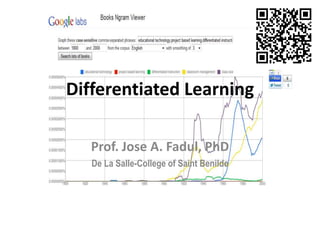
Differentiated Learning 
Prof. Jose A. Fadul, PhD 
De La Salle-College of Saint Benilde
Differentiated instruction and assessment (also known as 
differentiated learning or simply, differentiation) is a 
framework or philosophy for effective teaching that involves 
providing different students with different avenues to learning 
(often in the same classroom) in terms of: acquiring content; 
processing, constructing, or making sense of ideas; and 
developing teaching materials and assessment measures so 
that all students within a classroom can learn effectively, 
regardless of differences in ability. 
--Carol Ann Tomlinson, (2001). How to Differentiate 
Instruction in Mixed-Ability Differentiated 
Instructions provides access for all students to the 
general education curriculum. Classrooms (2 ed.). 
Alexandria, VA: Association for Supervision and 
Curriculum Development. ISBN 0871205122. 
Cited 27 times since 2001 (Google Scholar).
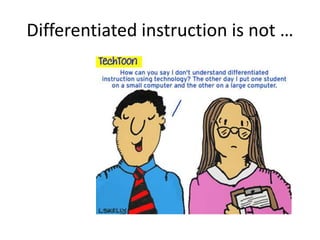
Differentiated instruction is not …
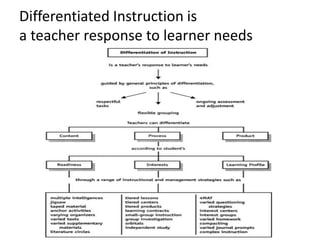
Differentiated Instruction is 
a teacher response to learner needs
Differentiated instruction will not 
reduce the work of the teacher. 
The fact that students differ may be inconvenient, 
but it is inescapable. Adapting to that diversity is 
the inevitable price of productivity, high standards, 
and fairness to kids. 
--Theodore Sizer, Brown University
Differentiated classrooms are responsive to student 
variety in readiness levels, interests and learning 
profiles. It is a classroom where all students are included 
and can be successful. To do this a teacher sets different 
expectations for task completion for students based 
upon their individual needs. 
--Diana Lawrence-Brown (2004). 
“Differentiated Instruction: Inclusive Strategies 
For Standards- Based Learning That Benefit 
The Whole Class”. American Secondary 
Education 32 (3): 34–62. 
Cited 125 times since 2004 (Google Scholar).
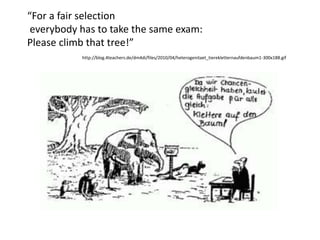
Differentiated Learning exposes irony
“For a fair selection 
everybody has to take the same exam: 
Please climb that tree!” 
http://blog.4teachers.de/dm4di/files/2010/04/heterogenitaet_tierekletternaufdenbaum1-300x188.gif
Thomas Jefferson 
on Fairness & Equality: 
http://www.goodreads.com/quotes/178043-there-is-nothing-more-unequal-than-the-equal-treatment-of
Differentiated Instruction 
versus inconsistent instructions
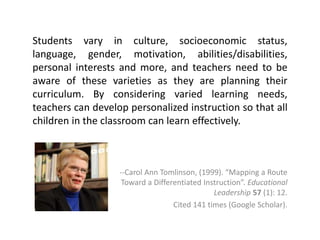
Students vary in culture, socioeconomic status, 
language, gender, motivation, abilities/disabilities, 
personal interests and more, and teachers need to be 
aware of these varieties as they are planning their 
curriculum. By considering varied learning needs, 
teachers can develop personalized instruction so that all 
children in the classroom can learn effectively. 
--Carol Ann Tomlinson, (1999). “Mapping a Route 
Toward a Differentiated Instruction”. Educational 
Leadership 57 (1): 12. 
Cited 141 times (Google Scholar).
A caveat: 
Differentiated Learning is closely related to 
other new ideas in education. 
http://bitstrips.com/r/2P6
Differentiated Learning uses 
Tiered Instruction
Differentiated Learning is compatible 
with many other Learning theories
15 
Comparison of Classrooms 
Traditional 
• Student differences are masked or acted 
upon when problematic 
• Assessment is at the end of learning to 
see “who got it” 
• A single definition of excellence exists 
• Whole-class instruction 
• Time inflexible 
• The teacher solves problems 
• Teacher provides whole-class standards 
for grading 
Differentiated 
• Student differences are studied as a basis 
for planning 
• Ongoing and diagnostic assessments 
• Excellence is defined by individual growth 
from the starting point 
• Many various instructional strategies are 
used 
• Flexible time according to student needs 
• Students help one another to solve 
problems 
• Whole-class and individual goals 
Source: Tomlinson C. (1999) The Differentiated 
Classroom; p. 16
How do teachers differentiate? 
• Through: content, process, product 
• According to student’s: readiness, interest, learning profile, etc.
How should we differentiate in CSB? 
• Start slow, two to three new ideas at a time 
• Make use of student files, diagnostic test results 
• Be familiar with students abilities and interest 
• Know your resources, including social networking 
sites and various apps 
• Organize your classroom 
• Make student prepare their portfolios 
• Have clear written directions for all activities 
• Post agendas for students every meeting 
• Provide for student interactions
Strategies used by teachers for 
Differentiated Instruction 
• Varying organizers 
• Literature Circles 
• Tiered Lessons 
• Tiered Assignments 
• Tiered Centers 
• Interest Centers 
• Interest Groups 
• Learning Contracts 
• Independent Study 
• Varied Questioning Strategies 
• Reading Buddies 
• Varied Homework 
• Small Group Instruction 
• Tiered Student Products 
Sources: The Differentiated Classroom, Tomlinson,1999; interview with selected CSB teachers
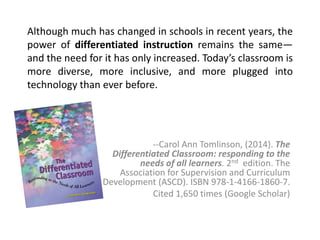
Although much has changed in schools in recent years, the 
power of differentiated instruction remains the same— 
and the need for it has only increased. Today’s classroom is 
more diverse, more inclusive, and more plugged into 
technology than ever before. 
--Carol Ann Tomlinson, (2014). The 
Differentiated Classroom: responding to the 
needs of all learners. 2nd edition. The 
Association for Supervision and Curriculum 
Development (ASCD). ISBN 978-1-4166-1860-7. 
Cited 1,650 times (Google Scholar)
Thank you!

Differentiated learning: differentiated instruction, differentiated assessment

  • 1.
    Differentiated Learning Prof.Jose A. Fadul, PhD De La Salle-College of Saint Benilde
  • 2.
    Differentiated instruction andassessment (also known as differentiated learning or simply, differentiation) is a framework or philosophy for effective teaching that involves providing different students with different avenues to learning (often in the same classroom) in terms of: acquiring content; processing, constructing, or making sense of ideas; and developing teaching materials and assessment measures so that all students within a classroom can learn effectively, regardless of differences in ability. --Carol Ann Tomlinson, (2001). How to Differentiate Instruction in Mixed-Ability Differentiated Instructions provides access for all students to the general education curriculum. Classrooms (2 ed.). Alexandria, VA: Association for Supervision and Curriculum Development. ISBN 0871205122. Cited 27 times since 2001 (Google Scholar).
  • 3.
  • 4.
    Differentiated Instruction is a teacher response to learner needs
  • 5.
    Differentiated instruction willnot reduce the work of the teacher. The fact that students differ may be inconvenient, but it is inescapable. Adapting to that diversity is the inevitable price of productivity, high standards, and fairness to kids. --Theodore Sizer, Brown University
  • 6.
    Differentiated classrooms areresponsive to student variety in readiness levels, interests and learning profiles. It is a classroom where all students are included and can be successful. To do this a teacher sets different expectations for task completion for students based upon their individual needs. --Diana Lawrence-Brown (2004). “Differentiated Instruction: Inclusive Strategies For Standards- Based Learning That Benefit The Whole Class”. American Secondary Education 32 (3): 34–62. Cited 125 times since 2004 (Google Scholar).
  • 7.
  • 8.
    “For a fairselection everybody has to take the same exam: Please climb that tree!” http://blog.4teachers.de/dm4di/files/2010/04/heterogenitaet_tierekletternaufdenbaum1-300x188.gif
  • 9.
    Thomas Jefferson onFairness & Equality: http://www.goodreads.com/quotes/178043-there-is-nothing-more-unequal-than-the-equal-treatment-of
  • 10.
    Differentiated Instruction versusinconsistent instructions
  • 11.
    Students vary inculture, socioeconomic status, language, gender, motivation, abilities/disabilities, personal interests and more, and teachers need to be aware of these varieties as they are planning their curriculum. By considering varied learning needs, teachers can develop personalized instruction so that all children in the classroom can learn effectively. --Carol Ann Tomlinson, (1999). “Mapping a Route Toward a Differentiated Instruction”. Educational Leadership 57 (1): 12. Cited 141 times (Google Scholar).
  • 12.
    A caveat: DifferentiatedLearning is closely related to other new ideas in education. http://bitstrips.com/r/2P6
  • 13.
    Differentiated Learning uses Tiered Instruction
  • 14.
    Differentiated Learning iscompatible with many other Learning theories
  • 15.
    15 Comparison ofClassrooms Traditional • Student differences are masked or acted upon when problematic • Assessment is at the end of learning to see “who got it” • A single definition of excellence exists • Whole-class instruction • Time inflexible • The teacher solves problems • Teacher provides whole-class standards for grading Differentiated • Student differences are studied as a basis for planning • Ongoing and diagnostic assessments • Excellence is defined by individual growth from the starting point • Many various instructional strategies are used • Flexible time according to student needs • Students help one another to solve problems • Whole-class and individual goals Source: Tomlinson C. (1999) The Differentiated Classroom; p. 16
  • 16.
    How do teachersdifferentiate? • Through: content, process, product • According to student’s: readiness, interest, learning profile, etc.
  • 17.
    How should wedifferentiate in CSB? • Start slow, two to three new ideas at a time • Make use of student files, diagnostic test results • Be familiar with students abilities and interest • Know your resources, including social networking sites and various apps • Organize your classroom • Make student prepare their portfolios • Have clear written directions for all activities • Post agendas for students every meeting • Provide for student interactions
  • 18.
    Strategies used byteachers for Differentiated Instruction • Varying organizers • Literature Circles • Tiered Lessons • Tiered Assignments • Tiered Centers • Interest Centers • Interest Groups • Learning Contracts • Independent Study • Varied Questioning Strategies • Reading Buddies • Varied Homework • Small Group Instruction • Tiered Student Products Sources: The Differentiated Classroom, Tomlinson,1999; interview with selected CSB teachers
  • 19.
    Although much haschanged in schools in recent years, the power of differentiated instruction remains the same— and the need for it has only increased. Today’s classroom is more diverse, more inclusive, and more plugged into technology than ever before. --Carol Ann Tomlinson, (2014). The Differentiated Classroom: responding to the needs of all learners. 2nd edition. The Association for Supervision and Curriculum Development (ASCD). ISBN 978-1-4166-1860-7. Cited 1,650 times (Google Scholar)
  • 20.