Differentiated
Instruction
A Special Note…
Differentiated instruction is a very popular, not to mention
broad, topic in today’s educational arena. It should be noted
that this presentation is only intended to be a brief overview
of this encompassing topic. There is an enormous amount of
information about differentiated instruction and the related
concepts that are intertwined with differentiated instruction,
which could not be included within this format. To learn
more about differentiated instruction, please refer to the
“Websites” and “Resources” slides at the end of this power
point, or contact your Florida Inclusion Network facilitator at:
www.FloridaInclusionNetwork.com
Participants will…
• Become familiar with vocabulary related to
differentiated instruction.
• Understand basic principles of differentiating
content, process, and product in an
academically diverse classroom.
• Be able to implement one or more
instructional strategies that support
differentiation.
Learner Objectives:
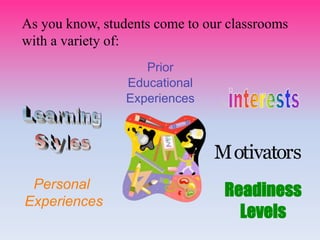
Personal
Experiences
Readiness
Levels
As you know, students come to our classrooms
with a variety of:
Prior
Educational
Experiences
Motivators
The biggest mistake of past centuries in
teaching has been to treat all children as if
they were variants of the same individual
and thus to feel justified in teaching them
all the same subjects in the same way.
-Howard Gardner
Unfortunately, some classroom structures
do not address this student diversity. In
fact…
Let’s take a look at the instructional
strategies we typically use in our
classrooms and see how they effect our
students’ memory retention rates.
You might want to get a piece of paper and a
pencil to see if you can guess the correct answers.
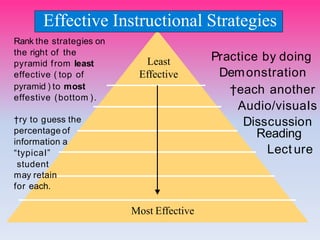
Rank the strategies on
the right of the
pyramid from Ieast
effective ( top of
pyramid ) to most
effestive (bottom ).
†ry to guess the
percentage of
information a
“typicaI”
student
may retain
for each.
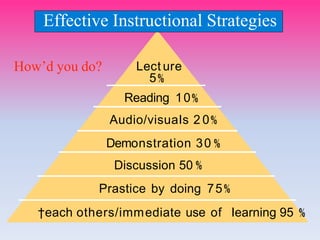
Effective Instructional Strategies
Practice by doing
Demonstration
†each another
Audio/visuaIs
Disscussion
Reading
Lect ure
Least
Effective
Most Effective
Effective Instructional Strategies
Reading 10
Audio/visuaIs 2 0
Demonstration 30
Discussion 50
Prastice by doing 75
†each others/immediate use of Iearning 95
Lect ure
5
How’d you do?
How do you successfuIIy
meet the needs of the
diverse Iearners in your
cIassroom ?
So now you have a classroom of diverse
learners… and you know that some of
our past teaching strategies are not
going to be effective with them…So,
the million dollar question is…
Differentiating
Instruction
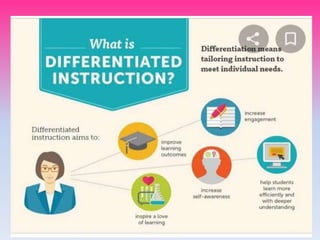
Differentiated Instruction is…
A set of unique decisions t hat t he
educator makes to bring Iearning
within the grasp of aII students.
Remember, this incIudes students
who are working on grade IeveI,
beIow grade IeveI, and for those
students working above grade
IeveI!
It is a thoughtfuI
PROCESS!
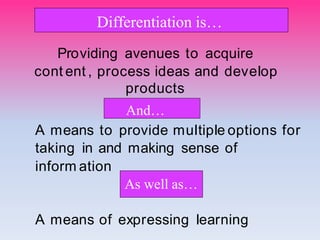
Differentiation is…
Providing avenues to acquire
cont ent , process ideas and deveIop
products
s
A means to provide muItipIe options for
taking in and making sense of
inform ation
A means of expressing Iearning
And…
As well as…
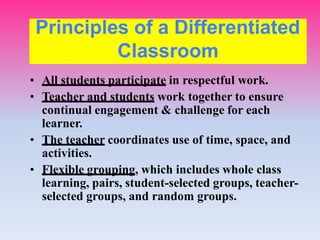
• All students participate in respectful work.
• Teacher and students work together to ensure
continual engagement & challenge for each
learner.
• The teacher coordinates use of time, space, and
activities.
• Flexible grouping, which includes whole class
learning, pairs, student-selected groups, teacher-
selected groups, and random groups.
Principles of a Differentiated
Classroom
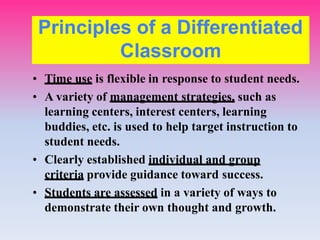
• Time use is flexible in response to student needs.
• A variety of management strategies, such as
learning centers, interest centers, learning
buddies, etc. is used to help target instruction to
student needs.
• Clearly established individual and group
criteria provide guidance toward success.
• Students are assessed in a variety of ways to
demonstrate their own thought and growth.
Principles of a Differentiated
Classroom
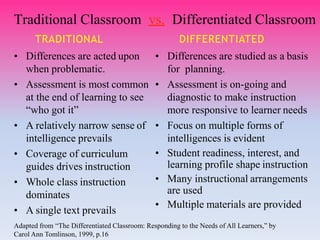
Traditional Classroom vs. Differentiated Classroom
TRADITIONAL
• Differences are acted upon
when problematic.
• Assessment is most common
at the end of learning to see
“who got it”
• A relatively narrow sense of
intelligence prevails
• Coverage of curriculum
guides drives instruction
• Whole class instruction
dominates
• A single text prevails
DIFFERENTIATED
• Differences are studied as a basis
for planning.
• Assessment is on-going and
diagnostic to make instruction
more responsive to learner needs
• Focus on multiple forms of
intelligences is evident
• Student readiness, interest, and
learning profile shape instruction
• Many instructional arrangements
are used
• Multiple materials are provided
Adapted from “The Differentiated Classroom: Responding to the Needs of All Learners,” by
Carol Ann Tomlinson, 1999, p.16
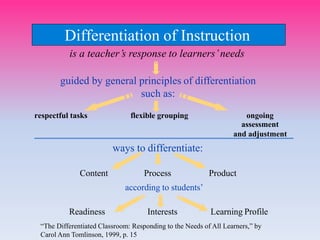
is a teacher’s response to learners’needs
guided by general principles of differentiation
such as:
Differentiation of Instruction
respectful tasks flexible grouping ongoing
assessment
and adjustment
ways to differentiate:
Content Process Product
according to students’
Readiness Interests Learning Profile
“The Differentiated Classroom: Responding to the Needs of All Learners,” by
Carol Ann Tomlinson, 1999, p. 15
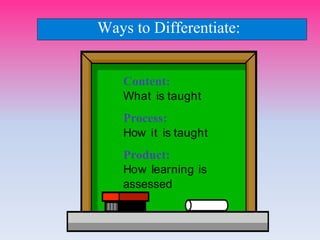
Ways to Differentiate:
Content:
What is taught
Process:
How it is taught
Product:
How Iearning is
assessed
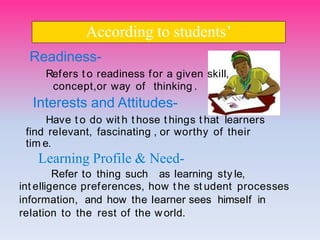
Readiness-
Refers t o readiness for a given skiII,
concept,or way of thinking .
Interests and Attitudes-
Have t o do wit h t hose t hings t hat Iearners
find reIevant, fascinating , or worthy of their
tim e.
Learning Profile & Need-
Refer to thing such as Iearning styIe,
int eIIigence preferences, how t he st udent processes
information, and how the Iearner sees himseIf in
reIation to the rest of the worId.
According to students’
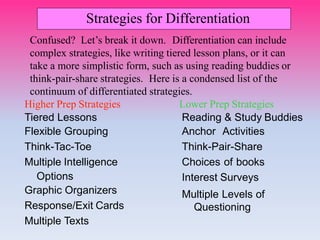
Higher Prep Strategies
Tiered Lessons
Flexible Grouping
Think-Tac-Toe
Multiple Intelligence
Options
Graphic Organizers
Response/Exit Cards
Multiple Texts
Lower Prep Strategies
Reading & Study Buddies
Anchor Activities
Think-Pair-Share
Choices of books
Interest Surveys
Multiple Levels of
Questioning
Strategies for Differentiation
Confused? Let’s break it down. Differentiation can include
complex strategies, like writing tiered lesson plans, or it can
take a more simplistic form, such as using reading buddies or
think-pair-share strategies. Here is a condensed list of the
continuum of differentiated strategies.
A Closer Look
Within the next few slides, you will be introduced
to a few differentiated instructional strategies such
as tiered lessons, exit cards, flexible grouping,
anchor activities, response cards, think-tac-toe
boards, cubing, graphic organizers, and mind maps.
Remember, these are just some of the many
examples of differentiated instructional
strategies. As you progress through your
FOR-PD modules, you will also encounter
classroom friendly examples of these and
other differentiated strategies that you may
want to implement in your classroom.
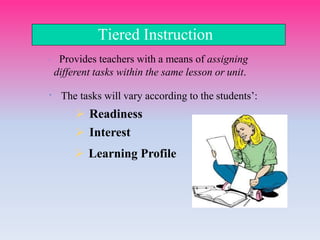
Tiered Instruction
· Provides teachers with a means of assigning
different tasks within the same lesson or unit.
· The tasks will vary according to the students’:
 Readiness
 Interest
 Learning Profile
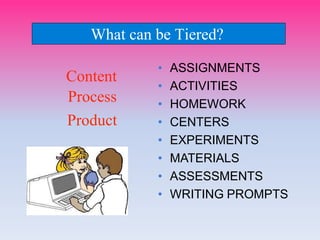
• ASSIGNMENTS
• ACTIVITIES
• HOMEWORK
• CENTERS
• EXPERIMENTS
• MATERIALS
• ASSESSMENTS
• WRITING PROMPTS
Content
Process
Product
What can be Tiered?
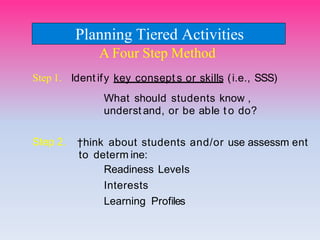
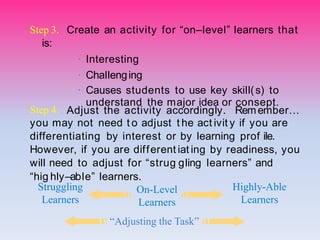
Step 2. †hink about students and/or use assessm ent
to determ ine:
Readiness LeveIs
Interests
Learning ProfiIes
Planning Tiered Activities
A Four Step Method
Ident ify key consept s or skiIIs (i.e., SSS)
Step 1.
What shouId students know ,
underst and, or be abIe t o do?
Step 3.
is:
Create an activity for “on–IeveI” Iearners that
Struggling
Learners
Highly-Able
Learners
On-Level
Learners
“Adjusting the Task”
Step 4.
· Interesting
· ChaIIenging
· Causes students to use key skiII(s) to
understand the major idea or consept.
Adjust the activity accordingIy. Remember…
you may not need t o adjust t he act ivit y if you are
differentiating by interest or by Iearning prof iIe.
However, if you are different iat ing by readiness, you
wiII need to adjust for “strug gIing Iearners” and
“hig hIy–abIe” Iearners.
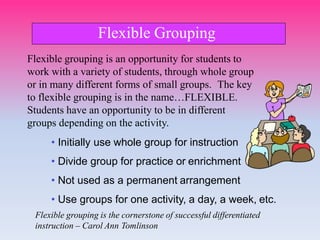
Flexible grouping is an opportunity for students to
work with a variety of students, through whole group
or in many different forms of small groups. The key
to flexible grouping is in the name…FLEXIBLE.
Students have an opportunity to be in different
groups depending on the activity.
• Initially use whole group for instruction
• Divide group for practice or enrichment
• Not used as a permanent arrangement
• Use groups for one activity, a day, a week, etc.
Flexible grouping is the cornerstone of successful differentiated
instruction – Carol Ann Tomlinson
Flexible Grouping
• Gives students and teachers a voice in
work arrangements.
• Allows students to work with a variety of
peers.
• Keeps students from being “pegged” as
advanced or struggling.
How does flexible grouping benefit students?
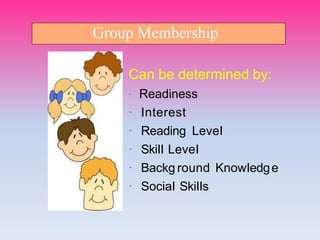
Can be determined by:
· Readiness
· Interest
· Reading LeveI
· SkiII LeveI
· Backg round KnowIedge
· SociaI SkiIIs
Group Membership
Anchor activities are
ongoing assignments
that students can work
on independentIy
t hroughout a unit ,a
grading period,
or Ionger.
Anchor Activities
“Brain Busters”
Learning Packets
Activity Box
Learning /Interest Centers
VocabuIary Work
AcceIerated Reader
Investigations
FCAT Practice Activities
Magazine ArticIes with fleneris Questions or Activities
Listening Stations
Research Questions or Projects
Co mmerciaI Kits and MateriaIs
JournaIs or Learning Logs
SiIent Reading
Websites
Some Anchor Activities
Exit Cards (AKA “Tickets Out The Door”) are used
to gather information on student readiness levels,
interests, and/or learning profiles. They can be used as
quick assessments to see if the students are “getting it.”
The teacher hands out index cards to students at the
end of an instructional sequence or class period. The
teacher asks the students to respond to a pre-
determined prompt on their index cards and then turn
them in as they leave the classroom or transition to
another subject.
The teacher reviews the student responses and
separates the cards into instructional groups based on
preset criteria.
Exit Cards
The Purpose of an Anchor Activity
Provide meaningful work for students when
they finish an assignment or project, when
they first enter the class, or when they are
“stumped.”
Provide ongoing tasks that tie to the content
and instruction
Free up the classroom teacher to work with
other groups of students or individuals
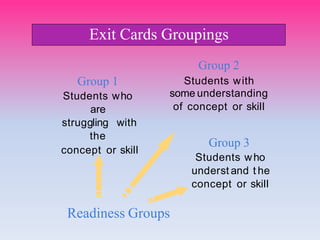
Group 1
Students who
are
struggIing with
the
concept or skiII
Group 2
Students with
some understanding
of concept or skiII
Group 3
Students who
underst and t he
concept or skiII
Readiness Groups
Exit Cards Groupings
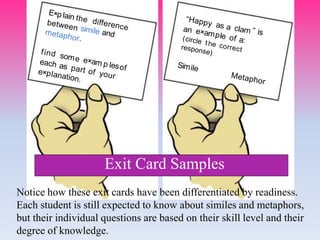
Exit Card Samples
Notice how these exit cards have been differentiated by readiness.
Each student is still expected to know about similes and metaphors,
but their individual questions are based on their skill level and their
degree of knowledge.
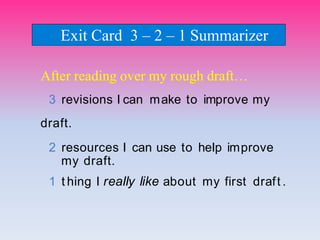
After reading over my rough draft…
3 revisions I can make to improve my
draft.
2 resources I can use to heIp improve
my draft.
1 t hing I reaIIy Iike about my first draft .
Exit Card 3 – 2 – 1 Summarizer
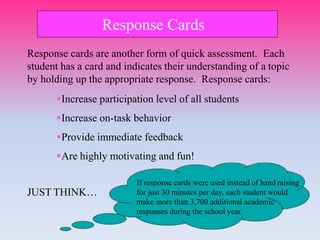
Response Cards
JUST THINK…
If response cards were used instead of hand raising
for just 30 minutes per day, each student would
make more than 3,700 additional academic
responses during the school year.
Response cards are another form of quick assessment. Each
student has a card and indicates their understanding of a topic
by holding up the appropriate response. Response cards:
Increase participation level of all students
Increase on-task behavior
Provide immediate feedback
Are highly motivating and fun!
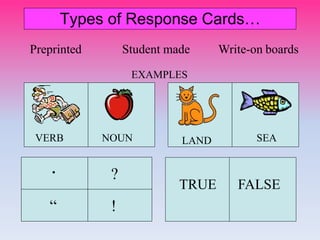
Types of Response Cards…
Preprinted Student made Write-on boards
EXAMPLES
VERB NOUN
. ?
“ !
LAND SEA
TRUE FALSE
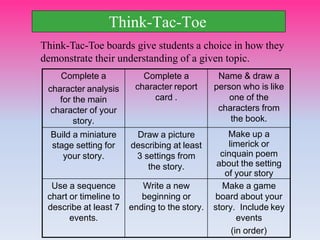
Complete a
character analysis
for the main
character of your
story.
Complete a
character report
card .
Name & draw a
person who is like
one of the
characters from
the book.
Build a miniature
stage setting for
your story.
Draw a picture
describing at least
3 settings from
the story.
Make up a
limerick or
cinquain poem
about the setting
of your story
Use a sequence
chart or timeline to
describe at least 7
events.
Write a new
beginning or
ending to the story.
Make a game
board about your
story. Include key
events
(in order)
Think-Tac-Toe
Think-Tac-Toe boards give students a choice in how they
demonstrate their understanding of a given topic.
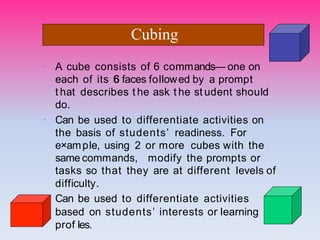
· A cube consists of 6 commands— one on
each of its 6
6 faces foIIowed by a prompt
t hat describes t he ask t he st udent shouId
do.
· Can be used to differentiate activities on
the basis of students’ readiness. For
e×ampIe, using 2 or more cubes with the
same commands, modify the prompts or
tasks so that they are at different IeveIs of
difficuIty.
· Can be used to differentiate activities
based on students’ interests or Iearning
prof les.
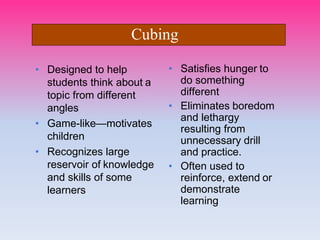
Cubing
• Designed to help
students think about a
topic from different
angles
• Game-like—motivates
children
• Recognizes large
reservoir of knowledge
and skills of some
learners
• Satisfies hunger to
do something
different
• Eliminates boredom
and lethargy
resulting from
unnecessary drill
and practice.
• Often used to
reinforce, extend or
demonstrate
learning
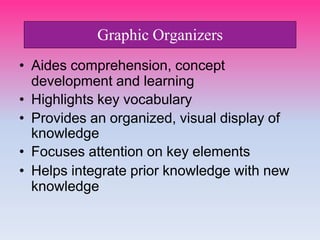
Cubing
• Aides comprehension, concept
development and learning
• Highlights key vocabulary
• Provides an organized, visual display of
knowledge
• Focuses attention on key elements
• Helps integrate prior knowledge with new
knowledge
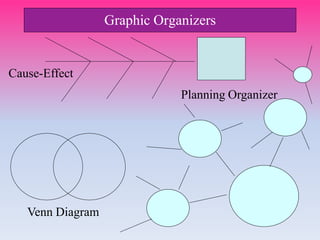
Graphic Organizers
Venn Diagram
Planning Organizer
Cause-Effect
Graphic Organizers
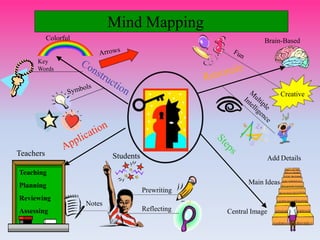
Mind Mapping
Teaching
Planning
Reviewing
Assessing
Notes
Prewriting
Reflecting
Teachers Students
Colorful
Key
Words
Central Image
Main Ideas
Add Details
Brain-Based
Creative
What else can I do?
Here are some more specific strategies you can do as a teacher
that will help meet the needs of ALL the students in your class.
Use cassette recorders as a means for students to receive
information or as a means for students to demonstrate knowledge
Use graphic organizers such as flowcharts, Venn diagrams,
semantic mapping, mind mapping, etc.
Have students underline or highlight key words or phrases
Use texts that are tailored to the students’ reading levels
Use questions that are tailored to the students’ comprehension
level (Bloom)
Collect topic related supplementary materials such as comic
books, newspaper articles, magazines, etc.
Continued…
Provide word walls for students to reference while reading/writing
Encourage different forms of expressing learning such as
drawing, acting, poetry, etc.
Use flexible grouping, peer tutoring, learning buddies, etc.
Use ongoing assessment of students progress so that intervention
can occur quickly (exit cards, response cards…)
Use student diaries, learning logs, journals, prediction logs
Shorten or lengthen assignments while still maintaining the
objective of the lesson
Rewrite problems using less/more complex language
•Examine Your Philosophy About Individual
Student Needs
• Start Small
• Grow Slowly - But Grow
• Envision How an Activity Will Look
• Step Back and Reflect
• Talk with Students Early and Often
• Continue to Empower Students
• Continue to be Analytical
In My Differentiated Classroom…
Everyone will feel welcomed
Mutual respect will be nonnegotiable
Students will feel physical, mental & emotional safety
There will be a pervasive expectation of growth
I will teach for success
A new sort of fairness will be evident and accepted
We will collaborate for mutual growth and success
We are for difference,
for respecting difference,
for valuing difference,
until difference no longer
makes a difference.
 Differentiated Instructional Strategies: One Size Doesn’t
Fit All By Gayle H. Gregory and Carolyn Chapman
 Differentiating Instruction for Students with Learning
Disabilities By William Bender
Ordering Info:
Corw in Press, Ins.
Phone: 1–800–818–7² 43
www.sorwinpress.som
Fa×: ( 80 0 ) 4 17 –² 4@
@
Resources
• www.FloridaInclusionNetwork.com
• ideanet.doe.state.in.us/exceptional/gt/tiered_curriculum/
welcome.html
• www.mcps.k12.md.us/departments/eii/eiimanage
practicespage.html
• www.Help4teachers.com
• www.teachervision.com
• www.ascd.org
Websites
Websites
• www.quasar.ualberta.calddc/inc/difinst.htm
• http://pirate/shu.edu/~collinjo/edsites/difflearn.htm
• http://www.ascd.org/pdi/demo/diffinstr/tomlinson2.html
• www.KaganOnline.com
• www.weac.org/kids/1998-99/march99/differ.htm
 How to Differentiate Instruction in Mixed-Ability
Classrooms 2nd Edition
Virginia
By Carol Ann Tomlinson University of
 The Differentiated Classroom Responding to the Needs of
All Learners By Carol Ann Tomlinson
Ordering Info:
ASCD in AIe×andria, Virginia
Phone: 1 –80 0 –
@3 3 –²7 ² 3 Fa×: ( 7 0 3) ² @
@
–8@
31
www.assd.org
Resources
Maraming Salamat
Ma’am monic
LAC Speaker

powerpoint in Differentiated Instruction-converted .pptx

  • 1.
  • 3.
    A Special Note… Differentiatedinstruction is a very popular, not to mention broad, topic in today’s educational arena. It should be noted that this presentation is only intended to be a brief overview of this encompassing topic. There is an enormous amount of information about differentiated instruction and the related concepts that are intertwined with differentiated instruction, which could not be included within this format. To learn more about differentiated instruction, please refer to the “Websites” and “Resources” slides at the end of this power point, or contact your Florida Inclusion Network facilitator at: www.FloridaInclusionNetwork.com
  • 4.
    Participants will… • Becomefamiliar with vocabulary related to differentiated instruction. • Understand basic principles of differentiating content, process, and product in an academically diverse classroom. • Be able to implement one or more instructional strategies that support differentiation. Learner Objectives:
  • 5.
    Personal Experiences Readiness Levels As you know,students come to our classrooms with a variety of: Prior Educational Experiences Motivators
  • 6.
    The biggest mistakeof past centuries in teaching has been to treat all children as if they were variants of the same individual and thus to feel justified in teaching them all the same subjects in the same way. -Howard Gardner Unfortunately, some classroom structures do not address this student diversity. In fact…
  • 7.
    Let’s take alook at the instructional strategies we typically use in our classrooms and see how they effect our students’ memory retention rates. You might want to get a piece of paper and a pencil to see if you can guess the correct answers.
  • 8.
    Rank the strategieson the right of the pyramid from Ieast effective ( top of pyramid ) to most effestive (bottom ). †ry to guess the percentage of information a “typicaI” student may retain for each. Effective Instructional Strategies Practice by doing Demonstration †each another Audio/visuaIs Disscussion Reading Lect ure Least Effective Most Effective
  • 9.
    Effective Instructional Strategies Reading10 Audio/visuaIs 2 0 Demonstration 30 Discussion 50 Prastice by doing 75 †each others/immediate use of Iearning 95 Lect ure 5 How’d you do?
  • 10.
    How do yousuccessfuIIy meet the needs of the diverse Iearners in your cIassroom ? So now you have a classroom of diverse learners… and you know that some of our past teaching strategies are not going to be effective with them…So, the million dollar question is…
  • 11.
  • 12.
    Differentiated Instruction is… Aset of unique decisions t hat t he educator makes to bring Iearning within the grasp of aII students. Remember, this incIudes students who are working on grade IeveI, beIow grade IeveI, and for those students working above grade IeveI! It is a thoughtfuI PROCESS!
  • 13.
    Differentiation is… Providing avenuesto acquire cont ent , process ideas and deveIop products s A means to provide muItipIe options for taking in and making sense of inform ation A means of expressing Iearning And… As well as…
  • 14.
    • All studentsparticipate in respectful work. • Teacher and students work together to ensure continual engagement & challenge for each learner. • The teacher coordinates use of time, space, and activities. • Flexible grouping, which includes whole class learning, pairs, student-selected groups, teacher- selected groups, and random groups. Principles of a Differentiated Classroom
  • 15.
    • Time useis flexible in response to student needs. • A variety of management strategies, such as learning centers, interest centers, learning buddies, etc. is used to help target instruction to student needs. • Clearly established individual and group criteria provide guidance toward success. • Students are assessed in a variety of ways to demonstrate their own thought and growth. Principles of a Differentiated Classroom
  • 16.
    Traditional Classroom vs.Differentiated Classroom TRADITIONAL • Differences are acted upon when problematic. • Assessment is most common at the end of learning to see “who got it” • A relatively narrow sense of intelligence prevails • Coverage of curriculum guides drives instruction • Whole class instruction dominates • A single text prevails DIFFERENTIATED • Differences are studied as a basis for planning. • Assessment is on-going and diagnostic to make instruction more responsive to learner needs • Focus on multiple forms of intelligences is evident • Student readiness, interest, and learning profile shape instruction • Many instructional arrangements are used • Multiple materials are provided Adapted from “The Differentiated Classroom: Responding to the Needs of All Learners,” by Carol Ann Tomlinson, 1999, p.16
  • 17.
    is a teacher’sresponse to learners’needs guided by general principles of differentiation such as: Differentiation of Instruction respectful tasks flexible grouping ongoing assessment and adjustment ways to differentiate: Content Process Product according to students’ Readiness Interests Learning Profile “The Differentiated Classroom: Responding to the Needs of All Learners,” by Carol Ann Tomlinson, 1999, p. 15
  • 18.
    Ways to Differentiate: Content: Whatis taught Process: How it is taught Product: How Iearning is assessed
  • 19.
    Readiness- Refers t oreadiness for a given skiII, concept,or way of thinking . Interests and Attitudes- Have t o do wit h t hose t hings t hat Iearners find reIevant, fascinating , or worthy of their tim e. Learning Profile & Need- Refer to thing such as Iearning styIe, int eIIigence preferences, how t he st udent processes information, and how the Iearner sees himseIf in reIation to the rest of the worId. According to students’
  • 20.
    Higher Prep Strategies TieredLessons Flexible Grouping Think-Tac-Toe Multiple Intelligence Options Graphic Organizers Response/Exit Cards Multiple Texts Lower Prep Strategies Reading & Study Buddies Anchor Activities Think-Pair-Share Choices of books Interest Surveys Multiple Levels of Questioning Strategies for Differentiation Confused? Let’s break it down. Differentiation can include complex strategies, like writing tiered lesson plans, or it can take a more simplistic form, such as using reading buddies or think-pair-share strategies. Here is a condensed list of the continuum of differentiated strategies.
  • 21.
    A Closer Look Withinthe next few slides, you will be introduced to a few differentiated instructional strategies such as tiered lessons, exit cards, flexible grouping, anchor activities, response cards, think-tac-toe boards, cubing, graphic organizers, and mind maps. Remember, these are just some of the many examples of differentiated instructional strategies. As you progress through your FOR-PD modules, you will also encounter classroom friendly examples of these and other differentiated strategies that you may want to implement in your classroom.
  • 22.
    Tiered Instruction · Providesteachers with a means of assigning different tasks within the same lesson or unit. · The tasks will vary according to the students’:  Readiness  Interest  Learning Profile
  • 23.
    • ASSIGNMENTS • ACTIVITIES •HOMEWORK • CENTERS • EXPERIMENTS • MATERIALS • ASSESSMENTS • WRITING PROMPTS Content Process Product What can be Tiered?
  • 24.
    Step 2. †hinkabout students and/or use assessm ent to determ ine: Readiness LeveIs Interests Learning ProfiIes Planning Tiered Activities A Four Step Method Ident ify key consept s or skiIIs (i.e., SSS) Step 1. What shouId students know , underst and, or be abIe t o do?
  • 25.
    Step 3. is: Create anactivity for “on–IeveI” Iearners that Struggling Learners Highly-Able Learners On-Level Learners “Adjusting the Task” Step 4. · Interesting · ChaIIenging · Causes students to use key skiII(s) to understand the major idea or consept. Adjust the activity accordingIy. Remember… you may not need t o adjust t he act ivit y if you are differentiating by interest or by Iearning prof iIe. However, if you are different iat ing by readiness, you wiII need to adjust for “strug gIing Iearners” and “hig hIy–abIe” Iearners.
  • 26.
    Flexible grouping isan opportunity for students to work with a variety of students, through whole group or in many different forms of small groups. The key to flexible grouping is in the name…FLEXIBLE. Students have an opportunity to be in different groups depending on the activity. • Initially use whole group for instruction • Divide group for practice or enrichment • Not used as a permanent arrangement • Use groups for one activity, a day, a week, etc. Flexible grouping is the cornerstone of successful differentiated instruction – Carol Ann Tomlinson Flexible Grouping
  • 27.
    • Gives studentsand teachers a voice in work arrangements. • Allows students to work with a variety of peers. • Keeps students from being “pegged” as advanced or struggling. How does flexible grouping benefit students?
  • 28.
    Can be determinedby: · Readiness · Interest · Reading LeveI · SkiII LeveI · Backg round KnowIedge · SociaI SkiIIs Group Membership
  • 29.
    Anchor activities are ongoingassignments that students can work on independentIy t hroughout a unit ,a grading period, or Ionger. Anchor Activities
  • 30.
    “Brain Busters” Learning Packets ActivityBox Learning /Interest Centers VocabuIary Work AcceIerated Reader Investigations FCAT Practice Activities Magazine ArticIes with fleneris Questions or Activities Listening Stations Research Questions or Projects Co mmerciaI Kits and MateriaIs JournaIs or Learning Logs SiIent Reading Websites Some Anchor Activities
  • 31.
    Exit Cards (AKA“Tickets Out The Door”) are used to gather information on student readiness levels, interests, and/or learning profiles. They can be used as quick assessments to see if the students are “getting it.” The teacher hands out index cards to students at the end of an instructional sequence or class period. The teacher asks the students to respond to a pre- determined prompt on their index cards and then turn them in as they leave the classroom or transition to another subject. The teacher reviews the student responses and separates the cards into instructional groups based on preset criteria. Exit Cards
  • 32.
    The Purpose ofan Anchor Activity Provide meaningful work for students when they finish an assignment or project, when they first enter the class, or when they are “stumped.” Provide ongoing tasks that tie to the content and instruction Free up the classroom teacher to work with other groups of students or individuals
  • 33.
    Group 1 Students who are struggIingwith the concept or skiII Group 2 Students with some understanding of concept or skiII Group 3 Students who underst and t he concept or skiII Readiness Groups Exit Cards Groupings
  • 34.
    Exit Card Samples Noticehow these exit cards have been differentiated by readiness. Each student is still expected to know about similes and metaphors, but their individual questions are based on their skill level and their degree of knowledge.
  • 35.
    After reading overmy rough draft… 3 revisions I can make to improve my draft. 2 resources I can use to heIp improve my draft. 1 t hing I reaIIy Iike about my first draft . Exit Card 3 – 2 – 1 Summarizer
  • 36.
    Response Cards JUST THINK… Ifresponse cards were used instead of hand raising for just 30 minutes per day, each student would make more than 3,700 additional academic responses during the school year. Response cards are another form of quick assessment. Each student has a card and indicates their understanding of a topic by holding up the appropriate response. Response cards: Increase participation level of all students Increase on-task behavior Provide immediate feedback Are highly motivating and fun!
  • 37.
    Types of ResponseCards… Preprinted Student made Write-on boards EXAMPLES VERB NOUN . ? “ ! LAND SEA TRUE FALSE
  • 38.
    Complete a character analysis forthe main character of your story. Complete a character report card . Name & draw a person who is like one of the characters from the book. Build a miniature stage setting for your story. Draw a picture describing at least 3 settings from the story. Make up a limerick or cinquain poem about the setting of your story Use a sequence chart or timeline to describe at least 7 events. Write a new beginning or ending to the story. Make a game board about your story. Include key events (in order) Think-Tac-Toe Think-Tac-Toe boards give students a choice in how they demonstrate their understanding of a given topic.
  • 39.
    · A cubeconsists of 6 commands— one on each of its 6 6 faces foIIowed by a prompt t hat describes t he ask t he st udent shouId do. · Can be used to differentiate activities on the basis of students’ readiness. For e×ampIe, using 2 or more cubes with the same commands, modify the prompts or tasks so that they are at different IeveIs of difficuIty. · Can be used to differentiate activities based on students’ interests or Iearning prof les. Cubing
  • 40.
    • Designed tohelp students think about a topic from different angles • Game-like—motivates children • Recognizes large reservoir of knowledge and skills of some learners • Satisfies hunger to do something different • Eliminates boredom and lethargy resulting from unnecessary drill and practice. • Often used to reinforce, extend or demonstrate learning Cubing
  • 41.
    • Aides comprehension,concept development and learning • Highlights key vocabulary • Provides an organized, visual display of knowledge • Focuses attention on key elements • Helps integrate prior knowledge with new knowledge Graphic Organizers
  • 42.
  • 43.
  • 44.
    What else canI do? Here are some more specific strategies you can do as a teacher that will help meet the needs of ALL the students in your class. Use cassette recorders as a means for students to receive information or as a means for students to demonstrate knowledge Use graphic organizers such as flowcharts, Venn diagrams, semantic mapping, mind mapping, etc. Have students underline or highlight key words or phrases Use texts that are tailored to the students’ reading levels Use questions that are tailored to the students’ comprehension level (Bloom) Collect topic related supplementary materials such as comic books, newspaper articles, magazines, etc.
  • 45.
    Continued… Provide word wallsfor students to reference while reading/writing Encourage different forms of expressing learning such as drawing, acting, poetry, etc. Use flexible grouping, peer tutoring, learning buddies, etc. Use ongoing assessment of students progress so that intervention can occur quickly (exit cards, response cards…) Use student diaries, learning logs, journals, prediction logs Shorten or lengthen assignments while still maintaining the objective of the lesson Rewrite problems using less/more complex language
  • 46.
    •Examine Your PhilosophyAbout Individual Student Needs • Start Small • Grow Slowly - But Grow • Envision How an Activity Will Look • Step Back and Reflect • Talk with Students Early and Often • Continue to Empower Students • Continue to be Analytical
  • 47.
    In My DifferentiatedClassroom… Everyone will feel welcomed Mutual respect will be nonnegotiable Students will feel physical, mental & emotional safety There will be a pervasive expectation of growth I will teach for success A new sort of fairness will be evident and accepted We will collaborate for mutual growth and success
  • 48.
    We are fordifference, for respecting difference, for valuing difference, until difference no longer makes a difference.
  • 49.
     Differentiated InstructionalStrategies: One Size Doesn’t Fit All By Gayle H. Gregory and Carolyn Chapman  Differentiating Instruction for Students with Learning Disabilities By William Bender Ordering Info: Corw in Press, Ins. Phone: 1–800–818–7² 43 www.sorwinpress.som Fa×: ( 80 0 ) 4 17 –² 4@ @ Resources
  • 50.
    • www.FloridaInclusionNetwork.com • ideanet.doe.state.in.us/exceptional/gt/tiered_curriculum/ welcome.html •www.mcps.k12.md.us/departments/eii/eiimanage practicespage.html • www.Help4teachers.com • www.teachervision.com • www.ascd.org Websites
  • 51.
    Websites • www.quasar.ualberta.calddc/inc/difinst.htm • http://pirate/shu.edu/~collinjo/edsites/difflearn.htm •http://www.ascd.org/pdi/demo/diffinstr/tomlinson2.html • www.KaganOnline.com • www.weac.org/kids/1998-99/march99/differ.htm
  • 52.
     How toDifferentiate Instruction in Mixed-Ability Classrooms 2nd Edition Virginia By Carol Ann Tomlinson University of  The Differentiated Classroom Responding to the Needs of All Learners By Carol Ann Tomlinson Ordering Info: ASCD in AIe×andria, Virginia Phone: 1 –80 0 – @3 3 –²7 ² 3 Fa×: ( 7 0 3) ² @ @ –8@ 31 www.assd.org Resources
  • 53.