Differentiated Instruction
IN ELEMENTARY CLASSROOMS
Hannah Best
American College of Education
LIT5091: Capstone Experience for Literacy
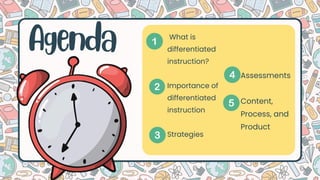
Agenda What is
differentiated
instruction?
Importance of
differentiated
instruction
Strategies
Assessments
Content,
Process, and
Product
What is Differentiation?
Differentiation is can be seen as an approach to
tailor instruction to meet diverse student needs.
“Differentiation means tailoring instruction to meet
individual needs” (Tomlinson, 2000). There are
many different ways that differentiation can be
done within the classroom. Throughout this
presentation we will learn why we use it, how we
use it, and the 3 elements that go with it.
Importance
Differentiated Instruction is something that every educator is either familiar
with or has heard of before. Below are some of the reasons it is so important to
our students in the classroom
Addresses individual student needs (Tomlinson, 2000).
Increases student engagement (British Council | TeachingEnglish, 2022).
Reduces Learning Gaps (Dauchess, 2025).
Improves classroom environment (Norfolk State University, 2022).
Academic growth outcomes (Nelson, 2023).
Social and emotional development (Norfolk State University, 2022).
Learning Stations
One great strategy for implementing differentiated instruction into the
classroom is through learning stations. This is a great way to include multiple
ways of contents to the students at once. All students learn differently so when
they get multiple opportunities to learn in different ways it can increase
student engagement and you can reach individual student needs. It can also
allow opportunities for flexible grouping. (Haas, 2024).
Stations can include things like
Task Cards
Technology
Writing tasks
Artwork
audiobooks
Another great strategy for differentiated instruction is through flexible
grouping. “: Flexible grouping is at the heart of differentiated instruction. It
provides opportunities for students to be part of many different groups based
on their readiness, interest, or learning style” (Mursky, 2011). There are many
opportunities for flexible grouping. They can be teacher selected or student
selected, they can be implemented when a task is focused on students
readiness levels. Flexible grouping provides many benefits such as
An easy strategy to focus on student needs
Builds collaborative skills
Provides opportunities for interaction with peers with similiar interested
and levels of readiness
Can tier assignments based on groupings
Flexible Grouping
Tiered instruction or assignments is a strategy that allows teacher to
design assignments based on student readiness within the same activity
or lesson. This is a great way to provide individualized instruction to meet
student needs all within one lesson. “ This approach allows you to
provide support to struggling students, challenge advanced learners,
and meet the learning needs of students in the middle” (Wahl, 2023). This
strategy can be used across multiple disicplines with a variety of
activities. An example of this could be a writing assignment about an
animal for Kindergarten students. The assignment can be tiered to meet
struggling students by illustrating and labeling their animal, students at
readiness level can write one sentence, and advanced learners can
include 2-3 sentences.
Tiered Instruction
Below is a list of more strategies for implementing differentiated instruction in the
classroom. (Silverman, 2024).
Personalized Learning Goals
Choice Boards
On going assessment
Pre assessment
Scaffolding
Varied Instructional Methods
Small Group Instruction
Think-Pair-Share
Graphic Organizers
MOre Strategies
Ongoing Assessment
Ongoing assessment (Ongoing Assessments ::
Differentiated-Instruction-101, 2019)is a way for
educators to take the data they are collecting to
inform their instruction to best meet student’s needs.
This means continually using assessments
throughout instruction rather than just at the end of a
unit or lesson. A big way to do ongoing assessment is
through pre-assessment, formative assessments and
summative. “The teacher who emphasizes
assessment to inform instruction understands that
only by staying close to student progress can he or
she guide student success” (Ongoing Assessments ::
Differentiated-Instruction-101, 2019).
Pre-Assessment
Pre-assessment is a way for teachers to get an
idea about what students know about a topic
before diving into the instruction. Being able to
know beforehand allows educators to then
tailor instruction based on this information, and
which students may need support. “They
provide evidence to help teachers effectively
match instruction with the needs of students.
This includes decisions about content, pacing,
materials, grouping, and specific learning
activities” (Mursky, 2011).
Pre-Assessment 2
Pre- assessments can be helpful when making
decisions like grouping, how to use students
learning styles and interests to increase
engagement, and which students are ready to
move forward with instruction. Below are some
pre-assessment ideas (Tomlinson, n.d.)
Exit and entrance tickets
Game activities
KWL charts
Concept maps
Self assessments
Formative Assessment
Formative assessments are used throughout
the instructional process. This provides
teachers with ongoing feedback to where
students are throughout to continue to tailor
instruction and support students needs. Here
are a few examples of formative assessments
in the classroom
Think-Pair-Share
Observation
Exit tickets
Self assessment
Virtual quizzes
Summative Assessment
Summative assessment takes place after all the
learning has occurred. This assessment type provides
feedback on what the students learned throughout
the unit. Pairing this with pre and formative
assessments creates a variety of assessment types to
tailor instruction and provides accurate data on how
to meet student needs. Here are summative
examples (Northern Illinois University Center for
Innovative Teaching and Learning, 2012)
Tests
Portfolios
Projects
Performances
Content
Content is one of the three elements of differentiated instruction. Content is what the
students are learning. “ Content can be adjusted based on how a student processes
information, and how they learn” (Del Mar, 2024). It’s important to remember that all
students progress and learn at different speeds. This is where materials and what the
students are learning can be differentiated to meet their needs. For example, one
student is learning how to decode words. Another student is not ready for this content
yet so they are focusing on connecting letter names with letter sounds. Examples of
Differentiating content (Tomlinson, 2000).
Variety of reading levels
Presenting ideas both audibly and visually
Meeting with small groups to re-teach or extend thinking
Process
Process is how the students will be learning the content. “ All students need to achieve
the same learning goals, but teachers can differentiate the way students learn the
content” (Del Mar, 2024). It is important to remember as a teacher you still have to
reach all of your students on content, but it is important that we can differentiate the
way it is taught that best meets students needs. Earlier in the presentation tiered
assignments were talked about. This is a great way to differentiate the process of the
learning. Below are some more examples of differentiating the process (Tomlinson,
2000)
Offering manipulatives or different materials
Providing differentiated learning centers
Varying the length of time
Product
Product is how students show what they have learned. This is when teachers can ask
students to demonstrate their mastery of the skills. In this part this is where the
summative assessment can assist in providing feedback on what they know. Even in
this stage it can be differentiated to students to best show what they learned. For
example they can show what they learned through a test or presentation. You can
allow them to complete a project on the topic to show the mastery. This is a great
opportunity to provide student choice and differentiation. Some more examples of
how to differentiate and show the product
Create rubrics with clear learning standards
Allowing students to work along or in groups
Encouraging students to create their own product
References
Tomlinson, C. A. (2000). What is differentiated instruction? Reading Rockets.
https://www.readingrockets.org/topics/differentiated-instruction/articles/what-differentiated-instruction
British Council | TeachingEnglish. (2022, October 14). Why is differentiation in learning important? (Understanding
Differentiation Part 1/6). YouTube. https://www.youtube.com/watch?v=hOpf5XkXLKY
‌
Dauchess, A. (2025, May 23). Differentiating Instruction for Diverse Learners in K-12 Education. Marymount University.
https://marymount.edu/blog/differentiating-instruction-for-diverse-learners-in-k-12-education/
‌
Norfolk State University. (2022, June 21). Why Inclusive and Differentiated Instruction Is Important for Students With Learning
Disabilities in Diverse Schools. Norfolk State University. https://online.nsu.edu/degrees/education/masters-special-
ed/general-curriculum/inclusive-differentiated-instruction-diverse-schools/
‌
Del Mar, Z. (2024, January 22). Differentiation: Content, Process, Product, and Learning Environment. Www.hmhco.com.
https://www.hmhco.com/blog/differentiation-content-process-product-learning-environment
References
Nelson, M. (2023). Reasons Differentiated Instruction Can Make All the Difference in a Child’s Education | 2023 Reasons Test
Prep - Teacher Certification. Teachercertification.com. https://teachercertification.com/differentiated-instruction-
student-success/
Haas, R. (2024, November 27). 20 Differentiated Instruction Strategies and Examples [+ Downloadable List].
Www.prodigygame.com. https://www.prodigygame.com/main-en/blog/differentiated-instruction-strategies-examples-
download
Mursky, C. (2011). Flexible Grouping. Wisconsin Department of Public Instru
ction. https://dpi.wi.gov/sites/default/files/imce/cal/pdf/flexible-grouping.pdf
‌
Silverman, A. (2024, March 26). Differentiated Instruction Strategies and Examples for Teacher and Student Success.
Www.hmhco.com. https://www.hmhco.com/blog/differentiated-instruction-strategies-examples
References
Mursky, C. (2011). Pre-Assessment. Wisconsin Department of Public Instruction.
https://dpi.wi.gov/sites/default/files/imce/cal/pdf/pre-assessment.pdf
‌
Tomlinson, C. (n.d.). Pre-Assessment Strategies. https://www.montgomeryschoolsmd.org/siteassets/Schools/High-
Schools/R-W/senecavalleyhs/uploadedFiles/academics/staffdev/ira-preassessments.pdf
‌
Ongoing Assessments :: Differentiated-instruction-101. (2019, June 5). Differentiated-Instruction-101. https://differentiated-
instruction-101.webnode.page/ongoing-assessments/
‌
Northern Illinois University Center for Innovative Teaching and Learning. (2012). Formative and Summative Assessment.
Northern Illinois University. https://www.niu.edu/citl/resources/guides/instructional-guide/formative-and-summative-
assessment.shtml

LIT5091 Original Contribution Differentiated Instruction in Elementary Classrooms

  • 1.
    Differentiated Instruction IN ELEMENTARYCLASSROOMS Hannah Best American College of Education LIT5091: Capstone Experience for Literacy
  • 2.
    Agenda What is differentiated instruction? Importanceof differentiated instruction Strategies Assessments Content, Process, and Product
  • 3.
    What is Differentiation? Differentiationis can be seen as an approach to tailor instruction to meet diverse student needs. “Differentiation means tailoring instruction to meet individual needs” (Tomlinson, 2000). There are many different ways that differentiation can be done within the classroom. Throughout this presentation we will learn why we use it, how we use it, and the 3 elements that go with it.
  • 4.
    Importance Differentiated Instruction issomething that every educator is either familiar with or has heard of before. Below are some of the reasons it is so important to our students in the classroom Addresses individual student needs (Tomlinson, 2000). Increases student engagement (British Council | TeachingEnglish, 2022). Reduces Learning Gaps (Dauchess, 2025). Improves classroom environment (Norfolk State University, 2022). Academic growth outcomes (Nelson, 2023). Social and emotional development (Norfolk State University, 2022).
  • 5.
    Learning Stations One greatstrategy for implementing differentiated instruction into the classroom is through learning stations. This is a great way to include multiple ways of contents to the students at once. All students learn differently so when they get multiple opportunities to learn in different ways it can increase student engagement and you can reach individual student needs. It can also allow opportunities for flexible grouping. (Haas, 2024). Stations can include things like Task Cards Technology Writing tasks Artwork audiobooks
  • 6.
    Another great strategyfor differentiated instruction is through flexible grouping. “: Flexible grouping is at the heart of differentiated instruction. It provides opportunities for students to be part of many different groups based on their readiness, interest, or learning style” (Mursky, 2011). There are many opportunities for flexible grouping. They can be teacher selected or student selected, they can be implemented when a task is focused on students readiness levels. Flexible grouping provides many benefits such as An easy strategy to focus on student needs Builds collaborative skills Provides opportunities for interaction with peers with similiar interested and levels of readiness Can tier assignments based on groupings Flexible Grouping
  • 7.
    Tiered instruction orassignments is a strategy that allows teacher to design assignments based on student readiness within the same activity or lesson. This is a great way to provide individualized instruction to meet student needs all within one lesson. “ This approach allows you to provide support to struggling students, challenge advanced learners, and meet the learning needs of students in the middle” (Wahl, 2023). This strategy can be used across multiple disicplines with a variety of activities. An example of this could be a writing assignment about an animal for Kindergarten students. The assignment can be tiered to meet struggling students by illustrating and labeling their animal, students at readiness level can write one sentence, and advanced learners can include 2-3 sentences. Tiered Instruction
  • 8.
    Below is alist of more strategies for implementing differentiated instruction in the classroom. (Silverman, 2024). Personalized Learning Goals Choice Boards On going assessment Pre assessment Scaffolding Varied Instructional Methods Small Group Instruction Think-Pair-Share Graphic Organizers MOre Strategies
  • 9.
    Ongoing Assessment Ongoing assessment(Ongoing Assessments :: Differentiated-Instruction-101, 2019)is a way for educators to take the data they are collecting to inform their instruction to best meet student’s needs. This means continually using assessments throughout instruction rather than just at the end of a unit or lesson. A big way to do ongoing assessment is through pre-assessment, formative assessments and summative. “The teacher who emphasizes assessment to inform instruction understands that only by staying close to student progress can he or she guide student success” (Ongoing Assessments :: Differentiated-Instruction-101, 2019).
  • 10.
    Pre-Assessment Pre-assessment is away for teachers to get an idea about what students know about a topic before diving into the instruction. Being able to know beforehand allows educators to then tailor instruction based on this information, and which students may need support. “They provide evidence to help teachers effectively match instruction with the needs of students. This includes decisions about content, pacing, materials, grouping, and specific learning activities” (Mursky, 2011).
  • 11.
    Pre-Assessment 2 Pre- assessmentscan be helpful when making decisions like grouping, how to use students learning styles and interests to increase engagement, and which students are ready to move forward with instruction. Below are some pre-assessment ideas (Tomlinson, n.d.) Exit and entrance tickets Game activities KWL charts Concept maps Self assessments
  • 12.
    Formative Assessment Formative assessmentsare used throughout the instructional process. This provides teachers with ongoing feedback to where students are throughout to continue to tailor instruction and support students needs. Here are a few examples of formative assessments in the classroom Think-Pair-Share Observation Exit tickets Self assessment Virtual quizzes
  • 13.
    Summative Assessment Summative assessmenttakes place after all the learning has occurred. This assessment type provides feedback on what the students learned throughout the unit. Pairing this with pre and formative assessments creates a variety of assessment types to tailor instruction and provides accurate data on how to meet student needs. Here are summative examples (Northern Illinois University Center for Innovative Teaching and Learning, 2012) Tests Portfolios Projects Performances
  • 14.
    Content Content is oneof the three elements of differentiated instruction. Content is what the students are learning. “ Content can be adjusted based on how a student processes information, and how they learn” (Del Mar, 2024). It’s important to remember that all students progress and learn at different speeds. This is where materials and what the students are learning can be differentiated to meet their needs. For example, one student is learning how to decode words. Another student is not ready for this content yet so they are focusing on connecting letter names with letter sounds. Examples of Differentiating content (Tomlinson, 2000). Variety of reading levels Presenting ideas both audibly and visually Meeting with small groups to re-teach or extend thinking
  • 15.
    Process Process is howthe students will be learning the content. “ All students need to achieve the same learning goals, but teachers can differentiate the way students learn the content” (Del Mar, 2024). It is important to remember as a teacher you still have to reach all of your students on content, but it is important that we can differentiate the way it is taught that best meets students needs. Earlier in the presentation tiered assignments were talked about. This is a great way to differentiate the process of the learning. Below are some more examples of differentiating the process (Tomlinson, 2000) Offering manipulatives or different materials Providing differentiated learning centers Varying the length of time
  • 16.
    Product Product is howstudents show what they have learned. This is when teachers can ask students to demonstrate their mastery of the skills. In this part this is where the summative assessment can assist in providing feedback on what they know. Even in this stage it can be differentiated to students to best show what they learned. For example they can show what they learned through a test or presentation. You can allow them to complete a project on the topic to show the mastery. This is a great opportunity to provide student choice and differentiation. Some more examples of how to differentiate and show the product Create rubrics with clear learning standards Allowing students to work along or in groups Encouraging students to create their own product
  • 17.
    References Tomlinson, C. A.(2000). What is differentiated instruction? Reading Rockets. https://www.readingrockets.org/topics/differentiated-instruction/articles/what-differentiated-instruction British Council | TeachingEnglish. (2022, October 14). Why is differentiation in learning important? (Understanding Differentiation Part 1/6). YouTube. https://www.youtube.com/watch?v=hOpf5XkXLKY ‌ Dauchess, A. (2025, May 23). Differentiating Instruction for Diverse Learners in K-12 Education. Marymount University. https://marymount.edu/blog/differentiating-instruction-for-diverse-learners-in-k-12-education/ ‌ Norfolk State University. (2022, June 21). Why Inclusive and Differentiated Instruction Is Important for Students With Learning Disabilities in Diverse Schools. Norfolk State University. https://online.nsu.edu/degrees/education/masters-special- ed/general-curriculum/inclusive-differentiated-instruction-diverse-schools/ ‌ Del Mar, Z. (2024, January 22). Differentiation: Content, Process, Product, and Learning Environment. Www.hmhco.com. https://www.hmhco.com/blog/differentiation-content-process-product-learning-environment
  • 18.
    References Nelson, M. (2023).Reasons Differentiated Instruction Can Make All the Difference in a Child’s Education | 2023 Reasons Test Prep - Teacher Certification. Teachercertification.com. https://teachercertification.com/differentiated-instruction- student-success/ Haas, R. (2024, November 27). 20 Differentiated Instruction Strategies and Examples [+ Downloadable List]. Www.prodigygame.com. https://www.prodigygame.com/main-en/blog/differentiated-instruction-strategies-examples- download Mursky, C. (2011). Flexible Grouping. Wisconsin Department of Public Instru ction. https://dpi.wi.gov/sites/default/files/imce/cal/pdf/flexible-grouping.pdf ‌ Silverman, A. (2024, March 26). Differentiated Instruction Strategies and Examples for Teacher and Student Success. Www.hmhco.com. https://www.hmhco.com/blog/differentiated-instruction-strategies-examples
  • 19.
    References Mursky, C. (2011).Pre-Assessment. Wisconsin Department of Public Instruction. https://dpi.wi.gov/sites/default/files/imce/cal/pdf/pre-assessment.pdf ‌ Tomlinson, C. (n.d.). Pre-Assessment Strategies. https://www.montgomeryschoolsmd.org/siteassets/Schools/High- Schools/R-W/senecavalleyhs/uploadedFiles/academics/staffdev/ira-preassessments.pdf ‌ Ongoing Assessments :: Differentiated-instruction-101. (2019, June 5). Differentiated-Instruction-101. https://differentiated- instruction-101.webnode.page/ongoing-assessments/ ‌ Northern Illinois University Center for Innovative Teaching and Learning. (2012). Formative and Summative Assessment. Northern Illinois University. https://www.niu.edu/citl/resources/guides/instructional-guide/formative-and-summative- assessment.shtml