MQS/FME
A/PPT,
1
FMEA RATING TABLES
MQS/FME
A/PPT,
2
Design FMEA : Severity of Effect
Effect Criteria Ranking
Hazardous
without
warning
Very high severity ranking when a potential failure mode
affects safe vehicle operation and / or involves noncompliance
with government regulation without warning.
10
Hazardous
with warning
Very high severity ranking when a potential failure mode
affects safe vehicle operation and / or involves noncompliance
with government regulation with warning.
9
Very High Vehicle / item inoperable, with loss of primary function. 8
High Vehicle / item operable, but at reduced level of performance.
Customer very dissatisfied.
7
Moderate Vehicle / item operable, but Comfort / Convenience item(s)
inoperable. Customer dissatisfied
6
Low Vehicle / item operable, but Comfort / Convenience item(s)
operable at reduced level of performance. Customer
experiences some dissatisfaction.
5
Very Low Fit & Finish / Squeak & Rattle item does not conform. Defect
noticed by most customers.
4
Minor Fit & Finish / Squeak & Rattle item does not conform. Defect
noticed by average customers.
3
Very Minor Fit & Finish / Squeak & Rattle item does not conform. Defect
noticed by discriminating customers.
2
None No effect. 1
DFMEA Severity
MQS/FME
A/PPT,
3
DFMEA Occurrence
DFMEA Occurrence Evaluation Criteria
Probability of Failure Possible Failure Rates Ranking
Very High: Persistent Failures >/= 100 per thousand vehicles/ items 10
50 per thousand vehicles / items 9
High: Frequent Failures 20 per thousand vehicles / items 8
10 per thousand vehicle / items 7
Moderate: Occasional Failures 5 per thousand vehicle / items 6
2 per thousand vehicle / items 5
1 per thousand vehicle / items 4
Low: Relatively Few Failures 0.5 per thousand vehicle / items 3
0.1 per thousand vehicle / items 2
Remote: Failure is unlikely </= 0.01 per thousand vehicle / items 1
MQS/FME
A/PPT,
4
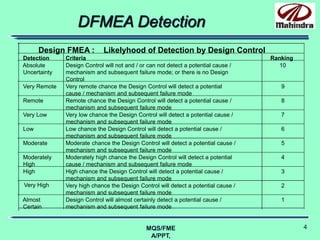
DFMEA Detection
Design FMEA : Likelyhood of Detection by Design Control
Detection Criteria Ranking
Absolute
Uncertainty
Design Control will not and / or can not detect a potential cause /
mechanism and subsequent failure mode; or there is no Design
Control
10
Very Remote Very remote chance the Design Control will detect a potential
cause / mechanism and subsequent failure mode
9
Remote Remote chance the Design Control will detect a potential cause /
mechanism and subsequent failure mode
8
Very Low Very low chance the Design Control will detect a potential cause /
mechanism and subsequent failure mode
7
Low Low chance the Design Control will detect a potential cause /
mechanism and subsequent failure mode
6
Moderate Moderate chance the Design Control will detect a potential cause /
mechanism and subsequent failure mode
5
Moderately
High
Moderately high chance the Design Control will detect a potential
cause / mechanism and subsequent failure mode
4
High High chance the Design Control will detect a potential cause /
mechanism and subsequent failure mode
3
Very High Very high chance the Design Control will detect a potential cause /
mechanism and subsequent failure mode
2
Almost
Certain
Design Control will almost certainly detect a potential cause /
mechanism and subsequent failure mode
1
MQS/FME
A/PPT,
5
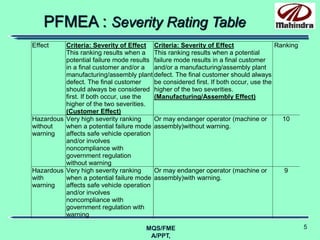
PFMEA : Severity Rating Table
Effect Criteria: Severity of Effect
This ranking results when a
potential failure mode results
in a final customer and/or a
manufacturing/assembly plant
defect. The final customer
should always be considered
first. If both occur, use the
higher of the two severities.
(Customer Effect)
Criteria: Severity of Effect
This ranking results when a potential
failure mode results in a final customer
and/or a manufacturing/assembly plant
defect. The final customer should always
be considered first. If both occur, use the
higher of the two severities.
(Manufacturing/Assembly Effect)
Ranking
Hazardous
without
warning
Very high severity ranking
when a potential failure mode
affects safe vehicle operation
and/or involves
noncompliance with
government regulation
without warning
Or may endanger operator (machine or
assembly)without warning.
10
Hazardous
with
warning
Very high severity ranking
when a potential failure mode
affects safe vehicle operation
and/or involves
noncompliance with
government regulation with
warning
Or may endanger operator (machine or
assembly)with warning.
9
MQS/FME
A/PPT,
6
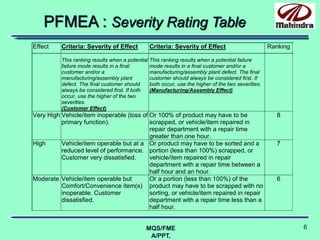
PFMEA : Severity Rating Table
Effect Criteria: Severity of Effect
This ranking results when a potential
failure mode results in a final
customer and/or a
manufacturing/assembly plant
defect. The final customer should
always be considered first. If both
occur, use the higher of the two
severities.
(Customer Effect)
Criteria: Severity of Effect
This ranking results when a potential failure
mode results in a final customer and/or a
manufacturing/assembly plant defect. The final
customer should always be considered first. If
both occur, use the higher of the two severities.
(Manufacturing/Assembly Effect)
Ranking
Very High Vehicle/item inoperable (loss of
primary function).
Or 100% of product may have to be
scrapped, or vehicle/item repaired in
repair department with a repair time
greater than one hour.
8
High Vehicle/item operable but at a
reduced level of performance.
Customer very dissatisfied.
Or product may have to be sorted and a
portion (less than 100%) scrapped, or
vehicle/item repaired in repair
department with a repair time between a
half hour and an hour.
7
Moderate Vehicle/item operable but
Comfort/Convenience item(s)
inoperable. Customer
dissatisfied.
Or a portion (less than 100%) of the
product may have to be scrapped with no
sorting, or vehicle/item repaired in repair
department with a repair time less than a
half hour.
6
MQS/FME
A/PPT,
7
PFMEA : Severity Rating Table
Effect Criteria: Severity of Effect
This ranking results when a
potential failure mode results in a
final customer and/or a
manufacturing/assembly plant
defect. The final customer should
always be considered first. If both
occur, use the higher of the two
severities.
(Customer Effect)
Criteria: Severity of Effect
This ranking results when a potential failure
mode results in a final customer and/or a
manufacturing/assembly plant defect. The final
customer should always be considered first. If
both occur, use the higher of the two severities.
(Manufacturing/Assembly Effect)
Ranking
Low Vehicle/item operable but
Comfort/Convenience item(s)
operable at a reduced level of
performance
Or 100% of the product may have to be
reworked, or vehicle/item repaired offline
but does not go to repair department.
5
Very low Fit and finish/Squeak and
Rattle item does not conform.
Defect noticed by most
customers (greater than
75%).
Or the product may have to sorted, with
no scrap, and a portion (less than
100%)reworked.
4
Minor Fit and finish/Squeak and
Rattle item does not conform.
Defect noticed by 50% of
customers.
Or a portion (less than 100%) of the
product may have to be reworked, with
no scrap, online but out of station.
3
MQS/FME
A/PPT,
8
PFMEA : Severity Rating Table
Effect Criteria: Severity of Effect
This ranking results when a
potential failure mode results in a
final customer and/or a
manufacturing/assembly plant
defect. The final customer should
always be considered first. If both
occur, use the higher of the two
severities.
(Customer Effect)
Criteria: Severity of Effect
This ranking results when a potential failure
mode results in a final customer and/or a
manufacturing/assembly plant defect. The final
customer should always be considered first. If
both occur, use the higher of the two severities.
(Manufacturing/Assembly Effect)
Ranking
Very
Minor
Fit and finish/Squeak and
Rattle item does not conform.
noticed by discriminating
customers(less than 25%)
Or a portion (less than 100%) of the
product may have to be reworked, with
no scrap, online but in station.
2
None No discernible effect Or slight inconvenience to operation or
operator, or no effect.
1
MQS/FME
A/PPT,
9
PFMEA : Occurrence Rating Table
Probability Likely Failure Rates Ppk Ranking
Very High: Persistent Failures >/= 100 per thousand pieces <0.55 10
50 per thousand pieces >/=0.55 9
High: Frequent Failures 20 per thousand pieces >/=0.78 8
10 per thousand pieces >/=0.86 7
Moderate: Occasional Failures 5 per thousand pieces >/=0.94 6
2 per thousand pieces >/=1.00 5
1 per thousand pieces >/=1.10 4
Low: Relatively Few Failures 0.5 per thousand pieces >/=1.20 3
0.1 per thousand pieces >/=1.30 2
Remote: Failure is unlikely </= 0.01 per thousand pieces >/=1.67 1
MQS/FME
A/PPT,
10
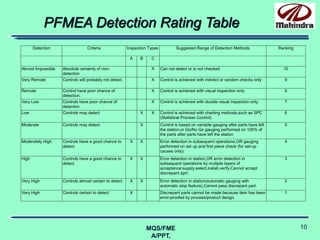
PFMEA Detection Rating Table
Detection Criteria Inspection Types Suggested Range of Detection Methods Ranking
A B C
Almost Impossible Absolute certainty of non-
detection
X Can not detect or is not checked 10
Very Remote Controls will probably not detect. X Control is achieved with indirect or random checks only 9
Remote Control have poor chance of
detection.
X Control is achieved with visual inspection only 8
Very Low Controls have poor chance of
detection
X Control is achieved with double visual inspection only 7
Low Controls may detect X X Control is achieved with charting methods,such as SPC
(Statistical Process Control)
6
Moderate Controls may detect X Control is based on variable gauging after parts have left
the station,or Go/No Go gauging performed on 100% of
the parts after parts have left the station
5
Moderately High Controls have a good chance to
detect.
X X Error detection in subsequent operations,OR gauging
performed on set up and first piece check (for set-up
causes only).
4
High Controls have a good chance to
detect.
X X Error detection in station,OR error detection in
subsequent operations by multiple layers of
acceptence:supply,select,install,verify.Cannot accept
discrepant aprt.
3
Very High Controls almost certain to detect X X Error detection in station(automatic gauging with
automatic stop feature).Cannot pass discrepant part.
2
Very High Controls certain to detect X Discrepant parts cannot be made because item has been
error-proofed by process/product design.
1

Dfmea rating

  • 1.
  • 2.
    MQS/FME A/PPT, 2 Design FMEA :Severity of Effect Effect Criteria Ranking Hazardous without warning Very high severity ranking when a potential failure mode affects safe vehicle operation and / or involves noncompliance with government regulation without warning. 10 Hazardous with warning Very high severity ranking when a potential failure mode affects safe vehicle operation and / or involves noncompliance with government regulation with warning. 9 Very High Vehicle / item inoperable, with loss of primary function. 8 High Vehicle / item operable, but at reduced level of performance. Customer very dissatisfied. 7 Moderate Vehicle / item operable, but Comfort / Convenience item(s) inoperable. Customer dissatisfied 6 Low Vehicle / item operable, but Comfort / Convenience item(s) operable at reduced level of performance. Customer experiences some dissatisfaction. 5 Very Low Fit & Finish / Squeak & Rattle item does not conform. Defect noticed by most customers. 4 Minor Fit & Finish / Squeak & Rattle item does not conform. Defect noticed by average customers. 3 Very Minor Fit & Finish / Squeak & Rattle item does not conform. Defect noticed by discriminating customers. 2 None No effect. 1 DFMEA Severity
  • 3.
    MQS/FME A/PPT, 3 DFMEA Occurrence DFMEA OccurrenceEvaluation Criteria Probability of Failure Possible Failure Rates Ranking Very High: Persistent Failures >/= 100 per thousand vehicles/ items 10 50 per thousand vehicles / items 9 High: Frequent Failures 20 per thousand vehicles / items 8 10 per thousand vehicle / items 7 Moderate: Occasional Failures 5 per thousand vehicle / items 6 2 per thousand vehicle / items 5 1 per thousand vehicle / items 4 Low: Relatively Few Failures 0.5 per thousand vehicle / items 3 0.1 per thousand vehicle / items 2 Remote: Failure is unlikely </= 0.01 per thousand vehicle / items 1
  • 4.
    MQS/FME A/PPT, 4 DFMEA Detection Design FMEA: Likelyhood of Detection by Design Control Detection Criteria Ranking Absolute Uncertainty Design Control will not and / or can not detect a potential cause / mechanism and subsequent failure mode; or there is no Design Control 10 Very Remote Very remote chance the Design Control will detect a potential cause / mechanism and subsequent failure mode 9 Remote Remote chance the Design Control will detect a potential cause / mechanism and subsequent failure mode 8 Very Low Very low chance the Design Control will detect a potential cause / mechanism and subsequent failure mode 7 Low Low chance the Design Control will detect a potential cause / mechanism and subsequent failure mode 6 Moderate Moderate chance the Design Control will detect a potential cause / mechanism and subsequent failure mode 5 Moderately High Moderately high chance the Design Control will detect a potential cause / mechanism and subsequent failure mode 4 High High chance the Design Control will detect a potential cause / mechanism and subsequent failure mode 3 Very High Very high chance the Design Control will detect a potential cause / mechanism and subsequent failure mode 2 Almost Certain Design Control will almost certainly detect a potential cause / mechanism and subsequent failure mode 1
  • 5.
    MQS/FME A/PPT, 5 PFMEA : SeverityRating Table Effect Criteria: Severity of Effect This ranking results when a potential failure mode results in a final customer and/or a manufacturing/assembly plant defect. The final customer should always be considered first. If both occur, use the higher of the two severities. (Customer Effect) Criteria: Severity of Effect This ranking results when a potential failure mode results in a final customer and/or a manufacturing/assembly plant defect. The final customer should always be considered first. If both occur, use the higher of the two severities. (Manufacturing/Assembly Effect) Ranking Hazardous without warning Very high severity ranking when a potential failure mode affects safe vehicle operation and/or involves noncompliance with government regulation without warning Or may endanger operator (machine or assembly)without warning. 10 Hazardous with warning Very high severity ranking when a potential failure mode affects safe vehicle operation and/or involves noncompliance with government regulation with warning Or may endanger operator (machine or assembly)with warning. 9
  • 6.
    MQS/FME A/PPT, 6 PFMEA : SeverityRating Table Effect Criteria: Severity of Effect This ranking results when a potential failure mode results in a final customer and/or a manufacturing/assembly plant defect. The final customer should always be considered first. If both occur, use the higher of the two severities. (Customer Effect) Criteria: Severity of Effect This ranking results when a potential failure mode results in a final customer and/or a manufacturing/assembly plant defect. The final customer should always be considered first. If both occur, use the higher of the two severities. (Manufacturing/Assembly Effect) Ranking Very High Vehicle/item inoperable (loss of primary function). Or 100% of product may have to be scrapped, or vehicle/item repaired in repair department with a repair time greater than one hour. 8 High Vehicle/item operable but at a reduced level of performance. Customer very dissatisfied. Or product may have to be sorted and a portion (less than 100%) scrapped, or vehicle/item repaired in repair department with a repair time between a half hour and an hour. 7 Moderate Vehicle/item operable but Comfort/Convenience item(s) inoperable. Customer dissatisfied. Or a portion (less than 100%) of the product may have to be scrapped with no sorting, or vehicle/item repaired in repair department with a repair time less than a half hour. 6
  • 7.
    MQS/FME A/PPT, 7 PFMEA : SeverityRating Table Effect Criteria: Severity of Effect This ranking results when a potential failure mode results in a final customer and/or a manufacturing/assembly plant defect. The final customer should always be considered first. If both occur, use the higher of the two severities. (Customer Effect) Criteria: Severity of Effect This ranking results when a potential failure mode results in a final customer and/or a manufacturing/assembly plant defect. The final customer should always be considered first. If both occur, use the higher of the two severities. (Manufacturing/Assembly Effect) Ranking Low Vehicle/item operable but Comfort/Convenience item(s) operable at a reduced level of performance Or 100% of the product may have to be reworked, or vehicle/item repaired offline but does not go to repair department. 5 Very low Fit and finish/Squeak and Rattle item does not conform. Defect noticed by most customers (greater than 75%). Or the product may have to sorted, with no scrap, and a portion (less than 100%)reworked. 4 Minor Fit and finish/Squeak and Rattle item does not conform. Defect noticed by 50% of customers. Or a portion (less than 100%) of the product may have to be reworked, with no scrap, online but out of station. 3
  • 8.
    MQS/FME A/PPT, 8 PFMEA : SeverityRating Table Effect Criteria: Severity of Effect This ranking results when a potential failure mode results in a final customer and/or a manufacturing/assembly plant defect. The final customer should always be considered first. If both occur, use the higher of the two severities. (Customer Effect) Criteria: Severity of Effect This ranking results when a potential failure mode results in a final customer and/or a manufacturing/assembly plant defect. The final customer should always be considered first. If both occur, use the higher of the two severities. (Manufacturing/Assembly Effect) Ranking Very Minor Fit and finish/Squeak and Rattle item does not conform. noticed by discriminating customers(less than 25%) Or a portion (less than 100%) of the product may have to be reworked, with no scrap, online but in station. 2 None No discernible effect Or slight inconvenience to operation or operator, or no effect. 1
  • 9.
    MQS/FME A/PPT, 9 PFMEA : OccurrenceRating Table Probability Likely Failure Rates Ppk Ranking Very High: Persistent Failures >/= 100 per thousand pieces <0.55 10 50 per thousand pieces >/=0.55 9 High: Frequent Failures 20 per thousand pieces >/=0.78 8 10 per thousand pieces >/=0.86 7 Moderate: Occasional Failures 5 per thousand pieces >/=0.94 6 2 per thousand pieces >/=1.00 5 1 per thousand pieces >/=1.10 4 Low: Relatively Few Failures 0.5 per thousand pieces >/=1.20 3 0.1 per thousand pieces >/=1.30 2 Remote: Failure is unlikely </= 0.01 per thousand pieces >/=1.67 1
  • 10.
    MQS/FME A/PPT, 10 PFMEA Detection RatingTable Detection Criteria Inspection Types Suggested Range of Detection Methods Ranking A B C Almost Impossible Absolute certainty of non- detection X Can not detect or is not checked 10 Very Remote Controls will probably not detect. X Control is achieved with indirect or random checks only 9 Remote Control have poor chance of detection. X Control is achieved with visual inspection only 8 Very Low Controls have poor chance of detection X Control is achieved with double visual inspection only 7 Low Controls may detect X X Control is achieved with charting methods,such as SPC (Statistical Process Control) 6 Moderate Controls may detect X Control is based on variable gauging after parts have left the station,or Go/No Go gauging performed on 100% of the parts after parts have left the station 5 Moderately High Controls have a good chance to detect. X X Error detection in subsequent operations,OR gauging performed on set up and first piece check (for set-up causes only). 4 High Controls have a good chance to detect. X X Error detection in station,OR error detection in subsequent operations by multiple layers of acceptence:supply,select,install,verify.Cannot accept discrepant aprt. 3 Very High Controls almost certain to detect X X Error detection in station(automatic gauging with automatic stop feature).Cannot pass discrepant part. 2 Very High Controls certain to detect X Discrepant parts cannot be made because item has been error-proofed by process/product design. 1