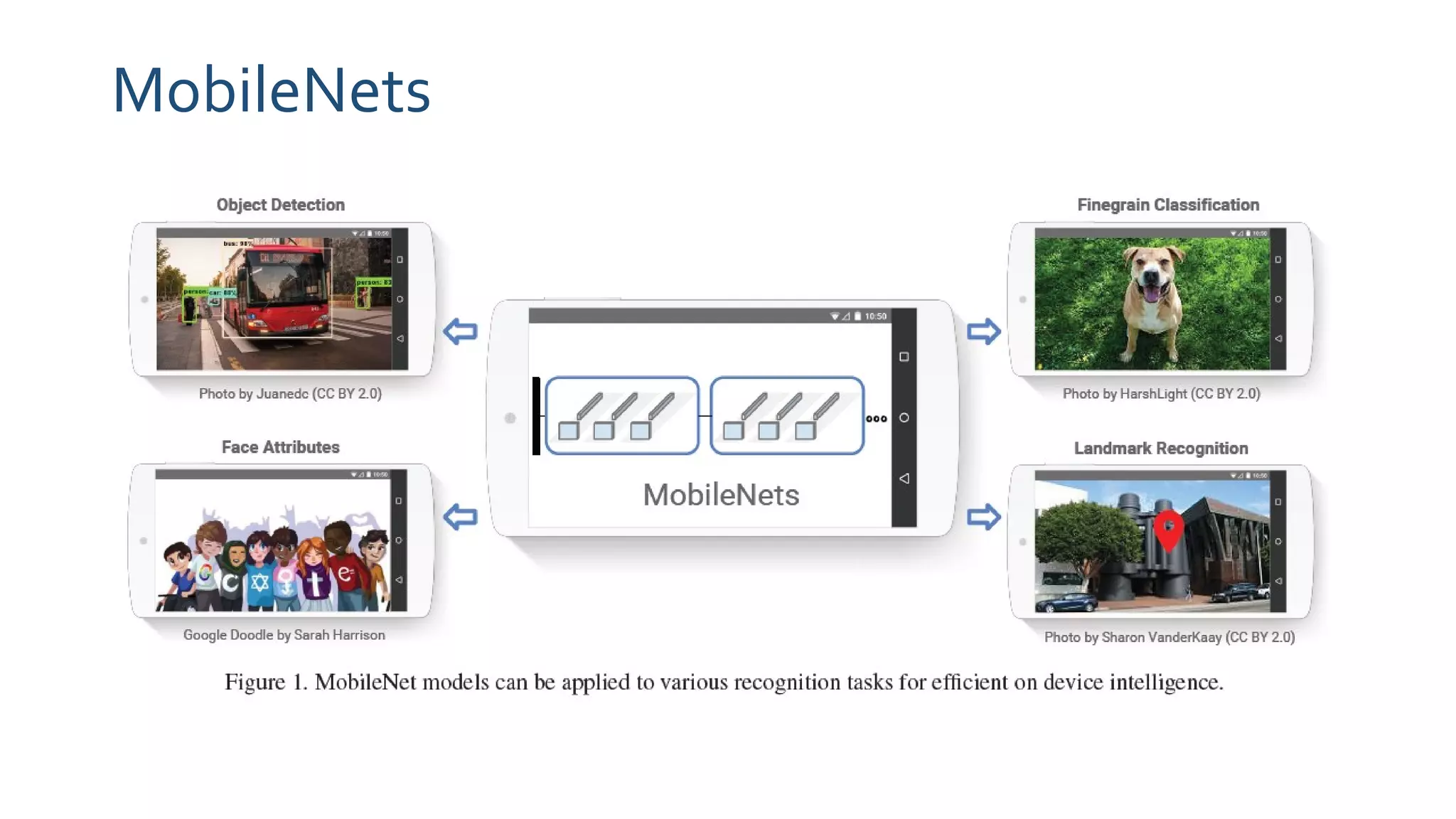
MobileNets:
Efficient Convolutional Neural Networks for
MobileVision Applications
29th October, 2017
PR12 Paper Review
Jinwon Lee
Samsung Electronics
MobileNets
Key Requirements for Commercial Computer
Vision Usage
• Data-centers(Clouds)
 Rarely safety-critical
 Low power is nice to have
 Real-time is preferable
• Gadgets – Smartphones, Self-driving cars, Drones, etc.
 Usually safety-critical(except smartphones)
 Low power is must-have
 Real-time is required
Slide Credit : Small Deep Neural Networks - Their Advantages, and Their Design by Forrest Iandola
What’s the “Right” Neural Network for Use in a
Gadget?
• Desirable Properties
 Sufficiently high accuracy
 Low computational complexity
 Low energy usage
 Small model size
Slide Credit : Small Deep Neural Networks - Their Advantages, and Their Design by Forrest Iandola
Why Small Deep Neural Networks?
• Small DNNs train faster on distributed hardware
• Small DNNs are more deployable on embedded processors
• Small DNNs are easily updatable Over-The-Air(OTA)
Slide Credit : Small Deep Neural Networks - Their Advantages, and Their Design by Forrest Iandola
Techniques for Small Deep Neural Networks
• Remove Fully-Connected Layers
• Kernel Reduction ( 3x3  1x1 )
• Channel Reduction
• Evenly Spaced Downsampling
• Depthwise Separable Convolutions
• Shuffle Operations
• Distillation & Compression
Slide Credit : Small Deep Neural Networks - Their Advantages, and Their Design by Forrest Iandola
Key Idea : Depthwise Separable Convolution!
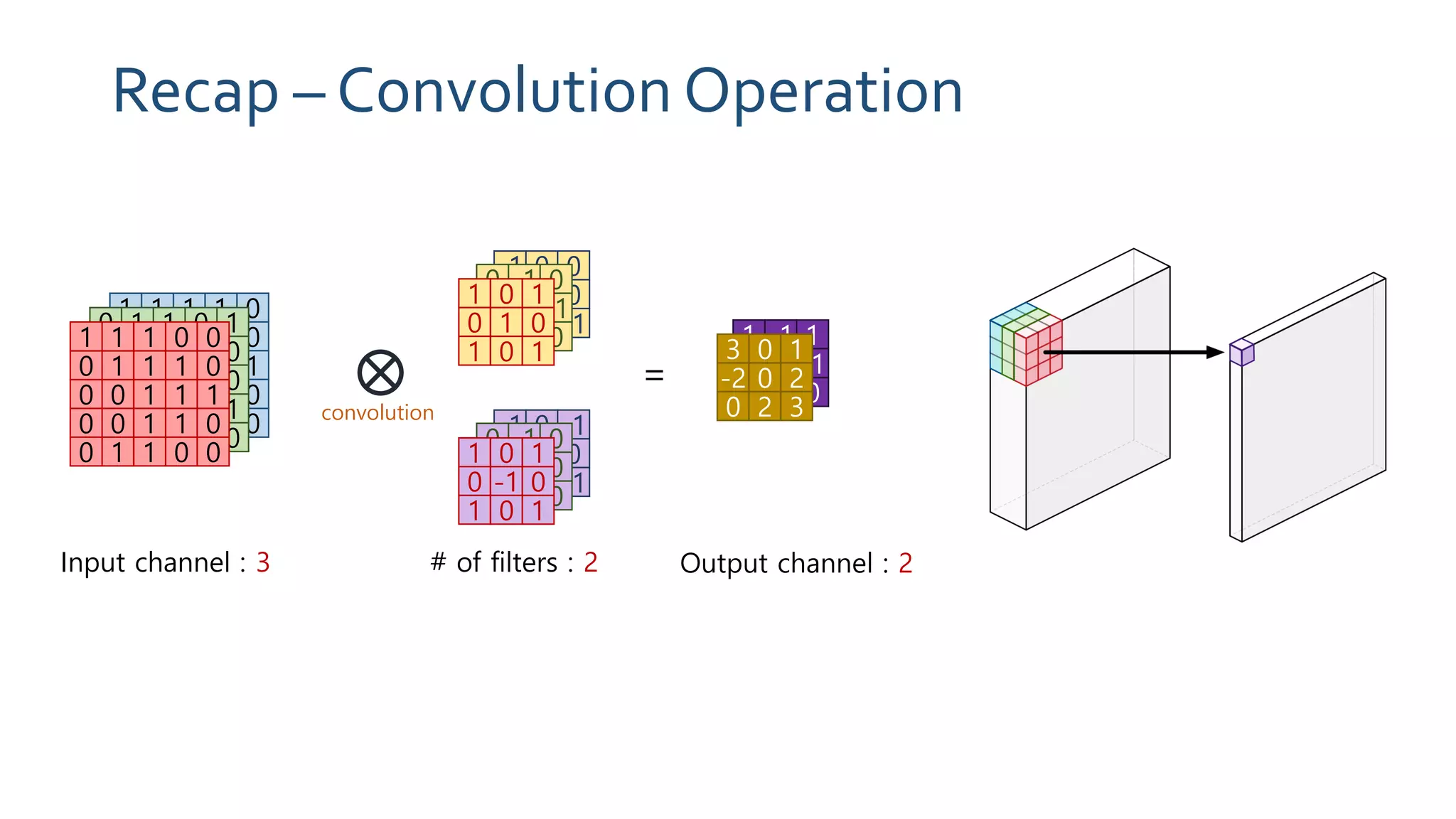
Recap – Convolution Operation
1 1 1 1 0
1 1 1 1 0
0 0 0 1 1
0 1 1 1 0
0 1 1 0 0
0 1 1 0 1
0 1 1 0 0
0 0 1 1 0
0 0 1 1 1
1 1 1 0 0
1 1 1 0 0
0 1 1 1 0
0 0 1 1 1
0 0 1 1 0
0 1 1 0 0
-1 0 0
0 1 0
0 0 -1
0 -1 0
-1 1 -1
0 -1 0
1 0 1
0 1 0
1 0 1
-1 0 -1
0 1 0
0 0 -1
0 -1 0
-1 1 0
0 -1 0
1 0 1
0 -1 0
1 0 1
1 -1 1
0 -1 -1
3 1 0
3 0 1
-2 0 2
0 2 3
=
convolution
Input channel : 3 Output channel : 2# of filters : 2
Recap –VGG, Inception-v3
• VGG – use only 3x3 convolution
 Stack of 3x3 conv layers has same effective receptive
field as 5x5 or 7x7 conv layer
 Deeper means more non-linearities
 Fewer parameters: 2 x (3 x 3 x C) vs (5 x 5 x C)
 regularization effect
• Inception-v3
 Factorization of filters
Why should we always consider all channels?
Standard Convolution
Depthwise convolution
Figures from http://machinethink.net/blog/googles-mobile-net-architecture-on-iphone/
Depthwise Separable Convolution
• Depthwise Convolution + Pointwise Convolution(1x1 convolution)
Depthwise convolution Pointwise convolution
Figures from http://machinethink.net/blog/googles-mobile-net-architecture-on-iphone/
Standard Convolution vs Depthwise Separable
Convolution
Standard Convolution vs Depthwise Separable
Convolution
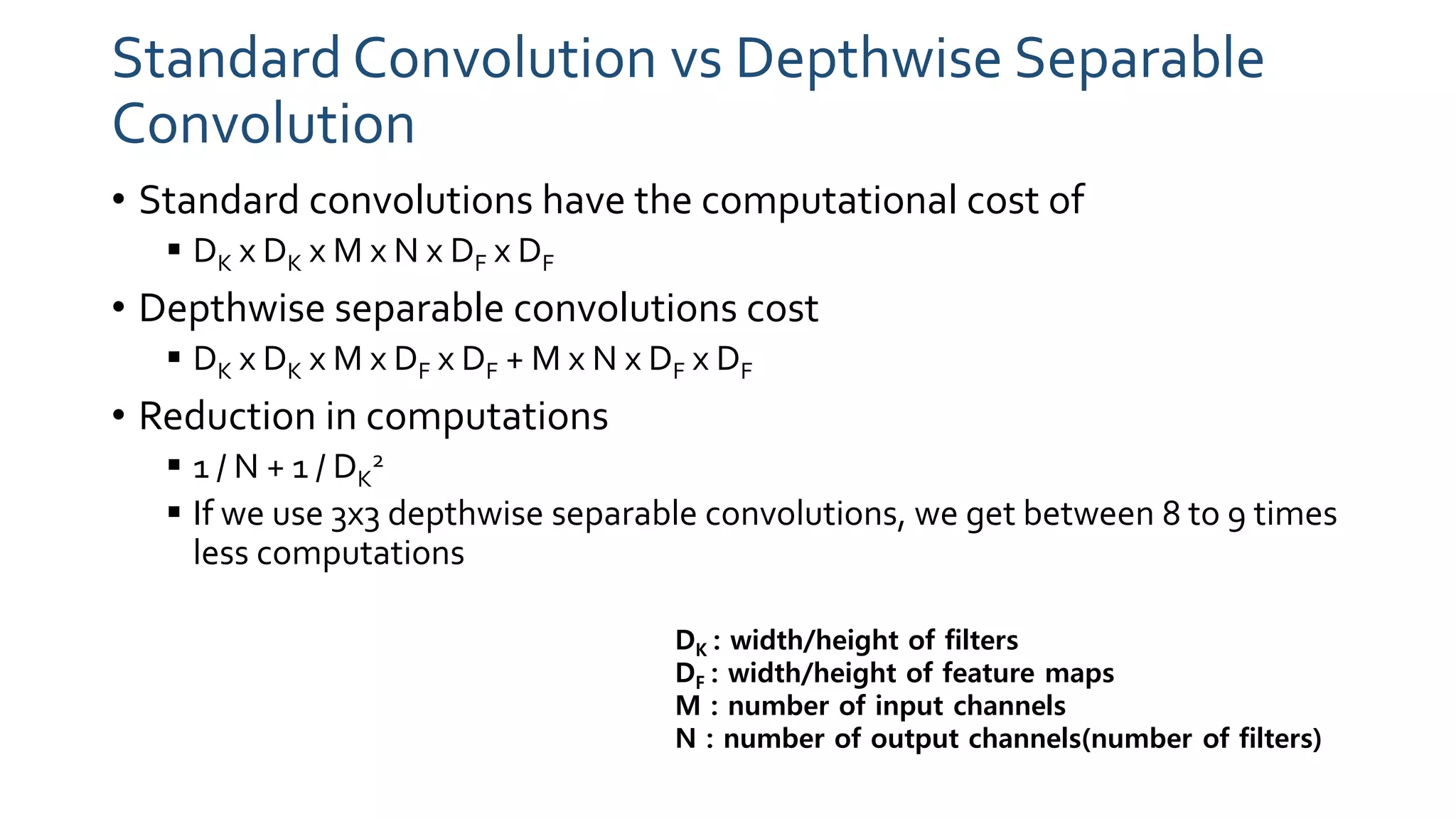
• Standard convolutions have the computational cost of
 DK x DK x M x N x DF x DF
• Depthwise separable convolutions cost
 DK x DK x M x DF x DF + M x N x DF x DF
• Reduction in computations
 1 / N + 1 / DK
2
 If we use 3x3 depthwise separable convolutions, we get between 8 to 9 times
less computations
DK : width/height of filters
DF : width/height of feature maps
M : number of input channels
N : number of output channels(number of filters)
Depthwise Separable Convolutions
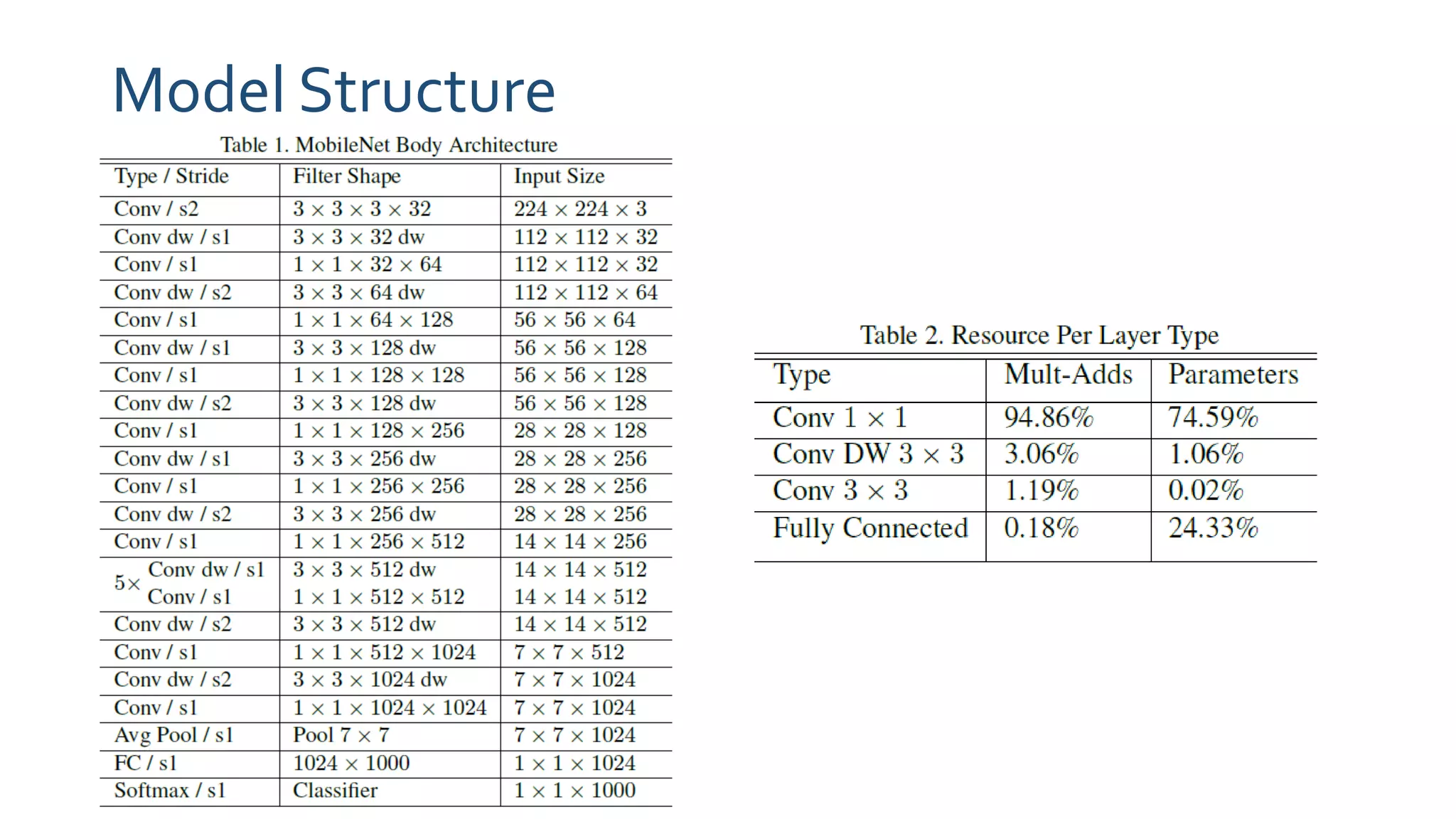
Model Structure
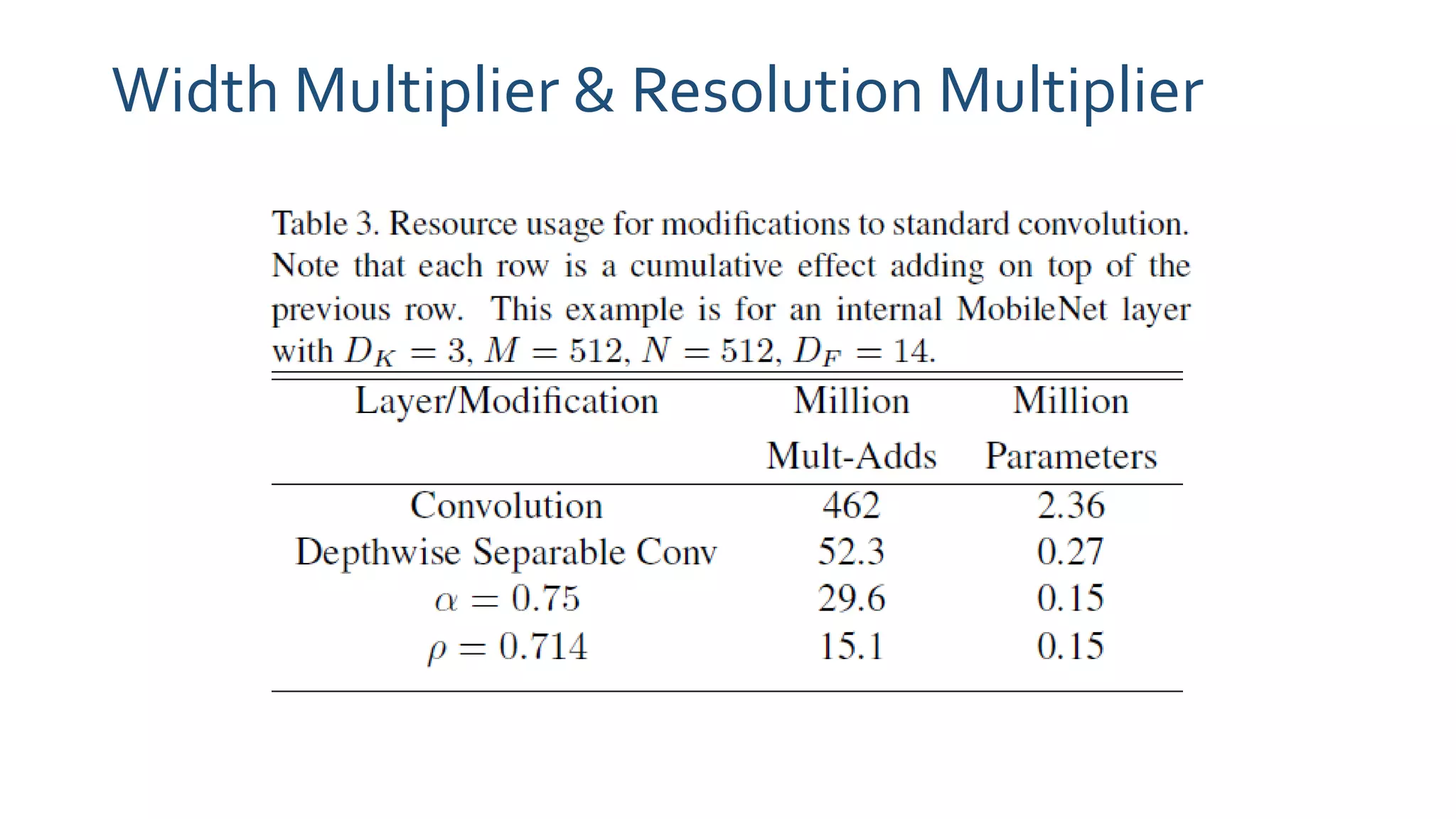
Width Multiplier & Resolution Multiplier
• Width Multiplier –Thinner Models
 For a given layer and width multiplier α, the number of input channels M
becomes αM and the number of output channels N becomes αN – where α
with typical settings of 1, 0.75, 0.6 and 0.25
• Resolution Multiplier – Reduced Representation
 The second hyper-parameter to reduce the computational cost of a neural
network is a resolution multiplier ρ
 0<ρ≤1, which is typically set of implicitly so that input resolution of network
is 224, 192, 160 or 128(ρ = 1, 0.857, 0.714, 0.571)
• Computational cost:
DK x DK x αM x ρDF x ρDF + αM x αN x ρDF x ρDF
Width Multiplier & Resolution Multiplier
Experiments – Model Choices
Model Shrinking Hyperparameters
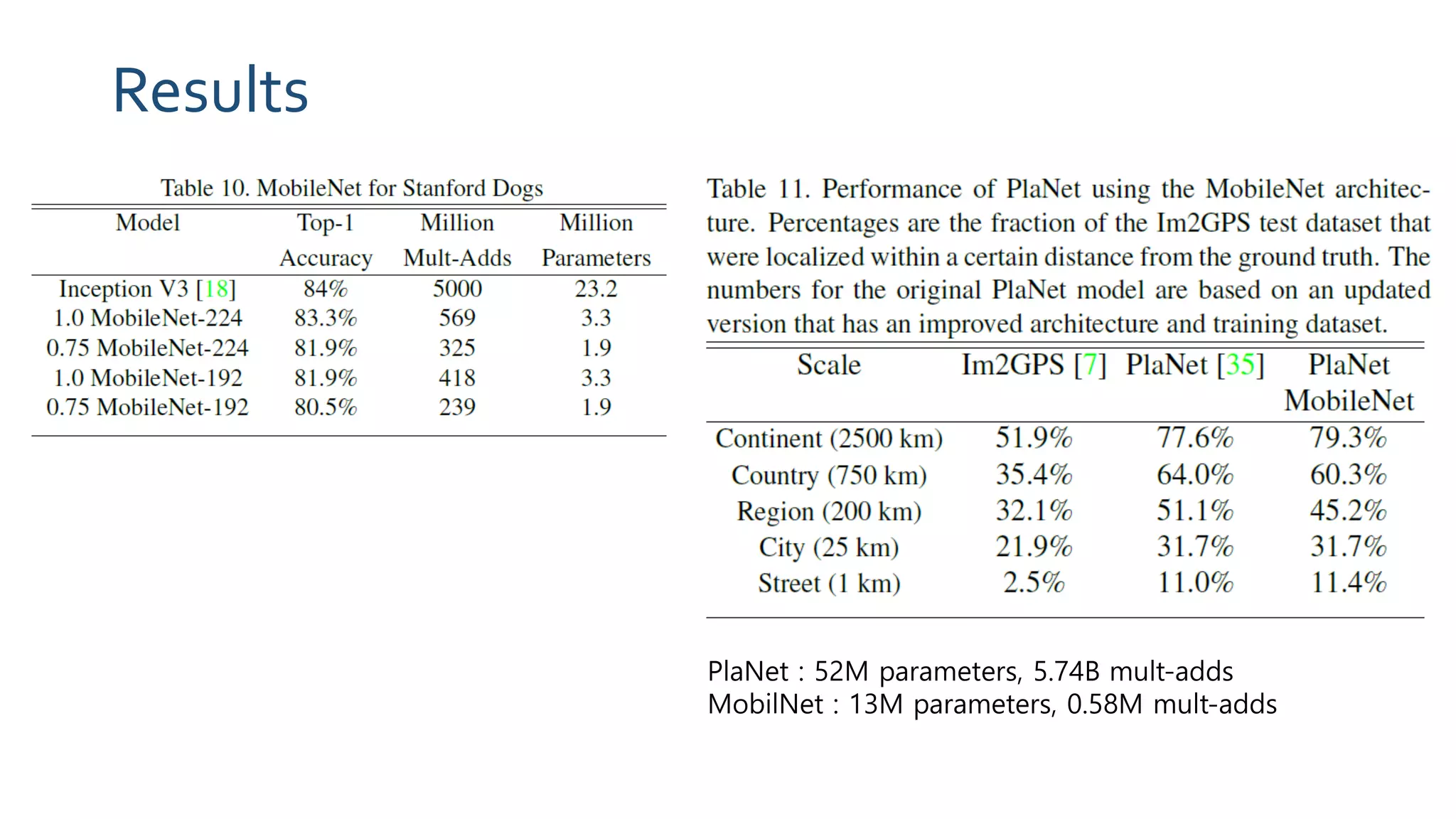
Results
Results
PlaNet : 52M parameters, 5.74B mult-adds
MobilNet : 13M parameters, 0.58M mult-adds
Results
Results
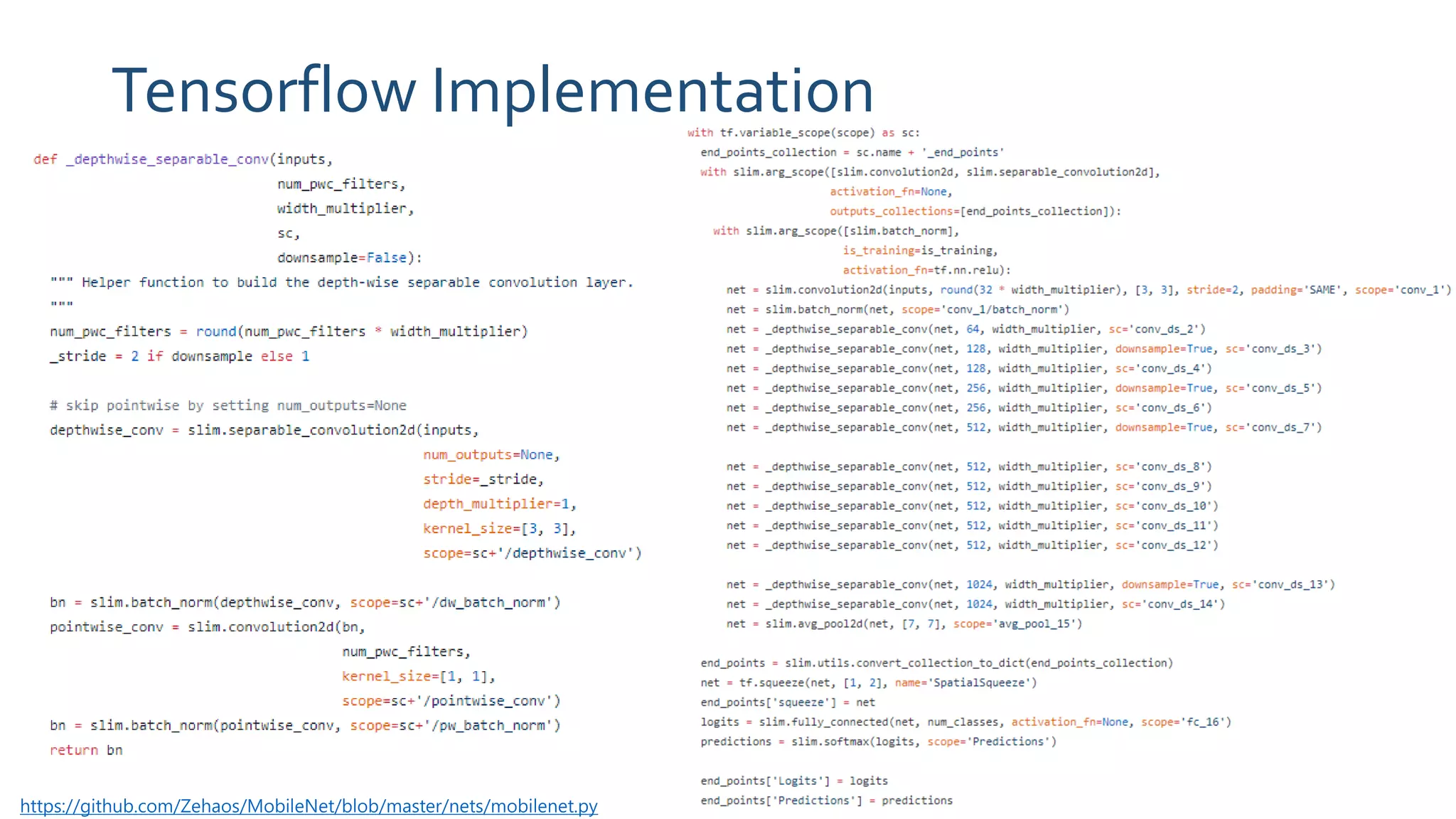
Tensorflow Implementation
https://github.com/Zehaos/MobileNet/blob/master/nets/mobilenet.py

MobileNet - PR044

  • 1.
    MobileNets: Efficient Convolutional NeuralNetworks for MobileVision Applications 29th October, 2017 PR12 Paper Review Jinwon Lee Samsung Electronics
  • 2.
  • 3.
    Key Requirements forCommercial Computer Vision Usage • Data-centers(Clouds)  Rarely safety-critical  Low power is nice to have  Real-time is preferable • Gadgets – Smartphones, Self-driving cars, Drones, etc.  Usually safety-critical(except smartphones)  Low power is must-have  Real-time is required Slide Credit : Small Deep Neural Networks - Their Advantages, and Their Design by Forrest Iandola
  • 4.
    What’s the “Right”Neural Network for Use in a Gadget? • Desirable Properties  Sufficiently high accuracy  Low computational complexity  Low energy usage  Small model size Slide Credit : Small Deep Neural Networks - Their Advantages, and Their Design by Forrest Iandola
  • 5.
    Why Small DeepNeural Networks? • Small DNNs train faster on distributed hardware • Small DNNs are more deployable on embedded processors • Small DNNs are easily updatable Over-The-Air(OTA) Slide Credit : Small Deep Neural Networks - Their Advantages, and Their Design by Forrest Iandola
  • 6.
    Techniques for SmallDeep Neural Networks • Remove Fully-Connected Layers • Kernel Reduction ( 3x3  1x1 ) • Channel Reduction • Evenly Spaced Downsampling • Depthwise Separable Convolutions • Shuffle Operations • Distillation & Compression Slide Credit : Small Deep Neural Networks - Their Advantages, and Their Design by Forrest Iandola
  • 7.
    Key Idea :Depthwise Separable Convolution!
  • 8.
    Recap – ConvolutionOperation 1 1 1 1 0 1 1 1 1 0 0 0 0 1 1 0 1 1 1 0 0 1 1 0 0 0 1 1 0 1 0 1 1 0 0 0 0 1 1 0 0 0 1 1 1 1 1 1 0 0 1 1 1 0 0 0 1 1 1 0 0 0 1 1 1 0 0 1 1 0 0 1 1 0 0 -1 0 0 0 1 0 0 0 -1 0 -1 0 -1 1 -1 0 -1 0 1 0 1 0 1 0 1 0 1 -1 0 -1 0 1 0 0 0 -1 0 -1 0 -1 1 0 0 -1 0 1 0 1 0 -1 0 1 0 1 1 -1 1 0 -1 -1 3 1 0 3 0 1 -2 0 2 0 2 3 = convolution Input channel : 3 Output channel : 2# of filters : 2
  • 9.
    Recap –VGG, Inception-v3 •VGG – use only 3x3 convolution  Stack of 3x3 conv layers has same effective receptive field as 5x5 or 7x7 conv layer  Deeper means more non-linearities  Fewer parameters: 2 x (3 x 3 x C) vs (5 x 5 x C)  regularization effect • Inception-v3  Factorization of filters
  • 10.
    Why should wealways consider all channels?
  • 11.
    Standard Convolution Depthwise convolution Figuresfrom http://machinethink.net/blog/googles-mobile-net-architecture-on-iphone/
  • 12.
    Depthwise Separable Convolution •Depthwise Convolution + Pointwise Convolution(1x1 convolution) Depthwise convolution Pointwise convolution Figures from http://machinethink.net/blog/googles-mobile-net-architecture-on-iphone/
  • 13.
    Standard Convolution vsDepthwise Separable Convolution
  • 14.
    Standard Convolution vsDepthwise Separable Convolution • Standard convolutions have the computational cost of  DK x DK x M x N x DF x DF • Depthwise separable convolutions cost  DK x DK x M x DF x DF + M x N x DF x DF • Reduction in computations  1 / N + 1 / DK 2  If we use 3x3 depthwise separable convolutions, we get between 8 to 9 times less computations DK : width/height of filters DF : width/height of feature maps M : number of input channels N : number of output channels(number of filters)
  • 15.
  • 16.
  • 17.
    Width Multiplier &Resolution Multiplier • Width Multiplier –Thinner Models  For a given layer and width multiplier α, the number of input channels M becomes αM and the number of output channels N becomes αN – where α with typical settings of 1, 0.75, 0.6 and 0.25 • Resolution Multiplier – Reduced Representation  The second hyper-parameter to reduce the computational cost of a neural network is a resolution multiplier ρ  0<ρ≤1, which is typically set of implicitly so that input resolution of network is 224, 192, 160 or 128(ρ = 1, 0.857, 0.714, 0.571) • Computational cost: DK x DK x αM x ρDF x ρDF + αM x αN x ρDF x ρDF
  • 18.
    Width Multiplier &Resolution Multiplier
  • 19.
  • 20.
  • 21.
  • 22.
  • 23.
    Results PlaNet : 52Mparameters, 5.74B mult-adds MobilNet : 13M parameters, 0.58M mult-adds
  • 24.
  • 25.
  • 26.