SPACE MATRIX
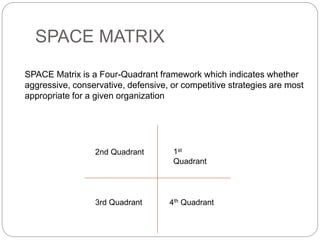
SPACE Matrix is a Four-Quadrant framework which indicates whether
aggressive, conservative, defensive, or competitive strategies are most
appropriate for a given organization
1st
Quadrant
2nd Quadrant
3rd Quadrant 4th Quadrant
Most important determinants of an organization’s
overall strategic position
1st
Quadrant
2nd Quadrant
3rd Quadrant 4th Quadrant
• Two Internal dimensions (financial position [FP] and competitive position
[CP])
• Two External dimensions (stability position [SP] and industry position [IP])
Internal Dimension
External
Dimension
1st
Quadrant
2nd Quadrant
3rd Quadrant 4th Quadrant
Internal Dimension
External
Dimension
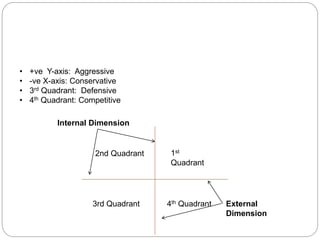
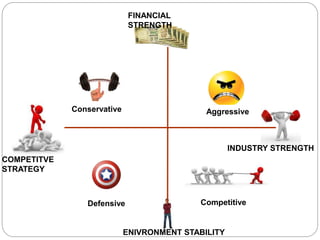
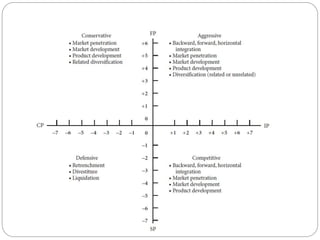
• +ve Y-axis: Aggressive
• -ve X-axis: Conservative
• 3rd Quadrant: Defensive
• 4th Quadrant: Competitive
FINANCIAL
STRENGTH
INDUSTRY STRENGTH
ENIVRONMENT STABILITY
COMPETITVE
STRATEGY
Conservative Aggressive
Defensive Competitive
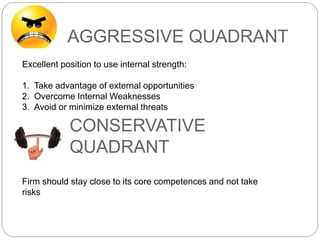
AGGRESSIVE QUADRANT
Excellent position to use internal strength:
1. Take advantage of external opportunities
2. Overcome Internal Weaknesses
3. Avoid or minimize external threats
CONSERVATIVE
QUADRANT
Firm should stay close to its core competences and not take
risks
DEFENSIVE QUADRANT
Focus on rectifying internal weakness and external
threats
COMPETITIVE
QUADRANT
Use Competitive strategies
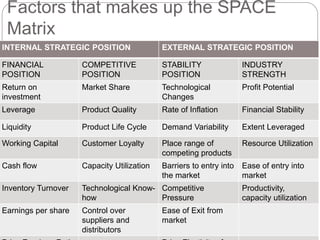
Factors that makes up the SPACE
Matrix
INTERNAL STRATEGIC POSITION EXTERNAL STRATEGIC POSITION
FINANCIAL
POSITION
COMPETITIVE
POSITION
STABILITY
POSITION
INDUSTRY
STRENGTH
Return on
investment
Market Share Technological
Changes
Profit Potential
Leverage Product Quality Rate of Inflation Financial Stability
Liquidity Product Life Cycle Demand Variability Extent Leveraged
Working Capital Customer Loyalty Place range of
competing products
Resource Utilization
Cash flow Capacity Utilization Barriers to entry into
the market
Ease of entry into
market
Inventory Turnover Technological Know-
how
Competitive
Pressure
Productivity,
capacity utilization
Earnings per share Control over
suppliers and
distributors
Ease of Exit from
market
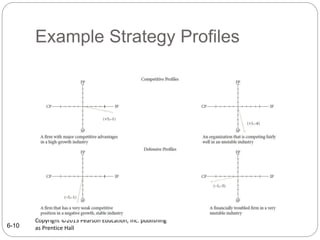
Example Strategy Profiles
Copyright ©2013 Pearson Education, Inc. publishing
as Prentice Hall6-10
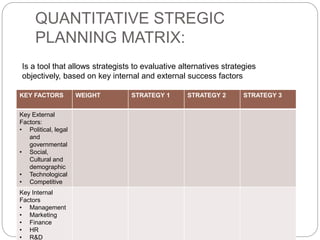
QUANTITATIVE STREGIC
PLANNING MATRIX:
Is a tool that allows strategists to evaluative alternatives strategies
objectively, based on key internal and external success factors
KEY FACTORS WEIGHT STRATEGY 1 STRATEGY 2 STRATEGY 3
Key External
Factors:
• Political, legal
and
governmental
• Social,
Cultural and
demographic
• Technological
• Competitive
Key Internal
Factors
• Management
• Marketing
• Finance
• HR
• R&D
CONTIGENCY STRATEGIES
• A Back-up Plan
• made on the basis of certain assumptions and conditions
• Formulated in advance to take care of unknown events
and unexpected challenges
• Eg,. Labour strikes, a downturn in the economy or an
overnight change in government policy
• Identify the scenario
• Come out with alternative strategies
• Identify the alternatives

Space matrix

  • 1.
    SPACE MATRIX SPACE Matrixis a Four-Quadrant framework which indicates whether aggressive, conservative, defensive, or competitive strategies are most appropriate for a given organization 1st Quadrant 2nd Quadrant 3rd Quadrant 4th Quadrant
  • 2.
    Most important determinantsof an organization’s overall strategic position 1st Quadrant 2nd Quadrant 3rd Quadrant 4th Quadrant • Two Internal dimensions (financial position [FP] and competitive position [CP]) • Two External dimensions (stability position [SP] and industry position [IP]) Internal Dimension External Dimension
  • 3.
    1st Quadrant 2nd Quadrant 3rd Quadrant4th Quadrant Internal Dimension External Dimension • +ve Y-axis: Aggressive • -ve X-axis: Conservative • 3rd Quadrant: Defensive • 4th Quadrant: Competitive
  • 4.
  • 5.
    AGGRESSIVE QUADRANT Excellent positionto use internal strength: 1. Take advantage of external opportunities 2. Overcome Internal Weaknesses 3. Avoid or minimize external threats CONSERVATIVE QUADRANT Firm should stay close to its core competences and not take risks
  • 6.
    DEFENSIVE QUADRANT Focus onrectifying internal weakness and external threats COMPETITIVE QUADRANT Use Competitive strategies
  • 7.
    Factors that makesup the SPACE Matrix INTERNAL STRATEGIC POSITION EXTERNAL STRATEGIC POSITION FINANCIAL POSITION COMPETITIVE POSITION STABILITY POSITION INDUSTRY STRENGTH Return on investment Market Share Technological Changes Profit Potential Leverage Product Quality Rate of Inflation Financial Stability Liquidity Product Life Cycle Demand Variability Extent Leveraged Working Capital Customer Loyalty Place range of competing products Resource Utilization Cash flow Capacity Utilization Barriers to entry into the market Ease of entry into market Inventory Turnover Technological Know- how Competitive Pressure Productivity, capacity utilization Earnings per share Control over suppliers and distributors Ease of Exit from market
  • 9.
  • 10.
    Example Strategy Profiles Copyright©2013 Pearson Education, Inc. publishing as Prentice Hall6-10
  • 11.
    QUANTITATIVE STREGIC PLANNING MATRIX: Isa tool that allows strategists to evaluative alternatives strategies objectively, based on key internal and external success factors KEY FACTORS WEIGHT STRATEGY 1 STRATEGY 2 STRATEGY 3 Key External Factors: • Political, legal and governmental • Social, Cultural and demographic • Technological • Competitive Key Internal Factors • Management • Marketing • Finance • HR • R&D
  • 12.
    CONTIGENCY STRATEGIES • ABack-up Plan • made on the basis of certain assumptions and conditions • Formulated in advance to take care of unknown events and unexpected challenges • Eg,. Labour strikes, a downturn in the economy or an overnight change in government policy • Identify the scenario • Come out with alternative strategies • Identify the alternatives